
DAVID AND GOLIATH IN IRAN AND UKLAINE

In Ukraine and the Middle East, mighty Russia and America are stuck in the quagmire not knowing how to get out.  They are losing the support of their own people too.  It’s “the same old, same old” arrogance repeated by super powers time and time again in history.   It’s like the tragicomedy of Goliath killed by a shepherd boy David who had only a slingshot and a stone.  When do they ever learn?

In Ukraine inexpensive drones have replaced a slingshot and a stone against the giant Russia.  In Vietnam, who forced the remnants of Americans to escape by a helicopter from the rooftop of the American Embassy?  Initially the main force that drove mighty U.S. forces into the corner were the band of peasant guerilla fighters called Vietcong carrying only AK47 with the sandals made of old tires. They had no helicopter or Jet fighter.  The defeat of the mighty USSR forces in Afghanistan was an enactment of the same scenario: David against Goliath.  During the Second World War, before General MacArthur’s mighty U.S. military forces returned to the Philippines to reclaim the Philippine Islands, a brave band of Anti-Japanese men and women called “HUKS – Hukubalahap” constantly harassed the Japanese occupiers sapping the energy out of Japanese occupiers.

What I am trying to say is that determined people like David with a slingshot have more power in the end than the mighty Goliath.  Remember: America and Russia lost all their military engagements after the Second World War.  I feel sorry for American and Russian citizens who had to pay for the cost of such old -fashioned and expensive military misadventures in life and money.

Two Peace maker soldiers

Marshall and MacArthur

On the D Day June 6,I wanted to remind myself that PEACE is the ultimate goal of all wars. On that day, my father-in-law Jack Mellow was in the Canadian Air Force as a mechanic servicing Spitfires in Southern England. He told of many who did not come back. My uncle who was the youngest brother of my father still is officially “Missing in Action” in the Pacific. He was18 years’ old. We must remember those who made ultimate sacrifices. The goal of all wars is no more hostiliy. The continuing hatred is the mark of the failed war.

George Marshall and Douglas MacArthur were the most successful generals not only because they were good at winning the war but also they succeeded turning the vanquished nations into prosperous and loyal allies. If lasting peace is the ultimate goal of all wars, it does not only come from good soldiers and superior weapons. It has to come also from successful work in reconciliation. No more war means the world without enemy. There were two American generals who helped former enemies to recover from the devastation. For a person who grew up in the culture which values and admires the successful revenge as the ultimate moral excellence of the lives of Samurai, it was not an easy realization.

Gen. George Marshall was a no nonsense tough Chief of Staff of the U.S. Army during the WW 2. He fired a record number of Generals for being tough enough according to Wikipedia. However, after the war in the late 1940’s, he proposed massive foreign aid program to help recover and restart whole Western Europe that included the former enemy of Germany. It was an unprecedented foreign aid program of the U.S. $ 13.3 billion. It was in today’s value about $137 billion U.S. dollars. It was unprecedented action not only in terms of the cost but also in terms of the idea helping the former enemy. Of course it was to prevent the spread of Communism. Nevertheless, that was how Western Europe quickly recovered from the devastation of the war particularly Western Germany leaving Eastern Europe behind with an impoverished Communist economy. That was how Democracy won and Communism was utterly defeated. Marshall Plan was the greatest success story of foreign a id program also as the practical benefit of reconciliation. It was an opposite of revenge. Which country today is the most prosperous solid economy in Europe? Germany. What a contrast it was comparing to the outcome of the harsh measures imposed on the defeated Germany after the First World War. The treatment Germany and its people suffered was the action of punishment and revenge. If something like the Marshall Plan was in place after the WW 1, Adolf Hitler and his right wing extremism would not have emerged.

Gen. Douglas MacArthur was equally a tough soldier. He was fired by President Harry Truman for being too tough in the Korean War. However, in the treatment of Japan after the WW2, he was not avenger. Of course the leaders of the Japanese military and the war criminals met the consequence of their actions. But MacArthur did not bring the Supreme Commander of the Japanese Armed Forces to the court. He kept Japanese Emperor in his position as the symbol of the nation. MacArthur knew Hirohito was a powerless puppet of the military. He also knew that without the imperial intervention the war would have continued resulting in massive American casualties. MacArthur ordered a massive food aid to Japan when the public was starving.

It is interesting that two men who made the most critical comments about war were American Generals. Dwight Eisenhower warned the danger of establishing “Military Industrial Complex” in 1961 at the end of his Presidency when Cold War was still raging. Douglas MacArthur commented during the early period of Vietnam War, “Anyone who contemplates another war in Asia has to have their head examined.” They must have known that superior military power does not bring peace.

Bloody conflict between Catholics and Protestants in the Northern Ireland that had lasted for centuries did not end because of superior weapons. The previously called “terrorist” the head of the IRA became the Chief Minister of Northern Ireland. It was reconciliation. Decades long bloody racial conflict under Apartheid was resolved with the conciliatory aproach to establish “Truth and Reconciliation Commission – TRC” in South Africa. It was Nelson Mandela’s idea supported by Arch Bishop Desmond Tutu. Tutu chaired the proceedings of TRC as the chair. In Zimbabwe, Robert Mugabe who had aspired to rule Zimbabwe as the President for Life, brought in the notorious North Korea Military advisers to create 5th Brigade killing his rival nation Matebele people by the thousands. Despite its rich natural resource Zimbabwe still is economically backward under-developed country.

IS LIFE A TERMINAL DISCEASE?

WE WILL DIE

IS LIFE A TERMINAL DISEASE?

We know that life and death are a single integrated and inseparable process. Life starts its dying process when it begins. Life is a terminal disease. There is no life without death, neither is there death without life. It’s like two sides of a sheet of paper. There is no paper without the other side. We had feared death so much that we tried hard to deny its inevitability because of the pain, suffering, and violence that often came with death. We now know how to avoid those menaces. The world is a better place for many of us. We now live in a relatively harmonious and peaceful world. The dying process is more comfortable than it used to be. People live longer too. For many of us fear of death is not a big issue. Some people, like my mother, live so long that her complaint was, “I’m tired. What’s the point.” She had signed the “No resuscitation” order. The “MAID” provision had not been in place then.

Advanced medical science is largely responsible for today’s state of affairs. For some, the process of dying is like falling asleep. Many of us are less afraid of death. Granted that separation from the loved ones breaks our hearts. Otherwise the dying process itself can be less serious grief. Many traditional funeral hymns sound redundant. We hold “Celebration of Life” to bid farewell to the dearly departed in the company of friends with food and drink. Proviso is however, there are still many people in the world who suffer painful death. We must continue to work to eliminate pain and suffering that go with the end of life.

We no longer expect doctors to keep alive near death persons to suffer incurable illness or unbearable pain merely to keep them alive. “Medical Assistance in Dying” is a legal procedure which many Canadians take advantage of. “Eternal Life” begins to sound like an oxymoron ‘fake truth.’ It’s an attempt to escape the fear of death. We have to realize that there is no life without death. We have to get out of the futile attempt to separate the inseparable. So Apostle Paul replaced the meaning of resurrection from “Jesus died but came back to life” in the Gospel to “He returned in a spiritual (different kind of) body” in his Letter.

However, I do not believe that the physical elements that constitute a person disappear into nothingness. Einstein proposed with his famous equation that matter continues to exist in different forms as particles, light, waves, energy, etc. The problem is our self-consciousness. My ego doesn’t allow “I” to vanish and turn into ashes to be a part of the atmosphere when my body is cremated. Our self-consciousness demands us to stay as an independent entity in one piece. The offence against God in the Creation Story is about the emergence of our self consciousness. Rebelling against God, we became conscious of our naked truth. We didn’t like what we saw. So we cover ourselves to hide our naked truth. We want to live in a narcissistic delusion as an almighty immortal individual. We found we weren’t. We saw the truth and didn’t like it. The truth we saw of ourselves was not Michelangelo’s beautiful ‘David.’ It was death. The ultimate curse of self-consciousness that we have to live with is the knowledge that we die. Awareness of such reality gave birth to self-loathing: the cold sweat of “Fear of Death.”
Without self- consciousness, we can happily exist forever in the vast universe in various forms as parts of other existence. The idea of Eternal Life must be rephrased if one wants to have “Eternity” to feel good about ourselves. We will have to re-discover the notion of corporate personality: “I” as tiny elements of various bodies in the vast universe. I am comfortable with that.

Robin Wall Kimmerer is mother, botanist, professor, celebrated one of the hundred most influential persons in the world, by the Time Magazine in 2025. She is an American indigenous person. She is teaching us in her book, “Braiding Sweet grass,” about the wisdom of indigenous scientific knowledge and the teaching of plants. She advises us to listen to the plants to learn from their wisdom.

In Christian Church however, such a notion was rejected as “Animism. Growing up in Japanese culture, I always had problems accepting such an anthropocentric obsession. I grew up in the culture to respect sacred animals, plants, trees, mountains, rivers and rocks. We believed that we are the children of the Great Sun Goddess Amaterasu, who brought all of us into the world and sustains us with energy and warmth.
We must learn from the wisdom of animals and plants to live together in harmony as the family of the universe. I believe in the eternity of existence. I am a part of the Corporate Person. I am happy with that thought.

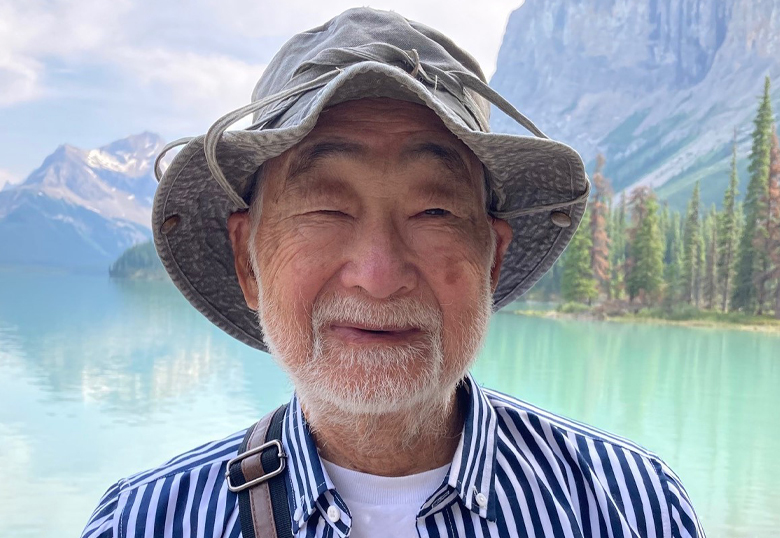
GROWING OLD GRACEFULLY IS NOT EASY

GROWING OLD GRACEFULLY

As I got old I have realized that growing old gracefully is not that easy. Some cultures make it easier. In Africa and Asia elderly people are honored and respected, letting them walk with their heads high. That’s one reason why some foreign tourists are disliked in Japan because of their disrespectful attitude to the elderly. In Lesotho in Southern Africa, I heard of a young man sentenced into prison for a few months by a magistrate after he verbally insulted an elderly kitchen woman at the university cafeteria. The same court sentenced a boy who stabbed another boy in a fight but gave him merely six lashes.

The same tenet still dictates me. When I was ordained to be a minister of religion in Tokyo, I tried hard to look older because I had a childish visage. I don’t want to be young again. I remember the frustrations from inexperience and lack of self-confidence.

The ultimate insult for a Japanese man is having to ask for a fork at a Japanese restaurant. The muscles of my hands atrophied and can not handle chopsticks any more. Body parts are replaced by artificial ones one by one. When I reached the bottom of the staircase, I don’t remember why I came to the basement. The worst is dwindling cognitive functions. “Aging ain’t for a sissy.” said the late Stuart McLean. The most difficult thing is to acknowledge the reality of the aging process without self-pity. A person who is helping me by correcting mistakes and by updating my old database is not insulting me. They are saving me from disaster. I must recognize our reality of the aging process with dignity and accept the offer of help gratefully.

When libido recedes and memories disappear into ether, we find ourselves desperate to hang on to the only thing left intact: vanity of pride. Some old men become more greedy. There is nothing more pathetic to see than a shriveling old man trying to show off his wealth and power. The rich and the powerful die at the same age as average people. What they treasure doesn’t seem to add even a few months to their years. Death lets us know that pleasure, money and power are good only in the fleeting world, which is in Japanese called “Ukiyo.” You can not take money with you to the other side. Death is the most effective equalizer. Then I have to ask, “What for?”

After I got old it’s good that I do not make unwise decisions as often as I used to. It seems that accumulated knowledge have been sifted through a mesh. The stupid, trivial, and ugly seem to have been be exposed and blown into the wind.

It’s time to sit and wait for the spirit to catch up with me.

Tad Mitsui honored by University of Lethbridge

University of Lethbridge recognized Tad Mitsui’s commitment to bettering society.

Tadashi (Tad) Mitsui has devoted his life to enriching the lives of citizens and their communities locally, nationally and internationally through compassion, courage, empathy and activism, giving a voice to those unheard and hope to those in need. The University of Lethbridge will recognize Mitsui’s dedication to bettering society by granting him an honorary degree at Spring 2024 Convocation. “It’s hard to grasp all the ways in which Tad Mitsui has made a difference in people’s lives, through his work as a minister, a volunteer or simply a caring citizen,” says University of Lethbridge Chancellor Terry Whitehead (BA ’94). “Still today, the letters he pens in the local paper are poignant, thoughtful and extremely insightful. The University is proud to recognize his commitment to humanity with an honorary degree.”

The University of Lethbridge presented Tad Mitsui with an honorary Doctor of Letters, honoris causa, at Spring 2024 Convocation, Ceremony I, on Thursday, May 30, 2024, at 9:30 a.m. in the 1st Choice Savings Centre gymnasium.

Had you no idea his pen was behind the thoughtful, engaging Letters to the Editor in the local newspaper, or that he’d been recognized with an honorary Doctor of Divinity from United Theological College affiliated with McGill University, you could assume Tad Mitsui was an earnest volunteer giving his time to Nikka Yuko Japanese Garden and assisting as a guest moderator for the Southern Alberta Council on Public Affairs.

Were you to take the time to listen to him speak, to present a sermon as Minister Emeritus at Southminster United Church or deliver his Tad and Tomo Stories to children at the garden, you would quickly begin to grasp the full depth of Tad Mitsui’s experience and the fascinating and meaningful life he has lived.

Born in Japan, Mitsui earned a Bachelor of Art and Bachelor of Divinity from Tokyo Union Theological Seminary in 1956. The following year he immigrated to Canada and was ordained into the United Church of Canada in 1958. For 10 years he served as minister with the Vancouver Japanese United Church, all the while earning a Master of Sacred Theology from Union College, affiliated with the University of British Columbia, and later a Doctor of Sacred Theology at United Theological College.

From 1968 through 1975, Mitsui was a lecturer and then Dean of Student Affairs at the University of Botswana, Lesotho and Swaziland. Throughout the 1970s, 80s and 90s he worked out of Geneva, Switzerland (six years living in and commuted frequently) performing administrative and advocacy work with NGOs and ecumenical organizations to facilitate international projects related to human rights, refugees, liberation movements, food security and development.

The work he did in areas such as human rights, justice and development was impactful and often fraught with danger in conflict environments. From 1975-79 he served as the Associate Secretary for Africa, International Headquarters of the World University Service, where he worked as a fundraiser and coordinator of anti-Apartheid solidarity work of National World University Service committees. From 1988-90 he was the Associate Secretary for the Canadian Council of Churches for Africa and Middle East, helping coordinate the churches’ work among Palestinian refugees in Israel and other Middle East countries.

Since moving to Lethbridge, he has continued to use his knowledge and experience to better society. A devoted volunteer at Nikka Yuko Japanese Garden, his expertise and wise counsel have helped advance the garden’s programming and impact on the community and in 2023, he was awarded a Queen Elizabeth Golden Jubilee Medal.

Honorary Degree

University of Lethbridge to recognize Tad Mitsui’s commitment to bettering society with honorary degree

Tadashi (Tad) Mitsui has devoted his life to enriching the lives of citizens and their communities locally, nationally and internationally through compassion, courage, empathy and activism, giving a voice to those unheard and hope to those in need. The University of Lethbridge will recognize Mitsui’s dedication to bettering society by granting him an honorary degree at Spring 2024 Convocation.

Tadashi (Tad) Mitsui has devoted his life to enriching the lives of citizens and their communities.

“It’s hard to grasp all the ways in which Tad Mitsui has made a difference in people’s lives, through his work as a minister, a volunteer or simply a caring citizen,” says University of Lethbridge Chancellor Terry Whitehead (BA ’94). “Still today, the letters he pens in the local paper are poignant, thoughtful and extremely insightful. The University is proud to recognize his commitment to humanity with an honorary degree.”

The University of Lethbridge will present Tad Mitsui with an honorary Doctor of Letters, honoris causa, at Spring 2024 Convocation, Ceremony I, on Thursday, May 30, 2024, at 9:30 a.m. in the 1st Choice Savings Centre gymnasium.

Tadashi (Tad) Mitsui

Had you no idea his pen was behind the thoughtful, engaging Letters to the Editor in the local newspaper, or that he’d been recognized with an honorary Doctor of Divinity from United Theological College affiliated with McGill University, you could assume Tad Mitsui was an earnest volunteer giving his time to Nikka Yuko Japanese Garden and assisting as a guest moderator for the Southern Alberta Council on Public Affairs.

Were you to take the time to listen to him speak, to present a sermon as Minister Emeritus at Southminster United Church or deliver his Tad and Tomo Stories to children at the garden, you would quickly begin to grasp the full depth of Tad Mitsui’s experience and the fascinating and meaningful life he has lived.

Born in Japan, Mitsui earned a Bachelor of Art and Bachelor of Divinity from Tokyo Union Theological Seminary in 1956. The following year he immigrated to Canada and was ordained into the United Church of Canada in 1958. For 10 years he served as minister with the Vancouver Japanese United Church, all the while earning a Master of Sacred Theology from Union College, affiliated with the University of British Columbia, and later a Doctor of Sacred Theology at United Theological College.

From 1968 through 1975, Mitsui was a lecturer and then Dean of Student Affairs at the University of Botswana, Lesotho and Swaziland. Throughout the 1970s, 80s and 90s he worked out of Geneva, Switzerland (six years living in and commuted frequently) performing administrative and advocacy work with NGOs and ecumenical organizations to facilitate international projects related to human rights, refugees, liberation movements, food security and development.

The work he did in areas such as human rights, justice and development was impactful and often fraught with danger in conflict environments. From 1975-79 he served as the Associate Secretary for Africa, International Headquarters of the World University Service, where he worked as a fundraiser and coordinator of anti-Apartheid solidarity work of National World University Service committees. From 1988-90 he was the Associate Secretary for the Canadian Council of Churches for Africa and Middle East, helping coordinate the churches’ work among Palestinian refugees in Israel and other Middle East countries.

Since moving to Lethbridge, he has continued to use his knowledge and experience to better society. A devoted volunteer at Nikka Yuko Japanese Garden, his expertise and wise counsel have helped advance the garden’s programming and impact on the community and in 2023, he was awarded a Queen Elizabeth Golden Jubilee Medal.

May 6, 2024

Traitor of Class

TRAITORS OF THE CLASS

I have always wondered why “Progressive” movements are often occupied by people from the intellectual middle class and the supporters of the Right of Center ideology are often low-income workers. I had an “Aha!” moment when I read the report of a research done by an economist Thomas Piketty. It is about “Who voted for whom?” It shows that in the 1970’s majority of highest earning and well educated voters in the most of the western countries supported right of centre political party candidates like Christian Democrats in Germany, and Conservatives in the U.K., and Republicans in the U.S.A. Meanwhile, the lower earning and the people of lower income and lower education level, workers and laborers, voted for the left of center parties like the Democratic Pary in the U.S., the New Democratic Party in Canada, Labour Party in the U.K., and Social Democratic parties in Germany.

Forty years later in 2010 however, the same researcher found the rich stayed with the Right of Centre parties, but the well educated among them e.g. holders of graduate degrees have switched their support to the centre left parties. As for the less educated and the lower income earners, they have switched their support to the Right of Centre parties. They include farmers and laborers. They are the core supporters of the populist right-wing causes like Donald Trump and Brexit. Picketty calls the wealthy business class who remained with the Right of Centre parties, “Merchants Right,” and the educated who moved to the left, “Brahmins Left.” What happened during those forty years? The report does not say.

My guess as an amateur observer is that the “Brahmin Left” felt betrayed by the “Merchant Right.” The economic meltdown of 2008 had confirmed the suspicion that market is amoral. The banks exploited the gullible lower income public with products like sub-prime mortgage. Banks failed but were bailed out by the government because they were “too big to fail.” Meanwhile the average income earners lost their homes, pensions, and life savings. Even the Chairman of the U.S. Federal Reserve, Alan Greenspan, was appalled by the recklessness and amoral behaviours of the financial sector. “Merchant Right” chose profit rather than fairness. Nevertheless, the middle class youths who joined hippies and anti-war movements safely remained Middle Class.

I have a difficulty guessing what happened to the lower income and less educated masses who became Trump supporters and those voted for the Alberta’s United Conservative Party. It is possible that they have never embrased left-wing ideology. Their aspiration could always have been to join the rank of the rich. They might have felt betrayed when they lost the jobs and homes while the elitist Brahmin Left remained comfortably middle class in academia or in government bureaucracy. They might have concluded that the educated Left are hypocrites and traitors to their tribe.

As for those in the agricultural sector who had joined the Commonwealth Cooperative Federation (CCF) during the depression and the 1940’s in Canada, with the shift from small scale family farms to capital intensive mechanized big business, they joined the “Merchant Right.” If both Left and Right want to take back the lost ground, the Left must learn to talk to those who work with sweat and blood; and the Right must learn the way to appeal to the people who think.

Why I am not a vegetarian

LAMB OF GOD

I wanted to be a vegetarian many timed but I decided not. This is why:

In Lesotho Southern Africa my family and I lived in a small village for a few months to learn the language. Meat supply was a leg of mutton delivered by bus once a week. Otherwise we bought chickens with their wings still flapping from neighbors in the village. We asked the young man who looked after our vegetable garden to do the killing. One day chicken was delivered during the weekend and our man was not available. So I butchered it. I could not eat that bird.

All of us live because other lives die for us. Even vegetarians kill some kind of life-forms as food. Our world is an interdependent world. All life forms, including us, live because other lives die. Lobsters and crabs are boiled alive. Japanese eat live fish as delicacy. It is the reality of nature, cruel as it maybe. Every time I see the pictures of animals, chickens, cows, fishes, pigs, or rabbits on the way to our dinner table, I want to be vegetarians. Their eyes look at me pleading, “Don’t kill me!” The first time this city grown man killed a chicken, he could not eat it. Pathetic? I agree. City dwellers buy meat wrapped in plastic. My cousins who lived in countryside knew how meats came to the table. So did my friends and neighbours in Africa. In Lesotho, church dinners often began a day before by killing live cows in the church yard while congregants watched.

The notion of “Lamb of God” tells us a lot about our interdependent world. We live because others give up their lives for us. When we die we become food for bacteria and flies that lay eggs on our bodies. The maggots feed on us. In extreme situations, humans ate dead persons. The first Christians began to call Jesus “Lamb of God” remembering the lambs enslaved Jews in Egypt slaughtered to save their first born sons when they were preparing their escape from slavery. The Roman authorities accused Christians of practicing cannibalism when they heart the Christian priest pronouncing “Body of Christ” as he was distributing bread at the Communion table in remembrance of the Last Supper of Christ.

All lives are sacred, including the ones we eat at the table. They are sacrificed so we live. In some cultures, the traditional way to prepare the live animals for food included some kind of ritual to express gratitude. In Japan, at the table they put the hands together, bow, and say “Itadaki-mas” thanking all who gave us food, including the once lived animals, fish, and vegetables. I saw a film at “Head Smashed-in Buffalo Jump” Museum in Southern Alberta that showed a scene where a man was butchering a buffalo. He picked up the dead animal’s heart, raise it into the sky in thanksgiving. What a difference that is from the industrial slaughterhouses scene where hundreds of animals are funneled into the tunnel to be electrocuted mechanically like machine parts. They had life and is the Lamb of God. A friend of mine who is an avid hunter told me that his way to provide meat to his table was much more environmentally less harmful because he killed only what they ate. There is no waste.

I am not a vegetarian. I could have been. But I accept the laws of God’s world. We live in an interdependent world.

When I die.

WHAT HAPPENS WHEN I DIE? – Two ideas from Japan of antiquity.

When I was growing up in Japan, I heard Samurai of old believed that the purpose of life was to find a good death. That’s why they preferred “Seppuku – Harakiri” in stead of living forever in shame. Suicide therefore was ubiquitous tragedy but honorable. When I came to Canada in 1957, I was surprised to find that suicide was a felony. The situation changed. Today “Medical Assistance in Dying (MAID)” is legally allowed today since a decade ago. Death and dying are no longer a morbid subject of conversation. This year I became 94 years old. I think of the end of my life often. The thought of separation from my love ones is unbearable. But the idea of joining the eternity to be a part of it attracts me, not as an individual person but as a part of it no matter what and how I may be.

I have grown up in Japan influenced by Japanese traditional thinking even though I was born and grew up in a Christian pastor’s home. The ideas that evoke in the following two poems sound like a hybrid of different Asian spiritual traditions. I am attracted to one haiku by Matsuo Basho. It succinctly summaries our existent. Basho, Haiku poet, lived in 1644 – 94 CE in Edo (Tokyo) which was the seat of the Tokugawa Shogunate. With 5, 7, 5 syllables he described human existence merely as “the sound of a frog jumping into the old pond.” The murky old pond to me represents the enduring peaceful expanse of eternity. A frog represents the fragile even pathetic existence of human being. I jumped into the world. I thought I achieved great deal. But the fact is I only made a barely audible sound and the silent eternity returns instantly.

Another one I admire very much is one children recite to memorize 47 Japanese phonetic signs called “Kana.” It is ingenious that it does not repeat any one written symbol. It recites the essence of Buddhist teaching with 47 Kana characters. We sing it like the song we sing alphabet A.B,C. According to the legend, it was written by a Buddhist monk Kuhkai (774 – 835) who brought Buddhism to Japan from China. The song is commonly known as “IROHA UTA” which is sung like the way the children sing “ABCDEFG” in English.

The song means: “Although its scent still lingers on, the form of a flower has scattered. For whom will the glory of this world remain unchanged for ever? Arriving today at the yonder side of the deep mountains of evaporable existence we shall never allow ourselves to drift away intoxicated in the world of shallow dream.”

The basic idea about death is entirely different from the common Western understanding of death as absolutely final. The end, hell, curse, etc. It describes human existence as a tiny insignificant disruption of the peace and silence of eternity – nothingness. When life ends, we will become a integral part of the universe to join the eternity, the end of the individual. I am happy with such a prospect.

Can you cure drug adiction?

Can drug addiction be cured? It’s difficult. The following are the stories of
three drug addicts I knew personally. They were good people. I hope their stories can help you think more deeply and sympathetically about drug addiction. The first person is my grand father. He was a veterinarian. The next was the professor of the Old Testament. The last was an ordinary young man and was a member of the church I served.

I start with horses to introduce my grandfather. Dr. Yukichi Takeda was a veterinary surgeon. Thinking of my own traumatic experience with a horse, it is not difficult to guess how one can become emotionally attached to horses. When I lived in Africa, one time I had to shoot my beloved horse. From that traumatic experience, I can guess how my grandfather became a drug addict.

My horse suffered acute pain from the twisted intestine. Horses can neither burp nor vomit so when the intestine is blocked, it’s fatal for them. After several days and nights of my futile attempts to open the passage, the vet shook his head and handed me a .22 handgun and marked X between his eyes. The horse’s eyes met mine just before I pulled the trigger. He was a gentle old gelding. He taught my family how to ride. We loved him. The trauma of the incident kept me awake many nights.

Dr. Yukichi Takeda was a veterinarian for a cavalry regiment. It was during Japan’s war against Russia in the early 1900’s. He saw the horses died in unimaginably cruel ways. Grandpa was a dysfunctional man after the war. He failed in every enterprise he tried because he was a drug addict. I often saw him sitting with his back straight chanting Buddhist mantra. His den always smelled disinfectant. In wars, we do terrible things to animals. I watched a British drama series “All Creatures Great and Small” on the PBS-TV. In it a cavalry veterinarian was ordered to slaughter all the horses that survived the war to save the cost of transportation back home when the WW I ended. Also Lethbridge Galt Museum Archives has a diary of an Alberta cowboy who went to fight in the Boer War. He wrote about nearly 300 horses which were thrown overboard in a storm to reduce the load to save the boat. Grandpa Ojiichan was still a drug addict when he passed away in his eighties.

Another drug addict I knew was my professor at the Theological College. Dr. Zenta Watanabe became addicted to pain killer, probably morphine, in Germany where he was working on his doctorate. He told us that it was a pain killer for an appendix operation that did it. At the time opium was a legally accepted recreational beverage like alcohol. Charles Dickens, Conan Doyle, Alexandre Dumas, and many other well known personalities were opium users. Dr. Watanabe beat the addiction. But “cold turkey” was so excruciating that he tried to kill himself a few times. He lived a productive life and became famous for his scholarship. His hands were shaking without stopping all the while he was teaching.

Johnny (Fictional name to protect the identity of the family) was a restless young man. As soon as Japanese Canadians were freed to leave the internment camp, he came to Vancouver in 1949. But Vancouver was still a hostile place for the Japanese Canadians who had been labeled “Enemy Aliens” since 1942. It would take several more years for other Japanese Canadians to return. Meantime Johnny got mixed up in the wrong crowd. By the time his family came back to the city to restart the family business, he was a drug addict. He joined the Japanese United Church with the family. He tried hard to get rid of the addiction. Church friends gave lots of support in his hopeless effort. He died of an overdose at home.

When humans were hunter gatherers, they lived only on what they could gather or hunt. Today everything is available whatever we want because we can buy and or produce everything anytime. We had to learn to stop consuming when we had enough. If we don’t learn, all good things will turn deadly. Even sugar can kill you if you’re a diabetic and ignore the limit. Obesity is the biggest killer today. We eat too much. Everybody knows that. But most of us do not stop, become obese, and die of weight related ailement.

There are many complementary food and drink to enrich our lives. Cola nut in West Africa is a part of their culture. It is a powerful stimulant and a part of the ritual to build up community. It’s like Qat (Khat) in the Arab world. They create euphoria and are harmless under control. It’s like alcohol which is a part of all our celebrations. Yet they are addictive and can be harmful. We have to know how to enjoy it and when to stop.

We are no longer hunter gatherers. We are free to eat and drink whatever we want and whenever we want. But freedom requires responsibility. We must know when to stop which is the responsibility of the free and civilized people. Total prohibition of Alcohol during the 1920’s was a total failure because it prohibited the exercise of freedom. As the result, organized crime skyrocketed. Production and distribution of illegal substance thrived underground. They produced more deadly stuff because there was no rule underground. Everything we consume and enjoy can be harmful if we don’t exercise self-control. But criminalizing them never worked and never will to restrain human bevavior. It’s a human nature to resist when freedom is taken away.

We also have to recognize that drug abuse and addiction are much more widespread than we think. Many addicted persons are hidden from the public. They are at home. Ministers of religion who from time to time conduct funerals for those deaths by overdose know how many hidden drug addicts there are.

God has granted us freedom. We must exercise it responsively.

Walk more and enjoy food

Every time I come home from Japan, I feel sad to see so many Canadians overweight. The situation is worse in the U.S. They say that the most serious health problem in Canada and the U.S. is obesity. In two countries of North Americs 6% of population is classified as obese wjicj is the worst in the worldf. In Korea and Japan it’s only 3.6%. Why is that? Most of information I found on the subject in social media point to the difference in diet in those two Asian countries from. I do not agree. They completely ignore the one most important factor. It’s clear that their intention is to sell a nutrition supplement and neglect to mention other factors. In short what makes us fat is the excess use of cars not eating too much food.

Japanese people spend awful lot of money for food more than we do in Canada, but few of them are overweight. I found it’s the same in France and Switzerland. In those countries you find food with good quality and expensive. Therefore serving is smaller. I heard many North American complain about the small serving and high cost. Many Japanese visitors we entertained in Canada and the U.S. complain cheaper quality of food and big quantity of serving they can not finish. The fact is Japanese people live much longer than any other country in the world. It’s clear we need to walk more and to drive less.”

Japanese people take public transport more often and walk a lot more to make connections, to bus stops and change destinations. Japan and other countries like Britain, France, Germany and Switzerland have the best public transport system in the world. It’s clear to me driving makes us fat more than food intake. Number of deaths as the result of overweight have overtaken cancer and cardiovascular conditions. But we try to avoid the subject because we have to give up a few pleasures of life like car. We rather drive to the gym and take Ozempic. That’s how we stopped running, walking, and taking public transport. Now we can eat as much as we want without moving our bodies. So many of us become overweight and die of heart attack.

Braiding Sweet Grass

We will all die. I wonder how the narcissist of the South would cope with such idea as his own death.

Last two years at the church I was a part of the discussion group to talk about “death and dying.” We met once a month. From the outset, we agreed that fear of death was no longer a morbid subject to avoid. We touched on the questions such as “how to die well,” body donation and parts thereof, Eternal Life, green burial, Medical Assistance in Dying (MAID), preparation for one’s own ending, ‘How to plan one’s own funeral, death and humor, etc. Ideas for topics never ran out. After Easter, we decided it was a good time to take a break.

We know that life and death are a single integrated and inseparable process. Life starts its dying process when it begins. There is no life without death, neither is there death without life. It’s like two sides of a sheet of paper. There is no paper without the other side. We had feared death so much that we tried hard to deny its inevitability because of pain, suffering, and violence that often came with death. We now know how to avoid those menace. The world is a better place for many of us. We now live in a relatively harmonious and peaceful world. The dying process is more comfortable than it used to be. People live longer too. For many of us fear of death is not a big issue. Some people, like my mother, live so long that their complain is, “I’m tired. What’s the point.”

Advanced medical science is largely responsible for today’s favorable situation. For some, the process of dying is like falling asleep. So many of us are less afraid of death. Granted that separation from the loved ones breaks our heart. Otherwise dying process itself can be less serious grief. Many traditional funeral hymns sound redundant. We hold “Celebration of Life” to bid farewell to the dearly departed in the company of friends with food and drink. Proviso is however, there are still many people in the world who suffer painful death. We must continue to work to eliminate pain and suffering.

We no longer expect doctors to keep alive near death persons to suffer incurable illness or unbearable pain merely to keep them alive. “Medical Assistance in Dying” is a legal procedure which many Canadians take advantage of. “Eternal Life” begins to sound like an oxymoron ‘fake truth.’ It’s an attempt to escape the fear of death. We have to realize that there is no life without death. We have to get out of the futile attempt to separate the inseparable. So Apostle Paul replaced the meaning of resurrection from “Jesus died but came back to life” in the Gospel to “He returned in a spiritual (different kind of) body” in his Letter.

However, I do not believe that the physical elements that constitute a person disappears into nothingness. Einstein proposed with his famous equation that the matters continue to exist in different forms as particles, light, waves, energy, etc. The problem is our self-consciousness. My ego doesn’t allow “I” to vanish and turn into ashes to be a part of the atmosphere when my body is cremated. Our self-consciousness demands us to stay as an independent entity in one piece. The offence against God in the Creation Story is about the emergence of our self consciousness. Rebelling against God, we became conscious of our naked truth. We didn’t like what we saw. So we cover ourselves to hide our naked truth. We want to live in a narcissistic delusion as an almighty immortal individual. We found we weren’t. We saw the truth and didn’t like it. The truth we saw of ourselves was not Michelangelo’s beautiful ‘David.’ It was death. The ultimate curse of self-consciousness that we have to live with is the knowledge that we die. Awareness of such reality gave birth to self-loathing: the cold sweat of “Fear of Death.”
Without self- consciousness, we can happily exist forever in the vast universe in various forms as parts of other existence. The idea of Eternal Life must be rephrased if one wants to have “Eternity” to feel good about ourselves. We will have to re-discover the notion of corporate personality: “I” as tiny elements of various bodies in the vast universe. I am comfortable with that.

Robin Wall Kimmerer is mother, botanist, professor, celebrated one of the hundred most influential persons in the world, by the Time Magazine in 2025. She is an American indigenous person. She is teaching us in her book, “Braiding Sweet grass,” about the wisdom of indigenous scientific knowledge and the teaching of plants. She advises us to listen to the plants to learn from their wisdom.

In Christian Church however, such a notion was rejected as “Animism. Growing up in Japanese culture, I always had problems accepting such an anthropocentric obsession. I grew up in the culture to respect sacred animals, plants, trees, mountains, rivers and rocks. We believed that we are the children of the Great Sun Goddess Amaterasu, who brought all of us into the world and sustains us with energy and warmth.
We must learn from the wisdom of animals and plants to live together in harmony as the family of the universe. I believe in the eternity of existence. I am a part of the Corporate Person. I am happy with that thought.
What does it mean?

In her recently book “At a loss for words,” Carol Off, who is a former CBC Radio host of “As It Happens” is warning about the erosion of the integrity of language. She believes what we say often does not mean it is supposed to mean any more. She is afraid that the erosion of the Canadian consensus may have begun. Pontius Pilate asked Jesus “What is truth?” There is no answer recorded in the Bible. Does that mean it is still a question? Is truth a fake news when it is inconvenient? It all depends?

I once lived and worked in the country where spoken word carried more weight than action. They say: “You don’t pray for the opposition party. When you pray for someone you don’t like, it means you are a hypocrite OR a liar. A case in point, a boy had a fight with another boy and stabbed him who survived with a superficial wound. The village chief sentenced him six lashes. The same magistrate sentenced another boy a much heavier punishment for verbally insulting an older woman. The boy was imprisoned for a few months. He said, “Superficial wound will heal. But a hurtful word will leave a scar on the soul.”

I hate to see beautiful words squandered. Corrupted language can poison air and create toxic environment. When a demagogue employs poisonous language, it can cause devastating damage to the nation’s soul. Dictators have done it and led gullible masses to their own demise as Hitler and Mussolini did. And now a demagogue and a pathological liar in the South of the boarder is following the examples of those devils incarnate who led people to their own demise. Where is a shiny example of the Republic?

Let me to pick one word “love.” It is very powerful and profound. It is also abused so often that the result is confusion. Few people bother to sort it out. When I watch the scene of hysterical mob cheering Adolf Hitler and other figures like them, I see the history repeating itself in the South of the boarder. People are refusing to notice and clean the contaminated language. Love word is a real problem because I is loaded, powerful, and ubiquitous. Let me think about it comparing it with the examples of other languages.

There is no one word in Japanese what we call in English “love.” Neither is there one word for love in the Koine Greek chosen by the writers of New Testament. I think we should qualify the love word with adjectives to avoid misuse and misunderstanding. For example, “love” described by St. Paul should be “charity.” King James Bible got it right as a translation of the original Greek “agapeh.” Otherwise it should be used with a qualifier like “God’s Love” or “self sacrificing love.”

My father told me what happened in his first Bible study class as a student teacher at a Christian Girls High School. It was during the 1920 Japan. He proposed to discuss love. He asked a girl what she thought about love. Her face turned red and took a long time to answer. Finally she said, “Isn’t it “himegoto” – the matter that must be kept secret? During those days in Japan there was no boy-girl contact permitted without chaperon. Marriages were arranged by match-makers. Love affairs were clandestine and rare. Japanese people did not say the word “love” without qualifier like “merciful” or “parental” before the noun “love.” Christian idea of “love” had no place except to mean “charity” as appeared in the King James Bible. 1st Corinthians Chapter 13 does not say “love.” In stead what spoke about is closer to “God’s love.” For English speakers, it may come as a shock that there is no one word for “love” in the Bible. In the original Bible in Greek there is no one word for love. Today “love” still is in the same conundrum mainly because of inadequate translation.

One word translated in English “love” comes from at least three Greek words. The word we use most often when we say “love” in English today comes from Greek word “Epithumia. ” It is translated as “desire” or “covet.” It’s the word often abused by young boys with only one thing in mind talking to young women. Obviously, the Biblical love does not mean that.

The word we think it means sexual love does not mean what we think it means. The word is “Eros.” Our common use of the word has sexual connotation. But in Greek, Plato used it differently. For Plato eros is the desire to be perfect. What we think means sex is another Greek word “Epithumia.”

Navy Lieutenant Paul Katayama, innocent man executed as a war criminal

Remembrance Day is the day to remember the war dead on both sides of conflict and be grateful for their sacrifice. We must promise never to repeat the folly of war. My father once spoke about Navy Lieutenant Paul Hideo Katayama of the Japanese Imperial Navy in his sermon. He wanted to express the gratitude for his ultimate sacrifice. However referring to the member of the church who died as a war criminal was not appreciated. He never mentioned the name again.

Recently I dug out the file that contained documents about Lt. Katayama. They were sent to me by a staff writer of a Japanese magazine 20 years ago. In September 1947, the Australian Court for the B & C Class War Criminals on the Pacific Island of Ambon found Lt. Katayama guilty of executing Australian airmen after their bomber was shot down and were taken prisoners. It was a war crime in violation of the Geneva Convention.

Reading those documents, it dawned on me that we apply double standards in remembering “war dead.” Most of them are honored as heroes but many others are disgraced or forgotten. In the movie or TV about the WWII , we often see German, Italian, and Japanese soldiers behaving like inhuman sadistic demons. The soldiers from the Axis countries were not all Fascists, Nazis, nor barbarians. Canada accepted millions of immigrants from those three countries as immigrants after WWII. Their descendants are now Canadian citizens. The soldiers from the “Axis” countries were mostly conscripted men were ordinary people who had no choice when they were called up. The following is an attempt to rehabilitate one decent human being who became a victim of the madness of war and died as a war criminal.

In February 2006, I received an email from Ms Hiroko Imamura, a staff writer of a Japanese Evangelical Christian Magazine, “Gospel for the Millions.” She asked me what I knew about Navy Lt. Katayama. She wanted to find out why all his letters and diary from the prison were sent to my father Rev. Isamu Mitsui asking him to deliver to Katayama’s widowed wife, his family, friends. I had no idea.

Ms Imamura also told me that Lt. Katayama’s story became a movie in Australia, titled “Who was Tried in Ambon?” It was distributed in 1990 by the Warner Brothers in Australia. The following year, it was shown in Japan with subtitles. Now it is a part of the permanent archival collection of the Australian War Memorial in Canberra that also includes copies of Katayama’s last letters to his family and friends and the diary he wrote in prison. The whole story reads like a typical scenario of “an innocent man executed for the crime he did not commit.”

The 18 year old Hideo Katayama was admitted into the prestigious Tokyo University College of Foreign Languages (Tokyo Gaigo Daigaku) and became fluent in English. His goal in life was to become a foreign diplomat. Meanwhile, he converted to Christian faith while staying in the students residence managed by Salvation Army. He was baptized and became a member of Ginza Methodist Church in Tokyo where my father Rev. Isamu Mitsui was minister.

When WWII broke out Katayama was conscripted into the navy. He became a language specialist with the rank of Lieutenant. He was assigned to be a member of the staff of the prisoners of war administration in the Pacific. He worked as an interpreter/translator on the Island of New Britain. When Japan surrendered, all Japanese military personnel were shipped back to Japan at the end of 1945. Katayama went home and got married.

A year later, in 1946 a notice was circulated among all veterans who served in the Prisoners of War camps in the South Pacific to report to the Allied Occupation Forces Headquarters in Tokyo. Some obliged but many former high ranking officers didn’t. They knew what that was all about. Katayama reported in and was immediately arrested. He was sent to a prison camp in the Pacific Island of New Britain, where he was charged for unlawful execution of Australian airmen. The trial lasted three days. He and another language officer were sentenced to death. He denied the charge and appealed. As an interpreter, he merely read the sentence in English. He stayed in the camp for the war criminals for a year waiting for the outcome of his appeal which was unsuccessful. He was executed in September, 1947 by firing squad. He was 27 years of age.

Waiting for the outcome of his appeal, he was assigned to work for the administration of the war criminal camp as an interpreter and a translator. In the meanwhile he organized a Bible Study group for the prisoners inviting Australian Army Chaplains to lead and conduct Sunday Service. The chaplains named the group “the Church of the Light (Hikari Kyokai).” Many prisoners were baptized. Some had their sentences reduced with the help from Katayama. During that time a few Australian officers in administration including chaplains began to wonder if Katayama was indeed guilty of the charge and launched an appeal. The Australians officers involved in the appeal began to discover strong evidences of the conspiracy among the Japanese senior officers who were in charge of the Allied POW Camp administration to shift their guilt to junior officers. The process to save Katayama’s life was launched by those Australians. But it was too late.

Walter Cronkite was a CBS News anchor for twenty years. He said, “War itself, of course, is a form of madness. It’s hardly a civilized pursuit. It’s amazing how much time we spend inventing devises to kill each other and how little time working for peace.”

I should have learned…

Fall 2025 has been stressful. Two good friends passed away. Ray Whitehead was close to me when I began working in Toronto after 12 years absence from Canada. His last job was Director of Doctoral Program of the Toronto School of Theology at the University of Toronto. He persuaded me to come back to Canada when I was working in Switzerland in 1978. He was a guest in our apartment while attending a house meeting. We became good friends during my days in Toronto. Wendy Sherman was a friend at the church. She always sat on the pew near us for twenty five years. We knew her passing was imminent but waiting was most difficult. Another reason for my stress was the visit of my daughter which was an absolutely happy event to be sure. But when she went back to Toronto, I sadly realized that I might not see her again. I will soon be 94 years old.

Those events led me to think about my own departure from this world. The end of my life is a certainty but was not the cause of my grief. The thought of separation from the loved ones is heart wrenching. We should all know that the end of life is the law of nature. Death is an integral part of life. If there is no death, it is not life. “Eternal life” is an oxymoron. Our ancestors used the word “life” to mean our existence. Eternal life means we will continue to exist after death but in a different way. St. Paul called it “spiritual body.” No matter how difficult it is to find the appropriate word, it is important to accept death as normal but not as final. I think it is a step forward. Accepting reality is not a defeat.

The memory of the crisis in my earlier life came back and made me realize what I should have learnt but didn’t many years ago. One is to be comfortable in solitude and find peace that enables me to keep thinking calmly, not delusion nor madness. I should have learned it in solitary confinement in 1971 but didn’t. Another is the lesson I learned from an old man who chose to seek wisdom not convenience.

We don’t plan a crisis. We run into crises. Some people can stay cool and deal with it. I couldn’t. The inside of me was havoc when it came. It was at Johannesburg Airport in January, 1971. It was the first step of my deportation. On that day I flew back to Johannesburg after attending the conference organized by the World Student Christian Federation in Dar es Salaam, Tanzania. I landed in Johannesburg to catch a connecting flight to Lesotho where I lived. I was met by an Immigration officer who came on board as soon as the plane landed and took me to the immigration detention centre. He took me to a room, told me to wait, locked the door, and walked away with my passport.

No one came back for three days except a scared looking waiter who delivered meals. Nobody told me why I was held up and for how long. I had nothing to read in my carry-on bag. The checked luggage was not delivered. It was solitary confinement except it wasn’t exactly that. The room was like a nice hotel without telephone and TV. The worst was the worry about my seven years old daughter waiting alone at home. My spouse was going to a conference that day. There was no way to let her know what happened to me. I was trained to be a minister of religion. I should have known all the tricks to keep the peace of mind: meditation and prayer, etc. The paralyzing fear had overtaken me. Sleep never came.

There was another lesson I should have learned but didn’t. It was from an old man who tried to teach me the importance of sitting and trying to make sense of the given situation. One evening on a mountain road in Lesotho, an old man was sitting by the roadside looking tired. I stopped the car and offered him a ride. He said “No. I walked all day. I am waiting for my spirit to catch up with me.” I had the graduate degree that qualified me to teach in university but I didn’t know how to sit and wait for my spirit. Religions speak in the language like prayer and meditation. I think those words mean, “calm down and think.” Atheists do that too.

What drove me crazy was my inability to distinguish what I could not do from what I could. I love the prayer the Alcoholic Anonymous members recite, “Grant me the serenity to accept things I can not change, and the courage to change that I can.”
The situation I found myself while locked up in a room in Johannesburg Airport was one I could not do anything about. It was a tough question to meditate on. I needed serenity to convince myself to accept my powerlessness. I had to accept it and hope that the world is compassionate and kind. And it was. My daughter was looked after by the kind neighbors’ family.

You can not pay your way out of aging and death. Fame, social standing, power, and wealth mean nothing when you are at the end of your life.

WALK MORE, EAT LESS

The Lethbridge Herald, March 19th, 26 reports, “Council of Women’s Shelters report highlights transportation barriers.” Public transportation is not only the safety issue of the venerable women, but to my opinion it is a public health issue. While ago, I found driving made me fat more effectively than food. I argue that a good public transit system is one of the ways to reduce obesity. Britain, France, Germany and Switzerland have the best public transport system in the world. Japan is another member of the club. China is catching up fast. You rarely see obese persons in those countries. Few people in Canada want to talk such irreverence because our relation with the automobile is sacred and is a love affair.

Every time I come home after visiting Japan, I feel sad. It seems many Canadians are overweight. They say it is worse in the U.S. Consequently the most serious health problems in North America are caused by obesity. In North Americas 45.6% of population is classified as obese. That is the worst in the world. In Korea and Japan obese people are 3.6% of the population. Number of deaths as the result of overweight have recently overtaken cancer and cardiovascular problems. However, most of the advice I found in social media point out the difference in diet between Americans and Asians as the cause. It’s clear to me that their intention is to sell nutrition supplement hiding other factors. They completely ignore the one most important reason. I think what makes us fat is our excess use of cars, preventing us to move our bodies. It’s not so much because of eating too much food or lack of proper nutrition.

Japanese people take public transport often, and walk to bus stops, change connections, and walk up and down the stairs. There is elevator who need them. It’s clear to me driving car makes us fat more than eating too much food. Number of deaths as the result of overweight have overtaken cancer and cardiovascular issues. But we try to avoid talking about it that way because we have to give up our love affair with cars. That’s how we stopped running, walking, and taking public transportation.

Japanese people spend a lot of money and eat an astonishing amount of food. They love food very much. But few of them become overweight. I found it’s the same in France and Switzerland where I lived for a period. In those countries I found foods well prepared and tasty but expensive. Serving is smaller. North American visitors complain about small serving and high cost of food in Europe and Japan. On the other hand, Japanese visitors to Canada complain about quality and big serving they can not finish. The fact is Japanese people live much longer than any other country in the world.

It’s clear we must walk more and drive less: select better quality food but less quantity.

we must learn from cockroach

I am happy that I am a Canadian. Empires rise and fall. American Empire is ending like all other empires. Rarely are they loved by the people who lived outside of them. Their end is always ugly. British, Mongolian, Roman Empires lasted much longer than the U.S. Many small countries live on and thrive: Andorra existed since 1278, Liechtenstein 1868, San Marino since 4th Century, etc. And Monaco is the tiniest country in the world where the largest number of the richest people in the world live. The small countries are lasting longer than all empires though they are so small and so insignificant that few of us know where they are.

Little cockroaches have existed millions of years before dinosaurs had appeared. Cockroaches are still living with us and will probably outlive us. For a long time, we have used to the idea that “the bigger the better.” I believe the time has come to examine that mantra. In the 1970’s, I read a book titled “Small is Beautiful” by E.F. Schumacher, and liked the notion. I believe that the trouble with us for not being able to change our life-style is caused by the fact that we do not want to give up our “big” mantra. We have to convince ourselves that “Small is Beautiful” and start behaving accordingly. Ancient Chinese wisdom has been warning us that “It’s better to be the head of a chicken than the tail of a cow.” We know the tail gets a lot of sh*t, though it is a part of a big and beautiful impressive animal. I pity those people whose only goal in life is to become big and famous. I rather want to stay small and happy.

I drive a Smart Car and I pay somewhere around $40 to fill the empty tank. I drive in a city alone most of the time. I can drive to Calgary 250 km away and come back without refill. The bigger the better? We have to be woken up to realize the fact that BIG doesn’t pay. Many big and majestic animals are now extinct. Where are dinosaurs and mammoth? Bisons were almost wiped out. Other huge creatures are disappearing fast too, e.g. elephants, hippopotamus, whales. They are big and impressive. Were there ever conditions where the big size was a better option to adopt in the survival of the fittest battle ground? The same question has to be asked about humans. Empires were huge and powerful. Some of them lasted a few centuries. But all of them were destroyed from within by the weight of their success. The end of empires has never been pretty. We are watching the decline of the American Empire. And it’s not pretty. We and the Europe are the collateral damage. Decline and fall of any empire has never been pretty. When a big rock cracks and pieces fall, they always take their innocent vassals down with them. What about the big guys who were the heads of those big empires? When you go through the list of recent dictators and tyrants, you see many of their ends are sad and ugly: Benito Mussolini, Adolf Hitler, Saddam Hussein, Muamar Gaddafi, etc. Were they loved? No. Feared, maybe. Why then we never learn that big is not so good as advertised.

Is progress always good?

Before we evolved from apes into the current form of human less than a million years ago, the earth had existed billions of years. The earth will continue to exist billions and trillions of years long after we are all gone. The planet earth does not need us, we need it. We are the ones who need clean environment. The earth does not need what we need. We are the ones turning the earth inhabitable by making air and water toxic. We may even kill ourselves by fighting each other. Existing nuclear weapons alone can blow up the earth a few times over. We are the one in need of help to get out of our own suicidal stupidity. We, the homo sapience, have been on this earth less than one million years, but cockroaches have existed 300 hundred million years. Even dinosaurs came into being after cockroaches. They will likely continue to thrive after we are long gone because they consume only what they need, know how to escape from danger. I ask myself who is more intelligent.

We think humans have better quality of life, are happier, and live longer thanks to our scientific achievements. We think we made great progress in food production, eliminated many deadly diseases, and created comfortable life. Some changes we made might have been harmful. I am beginning to wonder if a lot of our health problems might be the result of ignoring the fact that we have not yet fully evolved out of hunter/gatherers’ physical disposition.

Past is not always regressive. A professor of communication theory at the New York University, Neil Postman, begins his 1992 book “Technopoly” with the story told by Greek philosopher Socrates: Before humans came up with the idea of writing spoken word, the inventor Theuth proudly presented his new idea of what we call today as “letters” to the King Thames. “Written letters preserve spoken words without memorizing them.” The king was not impressed. He said, “They will lose ability to remember. Where there is no memories of spoken words, no wisdom emerge.” Thames was right. It’s why we are turning the earth inhabitable. Postman’s point is this: We should be aware that every progress has a negative consequence.

About Life and Death

RETHINKING LIFE AND DEATH

  • Reflection on my 90th birthday –

Rumour has it that Dustin Hoffman’s tombstone is expected to have an inscription: “I knew it would happen.”

Death is not a morbid subject of conversation. When I came to Canada in 1957, I found it strange that suicide was felony; condoms were hidden and sold from under the counter; and abortion and homosexual acts were illegal. I assumed it was the influence of Judeo-Christian culture to encourage procreation and to deny death. In Japan: “Death is real and Life is a sweet dream.” But it’s changed in Canada.

Medical Assistance in Dying (MAID) is legal and a few thousand Canadians benefit from it every year. Gay ministers of religion have been around for more than a few years in major Christian denominations, and same sex couples have been marrying legally for a few years. Conservatives try to avoid the subject of abortion to keep the votes from the middle of the road.

On the surface the Bible is very anti-gay and against masturbation. Lesbianism is ignored because it does not prevent procreation, nevertheless they had been persecuted though there is no Biblical base to condemn it. It was all about preventing waste of sperms. “Thou shall not kill” was a commandment applicable only within the tribe, meanwhile killing members of other tribes was tolerated, even encouraged. They all point to the supreme directives: procreate and proliferate.

It made sense when untimely early death was common and all outsiders were ready to kill you. It was a dangerous and unhealthy world. Too many infants died, many more than those survived. Henry VIII married six wives but had only one male heir. Other tribes were enemies. Humans killed each other by the hundreds of thousands throughout history. Hence life was most precious and death was to be avoided at all cost.

Thank God paradigms shifted: Life and death are no longer oxymoron. They are two sides of a coin. We had dreaded death because too many people died too early, and too often suffered painfully.

I eat wisely, exercise regularly. I enjoy life: family, friends, food, and nature. Without sickness and violence, our natural life should be much longer than it is now. I am an optimist. Prophet Isaiah said, “One who dies at one hundred years will be considered a youth.” Reality is moving rapidly closer to Isaiah’s ideals. It’s not unusual to see obituaries of centenarians. Dying no longer has to be painful. We live longer, procreate and proliferate faster, and stay healthy to the extent that the major concern now is the unsustainable large population.

When Homo Sapience became self-conscious and aware of finitude, the reaction was denial: “They die, but I won’t. I am different: chosen, special, top of the food chain.” So we conjured up something like “god” who will tweak the nature and make us live forever. Imagination invented “Eternal Life.” But now we can live until we are tired of it. MAID rendered “eternal life” pointless. My mother died in sleep at 96 and 1/2 years. She was happy and healthy until the end. Near the end however she kept saying, “My friends are gone. I can’t play piano anymore. Foods don’t taste the same. What’s the point?” Her wish was not eternal life. She wanted rest.

I intend to live fully. When the end comes whoever is out there will take care of the rest. I am happy with that.

LIFE IS A CONSTANT CHANGE Life is a river. You have to keep paddling to stay on the same spot. Likewise life is a process of continuous transformation. Mother Nature demands it. When you stop changing, it indicates you are dead. But the constant change is not easy. Remember the discomfort when you moved to a new school or a new job? I hated it every time but eventually I got used to it and became comfortable. Nothing stays the same. Even the words of a traditional prayer had to change with economy. “Debt” was a sin requiring forgiveness in the old Lord’s Prayer. Now debt is the engine of economy in the capitalist society. It’s called credit. So the wording changed to “trespass” to protect private property. Likewise ethics change with time. You can put an adulterer to death by stoning no more. Another example: Tattoo is in fashion and ubiquitous. But it bothers me. As a self-professed “progressive person,” this antipathy puzzles me. I think it is because memories die hard. Iin Japan only the members of “Yakuza” had tattoos. Yakuza, like Italian Mafia, are the outlaw gangs who have controlled gambling, debt collection and protection rackets for centuries. So hot spring hotels in Japan refuse anyone with tattoo; though white tourists with tattoo are reluctantly tolerated. How much traditions still control my judgement surprises me. I should know that nothing stays the same, but it is not easy to accept it. Having suffered many centuries of bloody turmoil, small island nations like Britain and Japan value order and stability. I realize reluctantly that I am Japanese therefore naturally conservative. This does not make sense. I am a son of a man, who got into trouble with the fascist police for singing the Socialist anthem “International.” He was in a theological seminary. He supported Japanese Socialist Party all his life. So I thought that progressive ideology was in my DNA. But I love some conservative qualities; cleanliness, clean desk, good manners, punctuality, order, proper clothes, stability, and traditions. In other words, I understand the frustration of conservative people. When things move too fast, you feel things are falling apart. You feel you are no longer respected. Change is upsetting but reality. I was born conservative (small “c”) but I know I have to persuade others that changes are normal and necessary. Change is a fact of life.

Is truth obsolete?

Post-Truth Era?

A recent article in The Economist laments the diminishing importance of truth (September 10, 2016). The most depressing thing about current American politics is not so much Donald Trump but the apparent demise of respect for facts. It does not seem to matter to Trump’s supporters how many times he fudges facts and tells lies. After the first debate with Hillary Clinton where he lied dozens of times, his percentage of support did not diminish. It’s a case of : ”My mind is made up, don’t bother me with facts.”

The Economist blames this on the loss of faith in institutions among people who used to enjoy their place in society; mostly white men. They lost influence and are angry. They feel they have been betrayed by institutions like banks, government, political parties, mainline media, and policies they implemented like globalization and free-trade. So they don’t trust anything coming from the traditional sources of information anymore. They think immigrants and women are taking over and undercutting America’s greatness. They explicitly deride “political correctness.” The Black President symbolizes all this. So they are fighting back.

The authority of mainline media has diminished because social media has become the primary information source. Social media has democratised the information sector. But there is no longer a fact checking mechanism hence no authoritative referee. Truth is determined by “who is saying it.” Anyone who says what you don’t like is unfriended and banished from your sight, so you see only what you like. Even scientific consensus is considered to be unbalanced if it is inconvenient.

As the result, there are few means to verify facts. Truth no longer depends on facts but on “who is saying it.” Truth is determined according to tribal loyalty, race, nationality, religion, or political ideology, leading to statements such as: “ I believe whatever he says, right or wrong; the NDP is leading us into a catastrophe because they are doing what NDP does (even though the Tories might have done the same thing.)” Even aesthetics can distort facts: Nicholos Sarkosy stated that “Bashar Al Assad can not be so bad because his wife is beautiful.” This is why Mr. Trump can get away with untruths.

We are in trouble even after American election is over, one way or another; we have to find a way to restore faith in truth based on facts.

In Paradise, there is no need for charity – everybody is a giver

BETTER TO GIVE THAN RECEIVE

The sage I adore very much said a long time ago, “It is better to give than to receive.” He was not trying to be funny, because it is true. I know it because I was once on a receiving end of charity and my pride was in tatters. I was envious of people who were rich enough to give to the needy. My idea of paradise is the place where nobody is an object of charity.

It was soon after the end of the WWII in Tokyo in 1945. I was hungry. Everybody was hungry. Infrastructure was totally broken down and food could not reach the cities. People who refused to go to black market starved. The story was the same in Europe, I am told. Then Americans came to the rescue with emergency relief. Were we grateful? Of course we were. But we were also ashamed having to depend on charity. We were proud, as all of us should be. It is a human nature. In an ideal world, we all should be proudly able to keep dignity of independence.

About one million Ethiopians died of starvation during the great African famine of the 1980’s. I worked in Geneva as a member of the team coordinating the relief work. We found that many who died of starvation were farmers. Despite plenty of the available emergency food they starved. Farmers are proud people: they did not want to go for free food until it was too late after eating seeds and selling all farm animals and implements. Then they were too weak to walk to relief centres. They were ashamed that they could not feed themselves.

Christmas is coming. It’s tine to give. We feel good when we give. But what about those who are on the receiving end? Of course they are grateful to receive. But have you ever stop to think that those who have to receive prefer to be on the giving side? It is better to give than to receive. We should work for the world where no one is needy and everybody knows the joy of giving.

ARE THE HUMANS ON TOP OF THE FOOD CHAIN?

EVOLUTION

There is no more room for dispute: evolution is how all existing life forms came into being.  It is the result of natural selection by the dictate of the survival skill of the fittest.  I resent the claim by some Christians that only “creationist theory” is the universal truth.  I am a Christian too and have no problem accepting the theory of evolution.  If they insist that the Biblical story of creation is how the world came into being, I say, “Not true.”   The Bible is not a scientific book.  The writers of the Bible would be embarrassed to find that some people take their words literary.   The Bible is a spiritual book.  It’s a collection of apocalyptic fantasies, folk tales, legends, metaphors, poetry, and sermons, all of which are the record of human’s search for the ultimate reality.   Scientific facts were not their interest.

I don’t care if some people want to believe that what the Book of Genesis says is how the world came into being.  But I have difficulty if a belief affects people adversely.  In that sense, I have two problems with the theory of evolution.  First, some people say that evolution is also a social theory.  They use evolution to justify ethics of free market economy: the winners are entitled to the riches because they have proven to be fit, and the losers deserve to be poor and are unfit to survive.  You can not do that.  Evolution is natural, not social, science.

The second problem is an assumption that human species are on top of food chain because we have survived this long and now dominate the planet.  They credit this to our survival skills and superior wisdom.   Here, we must remember that human race have existed for only about a million years.   I think that the jury is still out on the question of human forte.  Yes, we humans advanced so fast and are thriving.  The rate of human population increase is phenomenal.  In the process, we must also recognize that we are destroying the balance and equilibrium of the eco-system.   It is suicidal.  We are rushing in top speed towards a precipice.  We could be the shortest-lived organism hence the stupidest and the most unfit.

At the Museum of Insects in Montreal, the most impressive educational show piece for me is the section on cockroaches.  I had no idea that cockroaches had lived a few million years before dinosaurs.  And they are still with us.  Surely the skill to enable a species to survive must be the ultimate test of skill and wisdom.   Then, you can say we are inferior to cockroaches judging from the way we are destroying our environment hence ourselves.  We certainly are not on top of evolutionary process.  Or are we?  We’ll see in a billion years.

Christmas in Africa

NO CHRISTMAS SHOPPING IN AFRICA

– Celebrating love without Christmas tree nor turkey-

I lived for eight years in Lesotho, Southern Africa.  During Christmas, if  someone comes to your door and says “Kresmese! (Christmas!)” he is not wishing you a “Merry Christmas.”  He was asking for a hand-out.  It wrecked my romantic image of Christmas in Africa.  But soon I realized that my idea of Christmas needed a revision.  Birth of Christ was not nice nor neat.  There was no romance, but there was love.

Christmas comes in the middle of the summer in Southern Africa.  Temperatures can go up to the 40 degrees C and above.  The celebration awaits the cool air of the night.  “Carols in the Candle Light” is a very popular community event in the whole of Southern Africa.  Summer nights in South Africa are very dark but the skies are full of stars because there is no pollution.  People gather in town squares and soccer fields, sing Christmas Carols in the light of candles, and stage the Christmas pageants.

The pageants performance looks truly authentic.  The scenes described in the Bible must have looked like that of the one in Lesotho.  Animals are everywhere: Cattle, donkeys, horses, goats, pigs, and sheep roam everywhere in the soccer field.  Mary rides on a real donkey.  When the Bible mentions a stable the Basotho know it isn’t a pretty sight with a smell of  hay, stale milk, and manure.

Shepherds come with real sheep.   The audience knows how shepherds look like. Shepherds are everywhere in Lesotho, in the mountains, in the fields, or passing through the city streets.  They look like homeless people: rags on their backs, dirty, smelly, and always hungry. They are shunned by decent citizens and chased by dogs like thiefs.    They wear no bath robes.

The wise men of the East arrive on real horses.   In Africa, well dressed educated intellectuals are often seen as opportunistic and arrogant as they ride around in Mercedes.   When ordinary folks in Lesotho hear of wise men giving up everything to pursue what they believed to be the truth, they have a tremendous respect for such men.  For them, it is one of the miracles of Christmas.

The women know how to give birth without professional help, because that’s what they do with grannies and girls doing what they can.  When I saw the little girls play a nativity scene in a church, I was a bit taken aback.  They knew exactly what a birthing scene was like, so they played as it should look and sound like.  However, they also knew about an adept use of blankets to provide privacy, as blankets are integral part of their daily attire.  There was nothing inappropriate to stage a birth in the church.

As for dinner, Basotho meals are simple.  Their staple is “millipap” – white corn mill cooked into solid lump and eaten with yoghurt.   When they have extra cash, they can indulge in “stompo” – grains of white corn stewed slowly with beans, beef fat and salt with a bit of  curry.  Our

Christmas dinner doesn’t work so well in Lesotho.  Remember, Christmas comes in South Africa in the middle of extreme heat.  By the time the turkey is cooked, one gets sick of the

heat and the smell.

Gifts were mostly hand-made.  There was no store nearby where we lived first in Lesotho: we had no car either.  Our-4-year old daughter got a hand-crafted model car made of wire and wood from discarded crates.  A local village kid made it.  I paid a few cents for it.  I felt so bad for her remembering tons of store-bought toys she got the year before, in Canada.  But she didn’t see any problem.  A present is a present, she enjoyed it just the same.

Christmas belongs to all people, particularly to the poor.  For not so poor, like me, it is a celebration of love.   I enjoy presents and having turkey dinner with loved ones very much.  However, without love, food and presents don’t mean much.

“Blessed are the poor.  Yours is the Kingdom of God.”   I learned a lot about the true Christmas in Africa.

Welcome to Tad Mitsui’s Website!

Featured

Thank you for visiting my website.  You will find a list of my most recent posts on the right hand side of this page.  To explore the archived posts for this site, look at the horizontal list of categories (in blue type) that displays at the bottom of this post. Click on one of those categories, and you’ll find all articles in that category.  Feel free to post your comment in the bubble.

The photo on top is my spouse Muriel on the left and my sister Taeko on the right taken in South Africa.

Feel free to borrow or quote any part or whole of any article.  Giving me a credit will be nice.  Thank you.