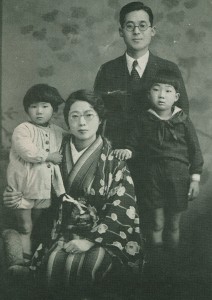
About tad

Retired United Church Minister. Born in Japan, came to Canada and worked in Vancouver, Lesotho, South Africa, Geneva, Switzerland, Toronto, Canada, and Montreal, Quebec. Married to Muriel Mellow. One daughter and two grand daughters.

B: RICH AND POOR – SECOND SUNDAY OF SEPTEMBER

RICH AND POOR

Proverbs 22:1-2,8-9,22-23, Psalm 125, James 2:1-10

September 10, 2000 by Tad Mitsui

An idealistic young man went to Africa. He wanted to bring light into the darkness and to educate natives to have a better living. He was appalled to see how poor people were. He was sure that the cause of their poverty was laziness. He saw a young man having a snooze under a palm tree in the middle of the morning. "Wake up," he said. The man opened his eyes and said, "What?" The man from overseas told him, "Get up and get to work." "Why?" "You can earn some money." "Money? I have enough." was the response. "But, if you have more money, you can eat better food." "I can eat what I like. There are lots of bananas and mangoes in the tree." "You can buy things with money." "What things?" "Nice clothes, furniture, and stuff." "Stuff? What for? I have enough stuff." "But if you have more money, you will have security. If you have security, you will have no worry. You can relax." By then, he was quite fed up. He spat out, "Relax? What did you think I was doing before you rudely woke me up?"

This story illustrates an old debate about religion and wealth. Which is more important; to have enough or to be saved? Should the church work to eradicate poverty, or to bring people to Christ to save their souls? The United Church of Canada has always been strong in Social Gospel. Many people in our church consider bringing justice to the poor people a Christian duty. The former Moderator Bill Phipps represents that section of our church. He believes in helping the poor and the suffering, and fight for social justice everywhere. Meanwhile Evangelical Christians, (there are many Evangelicals in the United Church too,) emphasized the importance of the spiritual aspect of the Gospel and accused the people like Bill Phipps of being too much humanist not enough Christian. But

the Bible is not much of a help to solve this dilemma either. Compare the difference, for example, in the Sermon on the Mount in Matthew and Luke. Matthew 5:3 says "Blessed are the poor in spirit." Here Jesus, according to Matthew, is speaking about people who are in need of spiritual fulfilment, not about people who are poor as such. But Luke 6:20 says, "Blessed are you who are poor." There is no mention of Spirit. In other words, Luke seemed to have heard Christ”s concern for the people who were poor. What do you do when you find such radically different versions of the words of our Lord?

Social activists love the Luke version of the Sermon on the mount, because it affirms their concerns for the poor people. Meanwhile, the Evangelicals find an affirmation of their belief in Matthew, because Jesus was concerned about spiritual needs, not material needs. But when you become familiar with the way the Bible tells you about the relationship between what is material and what is spiritual, you will find no contradiction between Luke and Matthew. Body and soul are one in the Bible. In other words, our religion does not see separation of spirits from the material. We express our spiritual values in the way we use material things. This is why we are willing to spend a fortune for someone we love. Love is very spiritual, and money spent for the sake of love represents that love. If you don”t know the spiritual values, you will never feel rich even if you are a billionaire, because you don”t know where the goal of your life is. So you don”t know when to stop. This is why so many rich people are still unhappy, because they feel they never reach the goal in life and frustrated. On the other hand, people who seek spiritual values often know how much is enough, and often quite happy with what they have. Remember the African man snoozing under the palm tree? Persons like Mother Teresa never owned anything in their lives, but they died happy, admired, and loved by many people.

This is why today”s scriptures, both the Book of Proverbs and the letter of James, are saying that the question of the relationship between a rich man and a poor man is not just an economic matter, but it is an important matter of our faith. This also means that the Bible is very much concerned about those people who do not have enough to enjoy decent living. The Bible never says, "If you endure the hardship of this life, you will be rewarded in heaven." Everybody is entitled to a decent living here and now. We all have responsibility to work for justice, so that everybody has go in earning a decent living. A work for justice is a spiritual work.

I end with a story told by a man who spoke about his experience of poverty. He said, "Three days ago my brother Randy died. Two months ago, my first grandchild Jacob was born. The holiness and the beauty of those two events are gradually sinking in. I"m sure I will never fully understand the mysteries in them. But the Spirit has been speaking to me. Jacob came to us in the poverty of birth. He was so small, weak, and naked. He was completely dependent on others. He had nothing but his need. But one day, soon after he was born, I lay down on the sofa with him asleep on my chest. I wept for no reason. I can”t explain. It was just overwhelming. I guess I was overcome at the wonder of it all. Like the poor widow who gave all she owned – a few copper coins, Jacob had no idea the size of his precious gift of love and trust and joy he gave me. And my brother too, there on the hospital bed, the morphine shutting down his eyelids, we spoke to each other from the poverty of his dying and the poverty of my grief. All I could say was, "I love you Randy." And from the pain-racked poverty of his dying, Randy gave the most precious gift he had ever given me. "I love you, too," he said.

Blessed are the poor, for theirs is the kingdom of God. They are so rich that they could give such a precious gift. They have nothing to give but themselves. So they give all they have – themselves. We should do the same.


A: SEEING GOD FROM BEHIND – THIRD SUNDAY OF OCTOBER

SEEING GOD FROM BEHIND

Exodus 33:17-23, Psalm 99, Matthew 22:15-22

October 20, 1996, by Tad Mitsui

I am fascinated by the image of Moses seeing God only in retrospect. Moses had his face covered when God Passed in front of him. A full view of God may be frightening, but the idea has fascinated the human race ever since its appearance on earth. The people of Israel also demanded to see God, because they were tired of hearing God”s plans only through a mouthpiece – Moses. But when they actually were allowed to be in the presence of God, they were terrified of the sight and the sound and begged to be spared of any further frightening experiences. Moses did not see God either. He only heard him. When at last he saw God, it was from behind. It was a rather limited view, you must admit. But it was enough to affirm the direction in which God was going.

Our society operates on the basis of "hindsight". We make choices consistent with past experience, based on known and already visible. It is more comforting that way. We resist change. In physics, this is called inertia. What is stationary tends to remain so and what moves tends to keep moving without changing direction. As a society and individuals we tend towards inertia. This is why we often reject visionary views of the future. We would love to know what future God has laid out for us, but are also terrified to know the truth. As hindsighted creatures, we can only cope with knowing so much. God alone possesses a complete foresight. Yet despite our limits, God keeps us moving forward, nudges us towards a better world, towards the kingdom of God. Our fear of change – of what the future foreseen by God may demand of us – is why we have often disliked and persecuted persons who had some sense of where God was leading.

Jesus was one of those people. He lived in occupied Palestine. When the Pharisees asked Jesus if the Jews should pay taxes to the Roman emperor, they were trying to trap him with a loaded question. If Jesus said Jews should, he was encouraging people to compromise their religion. But if he said they should not, he was inciting tax evasion and inviting wrath of the Roman authorities. For the Jews, it was a problem to use money which had images of the Caesar, because Caesar Augustus had decreed that he was a god. Caesar had claimed divinity in order to make his power absolute. The Jews naturally rejected that, because for them there was only one God: the God of Abraham, Jacob, and Moses. So they showed their rejection of the emperor”s claim for absolute authority by using traditional Jewish coins for their offering to the temple. But the fanatics argued that if they should remain good Jews, they must not use Roman coins even in business and commerce. So the answer Jesus gave was unexpected and ingenious. He told them to live like a good citizen while committing themselves to remain God”s people. This has been the norm of Christians in this world ever since.

To the extent that we are striving to be Christians by coming to church, we are distinctively the people of God, while living in this world just like any other people. We perform civic duties like any other citizens, but we keep our own unique values. We pay taxes and engage in business in the same way as any other persons do, using money with an image of secular authorities on it. But we do not worship that image. And this is the difference; state, business, and money are not absolute for us. In the mean time, we listen to the word of God, and try to live according to God”s merciful and just design. God”s ways are often different from the accepted norms of society. They are often inconvenient, and sometimes downright subversive to the existing customs and norms.

So people who follow the teaching of Jesus Christ seem a bit odd at times. Other times, they look outrageous or like fools. For example, why didn”t Jim Houden who willed so much money to our church, spend more money for his own pleasures before he died? We are surrounded by people, who did strange things like that, because they were Christians. No doubt, Jim Houden loved Howick United Church and its people. And I can understand why. But many ordinary people would not understand him unless they know what it means to follow God”s ways. Many prophets and saints not only were ridiculed by their contemporaries, but also were often badly persecuted. It was because they listened for the voice of God to tell them how things should be. They were ahead of their time; they knew things too early. They had strong sense of God”s foresight long before other people began to see the wisdom in divine visions.

Does this mean we can ignore the conventions and norms of this world in order to live according to God”s scheme? Jesus said, "No." He said that Caesar should receive what he deserved. Jesus said that because he believed that all authorities of this world should follow God”s path, even though they might be far behind God. Jesus did not believe in anarchy, though he believed that things must change according to God”s plans. We must live in this world as ones who know that things should change towards a better world. Yet we must not give up on this world. You must try hard to change it as a person who knows better, as someone who has glimpsed the direction in which God is headed. This is a tension we live with as ones who live in this world but know that there are problems that need solving.

As Christians, all of us live in this world with this tension. We are in the world but not of the world. We must pay taxes and give what is due to the state, but we do not completely belong to any country. Our real citizenship is of the kingdom of God. So we do not worship the image on the coin, even though we perform our civic duties by using that money. We do not believe that secular powers have absolute authority over us.

As people who have a sense of God”s plan for this world, we must constantly strive to move the world forward, towards God”s goals. Even if that glimpse of what lies ahead makes us uncomfortable sometimes. Seeing God only from behind seem like a limited view, but accepting that limit frees us from relying on "hindsight" alone to guide us. It is enough to give us an idea where God is headed – to turn our hindsight into foresight – and keep all the caesar of the world in perspective.

B: IN THE BEGINNING… – THIRD SUNDAY OF OCTOBER

IN THE BEGINNING, GOD…

Job 38:1-7, Psalm 104 , Mark 10:35-45

October 19, 1997 by Tad Mitsui

When we see good and innocent people suffer, and evil thrive, we feel that the world is unjust and God is unfair. Then, we must remind ourselves of two of the important articles of our faith. First, in the beginning when absolutely nothing existed, God was there. Secondly, this God is the same God who loves all of us no matter how small and insignificant we are. If we believe that, we will be able to put our view of life in this world into a proper perspective.

Confucius was a master of insight into the proper order of things. He once said, "It is better to be a head of a chicken than to be a tail of a cow." I could translate that to say, "It is better to be Mayor of Howick than to be a cleaning lady of the White House." But in a small community like Howick (population 300 you will realize very soon that to be Mayor means to be a servant, getting dozens of phone calls about the sewage system after midnight. When you read the Gospel story of a quarrel between James and John in the Bible, who fought for the right to sit next to Jesus, you will realize how silly it is to fight for a prestigious position. It also teaches us about a mark of leadership. Jesus said that to be a true leader was to be a servant. God alone is the ultimate leader. If we should follow God”s example for a leader, we must also remember that he took a form of a servant in Jesus Christ.

In the beginning, there was God. God alone is greater than all others, and everybody else is equal. That is to say, all are equal before the truth. It is said that one night during his campaign into Russia, Napoleon who was already the Emperor of much of the Western Europe, took a stroll around the encampment alone without any body guard. The soldiers were asleep in their tents. A sentry stopped him, "Halt. Don”t move or I will shoot." He was under a strict order to allow absolutely no-one to pass that point. "I am your Commander-in-Chief, Napoleon Bonaparte. Let me pass." said Napoleon, standing only a few inches away from the young soldier”s face. There was silence. Napoleon assumed that the sentry understood his predicament, so he was about to walk pass him. The young soldier aimed his musket at the emperor”s chest, "Don”t go any further or I will shoot." He looked as though he meant what he said. Napoleon was not prepared to risk his life by confronting a young man who was absolutely serious about performing his duties. The Private was praised by the Emperor next day.

Everyone, openly or secretly, wants to be ahead of others. But the world will be chaos, if everybody insists on being ahead of everybody else. Each one of us have to find our own place. We live in an inter-dependent world, where each person”s function has the equal value, though it is different from each other. A head is as important as a tail. Just like Napoleon found, we must sometimes swallow our pride and accept the directives from each other. You have to have an open mind, setting aside your pride and preconceived ideas. You have to, from time to time, listen to an unexpected and objectionable truth coming out of an unexpected source. It can be a child speaking to you, or can be a homeless street person. Sometimes such truths put us in our proper place.

Job didn”t like what he heard, when he finally had a chance to hear God speaking to him. But he found the truth about his place in the universe. He lost his wealth, his children, and his health. His wife urged him to give up his faith. His good friends urged him to confess his sins. They accused Job of committing some unspeakable sins to deserve such terrible sufferings. Despite all those physical, emotional, and spiritual torments, Job kept his faith in God. So he never stop asking God, "Why?" Then, at last God spoke to Job. God did not answer Job”s question. God asked him, "Where were you when I created the world?" When Job asked a question, God answered with a question. Not a very satisfying response! What a put down.

When you run into the passages like this, you must remember that you have to be honest enough to say, "I don”t like this." This is not unbelief. If you believe in God and take him seriously, you must be honest enough to ask questions and express your doubts and feelings. A loving relationship requires honesty. You can not build a house on styrofoam blocks. You must keep asking questions. However, you must also be humble enough to accept an answer you may not like. Truth can hurt and make you angry. But you must be humble and patient enough to accept truth you may not expect like the one coming from the mouth of your own child. Where was I when God created the world? I must say, "I didn”t exist." It is a realization that makes you feel small. But it”s the truth. The world can exist without you. It will continue to exist after you are gone. You may not like this. But it is a necessary step to see yourself on a realistic position in this world.

If you go to Insectarium in the Botanical Garden in Montreal, you can see many kinds of cockroaches from all over the world, big and small, alive and dead. It was a revelation for me to find that cockroaches had existed 150 millions years before Dinosaurs appeared on this planet. Dinosaurs dominated the earth for 350 million years together with plants related to the ones we know as ferns. Those plants and dinosaurs are now extinct. Their fossils are found today in the forms of coal, gas, and oil. But cockroaches outlived dinosaurs, are still with us today, and may outlive us. When you consider the fact that human beings have existed on this earth less than one million years, you must begin to look at cockroaches with respect. Most importantly, they make us realize our smallness in a big picture, the shortness of our span of domination in the eons of time.

If, God forbid, we human beings manage to destroy this planet because of our greed and our unbridled exploitation of the earth, our brief existence will be remembered in the history book of the universe as an insignificant hiccup. On the other hand, when we realize our seemingly insignificant existence, we will truly appreciate enormity, breadth and depth of love of God. God, who was here in the beginning, before anything else existed, before dinosaurs and cockroaches, is the same God who loved us so much that he sent his own begotten son to die for us to save us.

God told Job how things are. We may not like to hear what Job heard, because it makes us feel so small and our daily concerns so insignificant. But if we feel that way, we must also remember that it is the same God who loves us infinitely. We may be able to forget about the silly rat race to be on top of others, and start respecting all creatures large and small, starting with our friends and relations, and our neighbours.


B: DOES GOD ALLOW SICKNESS – FIRST SUNDAY OF OCTOBER

DOES GOD ALLOW SICKNESS?

Job 1:1, 2:1-10, Psalm 95, Mark 10:13-16

October 5, 1997 by Tad Mitsui

When you are sick, often you find that emotional questions trouble you more than the question of what ails you. Anxiety, guilt and damaged self-esteem is more serious than the actual sickness. I have recurrent migraine headaches. When I have a migraine, I feel useless and guilty staying in bed for a whole day. These feelings are worse than the headache itself. When we are seriously ill, we suffer as much from what illness does to our self image and sense of security as from what is does to our bodies. We often ask the meaning and reason for our sickness. I don”t think other animals ask such a question. When you ask "why", you are asking spiritual questions. The book of Job asks why we suffer.

The book of Job belongs to a category of old Hebrew scriptures that are called "Writings". Books like Job, Jonah, Ruth, Esther and Psalms, which belong to this category, are stories and poems written by people, who were seeking God”s plans in their lives. Because of their origins, it is OK for us to appreciate their good points, challenge some others, and sometimes say, "I don”t agree." The author of Job teaches us many important lessons about faith. But in the end, I, for one, don”t agree with his conclusions. I rather take the position taken by Jesus Christ, which is different from Job”s.

You see, the author of Job interpreted life as a stage where a contest between God and Satan took place. The story has it that God was proud of faithful Job. But Satan challenged God by saying, "Job is faithful to you because he is happily married, has good and hard working children, and is wealthy and healthy. But if you take away those good things from him, he will betray you." So they had a contest. God allowed Satan to take away the good things, one by one. After losing everything, Job contracted an ugly disease. His body was covered with boils and scabs. His wife thought that her husband was a fool, and told him it would be better to "curse God and die." But Job remained faithful to God. So God won the contest with Satan.

I don”t agree with the suggestion of this book because I don”t believe God, who loves us, will ever treat a person like a football in a game with Satan. God, who became like one of us and suffered for us, would never treat us like a pawn, a chessman, or a football. I wonder if the presence of Satan in this book is really the presence of our own self-doubt and frustrations with sicknesses that limit our energies and plans. Looked at in this way the contest that the book of Job teaches us about is not a contest between good and evil but a contest between our self-doubts and our faith in God”s love for us. The book makes clear that Job, who in the end accepted his suffering as the will of God, did not give up easily. He kept demanding an answer, pointing his finger at God and saying, "I did not do anything wrong. I never betrayed you. Yet you make me suffer so much. Why? Why? Why?" I do admire Job”s determination in asking questions. He never gave up, while many of us just give up and fall like a dead leaf. Job teaches us about the uniqueness of being a human. We ask, "why?" Animals don”t ask such questions. They just take whatever comes. Job”s refusal to stop asking why, shows his continued faith in a God who will respond despite all his other losses, Job did not lose his self-esteem and sense of being a valued child of God.

Buddhist philosophy stands in marked contrast to the lessons we might learn from the book of Job. Buddhism is based on the idea of "giving up" as the best way to solve of life”s problems. The founder of Buddhism, Gautama Siddhartha, knew that life was full of misery and suffering. As a wandering monk he searched for a solution to misery and suffering. After many years of search, he reached the conclusion that all sufferings came from desire. All suffering would disappear when we were free from all cravings. In other words, we must not expect anything from life and accept whatever comes to us as fate. Then we will no longer suffer. This is a philosophy that teaches people to accept suffering without asking questions. Job would make an bad Buddhist.

To accept suffering without asking questions can lead to a kind of fatalism that is damaging to ourselves and to others. To not ask why, means we may fall into the trap of seeing ourselves as our fault. Guilt is an enormous barrier to healing. To view our sickness fatalistically can also lead to discrimination against others. This is how our society justifies discrimination against mentally ill people, people with AIDS, and people with the kinds of sickness that generate feelings of disgust. We think that there is something wrong with them and they got what they deserve.

People in the Bible had a similarly fatalistic attitude towards the sick: they thought that lepers and mentally sick people were cursed by God. They made those sufferers outcast of society. This is why when Jesus touched and healed the sick people – those untouchable, it was a shocking incident. He refused to accept suffering as unchangeable. His miracles were the expressions of his concern towards people who were suffering. They were also a response to people who actively sought his help. Like Job who continued to demand an explanation from God, these people believed that their suffering was not the end of the story. From this, it is clear that God does not want anyone to suffer. He cares about us when we suffer. He expects us to have the same attitude towards sick people as Jesus did.

I can not tell you why God allows sickness. The Bible does not give a clear answer. But what is clear is that God does not expects us to accept suffering fatalistically – either the suffering of others or our own.

The book of Job reminds us that to question is to be human. It also teaches us that we must continue to believe that there is a God who will respond even if it is a response that we are not comfortable with. God does not play games with us. As Christians we have faith in a God who reaches out to us in our suffering. Believing this, not just patiently but persistently, means we may just hang in long enough for a miracle to happen.


A: WE ARE BORN-AGAIN CHRISTIANS – LENT 2

WE ARE BORN-AGAIN CHRISTIANS

Genesis 12:1-4a, Psalm 121, John 3:1-17

February 28, 1999 by Tad Mitsui

One day, a man asked me in a cafeteria, "Are you saved? Are you born again to Christ?" I said, "Yes." The he said, "When?" I said, "Everyday." It is a pity that some perfectly good expressions like "born again" get used as labels and the original meanings are changed or lost. "Evangelical" and "Born Again" are expressions that have become labels for some particular groups of people. But if we believe the Bible, we are all born again Evangelical Christians. I feel that we must reclaim those names as ours as they are used in the Bible.

The Christians, who live in the so-called non-Christian countries, have a tendency to idealize the countries like Canada which are considered to be "Christian" countries. A Japanese Christian came to Canada to attend an interdenominational meeting. He was shocked to see quarrels between "Evangelicals" and "Liberals", Presbyterians and United, Catholics and Protestants, etc. He was disappointed to find that Christians fought in Canada too like Japanese do at home. Someone asked him, what he was. He said, "I”m a Christian, and I thought you all were."

We are Christians before we are Baptists, Catholics, United, Presbyterians, or whatever the label we put on. Furthermore, we are "Born Again" Christians according to today”s Gospel reading. In the Gospel according to John, you find that the expression "Born Again" was first used by Jesus. He said that no one could be his follower and enter the kingdom of God unless one was born again. By this definition, we all are, or should be, born again Christians. The story has it that one night a prominent Pharisee leader by the name of Nicodemus came to see Jesus. He said, "Teacher, I know you come from God. No one can do what you are doing unless one comes from God." Jesus said to him, "If you really want to follow God”s way, you must first be born again." This really threw Nicodemus off balance, because he was a man of reason. "Born again? I am a grown up man. I can not go back to my mother”s womb." He was a man who used the brain to think. He was a scholar. Reason was the faculty he valued. He was not used to be confronted with things that made no logical sense. But he came face to face with the fundamental fact of faith; faith is the matter of both spirit and mind. He had to integrate reason with passion to start afresh in the life of faith – to be born again in spirit.

It is not easy for a person who has a superior mind to give oneself to emotion or passion. One is afraid to look silly. This is why Nicodemus came to see Jesus at night. He was the leader of the scholarly and righteous lawyers who took it upon themselves to be the watch dogs of the nation”s moral standards. He knew that Jesus was a very special man. He could tell that Jesus had to come from God, because Nicodemus was a God fearing righteous man. But his cool reasoning prevented him to make a leap of faith. He could not be seen as acting in a hasty manner, especially about a matter of national importance; people were calling Jesus the Messiah – the true king. He had to be careful. So he came secretly. But faith must involve a whole person. The whole person includes feelings, emotions, passion, and can be creative and impulsive, in addition to a cool mind that calculates and reasons. Faith requires both attributes, because faith requires a whole person. A whole person is a person who draws on both mind and spirit.

Dr. Helen Caldicot is a paediatrician who became famous in a movement to stop the spread of nuclear weapons during the height of the cold war in the eighties. She was once asked why she was so emotional when she spoke about the danger of nuclear weapons. The insinuation was that "Emotional people are not credible because they are not reasonable. Women are often emotional. Therefore they are not credible. If you want to be heard, stay cool and speak with reason. Be like a man." She answered that ”Yes, I am emotional about this. I am a woman and a mother. If my patient does not get emotional about the future of her child, she is mentally ill. I ”ll send her to a Psychiatrist." Any good parent is both emotional and reasonable about one”s own child.

This also means that faith is not complete if passionate belief does not seek reason. Our minds are God”s creation, as much as our spirits are gifts from God. Faith has to grow in mind and spirit, even when faith comes into our life through emotion and passion. And faith has to be fed with reason as it grows. Faith does not stay alive by passion alone. Sometime those who believe with passionate faith criticize those people who study the Bible scientifically, and examine our beliefs systematically. But those people too must be born again to integrate their passion for God with reason and scientific logic, because faith involves the whole person. And a whole person is a person with both passion and reason.

Abraham was already a rich man when he was still in the land of Haran, the present day Iraq. He had tens of thousands of heads of livestock of all sorts and an army of workers within his household. He was almost like a head of a nation. But one night, he had a vision. God spoke to Abraham and told him to pack up all his household and move. God did not tell him where to. He just said, "Pack up and go." The Bible says that Abraham went without knowing where he was going. Perhaps it was because he didn”t know where he was going, that he went so far. It was a totally irrational thing to do for a successful farmer and businessman who made virtually billions of dollars. It was not a rational decision. It was a decision made from the heart, out of his passionate trust in God. He was ready to start afresh. At that point, Abraham was born again into faith, both in mind and spirit.

We are also called upon to be born again. Made afresh today, tomorrow, and many more times to be born anew. There are some people who can pinpoint the time and the day when he/she was born again. But we are all very different. For many of us, like me, the process of being "born again" is a quiet process that repeats itself many times. I try to live everyday like a new person, refreshed by the belief that God loves me. We have to be born again, again and again. Sometimes, God will help us with an inspirational or emotionally high experience. After those experiences, we must settle down and become stable with reason, like a bowl of hot jelly cools and settles in a fridge. At other times, our cool rational belief system has to be shaken, perked up, and refreshed with stirring hymns or by the love of a friend. In either case, we are born again as a new Christian person.


C: EASTER AND STAR TREK

EASTER AND STAR TREK

John 20:1-18

A week ago last Saturday, two very important things happened on the new Star Trek series : Voyager. When two ugly but very scientifically advanced life-forms were beamed up and arrested, Captain Janeway was ready to kill one of them in order to recover the lungs which they stole from one of her crew members – Neelex and had used in a transplant operation. But she discovered that these life-forms were being driven to extinction, because of some virus which was destroying their organs. So what did Captain Janeway do? She decided to let him live and go. I don”t know what she was going to do with the dying crew member, who was being kept alive on a life-support system. The story never said. The second clip was about a crew whose lungs were stolen, thus he was on the verge of certain death. He was prepared to die, but didn”t because a woman offered to give one of her lungs to save his life. The story never made it clear but she had some special attachment to this particular crew member.

What did I get from those stories? Compassion and love win at the end of the day. Despair and hopelessness do not say the last word. We don”t know how it works, but love leads us to go beyond what looks like the end of all possibilities.

Mary Magdalene loved Jesus dearly. The Bible makes it quite clear that for Mary, Jesus was her life. So when he died on the cross, her life was also gone. She was in despair. Nothing mattered any more, there was no hope. Anyone who lost a loved one knows this. When my father died suddenly when he was 50 and I was in early twenties, I thought that the whole world came to an end. It simply was not possible to think of any future without him. Death in this case was more than physical end of brain or heart activity, and the beginning of the process of decomposition of our physical bodies. Death here means an absolute hopelessness.

So Mary was sitting outside of the cave where the body of Jesus had been brought in, and crying. What else was there to do, there was nothing in her life any longer. She asked two men to come, hoping that they would do something to recover the remains of her beloved teacher. But they went away as though they could solve the emptiness in their lives by being busy. We men often do that. But Mary stayed by the empty grave. What was she hoping by doing that? Nothing. She had no other thing to do, because life was impossible without him.

And he came, Jesus. She saw him. But she thought that he was a gardener. A person without any hope can not see what really is. She looked at him, and they even exchanged a few words. But she could not recognize the man in front of her as the dead beloved teacher, who came back to life. Despair inhibits the ability to see reality. Then he called her name. A very personal way to remind her of the nature of their relationship. And at last she recognized him. We parents all know that there is some unexplainable but special quality in the way your child calls you. My daughter is a grown woman. But she still calls me, "Daddy". Maybe its childish. But every time any body calls his or her father "daddy", I always have hard time controlling my tears.

There was no more despair. He was alive. How? We don”t know. We may never know how Jesus came to life again. I don”t think it matters. The main thing is that for those who loved him and owed their lives to him, they saw him and believed that the evil did not have the last word on their beloved teacher. He is risen, and lives among us.

It was obvious that Jesus came back from the dead beyond what we normally understand as physical realities. Perhaps, He came back in a spiritual form. So he walked through doors without opening them, appeared in many places at the same time. But you can not dismiss it, simply because it can not be proven scientifically, or does not fit our normal definition of what”s possible. That”s nonsense. The problem of today”s world is that many believe that spiritual world is less real than the scientifically provable world of facts. I believe that our society is sick because people dismiss the spiritual world less important than the world of science. We dismiss affection, love, beauty, joy and despair, goodness and evil as less than real. We must realize that this kind of common sense is the core of our problem.

But because Jesus loved each one of them, he came back and showed his love in a very personal way. For Mary it was calling her name. For a scientist like Thomas, he offered a physical proof. Thomas is a very modern man. He doubted everything, until it was proven with undisputable evidence. So Jesus said to Thomas, "Touch me, if you don”t believe me". For other disciples, that was not necessary. They sensed he was alive and this alone gave them new hope. Why should anybody need further proof? If you have to keep on giving expensive gifts to prove your love, love in that relationship is dead. True love does not need proof, it only needs to be expressed. So Jesus was sorry that Thomas needed proof. Jesus said, "Happy is the person who can believe without seeing and touching." But because Jesus loved each one of them in uniqueness and in their idiosyncrasies, he offered Thomas proof of this victory of love.

Mary saw risen Jesus beyond despair. Thomas saw Jesus which should have been impossible according to common sense. Star Trek may seem like a long way from the Easter story. But in both cases, Easter and Star Trek, we come to the same essential truth. Love leads us to go beyond what looks like the end of all possibilities.

Christ is risen! Hallelujah!


C: SEARCHING THE LIVING AMONG THE DEAD – EASTER

SEARCHING THE LIFE AMONG THE DEAD

I Cor. 15:20-26, Psalm 118, Luke 24:1-12

and John 20:1-18

April 19, 1998 by Tad Mitsui


There was a man, a lonely man. He was a senior civil servant in a city hall. His burning ambitions, passionate love, and sweet dreams all failed him, with nothing but bitter disappointments, a broken heart, and cynicism. He now lived by the recipe for a successful civil servant: "Never miss work. Never late to work. Do nothing." At forty-eight, he was only looking forward to retirement and time looking at his stamp collection. One day a doctor told him that he had only a few months to live. Despair and hopelessness overtook his life; he became pickled in alcohol.


One morning after a night in town, he found himself waking up on a strange bed in what looked like a shabby rooming house. A child brought him a cup of coffee. She was selling roses in the bar last night. Her mother had already gone to work, she said. He watched the girl playing with a cheap stuffed monkey he gave her. He picked it up somewhere in his drunken stupor. He was moved to see how the girl was absorbed in the play with the cheap dollar store stuffed animal. She looked utterly happy talking with a monkey in her pretend home. She looked so much alive. It was her very first toy in her entire life. He realized then that he was with people who lived in a slum area of town. A few years ago, the residents of this area asked the city to provide a playground for children. Their petition was sitting in his file for years. He had had no intention to do anything about it. But that morning, he became a changed man. He was late to work, because he had to look at all possible sites for the playground, before he got to the office. He ordered the Parks Department to draw up a plan and make a cost estimate, immediately. He encouraged the residents of the area to organize themselves and start lobbying the mayor and the key city councillors. He pestered his superiors to move things faster. He stepped on far too many toes and annoyed everybody. They thought that his thus-far-safe career in the city hall was ruined.


On the day of the official opening, the mayor came, gave a speech and cut the ribbon. After everybody went home, the now-very-sick man and the girl were on the swing, swinging back and forth, singing the old Japanese favourite, "Life is short, let us fall in love." Everybody remembered "that man" in the city hall, whenever they came to the park. Death made him more alive in people”s mind. But nobody remembered anything he did during his twenty-five year career in the city hall before the playground.


The resurrection of Jesus Christ tells us that there are some dead people though may be dead, can still be very much alive and continue to communicate with the living. On the other hand, a person may be biologically alive, but is, in truth, as dead as the dry bones. We believe that our Lord Jesus Christ was the first person who died physically, but is very much alive among us today.


The Jewish people believed that at death absolutely everything was over. Many people do not realize that the ancient Jews did not believe in the life after death. Life after death was an ancient Egyptian belief. Read the Old Testament carefully. You will not find the notion of life after death in it. At death one entered into nothing – void. This is why the Hebrew word "Hell" in the Old Testament is the same word for "Death – sheol." Because life ended with death, they treasured this life very much. They tried to live life – here and now as fully as possible, because to them this life was their only chance. So, they tried very hard to live this life in the best way possible. They enjoyed all the pleasures of life with gusto. But also they tried to do it right so as not to waste it. This was why the law became the very important guide to them.


This was how they came to the conclusion that the life that was wasted without joy and without purpose was not worth living; you might as well be dead. Also they decided in the same logic that sin was the same as death. Life is so precious that it had to be lived correctly and fully. Authentic life and death were not the same as biological life and death. Jesus Christ was the first fruit of the authentic life that did not die with biological death. He loved people completely. He enjoyed life, too. You notice how many times the Bible mentions about Jesus at the banquets, and about a dinner in his parables. He knew how to live fully and joyfully by loving people absolutely.


It is ironical. Isn”t it? Because he loved people unconditionally, he had to die. The society could not tolerate such love. So the people who had vested interest in the existing system had to kill him. People who hold power hate changes. But because Jesus truly lived by loving others, death did not have the last word. We can not prove this scientifically, but we know he is alive today. In Jesus Christ, we find a genuine life that travels back and forth between the biological divide of life and death.


There is not much point looking for the living among the dead. Mary came to the tome to embalm the dead body. But she did not find it. She was weeping by the empty tome. She didn”t know what to do; she was lost. It was only when she turned around in the direction of the voice of an unknown person, she saw a life truly living – the life that was not defeated by sin which tried to exterminate love; she met the risen Christ.


In the desert of the Western Sudan, many women and children were trying desperately to eke out meagre living on the perched dry sand. Their husbands and fathers are either missing or dead during the two decade long civil war. But life goes on despite the stupid greedy and power hungry men who don”t want to make peace. Men, who are determined to keep fighting for power, caused the two decade long civil war, which gave people nothing but misery, poverty, and death.


Women used to cultivate land when they were living among the green lush hills and fresh water lakes of the Southern Sudan. Now the dry sand of the refugee camps in the Sahara desert does not allow them to grow food as they used to at home. Only way they know how, to make a living in such a situation was to make beer out of sorghum and sell it. There are many thirsty men who buy it, though it is illegal under the Islamic law to consume alcohol. The prisons are full of women who were caught selling beer. So the church has been teaching them the different ways to make living; making soap out of palm oil and crushed lime stones, tie and dye cotton material, and sewing clothes. The church has a rotating loan fund providing them with money to buy sewing machines and start up their own businesses. Some of them started to crush peanuts into butter while waiting for customers and sold them besides dresses and materials. Others collect frankincense in the desert and sell it besides their tie and dye. Their children are now fed and have change of clothes now. There is life in the desert. Children are laughing and running in the dry land.


Jesus conquered death, not in the battle ground or in the forum of politics, but by loving people absolutely. That”s why Jesus is alive today, tomorrow, and forever. Hallelujah!


A: HE IS NOT HERE – EASTER

HE IS NOT HERE

Matthew 28:1-15

Tad Mitsui, Easter, 1996

One day, I ran into a crowd of people who were watching a dead person being dragged out of the water. It was a long time ago. I was on the way home from school. At first, I was afraid to look. But curiosity got the better of me, and I joined the crowd of spectators. It was not a pretty sight. Suddenly there was a shriek. A woman was running down the river bank. She grabbed the body and hugged the lifeless figure, while she cried aloud. She could have been the mother, or maybe the wife. Whoever it was, it was obvious that the drowned person was someone special to her. I felt ashamed, watching this tragedy as though it was a spectacle. For those who did not know the man, it was just another dead body. But for the woman who loved him, it was an entirely different experience. It was the body of a person she loved, from whom separation was an impossible nightmare.

We can not understand resurrection, unless we love someone dearly. We can not understand resurrection unless we know that there is difference between the spiritual body and the mere physical body. We can not believe in resurrection, if we think that we are just flesh on some bones. But when we recognize spiritual elements of our existence as reality, we will be transformed into another being. When I became a father, for example, it was a spiritual experience. When I saw my daughter for the first time, she honestly looked to me like an ugly lump of flesh. But soon a something hit me inside. The realization engulfed me; it was my own child. That same lump of flesh was transformed into a being with an entirely different significance. She had become someone who would always remain an integral part of my being and for whose safety I would even exchange my life.

When we speak about the resurrection of Jesus Christ, we are speaking about this special aspect of life, which turns a mere physical entity into a precious being with infinite significance. When two women, both called Mary, came to the tomb to put spice and ointment on Christ”s body, they found it empty. An angel told them that Jesus was not there. He had risen and went to Galilee. The angel also told them that there was no use looking for the living person among the dead.

When you love someone, there is an added dimension to the physical body of the one you love. That extra dimension goes beyond this visible world. When someone you love dies, for you, this person changes appearance. It is difficult to adjust to the new manifestation, because your love has been attached to the physical body you became familiar with. But soon you will know that a spiritual existence lives on, even though it is not visible in this world. Even if your memory fades, spiritual life goes on in God”s love. This is how we believe in eternal life. Eternal life is the life that lives on in the realm of God”s loving care. Science says that there is no evidence to prove that there is spiritual reality, and that life goes on in another form. It does not matter what science says, because science deals only with the physical aspects of this visible world. We know that there is a lot more to our existence beyond the mere touchable and visible reality.

So if you look for loved ones only in this visible world, there is no end to grief. The angel said to the women at the tomb, "He is not here. He went to Galilee." In other words, there is no use looking for the living person in this perishable world. He went ahead of you to your home in Galilee. Some students of the Bible suggest that Galilee traditionally meant a frontier, beyond which there is an unknown territory. It was not the known world of politics and religion like Jerusalem. He went to the frontier, into the future, in his new form of life. Jesus was the first one to put on this new life. When Mary said to the dispirited disciples, "I have seen the Lord.", she was testifying to the new form of reality. It was a spiritual experience but real. I can say it was real, because that is the only explanation for how a group of people in absolute despair suddenly turned into a band of brave, even reckless, evangelists, people who dared to talk about the one executed for blasphemy as Messiah.

You can not mourn the dead for ever. You have to get on with your life and venture into the future, into an unknown territory of living. Then you will find your loved one there – in the future. He has preceded you to Galilee – to your future. It is difficult to forget the body which the loved one used to wear, because that is what you knew. But the real person you loved has simply changed into another attire and has preceded you into the future.

When risen Jesus appeared before Mary Magdalene, she first thought that he was a gardener. It was only when he called her name, she realized that it was her master, the one she loved dearly. The shriek of a woman changed an ugly drowned body into someone”s loving husband or son. When I saw my own daughter, first I only saw a lump of flesh, until magic of love triggered a whole chain reaction of mind and emotion to make me realize that it was my own flesh and blood. It is only when a gardener changes into Jesus Christ, that the spiritual body becomes visible to us. Death is not the end. It is a door into another reality, into the spiritual world. Jesus Christ is not here. He is no longer with us in this perishable domain. But He is risen and lives with us for ever.

A: LIFE IS NEVER SAME – EASTER

LIFE IS NEVER SAME – EASTER

Acts 10:34-43, Psalm 118, Matthew 28:1-10

April 4, 1999 by Tad Mitsui

The changes that happen to human bodies between twelve and sixteen years of age, are exciting ones. Boys are transformed into young men, and girls into young women. Voices change, beards start to sprout. Curves develop where there was none before. Some changes may be embarrassing or even scary. But we know those physical changes are normal – not just normal but they are exciting and wonderful, because they tell you that you are growing up into a whole new world. We must celebrate those and many other signs, because your bodies have begun the preparation to join the grown-up society.

There are other big and normal passages into different stages of our lives. A fetus leaves mother”s body and changes into a baby, a child into an adolescent teenager and into full adulthood, and an adult into a senior and eventually into a next stage of life through a passage called death. There are also small changes that happen all the time in the normal course of life. New cells are born and old ones die in our bodies every second by the billions. We get rid of dead cells little by little, whenever we take a shower. Butterflies, dragonflies, and snakes shed their old skins only a few times in their lives, but we get rid of old selves bit by bit every second, everyday. Our bodies are completely new every three months, if you speak about them only as cells and their chemical components.

Life is like a river. It is never the same, and that”s normal. You wish that an adorable and cute a year old baby stays the same forever. Never mind, it will soon turn to be a little devil of a terrible two. When your daughter – a little princess – treats you like you are the most precious thing in the world, just wait a few years until she turns to be a teenager. She will treat you like a public enemy number one. But that too will pass. Life moves on.

When two women, both of them called Mary, went to the grave where Jesus had been laid, they could not find the body. They were told by the angels, "He is not here." Don”t look for a live person at the same place. He is not there. A live person moves on. That is the message of Easter. Jesus went through the passage of death, and moved on to another phase of his mission. And he showed us that we have nothing to fear from change; transformation is always about discovering new life. Death is never the end of the story. So, let us not mourn the passing of the old. Let us celebrate new phases of life, even if it is old age, or even death, because it is a normal passage of life.

This is why the church has a celebration for every passage of life: Baptism, Confirmation, Marriage, and Funerals. I personally think that there should be more, maybe once in every ten years, because all of us keep changing through out our lives. We welcome babies into a community through Baptism, and promise to support the parents to bring up the new born in the best way possible, the way of Jesus Christ. We welcome adolescents into the adult community by receiving them into full membership of the church. We mark those passages of life and celebrate them as a community.

But life goes on. It means there will be many twists and turns, ups and downs, happy and sad, easy and difficult. Children leave home, and people may quit the church. But you must remember, Christ is alive and lives within you and me. No one will ever be able to be separated from the love of God in Jesus Christ. God bless you.

B: PASSAGES – METAMORPHOSES – EASTER

PASSAGES – METAMORPHOSES

Isaiah 25:6-9, Psalm 118, John 20:1-18

Easter Sunday, 1997 by Tad Mitsui (Confirmation Service)

They say, cats have nine lives. But when we think of the changes we go through in our life time, we also have many lives. We may not change our appearances as much as an egg does when it hatches into a yellow baby chick, and then grows into a full grown chicken. But when you pull out some old pictures of yours, you realize how much you have changed. These big changes in life are called metamorphoses. Those people who confirmed their faith and joined the church today are making a lot of changes. They may not realize it, but even in those five short months of confirmation class, they grew up so much. From birth to death, all of us go through many transformations, almost as often as once in every ten years. And we call each period of time of change a passage. The message of Easter is that death is also a passage, not an end to life but a metamorphosis. Jesus showed us the way through a difficult passage called death, making our transition from mere physical existence into a state of spiritual being.

Passages often feel like difficult tight spaces to go through, which we must pass. When I am not well, I often have a nightmare of a dark, endless and narrow passage like a tube where the air is tight and suffocating. I awake gasping for air. It is frightening not only due to the fear of suffocation but also for the fear of unknown at the end of the tunnel. I don”t know what”s out there, and that”s scary. Psychologists suggest that at some level we remember the first passage we go through in our journey into the world; from our mother”s womb through the narrow, dark, and suffocating tube into open air. We usually do not consciously recall this because it is too scary to remember. We forget something we don”t want to remember. But our body remembers – so it comes back in bad dreams. After the birth passage, we go through other difficult new experiences in the first few years as a baby. Babies cry a lot, because often they don”t know what”s happening. And that”s frightening. When they are hungry, they cry because they don”t know why their tummies hurt. When they are wet, they cry because they don”t know why they have that yucky feeling on the bottom. When a baby cries, it is calling you to pay attention. It is a God”s call to love.

Puberty is another difficult passage of life. Between the ages of ten and fifteen, we go through incredible amount of change, in our bodies and in our mind. I remember I stumbled a lot because I had not realized how fast I was growing up. Friends begin to look more important than parents, though we are still very much dependent on them. Suddenly you become aware that people begin to pay more attention to you. You don”t realize that you are more attractive in appearance. You are like fresh bread just out of oven. And the attention people give you is not necessarily the kind you want. It is a difficult time.

When Jesus was twelve, he proved to the parents that he was growing not only in height but also in spirit. The mind begins to work differently at that age. Jesus and his parents went to the big city of Jerusalem for the spring festival of passover, which for us is the same time as our Easter. When they started to head home, they lost Jesus. But they did not worry. He was a big boy now. He had begun to spend more time with friends and grown-ups. They travelled looking for him among friends and relatives who were also going home. They could not find him for three days. Now they were really worried. So they went back to Jerusalem. After a frantic search of the city, finally they found him in the temple. He was talking with teachers of the Bible and the law. They were so fascinated by the young Jesus who had so much to say about religion, that they kept him in the Temple for three days talking with him. Jesus said to the parents, "Why are you worried? Don”t you know I am in my father”s house?" When you reach twelve or older, mere facts and figures alone are not as interesting as they were when you were younger. But now you want to know the meaning of things. The factual world is not enough. Also openly or secretly, you begin to be more interested in the other sex. Relationships are suddenly very important. Your interest has shifted to what is emotional and spiritual. So you ask "why" more often. You are now ready to enter into adult world just like Jesus was when he was twelve.

This is why in many cultures, the special training period for young people entering adolescence is important to prepare them for the shock of adulthood. The end of this training period is celebrated with gusto. It is important to mark this period of passage, because it is important for them to feel welcomed by a community of people who care for them. The adult world they are preparing to join is not an easy place. They must know that there are people beyond family, who have same values and same outlook in life. They must know that there are people who share happiness, and help you and support you in times of trouble. It is a way of God to tell us that he loves us. Schools do not do this.

I wish there were more celebrations of our lives” passages. Not only baptisms, weddings, and birthdays, but also occasions to acknowledge and show support for our friends and loved ones when they go through a mid-life crisis, or serious illness, separation, or retirement. They are difficult times and important times. In all those passages, we change, just like a butterfly in its different stages of development. We must have a community to celebrate together and affirm together the fact that God loves us. The community of faith is a group of people who stick with you no matter what. When we live in such a community, even death can become believable as another passage of life just like it was for Jesus, who came back from death and promised to live with us forever.


B: FRUSTRATION AND JOY OF IN-BETWEEN TIME – OCTOBER 1

LOOK UP. WAY UP. THERE IS A RAINBOW.

GENESIS 9:8-17, PSALM 25, MARK 1:9-15

October 1, 2000 by Tad Mitsui


I moved quite a few times in my life, and worked in different places and in several countries. From that experience, I can say that it takes two years before one can start working effectively in another place. In the first year, you notice and only hate the differences from the place you lived before, and remember how good things were. In the second year, you begin to forget the old and begin to appreciate the new place. The third year is the time to start functioning effectively living in their language and loving the food. You don”t have to hate or forget the old ways. Your past is what has made you what you are, and without it you lose your sense of identity. The secret to a successful transition is seeing beauty in both the past and the future. Rainbow is a fitting metaphor for such a time.


A rainbow appears in an in-between time, as the sun comes out when the rain is not quite finished. It is beautiful, because the interaction between rain and the sun brings out all colours of the sun separately. After the flood, God showed Noah a rainbow as a sign of hope. Today, we are living in between times. We are still living partly in the past, though it is passing. And we are moving into a time zone we have never seen. It is not an easy time. However, the message of the rainbow is that the time in between times can be beautiful, bringing out the grace of the past and the hope of the future. It is a time to remember and appreciate the old times and hope for the better times in future. Old ways do not work any more and new ways are so new that we are not quite comfortable with them. Often we hate the new ways or are scared of them. Religion seem to be on the way out and the church seems to be on the decline. Families do not look the same any more. However, we must realize that the notion of the "good old days" were not always so wonderful. If we remember how we used to live and work, we are living better today and enjoying things that we had never believed possible even a few decades ago. Times are definitely better today in many ways. We suffer today because we live in a time between times, and not so much because we don”t live in the so-called good old days. The good old days were not as good as we want to brag about.


Noah and his family lost everything they owned in the terrible flood. But eventually the rains stopped and land became dry. Standing in the middle of vast devastation, Noah and his family were lost and asked themselves, "What now?" They did not see that the future was theirs to make. All they saw was enormous uncertainty. They could see only the vast wilderness of chaos and wrecked humanity, and could not look up to see a beautiful rainbow of hope and possibilities of the future. Noah was a good and righteous man. But he had difficulty coping with a normal life after the experience of terrible calamity and trials. Noah had difficulty coping with an enormous potential offered by future. After the first harvest, Noah became uncontrollably drunk. He lay naked on the ground and fell asleep. His sons were so ashamed of their father and walked backward towards him trying not to see their father”s nakedness in order to cover him. Time inbetween times was difficult for Noah. Even he had a hard time coping with the first bumper crop.


It is important to remember the past, appreciate it and learn from it. But also it is equally important to let go of the past and move forward into the future, hopefully, and joyfully. Neglecting either of those times will cause disasters. When the past is good, one wants to remain in the past, basking in nostalgia, and does not want to look into the future. This situation creates a person who refuses to grow up. On the other hand, when the past is bad, one wants to forget it as fast as possible and run as quickly as one can into the future. Such a person is condemned to repeat the mistakes that caused the disaster, because this person does not know how to learn from past mistakes.


Jesus saw the rainbow of the covenant of God, when he was tempted in the wilderness. Satan offered some self-serving options for him. Money, power and popularity were attractive options for many past leaders. Jesus rejected those options. He saw God”s options differently. Jesus lived the life dedicated to others. The other end of the bargain for us in this covenant was our pledge to take care of God”s creation by loving our neighbours and taking care of this world. Let us come together to renew our promise to build and maintain the community of caring and sharing. Let us see a rainbow and celebrate it.


A: WE ARE BORN-AGAIN CHRISTIANS – LENT – 2

WE ARE BORN-AGAIN CHRISTIANS

Genesis 12:1-4a, Psalm 121, John 3:1-17

February 28, 1999 by Tad Mitsui

One day, a man asked me in a cafeteria, "Are you saved? Are you born again to Christ?" I said, "Yes." The he said, "When?" I said, "Everyday." It is a pity that some perfectly good expressions like "born again" get used as labels and the original meanings are changed or lost. "Evangelical" and "Born Again" are expressions that have become labels for some particular groups of people. But if we believe the Bible, we are all born again Evangelical Christians. I feel that we must reclaim those names as ours as they are used in the Bible.

The Christians, who live in the so-called non-Christian countries, have a tendency to idealize the countries like Canada which are considered to be "Christian" countries. A Japanese Christian came to Canada to attend an interdenominational meeting. He was shocked to see quarrels between "Evangelicals" and "Liberals", Presbyterians and United, Catholics and Protestants, etc. He was disappointed to find that Christians fought in Canada too like Japanese do at home. Someone asked him, what he was. He said, "I”m a Christian, and I thought you all were."

We are Christians before we are Baptists, Catholics, United, Presbyterians, or whatever the label we put on. Furthermore, we are "Born Again" Christians according to today”s Gospel reading. In the Gospel according to John, you find that the expression "Born Again" was first used by Jesus. He said that no one could be his follower and enter the kingdom of God unless one was born again. By this definition, we all are, or should be, born again Christians. The story has it that one night a prominent Pharisee leader by the name of Nicodemus came to see Jesus. He said, "Teacher, I know you come from God. No one can do what you are doing unless one comes from God." Jesus said to him, "If you really want to follow God”s way, you must first be born again." This really threw Nicodemus off balance, because he was a man of reason. "Born again? I am a grown up man. I can not go back to my mother”s womb." He was a man who used the brain to think. He was a scholar. Reason was the faculty he valued. He was not used to be confronted with things that made no logical sense. But he came face to face with the fundamental fact of faith; faith is the matter of both spirit and mind. He had to integrate reason with passion to start afresh in the life of faith – to be born again in spirit.

It is not easy for a person who has a superior mind to give oneself to emotion or passion. One is afraid to look silly. This is why Nicodemus came to see Jesus at night. He was the leader of the scholarly and righteous lawyers who took it upon themselves to be the watch dogs of the nation”s moral standards. He knew that Jesus was a very special man. He could tell that Jesus had to come from God, because Nicodemus was a God fearing righteous man. But his cool reasoning prevented him to make a leap of faith. He could not be seen as acting in a hasty manner, especially about a matter of national importance; people were calling Jesus the Messiah – the true king. He had to be careful. So he came secretly. But faith must involve a whole person. The whole person includes feelings, emotions, passion, and can be creative and impulsive, in addition to a cool mind that calculates and reasons. Faith requires both attributes, because faith requires a whole person. A whole person is a person who draws on both mind and spirit.

Dr. Helen Caldicot is a paediatrician who became famous in a movement to stop the spread of nuclear weapons during the height of the cold war in the eighties. She was once asked why she was so emotional when she spoke about the danger of nuclear weapons. The insinuation was that "Emotional people are not credible because they are not reasonable. Women are often emotional. Therefore they are not credible. If you want to be heard, stay cool and speak with reason. Be like a man." She answered that ”Yes, I am emotional about this. I am a woman and a mother. If my patient does not get emotional about the future of her child, she is mentally ill. I ”ll send her to a Psychiatrist." Any good parent is both emotional and reasonable about one”s own child.

This also means that faith is not complete if passionate belief does not seek reason. Our minds are God”s creation, as much as our spirits are gifts from God. Faith has to grow in mind and spirit, even when faith comes into our life through emotion and passion. And faith has to be fed with reason as it grows. Faith does not stay alive by passion alone. Sometime those who believe with passionate faith criticize those people who study the Bible scientifically, and examine our beliefs systematically. But those people too must be born again to integrate their passion for God with reason and scientific logic, because faith involves the whole person. And a whole person is a person with both passion and reason.

Abraham was already a rich man when he was still in the land of Haran, the present day Iraq. He had tens of thousands of heads of livestock of all sorts and an army of workers within his household. He was almost like a head of a nation. But one night, he had a vision. God spoke to Abraham and told him to pack up all his household and move. God did not tell him where to. He just said, "Pack up and go." The Bible says that Abraham went without knowing where he was going. Perhaps it was because he didn”t know where he was going, that he went so far. It was a totally irrational thing to do for a successful farmer and businessman who made virtually billions of dollars. It was not a rational decision. It was a decision made from the heart, out of his passionate trust in God. He was ready to start afresh. At that point, Abraham was born again into faith, both in mind and spirit.

We are also called upon to be born again. Made afresh today, tomorrow, and many more times to be born anew. There are some people who can pinpoint the time and the day when he/she was born again. But we are all very different. For many of us, like me, the process of being "born again" is a quiet process that repeats itself many times. I try to live everyday like a new person, refreshed by the belief that God loves me. We have to be born again, again and again. Sometimes, God will help us with an inspirational or emotionally high experience. After those experiences, we must settle down and become stable with reason, like a bowl of hot jelly cools and settles in a fridge. At other times, our cool rational belief system has to be shaken, perked up, and refreshed with stirring hymns or by the love of a friend. In either case, we are born again as a new Christian person.


B: IT”S A MATTER OF HEART – LENT 5

IT”S A MATTER OF HEARTS

Jeremiah 31:31-34, Psalm 119, John 12:20-33

April 9, 2000 by Tad Mitsui

I have had some fabulous jobs in my life. That does not mean, I got all the jobs I wanted. I received more rejections than acceptances. But in retrospect, I can now say I am glad that I did get those jobs. When I sent in my résumé, I had often followed my heart not my mind. My life could have been very difficult, even disastrous, if I had those jobs that I did not get. There is a saying, "Remember that not getting what you want is sometimes a wonderful stroke of luck."

We see in retrospect more clearly than in prospect. That”s why when we make decisions about future, we tend to follow our hearts, and they do not always tell us what is wise. Life would be a lot easier if we could see the future as clearly as we see the past. I often wish that our hearts and minds would speak in one same voice, so we have less grief. Often, I know what should be done, but I don”t do it, because my heart is not where it should be. I am completely in sympathy with Paul, who said in his letter to the Romans, "Even though I know very well what is good, I can not do it, and I do what is not right. What a wretched creature I am!" This is where Jeremiah”s "New Covenant" comes in. With the old covenant, God had to guide the people by the hand, but the new covenant would be written on the hearts of people.

Jeremiah lived at the time when the whole Jewish nation was facing a total disaster. Soon after, the Jews would become a nation without a country for three thousand years. Jeremiah said that it was the price they had to pay for breaking their covenant with God. They ignored his laws. But Jeremiah said, God would forgive them, and give them the new Covenant, which would be written on their hearts. Their minds could follow their hearts. Reason would be a tool for passion. They would want to do what was just and right.

The Bible uses the word "covenant" often. It is an important word to understand the relationship between God and people. A covenant is a solemn agreement like a contract. But there is a difference between a covenant and a contract. A covenant is a personal commitment. However, a contract is a legally binding agreement, that is enforced with the threat of a penalty, if it is broken. Lawyers say that a mere commitment without a penalty clause is meaningless, because it is not enforceable. But religion is a covenant with God, which is an agreement of hearts without the caveat of a penalty. In religion, mind should be an instrument of the heart. When the heart decides the destination, the mind will find the best way to reach it. Love is a matter of the heart, and the law is a matter of the mind.

The old covenant that God gave through Moses was often broken by people, because it had remained a matter of the mind – mere knowledge. When the rules remain only as knowledge, you will soon find how to break them because there is no commitment to abide by them. As a saying goes, "When you know the rules well, you know how to break them properly." All of us want to know the laws so as to find loopholes, which is the kind of thing that makes lawyers rich. Laws and rules without a commitment to the spirit behind them do not make sense, like following a map without having a destination.

The basis of the laws of Moses was the right relationship between God and people, and among people. We believe that the only right relationship is the one based on love. If there is no commitment to love God and others, then laws are meaningless. God demonstrated his love through the laws of Moses, because the laws showed the best way to live. People could return God”s love by obeying the laws. That was the covenant. But they broke it, because the laws had remained in their minds as mere knowledge. There was no heart in their understanding of the laws. There was no passion in their desire to keep a good relationship with God. They saw God only as a big scary guy in the sky with a stick, not as a loving parent.

So through Jeremiah, God offered a new covenant. In the new covenant, "the laws would be within them, because they were written on their hearts." God began by "forgiving their sins and no longer remembering their wrongs of the past," as the verse 34 put it. With the new covenant, the laws will be within people”s hearts, hence doing justice and righteousness will be their passion.

This does not make sense to the lawyers. To write a new contract by forgetting the past infractions and by allowing the offenders go free with impunity? Forgiveness does not make sense in law. But in a matter of the heart, it makes perfect sense. A father forgives and embraces a son, who wasted half of his fortune recklessly in a binge and on prostitutes. The father, like God, loves the son. Is this a sign of God”s incredible capacity to love or soft-hearted stupidity? In the new covenant, all the laws, all just and right things to do, are the protocols for love and caring. Then, what better way to make such protocols a matter of the heart, than demonstrating such love in an act of forgiveness? Foolish? Perhaps. Again Paul said in the letter to the Romans, "should you be wise in the eyes of God, you must become a fool in the eyes of the world."

When the laws are illuminated under the light of incredible love shown in forgiveness, your passion and knowledge become one. The knowledge of whatever pleases God becomes your desire. A psychiatrist once said to his friend, "I can help you find the source of your guilt. But I can never make you feel you are forgiven. Only God can." Jesus Christ fulfilled the promise of God”s new Covenant. He would finally performed the ultimate act of his divinity by forgiving those who made him suffer. This is why the crucifixion of Christ was the climax of the life of Jesus; the occasion of his glorification. When we can see clearly the cross as the climax of Christ”s life, we will be able to see justice joining love, and our hearts and minds speaking in one voice.


YEAR A: TEMPTATION OF JESUS – LENT 1

JESUS WAS TEMPTED LIKE WE ARE

Genesis 2:15-17, 3:1-7, Psalm 32, Matt 4:1-11

By Tad Mitsui, February 25, 1996

Jesus was tempted by Satan in the wilderness. This begs some questions, because our sense of Jesus being a divine "son of God" is stronger that of him being a human "son of Mary". In other words, we don”t think of him as human like us. Somehow in our imagination Jesus was a god most of the time, who didn”t even go to bathroom. But the story of the temptation of Jesus in the wilderness brings us back to reality of his humanity. Yes, he was tempted like we often are.

First of all, Jesus went into the wilderness and fasted for forty days. Forty was in Hebrew language a symbolic figure for a long testing period. Israelites wandered in the desert for forty years before they went into Palestine. Jesus was tested in the wilderness for a number of days for his suitability in God”s mission. The wilderness is an unfamiliar place, where nothing resembles what you have known. When we face a new situation in our life, we are led into a wilderness. A new job, unemployment or retirement, a new baby, a political change, or even death are all wilderness for us. It is an uncomfortable and unpleasant place, but it can be a gateway for a new future and opportunity. The wilderness is a metaphor for a place to learn God”s plan.

Some of us have to learn that there is no easy way to learn the art of living. We can be seduced into believing that there is a cheap way to learn. I don”t know how much money I wasted buying "How to" packages, "French in one week", or "Learn to drive a car with a book, and save money on Driving Lessons", etc. Learning is always hard, it is a wilderness experience. Jesus had to go through that to switch his career from a carpenter to the messiah. And it wasn”t easy.

After forty days of fasting, Jesus became hungry. I suppose one does after forty days. Satan asked him if he wanted to turn stones into bread. This first question was about choosing a priority, between material and spiritual goals. Of course, it is important to feed the hungry. But is it more important to solve the problem of hunger than it is to know the will of God? Which is more important? Jesus chose spirituality. To use religion to turn a stone into bread shows lopsided values, said Jesus. It is the word of God that has to come first. Then desire to solve the problem of hunger comes naturally out of obedience to God”s will. It is a warning to the United Church of Canada, in which one tends to overemphasize the importance of social action. Some of us do it at the expense of spiritual life. What suffers sometimes in our church is the knowledge of the Bible. Jesus clearly chose knowledge of God”s plan as a matter of priority. He believed that acts of charity would follow when we learn the will of God.

Without spiritual resources, our good works and social action are like a journey without destination. It can be a total waste. Many times I saw the cost of unwise acts of charity, when I was working on the famine relief in Africa. People can lose self-respect, for example, if they are treated without due dignity. Persons without self-respect do not have the will to support themselves. The word of God is like a water tap. Without a water tap, you can waste water, because there is no adequate control which can adjust to the need. By the time there is a genuine need, there may not be any water left. The word of God tells you what is needed, and when and where it is needed. The word of God comes first.

Then Jesus was taken to the top of a temple tower. Satan said, "Throw yourself down. Angels will catch you and bring you down to the ground level without any harm." Jesus said, "No thank you. I don”t have to test God." This second test was about the nature of his relationship with God. Jesus refused to use God to promote himself and save himself. You can make money and win a fame if you jump off a tall tower without a safety net and live. But by doing so, you turn God into a mere tool. If we believe in God merely to pray for success, God is only a means to achieve our goal. If we come to have something else more reliable, then we don”t need God. There are unfortunately many so-called Christians who perform healing for fame and money. This was not the way Jesus chose. He performed many miracles, but he always told those who were healed to keep quiet about what happened. And most importantly, he did not save himself on the cross by a miracle. Many people taunted him saying, "If you are the son of God, call on Moses and Elijah to save yourself." But he didn”t.

For Jesus, God was not a means to a goal. God was his goal. He obeyed God”s commandment to love, and thus healed the sick. But he never used God for his own purposes. There is something drastically wrong in a relationship, if a child says to the parents, "Now I am educated, have a job, a family, and a house. I don”t need you any more." In an authentic relationship, no one is a tool.

Finally, Jesus was taken to the mountain top and shown all the riches and splendour of the Kingdom of the world. Satan said, "All you see will be yours to take, if you worship me." To this, Jesus simply said, "Go away, I only worship God." This final test was about compromise. Jesus was offered the whole world on a plate, if he would combine two opposing views of life. He could conquer the whole world, if he would combine a little bit of evil in the God”s work. What a temptation! There have been so many people in this world who could not resist it. It is a very strong temptation. Imagine. What if I promise that the whole of Canada would turn into United Church members, filling the churches every Sunday, if we adopt the "right" strategies. You just have to promise not to ask questions about the morality of such a strategy.

Wouldn”t this be wonderful – we could be a powerful lobby group with such a large membership – pressuring the government to deal with child poverty, the homeless, etc? We would just have to ignore the initial compromise – the one that would give us power over so many people, rather than respecting religious diversity and the individual”s right to freedom of belief.

Power corrupts unless one refuses to compromise. I can offer one example where someone refused to compromise. As soon as Nelson Mandela was elected President of South Africa, Archbishop Tutu accused him of taking too big a salary. Mr. Mandela did not increase his own salary. He simple adopted what was normal for all presidents at the time. But Tutu said that if Mandela won the election with a promise to create a more just society, he should begin clean. So Mandela, to his credit, cut his salary by 30%.

If Jesus compromised a little in his journey to Jerusalem, he might not have had to be hung on a tree and killed. But he didn”t. Therein was his power. It was power of integrity, even thought he seemed powerless in the normal sense of the word.

As we begin Lent, we begin an intense period of reflection and learning. We are called into the wilderness. Today”s Gospel offers us 3 essential lessons to carry with us. The story reminds us of the importance of spirituality over material needs; of having to choose a relationship with God as our goal rather than just as a means to an end; and of integrity over compromise.

It is a sign of Jesus” humanity that he faced the temptations that he did. It is a sign of his divinity that he made the right choice. But above all, it is a sign of his closeness to us in love that he took the steps through the wilderness which now offer us a path to follow.

A: LIFE AFTER THE APPLE – LENT 1

LIFE AFTER THE APPLE

Genesis 2:15-17, Psalm 32, Matthew 4:1-11

February 21, 1999 by Tad Mitsui

I was so glad that at last Americans are ready to move from sex onto other important issues.* I am sure I”m not the only one who feels relieved. The fact that this scandal drew so much attention shows that sex is an obsession in our society. That”s why sex sells. It is a lure of a forbidden fruit. Sex is a wonderful gift from God, but we are ashamed of it. Without it, human race will become extinct, and yet we are inhibited to speak about it publicly. So we are condemned to enjoy it behind the thick curtain of hypocrisy.


* President Clinton’s sex scandal occupied the media for some time that year.

You can blame Adam and Eve and an apple for this double standard. But before going into the meaning of the story, there is one problem we need to settle once and for all. The question is: Did the Biblical stories like the Garden of Eden happen exactly as they were written, or were they made up? Personally, I think it matters very little whether it is a fact or a story somebody wrote. The important question is, why our ancestors chose to record it to tell us about God. What is the meaning of the particular event or of the story? That”s the question we should ask.

What then is the point of the story of Adam and Eve? For many centuries, Christians have been led to believe that Adam and Eve ate an apple against God”s command, and sex appeared as the result of disobedience. Therefore sex has become some thing to be ashamed of. After this, all humans are sinful by nature at conception, because no one is born without sex. This is why some people still believe that the baby who dies without baptism will not go to heaven. This notion is called Original Sin. We must realize, however, that this interpretation came from one man who lived in North Africa. His name was Augustine.

I don”t doubt that Augustine was a sincere Christian. He was born a very rich man in the city of Hippo in Carthage – today”s Tunisia. He was a play boy as a young man, had many mistresses, and had done almost everything sinful. When he was converted to Christianity, he had a serious problem dealing with his past. He had gone through a long period of time tormented by guilt. He wrote a thick book called "Confession" describing his sordid life before he became a Christian. Because of his deep sense of guilt, he became convinced that sin was imbedded deeply in human nature and sexual desire was its most obvious expression; only the sacrifice by the Son of God could redeem humans from sin. No doubt Augustine was sincere about his conclusion. Nevertheless, I must point out that it was one man”s interpretation of the Bible passage.

If you read the accounts of the Book of Genesis without any preconceived idea, you will find many aspect of the story do not quite fit with Augustine”s interpretation. For example, when God created the world including humans, he looked at his work and saw that it was good. He blessed all and said, "Be fruitful and multiply." The Bible was speaking about Original Blessing not sin. How can sex be the result of an evil act of disobedience, if God wanted us to be fruitful and multiply? Why could the fruit that gives wisdom to know good and evil be something to be forbidden? Did God want us to remain children? There are many other questions which don”t fit neatly with Augustine”s notion of Original Sin.

Without denying Augustine his right to interpret the story of Adam and Eve to make sense out of his journey of faith, we should look at the story with fresh eyes to find what it means to us today. One advantage many of us have over Augustine is the fact that we are parents and watched our children grow up. He never had. I suggest that we read today”s Genesis story, from the perspective of a parent watching a person growing up from childhood to adulthood.


Like young children, Adam was free and innocent in the beginning. He could do anything as he pleased and did not have to pay for what he took. Likewise, young children are allowed to do anything freely without taking any responsibility for their action. In those days, however, God told Adam not to go near the tree of knowledge of good and evil. Likewise, it would be unwise to let children exercise their discretion, because they can not be responsible. This is why parents must put restrictions on what a child can watch on the TV, and on how old a child should be before he can drive a car or sign a mortgage. That”s called responsible parenthood. Also young children are not shy to run around naked. But once a boy begins to feel lonely and a need for a companionship of opposite sex, he is ready for clothes, and other privileges and responsibilities. So, God provided a life companion, Eve. Adam was so happy, just like a teenage boy who fell in love for the first time.

But when he fell in love, he also had to face all sorts of risks. First, a snake appeared, and his sexuality was awakened. A snake has always been a symbol of male sexuality. But sexual awareness has to come with wisdom – a fruit that had so far been denied. As the young people grow up, they would want a right to use their own discretion, and for that they need wisdom. So they ate the apple. Incidentally, reference to "apple" is not mentioned in the Bible. In Genesis, it simply says, "the fruit of the tree of the knowledge of good and evil". Now that Adam and Eve ate the fruit, they were ready to enter the adult world. No privilege comes without risks and responsibility. They had to work with sweat and blood to earn the living, and have to go through anxiety and pain of childbirth. God warned them about hazard of the real world. God sounds like a worried parent whose grown child was ready to leave home. But you must notice also that the God of Genesis is the God who takes a walk in the garden when cool breeze ended heat of the day. God is described like a human, like any parent.

I believe that the message of the story of Adam and Eve is this: "Life is good and beautiful, but it is also full of hard work and pain. You are fully responsible for your life, and for that the knowledge of good and evil is essential." But, of course, this is only one of many interpretations, as much as Augustine is another one. For the fact that much of the Bible is written in the forms of stories, parables, and poems without giving away definitive interpretations, I believe that God is allowing each one of us to read the Bible in the way meaningful to us so long as we are absolutely sincere in that belief, and are humble and respectful of other people”s views which may be different from ours. That is why the Bible is so rich. Thanks be to God.


C: HOW CAN THIS BE A SIGN OF HOPE? – FOURTH SUNDAY OF NOVEMEBR

HOW CAN THIS BE A SIGN OF HOPE?

– REIGN OF CHRIST SUNDAY –

Jeremiah 23 : 1 – 6 Luke 23 : 33 – 43

The Church Calender helps us to remember important events in our faith. Today is the Reign of Christ Sunday. It is the day to highlight our belief that Jesus Christ is ultimately in charge of the world. Isn”t it strange, however, that today”s scripture reading is the story of the cross on which Christ was being executed; a sure sign that he failed in his mission? It completely betrays the expectation of some Christians that the Christian church eventually will dominate the world in the belief that Jesus Christ is the king of kings. This is because the message of the Gospel is that Christ rules the world but with humility and love, not by power and conquest. Paradoxically his death was the sign of the ultimate victory of love over hatred and self-centredness.

In the last two weeks, we have witnessed the violent deaths of two brave campaigners for justice and peace: Yitzhak Rabin and Ken Saro-Wiwa, an Israeli and a Nigerian, a Jew and a Christian. Rabin was a professional soldier, a General, a war hero turned a peace activist. He successfully fought the British, Jordanians, Egyptians, and Palestinians. He ruled the occupied land of Palestine with an iron fist as Minister of Defence. But in the end, he realized that no matter how much blood was spilt, peace would not come. He realized that security of his people could never be guaranteed with the power of arms, and that violence would cause more violence. Security could only come with peace and reconciliation. So he decided to shake the hands of his arch-enemy to reconcile with him and his people. He became a stubborn peace maker. And ironically, he met a violent death on his way not to a war but to reconciliation . He died not in a battle but for peace.

Ken Saro-Wiwa was a successful Nigerian poet and writer. He could have lived in a safe haven like Switzerland to continue his lucrative writing career. But he went back to his people in the Niger River Delta area, and organized a peaceful protest. His people belong to the minority Ogoni tribe whose livelihood was completely destroyed by an oil company which polluted the river and killed the fish stock. The military dictatorship tried him in a kangaroo court, found him guilty of a trumped up charge of murder, and hanged him. He was bad news for the country”s economy, which depended on income from oil exports.

I had a couple of friends who died in the South African prisons in the 1970”s. When I met them during the late sixties, they were students in a university Christian movement; one was studying medicine and the other Social Work. They tried to help their people to acquire self-confidence, by providing credits for small businesses through a credit union. They were arrested for allegedly inciting violence, and were murdered by the Police while in custody. The story of one of them, Steve Biko, became a Hollywood movie a few years ago.

They were not the only ones who paid for their work towards justice and peace, their wives and children lost their loving partners, fathers and a grandfathers. Saro-Wiwa”s family were not allowed even to mourn with their friends. The Nigerian dictator feared political violence by emotional admirers of the dead hero, and prohibited a memorial service in the church. Even a mention of his name is cause for arrest.

When someone becomes a martyr, the family of the martyr suffers just as much if not more. They become living martyrs. When Jesus was crucified most of the disciples ran away. But his mother Mary sat at the bottom of the cross in agony watching her son suffer. Jesus told some of the disciples who remained at the foot of the cross that Mary was now their mother, and asked them to take care of her. Unlike the disciples, Mary had never understood exactly what her son”s mission was all about. A few time, she tried to stop him in his ministry for fear of his safety. Of course, she was right. The pursuit of total love was a dangerous career.

I corresponded for several years with one of the widows of my dead South African friends. Her name was Nohle. She lost her house for lack of income, and became near destitute trying to raise her children. She often wondered why she had to be the one who married someone who would give his life to the people. Her husband”s suffering ended when he died, but Nohle”s suffering has continued.

At the state funeral of Yitzhak Rabin, 16 year old grand-daughter, Noa Ben Artzi, read the most touching piece, more memorable than any other given by the heads of states. "Excuse me," she said, " I do not want to speak a piece, but to speak to my grandfather…. Grandpa, you are the pillar fire in front of the camp, now we just have the camp alone. Dark. and we”re so cold and alone. I know that people are speaking in terms of national tragedy, but how can you comfort a whole nation and involve them in your personal pain when Grandmother cannot stop crying. We feel the incredible open space without you. Very few people really knew you. They can speak about you, but I feel like they really don”t know anything about how deep the pain is… Grandpa you are our hero. I want you to know, that in everything I did, I saw you before my eyes. Your love, appreciation took us with every step, every path and will be a light to us forever. You never abandoned us, but we are abandoning you now. I cannot do anything to help you. People bigger than me already eulogized you, but your caress, your great caress, your warm hug, that was reserved just for us. Your sort of semi-smile, that great smile doesn”t exist anymore. The pain is so great. The ground is slipping out from under our feet and we”re trying to deal with the vacuum."

This is a cry of a young suffering woman who lost a loved one for the sake of peace, which continues. It is like agony of Mary”s excruciating sadness, who lost her son to the salvation of the whole of humanity. Jesus never looked for such suffering, or for such painful death; neither did many other martyrs who followed him. Furthermore, they never intended their loved ones to suffer so much. But the families” agonies were inevitable because of their uncompromising pursuit of justice, love, and peace. Even as he was dying, Jesus forgave those who were responsible for his suffering and death. His pursuit of love continued even on to the cross.

When a just person suffers by the hands of an unjust, iniquity of the unjust is exposed. Like the snow which melts in the sun, evil can not withstand absolute love. When the good are killed for doing good, the iniquity of the power that kills the good becomes clear. As the darkest of the night is the sign of imminent dawn, the suffering of the just is the sign of hope of the end of the dominance of evil and the coming of the Kingdom of God.

When my friend Steve Biko was murdered, that was the last straw that broke American patience. The U.S. Congress immediately passed an arms embargo against South Africa. Iniquity was exposed in the bright light. The end of Apartheid began as the direct result of the death of one 31 year old medical student. Those who loved Steve carried the torch in their suffering as living martyrs. The death of Yitzhak Rabin caused so much anger in the Israeli society, that the movement for peace is now unstoppable. The word for martyr in the original Greek language (marturion) means simply a witness. Some of the witnesses for Christ died for their testimonies, but many continued to live. For every martyr, there are many living martyrs who continue the task of building a just and peaceful world in their grief.

It is a sign that the Kingdom of God is still incomplete, when the good people suffer and die for doing good. However, it is a sure sign of heaven on earth and the presence of Christ that there are brave lovers of humanity who never stop loving, even if it costs them their lives. The victory of love is achieved not just through the deaths but though the living cloud of witnesses that remembered them. The death of Jesus Christ is a sign of hope, because it means the victory of love.


November 26, 1995

Tad Mitsui

Howick, Quebec

B: WHY LOOK FOR THE LIVING AMONG THE DEAD – EASTER

WHY LOOK FOR THE LIVING AMONG THE DEAD

Isaiah 25:6-9, Psalm 118, Mark 16:1-8

April 23, 2000 by Tad Mitsui

A few days ago, my sister and I had a telephone conversation about our visit this summer in Japan. She told me about a party being organized for us by an old friend of mine. Apparently he recently started a Bible study group at his home. This surprised me, because the man I remembered was more interested in making bucks than religion. Apparently, he had a near death experience. His heart stopped. While the medical team was busy trying to revive him, he was outside of his body watching himself on the operating table. He also saw his family and friends huddled together outside of the operating room, and he felt much loved. My sister says that this experience spurred his quest for his spirituality.

This is not an unusual experience. We heard a similar story experienced recently by the leader of NDP in Alberta. She resigned from her seat and began a new life in search of spirituality. Books were written about that kind of near death experiences. There are two common features in those stories: an experience of leaving one”s own body, and an intimate and warm feeling towards the loved ones who surround the body. These stories may not satisfy scientists who demand material evidence, but they do point to the direction towards some kind of existence beyond this material and bodily life. In fact, our belief that Jesus Christ defeated death and came back to life again is the foundation of Christian faith. We do believe in life after death and believe that Christ was the first who came back.

However, there is no scientific evidence to prove that a physical body survives death. Scientists say that all those life after death experiences are the result of brains” momentary glitch caused by a powerful surge of despair or wishful thinking. I believe that this kind of arguments with science is pointless, because we are asking the wrong questions. When someone says that he loves you, you don”t ask him how much money he has right off the bat. It”s simply a wrong question at a wrong time. The message of Christ rising from the dead is not about the fate of our earthly bodies. It is about our life with God. Our life with God goes on beyond death. It is the belief that "Love overcomes death."

The significance of our physical body in our spiritual life will have to be asked sometime, but that is not the most important question to ask on Easter. The Easter message of the Bible is "God will destroy death and wipe away the tears from everybody”s eyes" as Isaiah said, and as an angel said to three women who came to look for Jesus in a tomb, "He is not here. Why look for the living among the dead?" The message of Easter was not about the physical aspect of life and death, but about hope and love that overcome despair.

For the writers of the Bible physical facts were not the point they tried to put across. If you are looking for some physical evidence of resurrection in the Bible, the facts are very confusing and often contradictory. Jesus sometimes had a very physical presence after resurrection in some accounts; eating breakfast of BBQ fish with Peter and Andrew on the beach, and showing Thomas the wounds on his hands. But in other parts, he appeared as a spiritual existence. He went through the locked doors without opening them, could disappear into the thin air after breaking bread in Emmaus, and could appear to three thousand people at the same time. These stories obviously mean to tell us that the risen Christ was in a spiritual body.

Instead of trying to make sense out of contradictory evidence, we should pay more attention to the main theme of the life of Jesus Christ. Because God loved us, Jesus Christ came to the world to live among us by being like us humans. He came to demonstrate his commitment to the love of God by living by it. He could have saved himself from humiliation and the painful death, had he compromised a little. But he didn”t. So, he had to die because he was totally committed to love. The people who do not believe in love get their kick out of defeating others. To them, other people”s death is an ultimate victory, because they believe that death marks the absolute end. But for the people who live by love get their satisfaction in life by sacrificing themselves for others, even at the cost of one”s own life. In the world of love, a grain falls on the ground and rots as it empties itself to bring forth sprouts – a new life. In a world of love, even death can be a sign of victory, because it shows an uncompromising love. We believe this because Christ showed us that death is not the end. The tomb was empty, because he went away to continue his ministry of love.

Christ transformed the meaning of life and death completely. True life is a living by the rules of love. It goes on beyond the end of the physical existence. Life has conquered death in Jesus Christ. In the meantime, death can occur while a process of physical life is still in progress. The life without love is the death appearing to be physically alive. Leo Tolstoy, in one of his children”s stories, spoke about people who breathed death. They were the people without love. They were the "living dead."

Three women went to the tomb where Jesus was laid, discovered the body missing, and ran away. But one of them came back. Her name was Mary Magdalene. She had nothing left in life. Life without Jesus was empty – as good as she was dead, so she came to join the dead at the grave. She did not recognize the living Christ, because she came to find the dead Jesus. It was only when he called her name, she saw the living Jesus. Love is intensely personal. You can not love without a name. And love never dies. So when she felt this intensely intimate moment of love, she could recognized the life which conquered death.

Let us, on this Easter day, renew our resolve to live by love as God commanded. We will taste eternal life, if we know the art of love that never dies. We will feel the presence of Christ who live with us when we believe that.


A: HOPE BEYOND HOPELESSNESS – FIFTH SUNDAY OF LENT

HOPE BEYOND HOPELESSNESS

EZEKIEL 37:1-14, PSALM 130, JOHN 11:1-45

March 21, 1999 by Tad Mitsui

 When I think of the disasters and tragedies that some people, including some of you, have managed to live through, I am astonished that they had courage to endure it all and to come out smiling. Today”s Scripture lessons deal with the kind of despair that defies any notion of hope. And yet, the message is very clear; that there is hope beyond hopelessness. What else is there that can symbolize utter hopelessness than a pile of dry bones or a four day old decomposing corpse? Prophet Ezekiel was told to start preaching to the pile of dry bones. He could not believe what he was told to do. It ignored all common sense. But he did, and spoke the words of the living God to the bones. Lo and behold, bones began to put on flesh, sinews, and skins, and came back to life. Four days after his death, Lazarus was a smelly heap of decomposing flesh. But Jesus told him to walk out of the tomb. And he did. In both cases, life came back through words. Words from the mouths of God”s agents conveyed amazing power of spirit proving that there was hope beyond hopelessness.


I read about a minister who had served as a military Chaplain for the U.S. Marine Corps, who was a witness to the power of the Gospel story. The war in the Pacific was finally over, and he and his regiment were on a troop ship going home. Veterans who have seen action know that going home is not always a happy process. Surviving the battle field leaves one with so much anxiety and trauma. Many of them come home psychologically sick. It is called "Post Trauma Stress Disorder". One such Marine came to see the Chaplain. He was in a deep depression. He was a well educated man. When he was called up into the service, he was in the midst of articling after completing his law degree. But now he was in a state of absolute despair. He had never been able to bring himself to tell the chaplain what had been troubling him; what kind of experience he had gone through, what he had seen, had done, or had been done to him. At any rate, he did not want to go home, he did not want to see any one back home, and he had no more courage to live on, but did not have courage to kill himself either. He was a living dead man. But one morning, the young man came to see the chaplain, a completely transformed man. He said that he had been so excited that he could not sleep that night. The story of Lazarus was the Gospel read at the evening prayer. There was no explanation of the passage nor any sermon on it. It was a simple service of a lesson and a prayer. The message of the son of God telling someone he loved very much to come back to life touched him deeply. In the battle field, soldiers often had to live with sight and stench of rotting corpses. The power of the words loaded with love that defied utter hopelessness had moved him. He gained strength to come face-to-face with his psychological scar.


Resurrection stories are not uncommon in many ancient cultures. The resurrection of the Sun goddess who gave birth to Japanese archipelago is one example. A man who saw her dead, and thus became the first witness of her resurrection, was severely punished, because no human was allowed to know that the goddess could be so vulnerable and died sometimes. There are numerous similar stories of the dead coming back to life in every culture. From this, we know that resurrection stories were a form of ancient literature teaching people the meaning of life and death. So, to try to prove the uniqueness and divinity of Jesus by the stories of miraculous resurrections which he performed does not succeed, because there are many other similar stories in other religions. I am not criticising those people who believe that that was the exactly the way it happened. They must believe what they feel right for them. But the important thing to remember in reading a resurrection story is that each story is different. We must find the uniqueness in each story and identify a distinct message.


What then is the point of the story of Jesus bringing life back to Lazarus? Let us make sure first that we know what it is not. We can all agree that this story is not same as the resurrection of Jesus Christ. Lazarus came back to life, but to become an old man, and to eventually die. Jesus, on the other hand, came back to a different kind of life to live forever. We believe that he lives among us even today. He lives a life that never dies. This is the fundamental difference. In fact, what happened in the story of Lazarus was a story of resuscitation not resurrection. Lazarus did not solve the problem of death; he came back to the same perishable flesh. But Jesus Christ by his resurrection demonstrated that his life was more than physical reality. His life goes on beyond death. His life is more than mere flesh and blood.


What is the meaning of the resuscitation of Lazarus? What is different about this story from other stories is the gruesome details John went into to say that Lazarus was truly dead. In other resurrection stories, of which there are at least four, the dead persons all died immediately before Jesus” arrival, making one wonder if they were only in a coma. But for John”s Gospel, when Jesus asked people to remove the stone that entombed Lazarus” remains, his sister Martha warned that he had been dead for four days and the stench would be unbearable. What could be more hopeless than a decomposing body? Why did John tell the story in such a graphic manner? I believe that John wanted to convey a sense of absolute hopelessness and the ugliness of despair. Remember also, the Jews during those days believed that body and spirit stayed together for three days after death. But on the fourth day, the spirit would depart from the body, allowing it to start decaying.

I think that John is trying to tell us that despair is not only dark and stormy and suffocating, but is also so smelly and ugly in a metaphorical sense that repels relationships. When you fall into such a deep depression of despair and hopelessness, you will not be able to climb out of it by yourself. You need help. But you can not seek help yourself, because you are not in a state to see how help from the outside could do any good. So the one who truly needs help looks hostile, unapproachable, and unlovable. We must remember that often the person who is hostile, spiteful, and difficult to love is lonely and in need of love more than anyone else.


Jesus loved Lazarus. He and his sisters, Mary and Martha, often provided Jesus with hospitality. He stood in front of the tomb where Lazarus was laid, and wept. He wept so much that everyone could tell that he loved Lazarus very much. Then he spoke, despite the ugliness and stench of despair. He spoke forcefully to Lazarus to get up and walk. And Lazarus got up and walked. I don”t want to analyze the power of words of love. But this story has made it clear to us that love intervenes forcefully in the situation where all hope had gone. It tells us that the words of love always give us hope where there is no hope, even in the tomb of our despair. Love brings life back to us, and calls us back to life.

B: SNAKE – AN AGENT OF HEALING OR OF DEVIL – LENT 4

IS A SNAKE AN AGENT OF HEALING OR CORRUPTION?

Numbers 21:4-9, Psalm 107, John 3:14-21

April 2, 2000 by Tad Mitsui

I used to take a group of boys to camping in Lesotho, Africa. There was a 11 year old bully called Morgan Archer, who was a son of a Canadian Professor of Education. He could sustain one burp long enough to sing "Twinkle, twinkle little star." Naturally, other boys respected him. They followed him everywhere. He took them on a snake hunt. They all pretended that they were not scared. They carried their catch in cotton bags. In the middle of the night, a fight broke out. They were fighting over snakes. It seemed that some snakes crept into the wrong bags. So, I had to keep all the snake bags in my tent to keep the peace. Everybody managed to sleep a little that night, except me. Fifteen years later, I ran into Morgan Archer in Toronto. He was a manager of a Second Cup Coffee outlet near the church office on St. Clair Avenue. I asked him if he still loved snakes. He said he never did. He just pretended that he liked snakes. What a price to be a bully!

The snakes have a bad reputation. They are often seen as a symbol of evil. They bite and kill people. This is why today”s scripture lessons surprise us. A bronze figure of a snake was lifted up by Moses as a symbol of healing and salvation. The Gospel according to John compares Jesus Christ, who was lifted up on the cross, with the bronze snake. It sounds puzzling. A snake first appeared in the Bible as an animal who tempted Eve into eating a forbidden fruit, thus caused the first rebellion against God. This incident branded the snake as evil ever since.

Careful reading of the Bible, however, shows that this characterization of the snake as an evil creature is incorrect. Take the first account of the snake in the Genesis. It says that the snake was the most cunning animal God has created, but does not say that it was evil. Snakes appear 58 times in the Bible. But only two times in the Book of Revelation, the snake is called Satan. Even there, it speaks about a huge dragon referred to as "an ancient snake". The Revelation was speaking about a different kind of creature, not a normal snake. All other references to the snake characterize them as cunning or clever, though it may have to crawl on the ground and eat dirt. Christ even commanded us to be like a snake saying, "You must be wise like a snake, and gentle like a dove." A snake as a model of wisdom certainly is a different image from what we used to think of it as a creepy and crawly vermin.

Back in Lesotho, Morgan Archer and the boys knew that most of the local snakes were harmless through Prof. Thelejane”s research project. He was a biologist doing a research on the snakes in the region, and had a huge collection of them in a tank. Most of the poison snake bites happen when people accidentally step on them. In fact, snakes are the ones who avoid people. We are the most dangerous enemies for snakes. When you walk on the grass in a snakes infested country, you should wear heavy boots, cover the legs, and always carry a stick and beat the grass ahead of you as you walk. Snakes do not attack you, if you give them enough warning. Generally speaking snakes are safe, if you know how not to bother them.

It is interesting to notice that the people of Israel were bitten by snakes, after they started to complain to God and Moses about hardship that the life of freedom brought to them. They said, "Did you have to bring us out of Egypt to die in the desert? We have to find water and food here. In Egypt, we did not have freedom but at least we had lots of food." Food was more important for them than freedom. They had not yet understood that dignity which freedom gave them was the most important gift from God. That was a sure sign of immaturity. We expect babies to want milk without worrying about their nakedness or wet bum, because they are babies. But if adults do not see the value of dignity, they have a serious problem. The problem with addiction, for example, is the fact that things like alcohol, drug, gambling, money, or even work take over their lives, and dignity is forgotten. They become slaves of substance or habits, and abandon the marks of adulthood such as dignity and responsibility. If such immaturity dominates adult”s life, anything, even the good things in life can become poisonous.

This is why I think the image of a snake as a metaphor for salvation as well as poison is very meaningful. Venom from poison snakes makes serum – a remedy for snake bites. We know that all drugs are poison, if we abuse or misuse them. They are medicine, because we know how to handle them. A mature adult knows how to remain in control of our environment, things we consume, and our habits. A snake meant disaster for immature Israelites, because they couldn”t handle responsibility therefore couldn”t appreciate freedom. A child can not handle freedom, so do not understand why one has to take responsibility. An immature person hates freedom and responsibility, like darkness hates light. The immature people never understand the value of dignity. They do not understand what healing and salvation mean. The Gospel according to John spoke about the coming of Christ and said, "The light came into the world, but the darkness rejected it." This is why those who did not see the true meaning of healing and salvation killed Christ on the cross. They thought that Jesus Christ was a disaster – a traitor to their dream, like the Israelites who thought that God and Moses were killing them by giving them freedom.

Life is a life long process of learning. We never stop growing and learning until the end. When you stop growing, you become a living dead no matter how young you are. Let us keep growing towards maturity without stopping at any instant gratification of a superficial pleasure. When you can see infinite possibilities that freedom of the wilderness offers, and when you can see healing beyond the frightening appearance of a snake, you will appreciate the meaning of salvation Christ brought to all of us.


B: GOD LOVES THE WORLD, NOT JUST NICE PEOPLE – LENT 4

GOD LOVES THIS WORLD, NOT ONLY NICE PEOPLE

Numbers 21:4-9, Psalm 107, John 3:14 – 21

March 9, 1997 by Tad Mitsui

In early years of the church, there were many rumours about Christianity. Some people even accused Christians of practising cannibalism. Disturbing and incredible as it may sound, there were many good reasons for outsiders to misunderstand some Christian customs. You see, Roman authorities banned this new religion because it did not recognize the divinity of Caesar. Even those, who did not like the Romans, the Jews and the Greeks alike saw Christians with suspicion. So Christians had to often meet secretly at night in places like underground cemeteries called "catacombs". When people met, they often observed Communion in which they broke bread saying, "Take eat. This is my body. Drink of this cup. This is my blood." Remembering the broken body and spilt blood of Christ is the essence of communion, which to this day is the most important and cherished sacrament of our faith. Of course, cannibalism was a totally false and unfair accusation. And yet the wording of the liturgy could sound upsetting to many people who did not know the Christian faith. We too have to come to grips with the language of sacrifice in our faith.

In order to understand the meaning of sacrifice, it is necessary for us to remember the ancient Hebrew belief about God”s justice and love. People of the Old Testament believed, as we still do, that God was just and loving. However, often justice and love, or righteousness and mercy could run into conflict with each other. What do you do when someone you love is unjust? Do you forgive and condone evil? Or would you fulfil the requirements of justice and deny the impulse of love? The notion of sacrifice emerged to solve this dilemma. To commit sin is like owing God a debt. The idea that someone could pay the debt for another person evolved into the idea of sacrifice. In the old Hebrew traditions, animals without blemish were sacrificed to pay that debt to God, so that injustice was properly dealt with. The innocent animals gave up their lives for the sinners. This was how the debts were paid and the books were balanced. The innocent one who was merciful paid a huge price. But through its sacrifice, justice was done. This is how the notion of Jesus being the ultimate sacrificial lamb evolved, to explain the love of God expressed in the death of Jesus on the cross. It was an first theological attempt to explain, in our limited human vocabulary, the mystery of God”s amazing grace in Jesus Christ.

When the Gospel says, "For God so loved the world, he gave his only begotten son.", it said "the world" without qualification. God loved the world of nature and human beings, the world where good and bad, material and spiritual, beautiful and ugly, are all co-existing. It does not say that God separated them and loved only the good people, only the one belonging to the spiritual world, and only the beautiful things. It says that God loved them all, as though they were all mixed up as one entity. This is a constant reminder for us who come to church. Yes, God loves us. But God loves those who are not in the church, also. Not only do we need to remind ourselves that we are not the only ones who are loved by God. We have to treat those outside of the church also as ones who are equally loved by God. We must never hold an "us v.s. them" attitude, because God doesn”t.

One of the difficult situations I, as a minister, face from time to time is the expression of guilt on the part of people who don”t come to church. Whenever people see a minister, inevitably some people begin to explain why they don”t come to church. I always have an urge to say to these people, "I don”t care. I like you anyhow." I understand some people don”t want to or can”t come to church. I did not go to church for a period for different reasons. For many of you, and for me, going to church is extremely important like breathing and eating. We get to show our faith in a safe place, and get fed with spiritual nourishment. But we do not have right to say that other people must feel the same as we do. God does not make a distinction between church goers and non-church people. God loves us all.

I like the attitude of medical doctors and nurses in this respect. They don”t judge people for their conduct. They treat saints and sinners alike. They do their best to treat a person even if the patient is ethically a hopeless case. Doctors and nurses do not discriminate about patients nor pass judgement about them. Likewise when God loves the world, and he does not discriminate. The difference from the medical people is: God is also the God of justice, who hates evil. In this context, it becomes all the more important to remember the sacrifice of Jesus Christ. The cross of Jesus Christ was the God”s way to love the world without compromising the principles of justice. When justice demanded retribution, God paid off our debts through Jesus Christ once and for all.


When I was a child, I heard a story of a dedicated and caring government official in Taiwan. Let us call him Mr. Song – a common Taiwanese name, because I forgot his name. He was sent by the central government into a remote region where mainly Aboriginal people lived to oversee its governance. He was a good man, and people came to love him dearly. Over the years, people came to regard Mr. Song as though he was the father of the tribe. But there was one problem even this good man could not solve. This particular people used to practice human sacrifice in times of great distress. They raided other tribes when plagues struck or crops failed, captured a prisoner, and made a human sacrifice and dedicate the head of the prisoner to appease angry god. The Government, of course, prohibited the practice of such a cruel custom, and meted out severe punishments whenever this happened and was discovered. But the barbaric practice never stopped. Once there was a great famine, and Mr. Song could tell that people were again ready to go back to their old barbaric custom. So he decreed that the government would overlook the practice of human sacrifice one more time – but henceforth after that, the practice would be met with an unimaginable and severe punishment. There was also a condition. Fir this last sacrifice, they would not be able to stage a raid into another people”s village: they would have to take whatever stranger who happened to pass the village. So the villagers captured the first stranger who came into the village. It was only after they beheaded him that they found this human sacrifice was their beloved Mr. Song in disguise. People wept for many days regretting their stupidity. As the story goes, from that day forward the barbaric practice of human sacrifice was never repeated in Taiwan.

For us, Christ was the final and ultimate sacrifice who paid the price of all of our transgressions once and for all. All we need to do is to believe this, and pledge to be forgiving and charitable to all of our neighbours. The sacrament of Holy Communion is our symbolic act to remember Christ”s final and ultimate sacrifice that paid off all our debts of past and future. Let us celebrate it joyfully and go out of this place as happy free people.

A: WHY WE DON”T LIKE TRUTH – LENT 4

WHY WE DON”T LIKE TRUTH?

1 Samuel 16:1-13, Psalm 23, John 9:1-41

March 14, 1999 by Tad Mitsui

The other day, someone asked me about a meeting I attended last Sunday. She had a second hand report about it. What she heard sounded like quite wrong to me. According to this person who reported it to my friend, the result of one particular vote was a complete opposite of what I thought it was. When you run into a situation like this, you realize that truth can be so elusive.

Jay Ingram is a science reporter, who used to host a science program on the CBC Radio. He recently wrote a book about human brains. In it, he quotes an interesting market research done by a women”s clothing manufacturer. Volunteers were led into a room with a pile of pantyhose, and were asked to pick one pair of pantyhose they would buy. After careful examination, every volunteer picked one best pair they would buy. They were asked to give reasons for their choices. They mentioned such things as superior materials, more comfortable, more agreeable colours, etc. But unbeknownst to them those pantyhose were exactly the same; knitted by the same machine, in the same size, of the same colour, and using the same material. Objectively speaking, none of the reasons they listed could possibly be true, because all of them were exactly the same. But Jay Ingram was sure that all of those women were sincere and truly believed that everything they said was right. Could this be one reason to say that there is no such thing as the universal truth? Is it all in your mind? It is up to you. Is it? But we believe that there is truth. Truth from God. Trouble is that we can not handle truth. We can not even agree on a simple fact. The story of healing of a blind man in the Gospel according to John is a typical example of human behaviours that always manage to make truth all muddled up.

One day, Jesus healed a blind man. He had been born blind, but now he could see. He had had to beg for living, but now he had a chance to make his own living. Healing is not just a matter of restoring the eyesight or of correcting physical problems. It is a deed to restore dignity and wholeness. The blind man, when he gained sight, discovered faith in God and in himself. He was not afraid to tell the truth any more. But what a furore this simple episode of healing provoked! Neighbours did not believe that it was the same blind man who was healed. They began to say, "Surely this is not the same man, who was blind and a beggar." Many of them saw what happened with their own eyes. But they did not believe what they saw, because they didn”t see what they didn”t want to see, and they forgot what they didn”t want to remember. So they asked the parents of the man if it was the same man, and they said it was. So they turned to the man who was blind and asked him if he was truly the same man who had been born blind, and he insisted that he was. They could not handle the truth they did not want to believe. But he was not afraid to tell the truth, and he did not shut up. Healing gave him courage to tell the truth no matter how much it annoyed people. So in the end, they ran him out of town. They banished the man, when they saw the truth and didn”t like it.

Pharisees had other problems about the truth. Jesus healed the blind man on Sabbath. According to the laws of Moses, nobody should work on Sabbath. But what is work? It was left to the lawyers to figure out those details of the law. Healing was work as far as the Pharisees” interpretation. They tried hard to perfect the laws by defining fine points of the laws. But sometimes lawyers forget the spirit of the law, when they try to figure out the meaning of the laws. That”s how they grab more and more power over people. That”s how they can tell people, "It”s all complicated. Leave it to me." For Pharisees, Jesus violated the Sabbath law, and he was not a qualified person to perform healing either. So the Pharisees scolded the man for allowing himself to be healed by a sinner. They told him to "Give glory only to God. We know that the man who healed you is a sinner." But he said, "I don”t know whether this man is a sinner. Only thing I know for sure is, though I was blind, but now I can see." He didn”t know the fine points of the law, but he knew the truth that counted. The laws are God”s instruments. They are there to help us to know God and to live accordingly. God is not bound by those instruments. God is bigger than any of them. But if your job is to maintain those instruments, you are tempted to guard them as though it is more important than God. This is how you get trapped in a folly, "My mind is made up. Don”t confuse me with facts."

The Church, too, have made the same mistake many times as the Pharisees did with Jesus and the blind man. It is only recently, the church at last admitted that the mistake was made by the church, during the sixteenth century, when it condemned those scientists, including Galileo Galilei, who said that the earth went around the Sun. The church used to say that the earth was the centre of the universe and the Sun and stars went around the earth. Some of them were burnt at stake as heretics for speaking contrary the church”s teaching. Many women were also burnt at stake during the medieval ages and as recently as two centuries ago in Americas branded as witches. Often their crime was their knowledge of herbal medicine, which they acquired while looking for edible plants. They were looking for herbs and spices for flavour and taste in food, they discovered healing properties of some plants. But medicine was reserved for men. So those women had to be punished for stepping on to men”s toes, even though their herbal medicine worked and must have cure diseases. We know today that herbal medicine works sometime better than the chemicals.

We too keep repeating the same mistake over and over again, and reject truth, because sometimes it does not suit us or threaten our vested interests. You can see how Jesus, as good and loving as he was, could end up being crucified as a criminal. During this season of lent, let us admit our prejudices and vested interests that cloud our mind. Let us start all over again and again with open mind. That is one way to know the truth about Jesus Christ, and how good and loving he was.


A: JESUS THE CAREGIVER – EASTER 4

JESUS THE CAREGIVER

Acts 2:42-47, Psalm 23, John 10:1-10

April 25, 1999 by Tad Mitsui

I imagine that losing one”s memory with Altzheimer”s disease is like being lost in a strange place and finding yourself among total strangers. Every time I go to see my mother these days, she first looks at me puzzled. But then she extends her hand to take mine as she does to all visitors. I take her hand firmly and say, "Hello, Mama." She breaks into a big smile, "Oh, Tachan! (that”s how she calls me.) Thanks for coming. How is your mother?" Obviously she doesn”t quite know who I am yet, but somehow knows that I am someone very close to her, and she can trust me.

It is amazing what a mere touch of someone”s hand can do. We surround ourselves with all sorts of chemical and technological wonders that are supposed to banish all anxieties and discomforts. But I observe that we are not as happy as we could be. We in fact may have become lonelier and unhappier, because machines keep people away from each other. We still find that a smile, kind words softly spoken, or the touch of a friend works wonders where even pills fail to heal a wounded soul.

According to the church calender, today is designated as "Good Shepherd Sunday." It is the day to highlight Jesus as a kind and caring leader. However, "shepherd" is not a familiar image to us. In our culture, not very many people know what it means to herd the sheep in the badlands. I wondered what would be another image for us today that would fit the character of a shepherd of old. I decided to suggest the image of a caregiver. I am suggesting that Psalm 23 can be paraphrased something like "The Lord is my nurse in the recovery room." Or the words of Jesus in the Gospel of John could be, "I am the wife of a terminally ill person, who always stays with him, feeding him and changing him, holding his hands."

There are many images for God in the Bible. The Creator, the Righteous One, the Holy One, the Merciful One, the Redeemer, the Shepherd, the Spirit, the Lord, to name a few. God can never be known by us totally. So people described their particular relations with God using different images that fit their experiences. The most frequently used image, however, was the "Lord". It was an image of the powerful king. But Psalm 23 qualifies that image by saying that, "Yes, God is the most powerful king, but he is also gentle and kind like a shepherd." Like the hymn says, "Saviour like a shepherd lead us." And this is the image Jesus chose for himself too: "I am a Good Shepherd."

We believe in God who is the king – the powerful leader. But also this leader is like a shepherd who is kind, helps us find security and comfort, and stays with us even in the dark shadow of death. By adopting the image of a shepherd, Jesus clearly described himself as the kind of a leader who would not abuse his power for his own benefit. This leader is not like a despotic king you heard about in history, or a dictator like Hitler or Milosevic, who thinks nothing of sacrificing human lives to stay in power. One hopes that our political leaders are not like those despots and dictators. But watching political scenes around us, I sometimes wonder if even our politician”s top priority is to be re-elected and to stay in power. In a perfect world, you run for an office in order to serve people. But I have not known very many political leaders who have put people”s interests before the prospect of their own re-election. The image of the shepherd as the king makes it absolutely clear the true nature of Jesus” leadership. He leads like a caregiver who puts the wellness of people before all other concerns. We must recover the image of Jesus as the compassionate man who was not afraid to touch lepers, and washed disciples” feet like a slave.

Professor Rodney Stark is a well known specialist in the Sociology of Religion. He has studied the rapid growth of the Christian Church in the first four centuries. The speed with which the number of Christians increased was phenomenal. Beginning as just a handful of followers of Jesus, increased their number so fast that they overtook the Roman Empire within a few centuries. It is even more remarkable when you consider the fact that the Jesus movement grew so fast while banned as an illegal religion and the Christians were persecuted severely. Stark was particularly impressed by the fact that, when two devastating waves of plague (probably small pox) reduced the population of the Roman Empire by a third in the third century, the number of Christians increased even more rapidly in the same period of time. Stark attributes this incredible phenomenon to Christian charity.

During those days, people did not know anything about bacteria or viruses. All diseases were considered to be caused by evil spirits. So sick people, especially those with repulsive skin conditions like leprosy, small pox, and boils were thought to be cursed and were often abandoned and isolated as untouchable. But the Christians followed the example of Jesus, and stayed with the sick and took care of them, while even the doctors did not go near those who contracted plague for fear of the wrath of gods. In fact Stark quotes the diary of a doctor, who went away for holiday because everybody in his care got sick, and there was nobody he could care for. For sure, many Christians contracted the disease and died. But because the sick people were well looked after, a larger number of them survived in the Christian community compared to the population at large. Many outsiders thought that the Christians were practicing powerful magic, and joined the church in droves. But it was not magic nor miracle, not even medical science. It was simply the touch of a friend, kind words softly spoken, and the warm company of concerned people that gave the sick courage to live on. They were following the example of the Christ the caregiver, God the shepherd.

The power of Christ the king is not the force that conquers, it is the courage to love. That”s what the image of God the shepherd means. That”s why I think that the image of Jesus as a caregiver fits very well.


A: THE CHURCH”S HONEYMOON – EASTER 4

THE CHURCH”S HONEYMOON

Acts 2:42- 47, Psalm 23, John 10:1-10

April 28, 1996, by Tad Mitsui

In the beginning of married life, we only think of our spouse and do romantic and silly things. We call this period the honeymoon. Most of us move beyond it in a few years. But some people never do. Secretly we may envy them, because it is kind of nice. But we know that we all have to grow up sometime. Ideally, the initial love matures, and we grow wiser to avoid excess and to start looking outward. The Christian Church went through a phase similar to a honeymoon after the first Easter. But the church in Jerusalem never matured beyond the honeymoon phase and consequently almost disappeared, and the active Christian church developed outside of the Holy Land.

After the resurrection of Jesus Christ, his followers were so excited and happy that they got together all the time and talked about their encounters with the risen Jesus. It soon became their custom to come together weekly on the day of resurrection. This is how the Christian Church began to meet on Sundays, the day after the Jewish Sabbath when Jesus rose from the dead. When they met, they followed the custom of the Synagogue: reading the Scriptures, singing Psalms, and listening to the followers of Jesus tell stories of Jesus Christ. After that they always had a meal together to remember the last supper Jesus had with his followers.

In the beginning, they did not think that they were starting a new religion. So they met in the synagogues, and called themselves people who followed "the Way". Soon it became difficult to meet in the synagogues, because other Jews began to suspect that the people of the Way were practising heresy. Some fanatical scholars, like Saul – who later became Paul – began to persecute the Christians by harassing them, putting them into jails, and sometimes executing them for advocating blasphemy against Judaism.

So those who followed "the Way" began to live in the new way of life especially in and around Jerusalem. They began to live in the communes eating together and making each meal like Holy Communion, and sharing all earthly possessions. Archaeologists dug out the ruins of similar communities in Palestine. One of them was called the Essenes and is well known today, because of its likelihood of being a community where John the Baptist or even Jesus himself might have lived. The Essenes located their communities in the mountains and deserts, in order to safeguard the purity of their belief.

This communal living might have been necessary. It was too dangerous to live alone as Christians in a hostile environment. But it was not just due to a need for security that they lived like this. It was mainly because of their enthusiasm and passion for their belief. Perhaps it was excessive, but they were so happy to be together, sharing the knowledge that Christ had risen. They lived in ecstasy. It was their honeymoon in their new faith.

They believed that the way of loving that Jesus taught could only be put into practice through a total sharing. They believed that if they loved their brothers and sisters in faith, they should share everything they owned. So they abolished private property. Some people kept a few possessions for themselves secretly instead of giving them all up to the communities. But they were made to feel ashamed. The Bible recorded the story of a couple who did not give everything away and secretly kept a portion of their money. They died of a heart attack because their deception was exposed. Some people stopped working for living, and devoted themselves to a life of charity and prayer. Some of them even stopped paying taxes, because they believed that Christ would come soon and establish a new kingdom of God. So they were prosecuted for tax evasion by the Roman authorities. They may have been idealistic and their devotion touching, but they were naive and not very practical.

This is why the first Christians who lived in Jerusalem became very poor and destitute. Those Christians who lived outside of Palestine, in Turkey, Greece, North Africa, and in Italy had to support them by raising funds to help them. But many of the Jerusalem Christians remained the same and stubbornly stuck to their ways. They did not fully accept those later converts who were not Jews. They insisted that these Gentiles convert to Judaism first through circumcision before they became the people of the Way. They became a cosy little group, never changing their ways and not wanting to welcome newcomers. Because of this obstinate attitude, the Church in Jerusalem nearly disappeared. The active Church, in its stead, developed in North Africa – in Egypt and Ethiopia, in Asia Minor – in Turkey, and in Europe – in Greece and Italy.

This is a classic case of people who never grew up. They never moved beyond the honeymoon. They remained inward looking and exclusive, like a newly married couple. They did this in the name of Jesus Christ. Love that does not mature becomes stale and poisonous. Their "way" became a huge boulder that blocked the road to growth rather than a highway on which to journey to maturity. The way, like a road or a street, is useful only when it allows you to move and go somewhere. The Christian way is an avenue for a movement. It challenges us to grow and move with change.

There are two lakes in Palestine, Lake Galilee and Dead Sea, which are connected to one river system – the River Jordan. One is alive and the other is dead. One can drink water out of Lake Galilee; fish are plentiful. But the Dead Sea has no visible life form living in it. One can not even stay in the water more than a few minutes, because water is too salty. The lake, as its name implies, is dead. What makes them so different though both of them get the water from the same river? Lake Galilee takes water in and lets it flow out. So fresh water moves through it continually. On the other hand, the Dead Sea is located below the sea level, and water has no place to go; it sits stagnant and evaporates leaving chemicals behind. So the lake died and killed other living things. Christ”s way of life, the way of loving is like a flowing water. It involves constant movement – that movement allows life to grow and thrive. Change allows love to become more mature.

But how? John”s Gospel today gives a very interesting hint. A true guide who leads you to safety is compared to a shepherd, but the one who leads you astray is called a thief and a bandit. Shepherding and thieving are both ways to make a living. But a shepherd makes a living by looking after others. A shepherd lived with the animals rain or shine: the welfare of the animals was the welfare of the shepherd. Shepherd made a living by caring, loving, and sharing. We know a lot of people like that. They make decent living, but equally they give well. Thieves on the other hand make a living by exploiting others without giving back in return. They certainly aren”t concerned with looking after the welfare of the victims. Their goal in life is to look after themselves, and nobody else. Others are all potential targets for exploitation or enemies. Their goal in life is strictly taking, and absolutely no giving. This kind of living will eventually leads you to self-destruction.

Just like the love life of honeymoon eventually dies and becomes poisonous unless it matures, the church that remains inward looking concerned only with itself also dies. I believe that, like the hymn we used to sing in Sunday School, "There”s a church in the valley by the wildwood" language of the church says too often "Come, come, come," and not often enough "Go, go, go." It is good to create a lovely caring community. You have in large measures succeeded in making such a community in Howick United Church. I would much prefer to be here than in a large and prosperous downtown church with bells and whistles, a paid choir and a large salary. But we must keep growing up. We must remember to consider what to do and how to do it when we leave the church building, just as much as remembering to come together for worship and fellowship. Do not forget, our guide and our teacher is like a shepherd who calls us out to journey through green pastures and dark vales, as often as he brings us back to a comfortable home through his gate.

It is he who shares the honeymoon with us as well as calls us forward to a more mature love.

A: THREE STRIKES AGAINST JESUS – LENT3

THREE STRIKES AGAINST JESUS

Romans 5: 1-11, Psalm 95, John 4:1-42

We don”t quite understand why the disciples were so shocked to find their master with a Samaritan woman by Jacob”s well, as it is described in the today”s Gospel. John said that the disciples were so astonished when they found who was with Jesus. They were too embarrassed to ask a question. Jesus must have had a knack of doing things wrong. He angered, annoyed, astonished, and disgusted many people. This is why the leadership of society, and even the public who used to follow him, demanded his death after only a few years in his ministry. And this episode in Samaria epitomizes Jesus” ministry that drove him to the death on the cross. It must have been pretty shocking incident. As far as I could gather, Jesus made three big mistakes.

The first mistake was that he spoke to an unaccompanied woman in public. She was a stranger, too. That was a very serious breach of etiquette. According to the custom of the time, no man is permitted to speak to an unaccompanied woman in public, unless she was his daughter or wife. This still is the case in many cultures even today. Worse still, Jesus asked for a drink of water. You can do it only in an intimate relationship. You don”t do that even today, unless you know the person well. According to the custom of the time, you might be permitted to ask a stranger for water. But you must bring your own container. Jesus had none. The woman said, "But sir, you don”t even have a bucket." She would have had to offer it to him with her own bucket. This could happen only between intimate friends or between family members. If you ask for a cup of water without your own cup, your are asking for relationship. And they had never met before. So you know how an outrageous act that was.

So the woman was surprised. But she did not run away, because she was a woman of experience with men. Anyhow, she was a Samaritan woman. That was the second strike against Jesus. It was a serious breach of Jewish customs. Samaritans had been despised and loathed by the Jews for nearly one thousand years. People even took long detour to avoid travelling through Samaria. Samaritans were an artificially created nation. King of Assyria defeated Kingdom of Israel in 900 B.C., drove the people out of Samaria, and like deportation of criminals to Australia, forced massive immigration from five different nations. They eventually intermarried and became a nation of mixed blood people. The king of Assyria did this out of spite to humiliate the Jews.

The Jews considered the Samaritans to be not only bastards but also pagans who desecrated the Hebrew religion. Samaritans brought in a Jewish priest to learn about the religion of the land they inherited. But they ended up mixing the Hebrew religion with their own and created a hybrid religion. So Jewish people at the time of Jesus despised and deeply hated the Samaritans for a religious reason, also. Jesus not only spoke to an unaccompanied stranger woman, but also to a Samaritan woman. A disgusting thing to do.

Thirdly, this Samaritan woman was a person of ill repute. She had five husbands, and currently was living with a man but not married to him. Jesus did not hesitate to be friends with women of ill repute, even with prostitutes. They were eager to learn the truth about God and spiritual life. He did not discriminate people who followed him. That was bad enough for his reputation. But this woman was a Samaritan. He had gone too far. I would be reluctant to be seen in a company of certain kind of people, especially discussing an intimate subject like history of sexual relationships.

What is interesting is the fact that nobody asked whether her misfortunes in her married life were because of her failings or were they due to circumstances beyond her control. But it was assumed that her many failed marriages indicated that she was not a good woman. Isn”t it possible that she was simply unlucky? She might have been widowed a few times. And yet, she was ostracised in society. She had to come to the well in the heat of the day – noon. Noone wants to go outside in the middle of the day in the Middle East, when the Sun is too hot. Temperature could be more than 100 degree F. Besides, it was a common custom in many cultures for women to socialize and to exchange useful information as well as gossips at the well or by the river. It was a good time for women. Why would this Samaritan woman come to the well at noon, when nobody was around? There must have been some serious reasons why she had to avoid more comfortable part of the day and pleasant company of friends. It was all because of her unfortunate marital past, which might not have been her fault at all.

It is the same with the status of the Samaritans. The origin of the Samaritan nation might have been a shameful event for the Jews. But that was not the fault of the Samaritans. Samaritans did not cause such an abnormal beginning. They did not even exist when such disgrace was forced upon the nation of Israel. The Samaritans were also the victims.

We have an appalling tendency to blame the victims rather than the perpetrators. We blame the poor and say it is their fault that they are poor. We blame the victim of sexual violence and say she must have been insolent. It is like beating your baby for not stop crying at night, only to discover that the child was in a terrible pain because of a broken bone. Jesus could see injustice in such treatment of victims. He did not hesitate to have a conversation with a Samaritan divorced woman. Jesus saw that she happened to be a person of profound spiritual insight. Jesus did not discriminate in the choice of his followers and friends. He did not see the labels on people, but saw spiritual quality in them.

You see, what Jesus said in the beginning of their conversation was enigmatic, if not totally puzzling. He spoke about living water. He said that it would make people never to thirst again. The woman was sceptical. She was not convinced until Jesus switched the subject of conversation to her personal life. He guessed about her failed married life. Then she immediately realized that this man was not teasing her or making a pass at her. It is to her great credit that she recognized Jesus as the Messiah, the one who would bring salvation. It showed that she was a person of some spiritual depth. Also it is, of course, due to Jesus” extraordinary spiritual capacity to recognize that, beyond a appalling reputation in society, this Samaritan woman had a inner gift of understanding in the spiritual matters.

For Jesus Christ, the labels on people had no meaning. A woman, a pagan, a half breed, a loose woman, all these were just the labels, some of which might have been false. Even the religious questions, such as whether to worship God in the Samaritan mountains or in the temple in Jerusalem, whether you kneel or stand to pray, or you are Catholic, Presbyterian, Muslims, Jews, or United Church; those are questions about labels and often are meaningless distinctions as far as God is concerned. He spoke about worshipping God in truth and spirit. He was not interested in discussing the difference between Jewish religion and Samaritan beliefs. He was only interested in salvation of all people.

This is why Jesus was a very disturbing element for those people, for whom religious differences, national distinctions, and social statuses were more important than God. This is why the ministry of Jesus had three strikes against him, in this story of Jesus and a Samaritan woman. Because some people are more concerned about keeping out other people, in order to preserve the purity of institutions. In the same token, we can say that the suffering and death of our Lord are the signs of his integrity and of his uncompromising love. He did not allow superficial labelling interfere with the matter concerning salvation of people. Jesus loves, and is ready to die again and again for us because he does not stop loving.

YEAR C: THE MOST IMPORTANT THINGS ARE OFTEN FREE – LENT 3

THE MOST IMPORTANT THINGS ARE OFTEN FREE

Isaiah 55:1-9, Psalm 63, Luke 13:1-5

March 15, 1998 by Tad Mitsui

We often consider cash as a measure for value; and this is a serious spiritual problem. Often we don”t know what real value means, and treat ourselves and each other poorly. Lord Beaverbrook, one of the richest men Canada has ever produced, was quoted as saying, "Everybody has a price… I would even go to hell if the price is right." A comedian, Jackie Mason, had a similar line about patriotism. It goes something like this: "I love America. I would give up anything for America. I would give up even my wife for America. But money? No! That”s different." We too often measure the value of things by looking at the price tags, and forget what is truly valuable does not cost money. This is why we call what is truly preciously "priceless", because we can not buy it.

Lent is the season to repent. The colour purple in the church is the symbol of repentance. To repent means not just to say sorry for what we did wrong, but also to change our mind and make a u-turn. Today”s scriptures suggest that we change our attitude and to start seeing the real value in what is freely available but priceless. Then, we will see what is truly important in our life is spiritual and free. We will understand the meaning of Isaiah”s words, "Those who thirst, come to the water. Those who are hungry, come to the food without money. Why spend money for things that are worthless. Why labour for things that do not satisfy. Come to me, says God."

Think about what you miss when you are way from home for a period. You miss people and things you have at home for free. You miss the baby who keeps you awake at night, and the kids who never stop to demand your attention and your time. You miss your wife who knows you a little bit too well. You miss your home and those messy rooms where you know exactly where things are. You feel comfortable when you are surrounded by those who love you and with things that are familiar to you. I attended many international meetings held in luxury hotels, with swimming pools, and good food, all paid for by somebody else. But always within a few days, I became homesick missing my family, my messy house and the home cooked meals.

They are the most important items in your life. And they don”t have any price tags attached to them. Also those freely available items in our lives are essential. Our life will be seriously in danger, if we do not know the affection and care that people give us freely in our homes and our communities. I was listening to the report on the sexual exploitation of children last week. Most of those children who end up on the streets, come from dysfunctional homes where they did not receive affection nor attention. Instead, they often received abuse and rejection, and their emotional growth had stopped. They are like a baby crying out for any kind of attention, even though they have the bodies of adolescents. We do not survive very long physically, if we do not receive affection.

A lack of emotional care affects us not only spiritually but physically; even animals can not survive very long without daily dose of attention. There was a well known experiment with mice. Two groups of mice lived under exactly the same conditions; same food, same environment, etc. But each mouse in one group received a head to toe rub everyday, and the others didn”t. The effects were quite definite. Those who received daily attention grew fatter and healthy looking, and lived longer. The others, though they were just as well fed and well provided for physically as the other group, but without daily rub they were less healthy and died earlier. A constant assurance of love is as essential to us as food and water.

It is well known fact that if we are emotionally secure in the knowledge that we are accepted and loved, we can stand up to difficult conditions longer than those who feel insecure. Misfortunes and tragedies hit all of us from time to time. Those who feel secure can take them as challenges, fight back, and survive them. But those who feel alone in the world because of experiences of rejection in the past, take such difficulty as a punishment. They end up bitter and often resort to self-destructive behaviours. What love gives does not cost any money. But it is far more valuable and long lasting than what money can buy.

Money represents only a part of us. Giving money is an manageable sacrifice. We can even pretend to be a good person by giving up a certain amount of money we can afford to throw away. We will look good, even though we are mean spirited inside. But in reality we can not get away with it. We must realize that the most important things in our lives, although they have no monetary value, are also very costly. It is because love demands a total commitment. There is no such thing as a partial commitment. It is just like there is no such thing as half pregnant; a commitment is always total. Therefore you can not buy love with money. Money can actually makes it cheap, and there is no such thing as cheap love. Love is always priceless. If you can buy it, it is not love; it is travesty of love, like prostitution. Love is priceless. It is so costly that it takes only a total commitment, but not in terms of money.

Loving God is a total commitment. We love God by loving our neighbours. To love God and to love people are one and the same thing. It is just like the Apostle John said in his letters, "If someone says that he loves God and does not love people, he is a liar." There are many ways to love. You can love people with money, too, if it is a genuine expression of what is inside of you. But if there is no love inside, money can be an indication of deceit.

When I was working in Africa, sometimes I saw people stuffing the coffins of their deceased family members with the receipts for the giving to the church. I appreciated their desperate attempts to make sure that their loved ones went to heaven. But money could not buy entry into heaven. Salvation is given freely. Christ sacrificed his life on the cross without demanding any payment from us. He did that because he loved us. So it was free; there was no precondition nor advance payment required. All we need to do is to accept his love and love him in return. Just like Isaiah suggested, "Come and drink the water and eat the food without money." Jesus is inviting us to come to a banquet. His table is always overloaded, the cups run over, the flour and oil never diminish, milk and honey are plentiful. You don”t need to pay, as his banquet is always free. What is it required of us, then? Nothing. Just love him. Then we will know how to love our neighbours. It is a total commitment to love. But it is a happiest commitment, because love is a great joy as we all know.

C: A GLORIOUS MISUNDERSTINGING – PALM SUNDAY

A GLORIOUS MISUNDERSTANDING

Isaiah 50:4-9, Psalm 31, Matthew 21:1-11

March 28, 1999 by Tad Mitsui

It was fun watching the Academy Awards last Sunday night. I was happy for those people who received the awards. To a large extent, I thought they deserved the honour. But I felt bad for those people who were nominated and, in my opinion, deserved them, just as much as those who won, but didn”t. Commentators keep saying that it is an honour to be nominated as much as receiving awards. They say that to think winning is everything is a misunderstanding of the purpose of the Academy Awards. But the fact is that it is all about receiving awards. So those equally deserving excellent artists, who don”t win those silly statues, think that they are losers. It is a cruel fact of life that such a misunderstanding makes losers out of those talented people who have made tremendous achievements.

Palm Sunday is also about misunderstanding. Thousands of people cheered Jesus, as he entered a gate of Jerusalem, because they thought Jesus was somebody else. He made it clear who he was by riding a donkey. But they didn”t see the point, because they didn”t want to see it. If he was a king, as people had expected the Messiah to be, he would have been on a chariot, or at least on a horse like a general. It was like riding a beat-up old rusty pick up truck, instead of a chauffeur driven Rolls Royce. But it didn”t matter. Once people misunderstand something, they don”t see contradictions in details, and they don”t realize what a big mistake they are making. It was a misunderstanding. They believed that the Messiah would be a powerful king, like the one they remembered – like the King David. They thought that, with a mighty army, the king would lead them into a victory over the Roman Empire and re-establish a powerful Jewish Kingdom. It was a glorious misunderstanding.

So when they discovered that Jesus was not such a king, their expectation turned to anger. The same crowd who had cheered him in the beginning of the week, turned into a crowd who cried "Crucify him! Kill him." They decided that Jesus betrayed them. They didn”t think that it was their misunderstanding. Jesus made it quite clear about his mission. He was riding a donkey – an animal that carried the kind of stuff we load our pick up truck with. It”s low, so is easy to load and unload. So a pregnant woman rode it when she was too big and heavy to walk. Children rode the donkey too. It was not an animal of prestige. It was not good looking but it was tough. You don”t park a pick-up with a load of hay in front of the Ritz Carlton Hotel nor drive it to a state dinner at the Rideau Hall. Jesus wanted to demonstrate that the real Messiah was humble, was like any ordinary person. He wanted to show that such humility was a sign of God”s love. God does not seek glory. That”s why Jesus chose a donkey to ride into Jerusalem.

What a misunderstanding! The disciples enjoyed their master”s popularity as people cheered him. They just loved it. That meant they didn”t understand Jesus either. They thought that their leader was finally recognized and going to be declared a king. He would rule the whole country. No more wandering around country side like a band of outcasts, no more being thrown out of town; no more eating whatever was offered like beggars. The disciples expected that people would admire them: They would wear fine clothes and live in luxury. They completely misunderstood Jesus. This is why they ran away when Jesus was arrested, tried, and crucified. That was the time when Jesus needed the show of love and faithfulness more than any other time from his disciples. They did not understand that the purpose of the ministry of Jesus was to demonstrate humility and the love of God. They had in mind majesty and power, fame and popularity. They were pole apart from the path of humility, love, and sacrifice on which Jesus was treading. They just didn”t understand.

We suffer from the similar misunderstanding today. Our misunderstanding is called Christendom. It was a misunderstanding from the fourth century. It was a glorious experience. The church enjoyed it enormously just like the disciples did when Jesus was welcomed with cheers by people. In Christendom, everybody went to church. Remember those days? The church was powerful and wealthy. Many fine buildings were dedicated for the work of the church. The church leaders were respected and feared. They were powerful. Those were the good old days. Many of us still remember those days and are nostalgic about them.

Christendom began during the fourth century when the Roman Empire made Christianity an official state religion. The church dominated Europe for sixteen centuries, expanding its influence sometimes even by force. It did a lot of good work, for sure. The church spread the spirit of love around the globe. But expansion and increasing its power still was a more important goal than creation of the caring community. Consequently the church caused many conflicts and deaths as it tried to expand. Such conflicts still continue in some parts of the world. In many ways, the current conflict in Balkans stem from the old religious rivalries. The church misunderstood its mission just like the disciples did Christ”s mission at the gate of Jerusalem.

The church is going through a difficult period of time. But I am not disappointed. We are going through the same experience as the disciples did when they watched their master crucified. But let us not run away like the disciples did. We know that the mission of the church is the same as Christ”s mission; that is to love and to be humble for the sake of love. Let us not misunderstand our mission ever again. Our mission is not to be big and wealthy. It is not to become influential and powerful. Our mission is to be humble, riding on a donkey, in order to love others as we love ourselves.

C: THE MOST IMPORTANT THINGS ARE OFTEN FREE – 3RD SUNDAY OF LENT

THE MOST IMPORTANT THINGS ARE OFTEN FREE

Isaiah 55:1-9, Psalm 63, Luke 13:1-5

March 15, 1998 by Tad Mitsui

We often consider cash as a measure for value; and this is a serious spiritual problem. Often we don”t know what real value means, and treat ourselves and each other poorly. Lord Beaverbrook, one of the richest men Canada has ever produced, was quoted as saying, "Everybody has a price… I would even go to hell if the price is right." A comedian, Jackie Mason, had a similar line about patriotism. It goes something like this: "I love America. I would give up anything for America. I would give up even my wife for America. But money? No! That”s different." We too often measure the value of things by looking at the price tags, and forget what is truly valuable does not cost money. This is why we call what is truly preciously "priceless", because we can not buy it.

Lent is the season to repent. The colour purple in the church is the symbol of repentance. To repent means not just to say sorry for what we did wrong, but also to change our mind and make a u-turn. Today”s scriptures suggest that we change our attitude and to start seeing the real value in what is freely available but priceless. Then, we will see what is truly important in our life is spiritual and free. We will understand the meaning of Isaiah”s words, "Those who thirst, come to the water. Those who are hungry, come to the food without money. Why spend money for things that are worthless. Why labour for things that do not satisfy. Come to me, says God."

Think about what you miss when you are way from home for a period. You miss people and things you have at home for free. You miss the baby who keeps you awake at night, and the kids who never stop to demand your attention and your time. You miss your wife who knows you a little bit too well. You miss your home and those messy rooms where you know exactly where things are. You feel comfortable when you are surrounded by those who love you and with things that are familiar to you. I attended many international meetings held in luxury hotels, with swimming pools, and good food, all paid for by somebody else. But always within a few days, I became homesick missing my family, my messy house and the home cooked meals.

They are the most important items in your life. And they don”t have any price tags attached to them. Also those freely available items in our lives are essential. Our life will be seriously in danger, if we do not know the affection and care that people give us freely in our homes and our communities. I was listening to the report on the sexual exploitation of children last week. Most of those children who end up on the streets, come from dysfunctional homes where they did not receive affection nor attention. Instead, they often received abuse and rejection, and their emotional growth had stopped. They are like a baby crying out for any kind of attention, even though they have the bodies of adolescents. We do not survive very long physically, if we do not receive affection.

A lack of emotional care affects us not only spiritually but physically; even animals can not survive very long without daily dose of attention. There was a well known experiment with mice. Two groups of mice lived under exactly the same conditions; same food, same environment, etc. But each mouse in one group received a head to toe rub everyday, and the others didn”t. The effects were quite definite. Those who received daily attention grew fatter and healthy looking, and lived longer. The others, though they were just as well fed and well provided for physically as the other group, but without daily rub they were less healthy and died earlier. A constant assurance of love is as essential to us as food and water.

It is well known fact that if we are emotionally secure in the knowledge that we are accepted and loved, we can stand up to difficult conditions longer than those who feel insecure. Misfortunes and tragedies hit all of us from time to time. Those who feel secure can take them as challenges, fight back, and survive them. But those who feel alone in the world because of experiences of rejection in the past, take such difficulty as a punishment. They end up bitter and often resort to self-destructive behaviours. What love gives does not cost any money. But it is far more valuable and long lasting than what money can buy.

Money represents only a part of us. Giving money is an manageable sacrifice. We can even pretend to be a good person by giving up a certain amount of money we can afford to throw away. We will look good, even though we are mean spirited inside. But in reality we can not get away with it. We must realize that the most important things in our lives, although they have no monetary value, are also very costly. It is because love demands a total commitment. There is no such thing as a partial commitment. It is just like there is no such thing as half pregnant; a commitment is always total. Therefore you can not buy love with money. Money can actually makes it cheap, and there is no such thing as cheap love. Love is always priceless. If you can buy it, it is not love; it is travesty of love, like prostitution. Love is priceless. It is so costly that it takes only a total commitment, but not in terms of money.

Loving God is a total commitment. We love God by loving our neighbours. To love God and to love people are one and the same thing. It is just like the Apostle John said in his letters, "If someone says that he loves God and does not love people, he is a liar." There are many ways to love. You can love people with money, too, if it is a genuine expression of what is inside of you. But if there is no love inside, money can be an indication of deceit.

When I was working in Africa, sometimes I saw people stuffing the coffins of their deceased family members with the receipts for the giving to the church. I appreciated their desperate attempts to make sure that their loved ones went to heaven. But money could not buy entry into heaven. Salvation is given freely. Christ sacrificed his life on the cross without demanding any payment from us. He did that because he loved us. So it was free; there was no precondition nor advance payment required. All we need to do is to accept his love and love him in return. Just like Isaiah suggested, "Come and drink the water and eat the food without money." Jesus is inviting us to come to a banquet. His table is always overloaded, the cups run over, the flour and oil never diminish, milk and honey are plentiful. You don”t need to pay, as his banquet is always free. What is it required of us, then? Nothing. Just love him. Then we will know how to love our neighbours. It is a total commitment to love. But it is a happiest commitment, because love is a great joy as we all know.

B: DAVID AND BATHSHEBA – ADULTERY AND MURDER – FOURTH SUNDAY OF JULY

DAVID AND BATHSHEBA

II Samuel 11:1-15, Psalm 14, Ephesians 3:14-21

July 27, 1997 by Tad Mitsui


The story of David and Bathsheba makes me wonder if all the people in the Bible are good people? The answer obviously is "No." This story is so sordid that it makes one wonder, when children are present, if the Bible should be read selectively. The story tells of a woman bathing nude on a rooftop, of adultery, and of a murder. How do you read a Biblical story like that? There have been two popular but contradictory interpretations. One makes the woman a seducer, a temptress who used sex as a way of becoming a queen. It makes King David a victim of an ambitious and conniving woman. The other interpretation makes David an immoral king, who committed adultery and subsequently a murder to eliminate the woman”s husband. Bathsheba becomes a victim of a forced sex by a man who abused power to satisfy his illicit desire. I totally reject the first interpretation. I believe that the second one is much closer to the mark. I believe, however, that the story in the Bible is not so much to warn us about adultery as it is to warn us about the abuse of power.


Let me begin with Bathsheba. A woman was bathing on a roof-top. The first interpretation that I spoke of assumes that she knew that she could be seen from the palace, and she wanted to seduce the king. This sounds like a typical misogynist” excuse to view women as seducers. It is her fault that she was raped. But we must remember that Bathsheba was bathing according to the religious law. A woman was supposed to take a ritual bath on the eighth day of menstruation, according to the book of Leviticus, which defines this purification rite. Bathsheba was going through a religious act, just like baptism.


Also, anyone who has been to tropical countries can easily acknowledge that this interpretation which makes Bathsheba a loose woman is off base. It is not uncommon sight to see people bathing in public in hot countries. They do it in rivers and lakes, as well as in their back yards. They know how to present themselves discreetly to maintain dignity and modesty even when they are naked. We must realize also that our idea about nudity is different from people in other countries. In Europe, topless sunbathing has been a common sight for decades. Even in my life time, I remember the day when the American occupational forces prohibited mixed bathing in the hot springs in Japan. We did not wear bathing suits in the hot springs. Many of us did not understand why mixed bathing was immoral, because such nudity was without sexual overtones; thus it did not present a moral problem.


If anybody was a culprit in this story, surely it must have been King David. According to the law of Moses in Leviticus, it was taboo to even share a roof with a woman who was not completely cleansed after menstruation. David knew why Bathsheba was bathing; every adult woman did it in a particular manner after her monthly period. And yet he sent for her. He knew that he was violating twice the religious law in one act. There is no denial that David did something terribly wrong. But the question is; what kind of wrong did he commit? Of course, adultery is not commendable conduct. But that is not the main point of this particular story. It was how adultery was committed. It was primarily an abuse of power that is being condemned here.


You see, if you consider the accepted practices in those days, and even as late as a hundred years ago, for a king to take women other than his own spouse was usually accepted as a tolerable royal indiscretion. King David married many wives and took many more concubines, according to the II Samuel. Solomon took more than one thousand wives and concubines according to the I Kings. Even after the Christianization of Europe, though the church allowed only one wife, it still closed its eyes on kings taking concubines. Remember Henry VIII? And the practice continued until even more recently. What is known as "le droit du seigneur", where dukes and marquis had the right to take the new brides of their subjects to bed before the rites of marriage, was carried on even in the last century in Europe. The Opera, "Marriage of Figaro", or the story of the famous Scottish hero of the "Braveheart" referred to that barbaric but accepted practice. I am not saying that what David did was acceptable. What I am trying to say is that the kind of thing that David did was nothing extraordinary for the king in those days. So what is the point? For what reason did the Bible take exception and give this story such an important place. What was it trying to tell us?


I believe it is a warning against the abuse of power. No one is allowed to use power in order to exploit other persons for one”s own benefit. You see, this was the first time that David did not go to war. He was getting old. He had a need to feel that he still had some kind of power in ways other than in the battle field. It is common knowledge that sex crimes are committed by people who otherwise feel powerless. For them preying on the weak – women and children – is the only way to feel that they still have power over someone else. The prophet Nathan skilfully gave that message in his story of a poor man”s sheep and a rich man”s greed. You see, our religious tradition has never been comfortable with the idea that any person should wield power over others. We recite "for thine is the kingdom, the power, and the glory for ever and ever" in the Lord”s Prayer, because we believe, since the time of the Old Testament, that ultimately only God has power. The power any human being holds is given in trust on a certain number of conditions. Power is defined as a force that obliges others to follow one”s will. According to our religious tradition, no one has the birthright to hold power over others, because we believe that we are all children of God, hence we are all equal. Power is given to some people on the condition that they do some of the God”s work. If anyone abuses the God given power for one”s selfish purposes, one is committing a grievous sin.


We must realize how poignant the moral of today”s story is. All of us have power over other people in various ways. As parents over our children, as owners of assets and properties, as holders of offices and positions of many kinds, we all have power to oblige others to do what we want to some extent. Particularly, politicians and business executives have tremendous power to determine the fate of other people. For all of us, the story of David and Bathsheba gives us an important lesson. It is, "Don”t ever use power to exploit others." We must remember Jesus Christ as the ultimate role model of a power figure. Though he was the son of almighty and all powerful God, he exercised his power only to care for and heal others, even though that attitude cost him his own life. That should be the model of a person with power. Not like David who used his power to satisfy his own selfish desire at the cost of another person”s life.


YEAR C: THE OTHER PRODIGAL SON – LENT 4

THE OTHER PRODIGAL SON

Luke 15 : 11 – 32

1. Jesus told a story about two sons. One of them can easily be us. Of the two, one demanded freedom. So father divided all assets between the two. The younger one took off with all the money he inherited and had good time and spent it all. The older one stayed home and continued to work for the family business. The younger one became destitute and nearly starved. But he decided to go home and ask for father”s forgiveness. The father forgave him and welcomed him. The one who stayed home got very angry seeing such soft-heartedness in the father, and did not go into the house to join the homecoming celebration.

2. The problem of the younger son is easy for us to understand. It is a good story to speak about incredible love of God, to speak about his generosity and forgiveness. But those of us who come to church usually manage to stay away from the kind of temptation that younger son succumbed to. I think that we are more like the older son.

3. He stayed home and remained a good boy but got angry about the father”s generosity and forgiveness. We hear the story of the older son less often, because he can easily be us. It is easier to think that other people have problems, but not us. And we don”t want another person to point out unpleasant truth about ourselves.

I was once completely surprised by a person who came to me after the service and declared that he would never come back to church. He said that I spoke about him in my sermon. I didn”t. In fact, I did not know him.

Now then, what were the problems of the one who stayed home? I want to mention three. There can be more.

4. First is the question of how you look at another person in a community. When the older son complained about his own brother, he basically disowned him. When speaking to his father, he refereed to his younger brother as "your son". It was the father who reminded him that the one who came back was also his "brother", his own flesh and blood. When does a man you grow up with, a brother becomes "your" son, not my brother?

When a community of people is bound by mutual affection and respect, everybody should be everyone else”s concern of everybody else”s. When that sentiment disappears, a person becomes somebody else”s concern, not "mine". It is a subtle switch but a significant change in the way of looking at another person. You can not deny a family tie for convenience. But he disowned his own brother. The trouble of this world often comes from our tendency to look at other people, when it is inconvenient, as though they have nothing to do with us. But they suddenly becomes great friends when they suit our needs. Certainly the older brother remained good and honest, a hard working man. But like St. Paul said, "even if I give away all my possessions for good causes, if I do not have love, I am nothing." That was his first problem.

5. Secondly, the question of what your family means to you. When the older brother complained about his father”s soft-heartedness, the older son said, "This is not faire. I worked for you like a slave, but you have not killed even a billy goat for me." But the father said, "What are you complaining about, son. You have always been with me. And you know very well that what is mine is always yours." Here is the man who stayed home and helped his father in the business, while the other one wasted his inheritance and nearly ruined himself. He could not see how lucky he was for being able to resist temptation; he always had a job, ate well, kept his dignity, and stayed within the loving family. We too often forget how blessed we are for not having been away from God.

There is also a question of the quality of the relationship. Are material things more important than human relationships? If you have enough money, don”t you still need a family who loves you? This is a very important question today. I believe that our society is in trouble, because increasingly people believe that wealth is more important than people.

One of my sisters was once nearly adopted by the more affluent aunt and uncle. They had no child of their own, and one of my sisters was their favourite ever since she was born. My sister liked them, too. They lived better because of their wealth. They proposed adopting her, when my sister was ten. Legal adoption between relatives is not unusual occurrence in Japan. It did not look like a permanent separation, we could see her anytime. We did not think that it was a bad idea. But after a few months of trial, my sister came home. I still remember what she said: "I don”t need anything. Can I stay with you?" So the adoption plan was off. We were never rich, ( what do you expect of a family of a clergyman?) but we have remained a close knit family.

The shape of the families may be changing today. But I believe that the basic need of human beings to live in a community of supportive people remains, be it a family, a circle of friends, or caring neighbours. When that need diminishes and the materials things take over in our order of priority, our society will be truly ruined.It would be a truly sick society where a child would say to the parents, "I don”t need you, I”ve got enough money."

6. And the most important mark of such a caring community is readiness to share. As the father said, "What is mine is always yours." It is such a comforting thought, isn”t it? This is God”s world, and he says, "What is mine is yours." You see, the problem of both sons was that they did not acknowledge that.

The one who got away thought, "all I have is mine and mine alone." He began to enjoy freedom without responsibility. "It”s mine, it”s mine. I don”t have to say anything to anybody about the way I spend this money." He forgot that it was once his father”s money. There was no sense of appreciation. Where there is no appreciation, there is no responsibility.

The problem of the older son, on the other hand, was the fact that he took responsibility only as a burden. When one sees an act of love only as a burden, one forgets about the blessing and joy that comes along with the responsibility. Love is both blessing and responsibility, give and take. It creates a sharing community where what God has given us is yours and mine, where everything is ours.

C: THE MARK OF LEADERSHIP – CHRIST THE KING

THE MARK OF LEADERSHIP – CHRIST THE KING

Jeremiah 23:1-6, Psalm 103, Luke 23:33-43

November 22, 1998 by Tad Mitsui

We will vote in a Provincial election in a week from tomorrow. I suspect that many of us are anxious about this, because our votes at this election may be crucial for the future of Quebec. However, the most unfortunate aspect of our election is the fact that we have to choose a party not a person. It is the party that decides in our system. So too much attention is given to the leaders of the parties, and many of us do not bother to find out who the candidates in our riding are. This is unfortunate. We have lost the practice to hold each of our representatives accountable. We are voting for a person who might as well be a dummy. We have to make each one of them responsible to us again rather than to their party leaders.

Traditionally, today is the last Sunday of the church calender year. It is called "Christ the King" or "Reign of Christ" Sunday. It is the last Sunday before the Advent – the season to prepare for Christmas. Today, we remind ourselves that Jesus Christ is the true King. It is he who demonstrated all the marks of authentic leadership. If we think of Jesus Christ as the ideal leader, we will learn how to choose a good leader by examining political figures according to the standards of leadership Jesus Christ had set.

We must first notice the significance of the Scripture passages chosen for today to celebrate Christ as King. The Jeremiah passage speaks about the shepherds, and the Luke passage depicts the scene on the cross on which Christ died. The image of a shepherd projects an image of a leader who takes care of the flock. Christ himself portrayed his role as that of a shepherd. The cross is the symbol of forgiveness and self-sacrifice. The crucified shepherd is a lofty role model for our political leaders. We can not expect any human being to fully live up to the kind of a standard set by Christ. But we can set the Christ”s example as a 100% perfect score – "A+", and grade our political figures accordingly.

Let us think about the image of a shepherd. We have a long tradition in our religion of comparing leaders with shepherds. Jeremiah compared the kings with shepherds who destroyed and scattered the flock to pass judgement on the performance of the bad kings. Jesus told his disciples to be shepherds also. Our present day understanding of that comparison may not quite fit with what the Bible intended to say, because livestock have become commodities, not friends. But when the authors of the Bible used the image of a shepherd, the relationship between people and animals was much closer – almost as though animals were part of the family. They roamed the barren land together in search of grazing land, sharing the good times and bad. They depended on each other, and their emotional attachment to each other was strong.

So when the Bible compared the kings with the shepherds, the expectation was that they would behave like the ones who cared about the people as much as they did about themselves. The kings were expected to be more than parents. A shepherds is visible. The shepherd had to be seen by the flock, walked in front of them, and often exposed themselves to the danger of the elements before their animals. The shepherd exercised their leadership by being visible as well as by being caring. There is a risk that goes with being visible. Bill Clinton must have learned that lesson. A leader is expected to be a role model by being open and visible. It is true not just for the political figures, but for other public figures too, teachers and ministers included.

Sometimes the price for authentic leadership can be extremely high. In the case of Jesus Christ, the price of his leadership was death on the cross. He did not have to be so public about loving the sick, the poor and the outcasts more than the rich and powerful. He could have loved them quietly, in private. But the mark of Christ”s leadership was that he demonstrated his loving care in public so that others could see God”s love clearly revealed and would follow his example. His deeds spoke more loudly than his words. When he prayed even in his extreme suffering, "Father forgive them, for they do not know what they are doing.", all his teaching about love and forgiveness became more credible than ever.

Human history records many persons who, like Jesus, paid the price of visible leadership. They met their demise because they tried to live out their beliefs. Peter and Paul were executed because they publicly professed their faith in Christ. Many martyrs followed their examples; some of them did so without the knowledge of Christ. In recent years, there were Mahatma Ghandi, Indira and Rajiv Ghandi, Jack and Bobby Kennedy, Martin Luther King, Steve Biko, Bishop Oscar Romero, and the most recently Itzak Rabine in Israel. I don”t think that they intentionally sought death. But they did not hesitate to express their conviction openly even though there was a risk in doing so. A Japanese saying has it, "A nail which sticks out inevitably will be hammered down." A leader must be seen when exercising leadership, and so sticks out like a sore thumb. A principled leader always takes a risk of being hammered down. A leader must be courageous to truly lead.

I can not say that all those human leaders I mentioned were perfect. In fact, all of them had flaws in their characters. But consciously or unconsciously, they all tried their best to live up to the standard of a perfect leader – Jesus Christ. Consequently, they paid the ultimate price in their sacrifice. As we stand in front of a ballot box, let us remind ourselves of the marks of a true leader. A true leader cares for us and is responsible to us. Also a true leader is ready to pay the price of leadership even at the expense of own demise. Most likely, we will have to settle for the very cheap and flawed version of a true leader. It is also possible that our riding will elect the wrong person for the wrong reasons. It is then our responsibility to demand their accountability and to make constructive criticism, according to the standard we believe in – of true leadership: Jesus Christ, the true leader of all other leaders, the crucified shepherd.


C: IS GOD ALWAYS ON OUR SIDE? – BAPTISM OF LORD, THIRD SUNDAY AFTER CHRISTMAS

Isaiah 42:1-9,
Psalm 27,
Acts 10:34-43

We just saw in Asia the worst natural disaster in known history.  Outpouring of generosity and support for the victims is truly admirable.  I am proud to be Canadians. But we must go further led by today’s scripture lessons.  We must remind ourselves that conflicts between peoples kill, by far, much more people than natural disasters.  For example, one bomb dropped in Hiroshima during the second world war killed 200,000 in a split second – more people than the total number of dead victims of the recent Tsunami.  The second world war killed tens of millions of people in mere four years.  We have to ask ourselves if the question of who is right and who is wrong is so important that so many people must be killed?

We are all different just like each of our faces are different.  So, if you think you are always right and others are always wrong, you will be the cause of conflicts and the menace to the world.  We all wish that other people would accept our ways, but they don”t.  We will not be able to live with other people, if all of us insist that “only my way is the right way.”  All of us eventually have to compromise in order to live in harmony.  Only immature people can not learn to compromise and do not accept other people’s ways.

We just lived through the most destructive century of conflicts in history.  And we continue to live in dangerous times, because we still don’t know how to live with differences.  The human race made amazing advances in science and technology.  But we also committed incredible acts of stupid self-destruction, because technology made the result of violent conflicts catastrophic.  The two great wars in the 20th century were the bloodiest and the most murderous in human history because of advanced weapons.  Millions since have been killed in Africa, Asia, Balkans, and Middle East.  All sides of conflicts believed that God was on their side.  Today the main cause of conflicts is three religions which believe in one God of Abraham, and follow the same book – the Old Testament.  Many Christians, Jews, and Muslims kill each other because of the difference in interpretation of the Bible.  Many think that Muslim terrorists are trying to kill Christians.  Many Muslims think that the war in Iraq is the new Christian crusade against Islam.  Some Jews believe that Arab Muslims are trying to destroy their country. 
The scripture lesson from the Acts records a sermon Peter preached in the Palestinian city of Caesarea.  Simon Peter spoke about Jesus to a group of people who were not Jews.  He baptized them right there after the sermon.  This event was a shocking event because Peter went into a house full of non-Jews and ate with them.  In those days, Jews were not permitted to eat with non-Jews because they were considered to be unclean.  The early church always met for meals, which later became our Communion Service.  Furthermore, Peter baptized those so-called unclean people without first making them Jews through circumcision.  By this action, Peter made it clear that the Jesus movement was a new religion.  Peter indicated that everybody was welcomed as soon as he/she accepted the teaching of the church.

It was unacceptable to the first generation of Christians because they didn’t believe that Jesus started a new religion.  They thought that the way of Jesus was a reform movement of Judaism.  But Peter declared that Christianity was a new religion.  Many people could not accept this.  So the church was split.  There was a faction based in Jerusalem, who still insisted that non-Jews had to be circumcised and become Jews before Baptism.  Peter believed that the church was open to all people as they were.

The conflict ended when the Church in Jerusalem disappeared.  But the other churches, which opened up their doors to all people, continued.   Peter didn’t ask "Is God on our side?" but asked "Are we on God”s side?"  Are we ready also to compromise for the sake of harmony and peace?  That is the most important question.  Those Christians who  followed Peter were Egyptians, Ethiopians, Jews, Romans, Greeks, and many other nationalities.  They were willing to give up what they held dear and compromise.  We must also be ready to give up something in order to follow what is real and true.  We should do the same between husbands and wives, between friends and co-workers too.  We must ask, “What can we do to resolve the difference?” not “I’m right, and you’re wrong.”

The three wise men who came to worship baby Jesus were astrologers – star gazers.  They didn’t know the Bible nor did they worshipped God of Abraham.  But they gave up everything and travelled in search of truth.  God led them to find the new born baby.  God will lead anyone to the truth if they earnestly seek to find it.  So, the question is:  "Are we ready to give up our ways, and follow God?" 

Whenever we run into a conflict situation, let us not think of my way or their way.  But let us think of God’s way not so much the way to win others over to our side, but of the way to find God’s way together.

C: UNDERSTANDING SUFFERING – FIRST SUNDAY IN NOVEMBER

JOB”S STRUGGLE TO UNDERSTAND SUFFERING

Job 19

We normally don”t think that doubting is a nice thing to do. Having said that, I must admit that it is dangerous to hide one”s doubt and pretend to be certain about something we are not sure. It is better to be honest and say "I can not believe it." Life is not simple. Simple answers to difficult questions of life may not be the answers at all.

There is in the Bible a story of a man who never gave up askig questions. His name was Job. He was a rich farmer. He and his wife had seven sons, and three daughters, all successful. He had many animals: seven thousand sheep, three thousand camels, one thousand draft oxen, and five hundred donkeys. So he had many hired hands. That was enormous wealth. Not only was he rich, but also he was a good and righteous man, believing in God and his words. He was an extraordinary man.

But all of a sudden, serious misfortunes unimaginable befell on him. A messenger came to report that there was a massive invasion of the enemy forces. They not only took his land but also stole all his animals and killed all employees. As Job and his wife were listening to this devastating news, another messenger came to inform that a sudden gust of wind, like a tornado, hit the house where all the sons and daughters were having a party with friends. No one came out alive. Job was stunned. He was so much in pain and sorrow that he shaved his head and tore the clothes he was wearing. He fell down on the ground and did not move. The shock kept him silent for a long time. But when he came to his senses, in stead of cursing God he said, "I was born of my mother”s womb naked, and I will go back to earth naked. God gave us everything, and he took it away. Blessed be the name of God."

This is an incredible man. It would be natural for him to start cursing everybody and everything. We would understand it. What kind of a man was this man Job? Is he crazy or possessed by some kind of religious fanaticism? But a real breaking point came when he himself was hit by a terrible decease. Very soon after all those calamity hit Job, he became seriously ill and his body was covered with loathsome sores from head to toes, some kind of skin infection that is still prevalent in the Middle East. He was so itchy all the time that he had to sit in ashes. Scratching with his own finger nails was not enough to sooth itchiness. He had to use pieces of broken pottery to scratch himself until he bled.

He was miserable. He cursed the day he was born. However, he did not curse God even though he was beginning to show the signs of bewilderment as to why such calamity befell on him. In other words, he still trusted God, but he did not understand why God was allowing such pain and suffering to happen to him. Not only was he miserable himself, but also he must have been a sorry sight to watch. His wife, who had so far shared his misfortune as bravely as Job, could not stand to watch her husband”s pain any longer. She said, "Why are you insisting to keep your integrity? I don”t understand you. God has been so cruel to you. Isn”t it easier to curse God and die? You will at least be free of your misery." She must have loved him very much. There must have been enough trust between them to suggest such a terrible act.

Do you remember the case of Jean Brush? She was recently found not-guilty of mercy killing of her husband, who was degenerating into a vegetable state because of Alzheimer”s decease. For her, not-guilty verdict was somewhat irrelevant, because she loved him so much that she was ready to sacrifice her integrity and ready to be condemned as a murderer. St. Paul also said, "For the love of my people, I would willingly give up my salvation." I know I am on a thin ice here. I don”t want you to hear me as someone advocating mercy killing. I can not give answer to that tricky question, because I don”t have an answer. I am simply saying that it took courage and true love to suggest what Job”s wife did to save her husband of his misery.

But Job did not curse God nor did he take his own life. He stubbornly kept questioning God, "Why, why, why? What did I do to deserve this?" It”s like a dog with a bone in his jaws, Job did not let go. We don”t normally do this. We give up too easily, and lose hope, become depressed or get drunk. This dogged, obstinate persistence can only be the result of genuine trust. We give up often too easily, because we don”t love enough. For Job, God can not be wrong. So he kept on asking, "Why?" Children can be trying for parents at times. I am sure that the children will say the same thing, about their parents. But what divides successful relationship from not-successful one is, a true love relationship never gives up asking questions. This is because, love trusts and never gives up. So we keep asking why, though the answer does not come easy.

Job was visited by his friends who had easy answers. Three good friends came to comfort him. But seeing how desperately miserable Job was, they just stayed away from him for seven days while remaining within the sight of him. They did not know what to say. So they kept silence. They must have been good friends, because they did not go away. Only answer they could find was: Suffering is a result of guilt. Job is being punished for his wrong doing. He should admit his guilt and repent. Then he will be saved from his misery. So they started to suggest to Job that he should renounce sin and repent. They were desperate to save their friend from suffering. In retrospect, it would have been better if they stayed silent, and stayed with Job. Often a simple act of being with your friend in silence is much more comforting than an easy but inappropriate answer.

Job was not ready to accept such an easy answer. "So far as I know, I have not done anything wrong. How can I renounce what I don”t know." Besides, Job asked, "if what you say is true, how come the wicked people often prosper better than the honest people. What did I do wrong? Tell me about my wrong doing, and then I will repent." Friends could not find any guilt in Job, because he was a righteous man. So after long hours of argument, they fell silent. Then there appeared another friend, who was older and wiser than the previous three. He started to expound a theory that suffering is God”s way of testing and educating people. We learn something every time we encounter suffering. Job could not accept this easy answer either, because his suffering and pain are too great for a mere lesson.

At the end of the story, God finally spoke to Job directly, and that was enough for him. He now understood that God”s greatness was one that surpassed all understanding. Furthermore, he was satisfied that God did not abandaned him. So he said, "I had heard of you by the hearing of the ear, but now my eyes have seen you." For an ordinary mortal like me, the story has no conclusion. We learn and admire the persistence of Job to go after God. We Christians believe that in the resurrection of Jesus, we have seen the solution to the problem of suffering. Love wins. Resurrection of Jesus proved that.

A: GOD, A RISK TAKER – THIRD SUNDAY OF NOVEMBER

GOD, A RISK TAKER

Judges 4:1-7, Psalm 128, Matthew 25:14-30

November 17, 1996 by Tad Mitsui

All of us have ups and downs. When I am up, I”m on top of the world. I feel so confident that I can bake the best pie in the world, run a billion dollar company, and wonder why people don”t come begging me to run in an election to save a country. But when I dropped Muriel”s treasured depression glass bowl handed down from her grandmother smashing it into pieces, I felt so humiliated by my own clumsiness that I could not even make a decent boiled egg. I feel like that every time I give a rotten sermon, too. In those times, you must not ask me to help you decide the colour of your curtain. If I put myself in a position of another person and look at myself from outside of myself, I wonder if I would trust a person like me who has so many ups and downs? Would I let him drive my brand new car, for example? I am not so sure if I would risk that.

Think about this man in Jesus” parable. Before he went away for a long trip, he gave a lot of money to three slaves and told them to look after it until he came back. Imagine the risk he was taking? To begin with, they were slaves. The slaves were not treated as humans in those days. They were never given any responsibility. Often they were treated wretchedly. So quite understandably slaves did not like their masters very much.

Secondly, value of the monetary unit used in this parable was an enormous amount of money. I estimate the value of "talent" today to be about a half a million dollars in our money. So this man gave one slave five million dollars, another one million, and the third a half a million dollars. Jesus was speaking about the situation which was almost unthinkable. No sane person would take such a big risk trusting a huge amount of money to some questionable people, who may be hating you inside.

As you may know, most of the Jesus” parables are about the Kingdom of God. They usually begin with a clause, "Kingdom of God is like:" So in this case, I believe that the point of the parable is that God”s Kingdom is in the risk taking, just like the man who trusted a huge amount of money to slaves and went away. God takes a risk trusting us. And that is what God”s rule means. I believe that the Kingdom of God is already here, though it is still in the making. Also I believe that we are participants of this project to create such a place. We are working with God to create a world, where the will of God is universally respected and followed. We are working with God to create the world where caring each other, love and respect are more important than winning and defeating others.

God takes a big risk in trusting us to work for his world. Imagine, a couple of guys who never handled big money before, played with millions of dollars of your money in risky business ventures or in a stock market. But if we look at ourselves honestly and consider our ups and downs, we realize the enormity of the risk God is taking. Those two slaves were lucky that they doubled the money. But the fact is; they gambled big-time with someone else”s money. It takes a lot of charitable spirit to give them any kind of credit, like the man in Jesus” parable. God wants us also to take risks and take part his project of building his kingdom. He does not scold us for taking risks, because we are participating in his work in the best way we know. He is pleased with us that we are sharing his risk. On the other hand, the one, who buried the money was scolded so severely, not so much because he was a coward, but because he did not share the risk the master was taking. He did not participate in a joint enterprise.

It is interesting, isn”t it. Jesus spoke about putting the money in the bank as the next best option for the weak-minded who was afraid to risk. But he did not caution against a possibility of a failure to those who participated in the business ventures. I get the impression that, for God, taking risks is, even with a possibility of failure, preferable to none participation. We can say the same thing about relationships. In our relationship with other persons, the important thing is to be engaged and to participate in a joint project called relationship. We may agree and sometimes we may disagree. We love and also we quarrel. Either way, we are engaged with each other and are participating in a joint enterprise called relationship. Love and hate – both positive and negative emotions are ingredients of relationships. This is why we say that love and hate are two sides of a coin. But if we don”t care, there is no relationship. If you don”t care, you don”t hate. The worst enemy of love is not hatred. It is apathy. If there is no love, we don”t fight because we don”t care. Then there is no relationship. To hate is an emotional involvement, hence there is relationship even in hatred. Relationship is a risk. Loving is a risk. When you love, you are taking a huge risk. But without risk taking in love, there is no participation. The building project of the Kingdom of God is participatory. God and we are partners both actively working together.

By inviting us to take part in the creation of heaven on earth, God is taking a huge risk. When I consider the mistakes that humans made throughout history, sometimes I wish that God did not give us such freedom and responsibility. If we should be like animals, always behaving purely on impulse and natural instinct, the world could have been a little better. Granted, animals fight over food and mates. But those fights are impulsive, not like the wars we humans wage using our sophisticated minds and technology. Animals fight impulsively. But humans organize mutual destruction systematically. This is why the result of human warfare is so much more devastating.

By giving us freedom to participate in his work, God also gave us an option to abuse it. God is risking a lot and he knows it. It is such an honour to be able to participate in God”s work in this world. But it is a big risk that we are also taking. To live in this world according to God”s commandment and to love our neighbours are a dangerous business. Sometimes cost of loving is enormous. If we do not want to get hurt, we must not love. We should cut ourselves off from other people. We should only take care of ourselves. Non-participation is very safe. It may mean that you have to live with loneliness and constant suspicion of others. But it is safe. You don”t get hurt. But it is not what God is calling us to be. God wants us to join him in the building of his country, Kingdom of God, by loving our neighbours as we love ourselves. There is risks in loving. But reward is huge. The reward is a joy of loving, loving people and loving God.


B: I LEARNED IT ALL WHEN I WAS A CHILD – FIRST SUNDAY OF NOVEMBER

I LEARNED IT ALL WHEN I WAS A CHILD

Ruth 1:1-18, Psalm 146, Mark 12:28-34

November 2, 1997 by Tad Mitsui

We hope that we will someday live in a society where every person is respected and never snubbed no matter where he/she comes from. The problem is: where nationalism is strong, often one culture is considered to be more important than others like the situation in Quebec. Can we not respect one tradition without diminishing another? The book of Ruth is an attempt to answer this question by telling the story of three women caught between two countries. It tells us that simple respect for other people will solve much of the problem of conflict between different cultures.

I said "simple respect" but I am not saying that it is easy. Simple things are often difficult to do. We invent conditions and make exceptions to excuse ourselves from doing simple decent acts. Robert Fulghum wrote a book titled, All I really need to know, I learned in kindergarten. His point is that most of the basic wisdom of life is quite simple. We learned it all when we were children. But later we learn not to follow what we tell our children.

Fulghum recalls those lessons: "Share everything. Play fair. Don”t hit other people. Put things back where you found them. Clean up your own mess. Don”t take things that aren”t yours. Say you are sorry when you hurt somebody. Wash your hands before you eat. Flush the toilet. (I like this next one.) Take a nap every afternoon…. When you go out into the world, watch out for traffic, hold hands and stick together." The list goes on. And it”s all very simple. You do not have to go to university to learn all this, because you probably have learned it all already when you were kids. It”s all the matter of respect and common decency. Note that these lessons do not discriminate. It does not say, "Share everything only with people you like." or "Don”t hit people of your own kind." But often we conveniently forget that we must respect everybody especially if we don”t like some people who look different. So what do we do to cover our hypocrisy? We say, "It”s not all that simple. Life is complicated." So children learn important lessons in their first few years, but spend many more years to learn that those rules are childish, naive and stupid. No wonder our world is in a mess.

The book of Ruth was written at the time of a great resurgence of Hebrew religion and culture. It was the time when the exiled Jews were allowed to return to Palestine after their captors were defeated by the Persians. The Hebrew nation was back together again in their homeland. The oppressors had tried to destroy the Hebrew nation by prohibiting the practice of their religion and traditions. But they were now free to worship their God, rebuild their temple, and re-discover their traditions.

Unfortunately at a time like this, when people enthusiastically take pride in their own culture, language and traditions, they tend to be suspicious of foreigners. They began to see foreigners and their influence as bad for their traditions. It was the reaction to the humiliation they suffered under the Babylonians. Racism begets racism. Consequently those who were keen to keep the purity of their culture and religion saw marriage with those outside of their race as unacceptable. They even told those men who had married foreign women to divorce them and to send them home. The book of Ruth was written during such a time. It was written to remind the Jews that the great-grand mother of their beloved King David was not a Jewish woman. The book was written to remind people that faithfulness to God is the same thing as being kind to every human being, whether friend, relative, or stranger. Preserving one”s own heritage does not mean the oppression of others who may be different. You will truly be able to respect your own culture when you know how to respect others”.

As the story has it, when the Hebrew people were still new in the land, they were fighting wars against neighbouring peoples all the time. During those difficult years, the crops failed a few years and there was a famine. A man by the name of Elimelech and his wife Naomi decided to migrate to avoid starvation. They went to the land of Moab on the east shore of the Dead Sea. Though the Moabites were enemies of the Jewish people, Elimelech and Naomi had no problem settling down among them. The Moabites exercised simple respect for their neighbours and extended their welcoming hands to hungry people. Today, we call Moabites Arabs who live in the kingdom of Jordan.

Elimelech and Naomi had a comfortable life in their adopted country. It shows: Both of their sons married Moabite women. The names of those daughter-in-laws were Orpah and Ruth. Now Elimelech and his two sons died one after another. The Bible does not say why. I don”t think that is a significant point of the story. Men have always died earlier than women, as they still do. The point of the story is the love between a mother-in-law and her daughters-in-laws. When Naomi decided to go back to her home in Bethlehem in the land of Judah, where she still had some relations, the two daughters-in-laws wanted to follow her, even though they knew they would run into difficulty in a foreign country. So the point of the story is the love that overcame cultural and national boundaries, and not so much about relationship between in-laws.

Naomi told the two young women to leave her and go home. She wanted to spare them the hostility they might run into in a country of former enemies. "No way." said the two. They loved Naomi and wanted to follow her. But after some persuasion, Orpah decided to go home. There were many tears and kisses as Orpah went back to her kinfolk in Moab. But Ruth stayed with Naomi. Ruth said, "Wherever you go, I will go. Your people shall be my people." So the mother-in-law and the daughter-in-law went to Naomi”s home in Bethlehem. There they ran into a very kind person who was a relative of Naomi”s. He helped them to survive the first difficult days and saved them from going hungry. Naomi even taught Ruth a cunning way to find a husband. Thus the Moabite Ruth and her Jewish man Boaz got married, raised a family, and became the great-grandparents of King David.

It is a simple story of genuine affection between three women, who overcame the fact that they were from two different countries, cultures and religions. Even when it describes Orpah who decided to remain in her own country, there is no hint of condemnation for her decision. The story recognizes and respects the Moab people and their culture. That is why Orpah was described as someone who was following a natural course of action. On the other hand, Ruth successfully fitted into the life of the people she married into. She could do that because she loved her mother-in-law and her husband. Both Orpah and Ruth were affirmed in this story even though they took different courses of life. When people are bonded together in love, differences between them will not be obstacles to their relationship. Differences may not go away, but through respect may enrich the relationship.

Some scholars of the Scriptures asked Jesus what the most important commandments were. They challenged Jesus with a question, which they assumed to be very difficult for an uneducated man like Jesus to answer. But Jesus answered by repeating the simplest and oldest commandments from Leviticus. "Love God, and love your neighbour." It was incredibly simple. The Bible clearly says, "There is no other commandment greater than these." Those educated people, just like us, were so used to seeing everything in such a complicated framework that they could not remember the simple basic rules of life; "To love God and to love people." The more we learn, the more we make simple things complicated. Today we must remind ourselves that those simple rules of life can resolve the difficult problems like the ones where cultures and nations collide head on, like in Quebec, Algeria, Northern Ireland, or Palestine. We learned it all when we were children. "Share everything. Don”t hit other people. Clean up your own mess. Flush the toilet. When you go out into the world, watch out for traffic, hold hands, and stick together."


A: REMEMBERANCE DAY – SECOND SUNDAY OF NOVEMBER

REMEMBERING THE PAST, THE PRESENT, AND THE FUTURE

Joshua 24:1-3, 14-18, Psalm 78, Matthew 25:1-13

REMEMBRANCE SUNDAY, 1996, by Tad Mitsui

Today we are honouring those men and women who died in the wars by remembering their sacrifices. Remembrance is an important lifesaving instinct for many living organisms. Cows do not cross an electrified fence, because they remember what happened the first time they touched it. If we do not learn from our past experience, we will not survive the future. Winston Churchill once said, "One who forgets history is condemned to repeat it." This is also why remembering Christ”s sacrifice is a very important part of Christian spirituality and the core of the sacrament of Holy Communion. By remembering God”s saving act in Jesus Christ, we live with assurance today and continue to live with confidence tomorrow.

The act of remembrance must be played out in three time zones; past, present and future.

First: We have to look the past straight in the eyes, and recognize what it is as it is. We must not sugar-coat it to make the horror of history palatable, neither must we exaggerate it in order to demonize it. We must not remember those who sacrificed their lives in the wars in any other way than by remembering how cruel their deaths were and how brave they were. We must thank those who risked or sacrificed their lives, mourn with their families who lost their loved ones, and promise that we will never repeat the same mistake, which may cause the same tragedy.

Secondly; by recognizing the awful nature of wars, we must learn to find a way to resolve the differences and problems in our lives and in our relationships in a peaceful way, instead of fighting over them. This is the challenge for today. We must give up the idea that there has to be a winner and a loser when there is a difference of opinions or a conflict of interests. History teaches us over and over again that violence never resolves a conflict completely, because the loser never forgets to come back for revenge. The horror of Bosnia is an act of revenge by a loser in the Ottoman Empire. Near genocide in Rwanda is an act of revenge by Hutus against the Tutsuis who ruled them brutally for many years. The means to resolve a conflict must be peaceful not violent, because violence always begets violence.

Thirdly: the memory of the past must also affect our attitude towards the future. The scripture today speaks of ten bridesmaids waiting for the arrival of a wedding party. It was getting late. One interpreter of the Bible suggests that the final negotiations about the amount of dowry often took place just before the reception. It often took some time to reach an agreement, as you can imagine. The job of bridesmaids was, of course, to accompany the bride and groom into the reception hall, in this case holding lamps to light up the passage. Five of them had spare oil, just in case. Five of them did not have spare oil, because they had not remembered the importance of carrying extra. So when they went out to look for a store to buy more oil, the bridal party arrived and the reception began without them.

What does "having spare oil" have to do with Remembrance Day? The memory of the past must teach us the way to prepare for our peaceful future. The oil of preparedness in this case is respect for others. If we respect others, we will never run out of patience to talk things over no matter how difficult the issues are. You never know; after lots of time talking, you may even end up liking the other people, whom you could have been tempted to fight because of some differences. Respect becomes a source of light to guide us through the darkness of disagreements.

So as I said at the beginning, remembrance is something that crosses 3 time zones. We remember the sacrifices of the past for the sake of the present and for the future, just like we remember the cross of Jesus Christ. Lest we forget.

B: HORRIBLE AND WONDERFUL BIRTHING – SECOND SUNDAY OF NOVEMEBR

HORRIBLE AND WONDERFUL BIRTHING

I Samuel 1:4-20, Psalm 16, Mark 13:1-8

November 16, 1997 by Tad Mitsui

I learned the language living among the villagers for six months and lived in an old abandoned Mission station, in the mountains of South Africa. There was a cemetery for missionaries in the compound. There were many graves of babies, who died during the first year of their lives, and of mothers who died while giving births. One French missionary lost one infant every year and in the fifth year he lost his wife and the child. It made me realize how horrible birthing used to be only a century ago. Times are definitely better today for expectant mothers and new born babies. Though birth meant a big risk for women and children, it was always seen as a harbinger of great blessing. According to Mark”s Gospel, Jesus forbid us to despair, even as he predicted terrible disasters, "because they are only the beginning of birth pang."

When Jesus predicted the destruction of the temple, he meant more than a mere demolition of a nice big building. It is historically correct that the temple in Jerusalem was totally razed to the ground in 65 A.D. when the Romans crushed the last Jewish rebellion. But it meant more than a loss of a temple. It signalled a loss of the soul of a nation. The spiritual traditions and values of the Hebrew nation lay in the ruins. Times are likewise hard for us, because of changing values. What many people used to respect do not mean very much for them any more. Many people don”t go to church. Sex is a casual entertainment. The pattern of the family life is changing. People do not respect the institutions any more; they distrust people in the Government and the police . The mail services are no more sure things. Market is volatile. There are still earthquakes, floods, epidemics of deadly diseases, and wars. But those disasters are not as serious threats as they used to be, because we are more confident that they can be overcome someday in the advanced civilization. But when the values you used to hold dear seem discarded, you have lost the foundation of your life. You don”t know where you stand any more. That is hard.

We suffer from loss of jobs or money, because in our system it means loss of dignity and security. This is because our operating values are for the individualistic society. In a collective society, security comes from a sense of being connected with the family and community. Old people who have no financial security do not suffer in such a society. In the traditional African or Asian communities, for example, families and communities look after the elderly. The older people keep their dignity because they know they are respected. On the other hand, being dispossessed by the family or community means death in such a society.

I had my first spiritual crisis, when I found a stack of years of my letters to Santa Claus in the bottom drawer of my father”s desk. This confirmed my doubt about existence of the jolly old man in the funny red outfit. That did not bother me, because I was right after all. But, a sense of betrayal, "My dad has been lying to me all these years." was a real shock. Thus, a rebel was born. You may find this a cute little story. But when it comes to a serious attempt to challenge other people”s culture and values, it is no longer a laughing matter. When you deny someone”s customs, language and spiritual values, you reject the existence of that person. You are saying to another person, "You are not good enough. You have to become someone else." As an English speaking people in Quebec, you understand how difficult that is. But we must come to terms face to face with such hurt and pain, and grow. Then, you will appreciate a crisis as a catalyst.

We know how difficult changes are, just like loss of your home, your church, or your money and property. Earthquakes, fire, flood, and economy cause those losses. Conflicts and wars also destroy and kill. But they are much worse because they divide friends and cause hatred among brothers and sisters. Destruction of the temple is a metaphor for the change in the value system, which is more serious than any material and physical change. even then Jesus still says, "Do not despair." They are but birth pains.

After many years of infertility and humiliation, Hannah at last became pregnant and bore a son. She was so very happy. Even with a possible social stigma as an unmarried mother, when Mary was informed that she was pregnant, she was happy. How can such horrible experiences of pregnancy and birthing be so wonderful? Birthing is horrible but wonderful, because it is not just an experience of sickly symptoms and pain. It means not just a change, but it means life is being transformed. When a fetus begins to give a sickly sensation or kicks the stomach from inside, it signals transformation of a woman into a mother. A carefree woman becomes a caregiver who is totally responsible for another life. You are utterly changed into another category of human being. This is not just a change. It is called transformation. It is like a larva changing into a butterfly. When a change is transformative, pain that accompanies it is like birth pain. You can anticipate a joyful conclusion at the end of a birth channel.

Change is a crisis. But transformative change is a creative crisis. A matured person can turn a crisis into an opportunity. You think that security is found on a solid ground. That is not so. Life is fluid. Life is like a river. You can not stay on one spot in a river. The art of living is not knowing ”how to stay put”. An art of living is knowing how to navigate a current, that could be slow and easy; or could be rapid and dangerous. Life is about taking up a change and turning it into a creative transformative process.

The Gospel according to Mark was written in a Roman prison. Mark was waiting to be executed. Remember, at that time, merely being a Christian was a capital crime. Peter and Paul, and many other Apostles had already been executed. Seeing that many people who knew Jesus personally were dying, Mark felt that he had to write the life and sayings of Jesus Christ before he himself was killed. He hoped that the succeeding generations could read about Jesus after those who had known Jesus were long gone. Mark wrote his Gospel in such a desperately critical situation. Is it a book of despair? On the contrary, Mark knew that all that suffering was a passing phase. He was not in despair.

This is how Mark remembered Jesus speaking about birth pang. A mother knows how horribly painful but wonderful experience to give birth, just like Hannah who gave birth to Samuel, and Mary who gave birth to our Lord. Jesus came to introduce new values. They upset the Jews and Romans alike. That”s why they persecuted the followers of Jesus. But Christ”s kingdom was beginning its journey in the birth channel of the world. Mark knew that.


C: CHILDREN DON”T DIE – VISION OF KINGDOM, THIRD SUNDAY OF NOVEMBER

"VISION OF KINGDOM" – CHILDREN DO NOT DIE.

Isaiah 65:17 – 25 1.

One excruciatingly hot summer day in Africa, an old man was sitting by the road looking tired or even sickly. A young Missionary had to stop the car and offered him a ride. But he declined the offer and said, "I walked a long way today. It was time to sit down and let my spirit catch up with me." Now we ask ourselves, when was the last time we got out of our car and waited for our spirit to catch up with us? Things are moving very fast now-a-days. We move an average of 50 km an hour in town, and 100 km on highways. When we fly we move with a speed of sound. Our spirit moves with a speed of 5 km an hour. We might be moving very fast but without getting anywhere, like a chicken with its head cut off. Spirit is the one who knows where we are going, not our body. When we don”t have a head, any speed might be dangerous. 2. Legend has it that Ancient king of Egypt, Thamus, often entertained himself by inviting god of invention, Theuth, and by watching the demonstration of his latest ideas. He invented Algebra, Geometry, Trigonometry, etc. But now he came up with the idea of letters, a writing system. No longer anyone needed to repeat oneself umpteen times to memorize some important events and sayings of the day. The next generations would know the wisdom of the ancestors from papers not from people. Wise king thought about it for a long time, but decided that he did not like the idea. He said, "Our brain will atrophy for not having to remember anything in future, because the letters will remember for you. The worst of all, we will degenerate into a state of some lower life form. We no longer have to talk with our sons and daughters telling them the important things that happened in our lives. There will be no time for families, and without time spent with families, we will be the same as some less intelligent animals. We will eventually perish as human beings." 3. This important lesson from Egypt is that new things are not automatically good unless we know what it is that these new things are good for and are not good for. One big problem we have today is that people believe whatever faster, bigger, newer, or lauder is automatically better. Once we stop to think about it, we know it isn”t always better. How come, then, we spend so much energy, money, and time to get often useless things without thinking what they are good for? 4. This is a question of values. The bigger is not necessarily the better, for example, unless we know why it is better because it is bigger. We have to have a goal to judge the values of things that are bigger, better, or newer. What, then, are our goal and values as Christians? 5. Our goal is to build the Kingdom of God here and now. We know that our values come from Love. So let us think about those. 6. The notion of the Kingdom of God is known in our Bible in many different ways: Heaven, Kingdom of Heaven, New Heavens and New Earth, New Jerusalem, etc. There are many different expressions, but they all mean the same thing. It is the world where God rules. Jesus Christ declared its coming. It is already here. The problem is, it is still in a process of completion. God expects us to join in the job of establishing the reign of God in this world. 7. How then should the Kingdom of God look like? Among many descriptions of the Kingdom of God in the Bible, I like the one found in the prophet Isaiah, Chapter 65 very much. It says that in new heavens and a new earth: 1) Children shall not die. 2) Old people live out their lives and die in dignity. 3) People build their houses and live in them. They shall not build and another inhabit. No one will take their houses away. 4) People eat fruits of their labour. They shall not plant and another eat. In other words, everyone will have work and can live on it. So our goal is to help build up the Kingdom of God, which will look like that. 8. What then are the values that create and uphold such a world? The force that gives us strength to work for the Kingdom of God is Love. When we have love, it is easier for us to see that the world must be the kind of place where the strong and the weak live together without harming each other. It is love for each other that allows lions and sheep to live in the same cave and share the same food. The strong will give way to the weak, so that all should survive. There will be no superior nor inferior, there is only difference. The law of nature ”survival of the fittest”, does not have to be the guiding principle any longer. Our ethics, philosophy, and religions do not accept the current practice of our society, which is based on competition. We doubt that only the biggest and the strongest should win the competition and survive. We can and want to let the weakest survive, because we love them. We want to live and stay with all creatures as loving brothers and sisters. We don”t condone the act of exterminating deformed and feeble-minded anymore, which was attempted many times in human history, as in Nazi Germany. We believe in the god who does not allow even a sparrow to fall. Those species which cannot compete do not have to, and must not become extinct. 9. All this sounds wonderful, but you will soon realize that I am speaking about what is an impossible dream. It looks impossible, because our society runs on the principle of competition:survival of the fittest. What deem to be weak and inferior are not allowed to remain on the scene. Most of us believe that we advance and progress because of competition. Without winning in the competitions, we will atrophy and perish, like dinosaurs did, who were presumably weaker than the elements that killed them. We believe that we will survive, because we are stronger than elements. We can beat the floods, earthquakes, and tidal waves, and wild beasts. We can beat the nature. We will outlive the nature. You can now easily see the problem in this kind of argument. We see others as competitors, rivals, enemies. And we don”t we our own destruction, if other creatures are destroyed. 10. Another problem with this argument is: we never stopped to ask, "What for the progress?" We really don”t know whether all this progress is good for us, especially if we have to look at others as enemies, or competitors at best. Competitions must produce losers, because without losers there is no winner. That is not good for those who did not make it in the society and become homeless, unemployed, or commit suicide. Secondly, all this rapid progress may not have any direction, and may be leading all of us to ultimate destruction. Destruction of our mother earth in the name of progress, balding mountains, dirty lakes and rivers may be telling us that we don”t know where we are going, and that it is time for us to stop to think where our spirit is. We must realize that if we don”t know where our spirit is, we are in a big trouble. There is nothing to tell us the direction of life.

C: MILLENNIUM BUG – THIRD SUNDAY OF NOVEMBER

MILLENNIUM BUG

Isaiah 65:17-25, Psalm 33, Luke 21:5-19

November 15, 1998

For some people, there are many reasons why we should be worried today. The upcoming Provincial election, for example, could be the beginning of the end for our beloved country. In addition, a lot of people are worried about the year 2000. One religious fanatic in the U.S, for example, led people to commit mass suicide, believing that the end of the world was imminent at the threshold of the new millennium. So-called "Millennium Bug" in the computer systems is worrying many people, and the rumour has it that our government has a secret plan to mobilize the entire Armed forces and the Police to deal with the chaos caused by the massive failures of computers in such essential services like banking, business records, hydro power distribution systems, transportation, etc. Some people declare that the recent spate of unusual and often disastrous weather patterns, and endemic of terminal diseases like AIDS and cancer are the signals to warn us about the imminent second coming of Jesus Christ, the last judgement, and the end of the world. What are we supposed to think about those predictions of doom and gloom? The message of Christ is very clear. "Do not be led astray by those who come in my name to predict the imminent end of time."

When the books in the New Testament were being written, many people in the church were in a collective state of anxiety. They were waiting for Jesus Christ to come back to establish the Kingdom of God, as he promised. But Jesus did not come back as they expected. So they kept on waiting. In the meantime, the Roman Empire began to persecute the Christians, and many started to die. They were very worried that those who had died before the second coming of Christ might have missed the chance to enter the Kingdom of God. They thought, wrongly I must say, that such a kingdom would come in the form of a political system, and would defeat the Roman Empire. Christ the King would sit on the throne, and all the Christians would be vindicated. So every time, something disastrous or unusual happened, always there were a certain number of people who declared that it was the sign of the second coming. They became very agitated, when they saw or heard about events like insurrections and riots, wars between nations, earthquakes and other natural calamities, spread of plagues and other deadly diseases. As the result, some people began to behave strangely. They quit work and refused to pay taxes. The Christians in Jerusalem sold all their personal property and started to live together sharing all possessions. Having to meet in secret in small groups in homes and underground cemeteries at night so that nobody outside of the church would find them did not lessen their anxiety. But fear is not what the message of the Kingdom of God is supposed to generate. The Gospel is the good news of freedom, hope, and love, not a blackmail of doom and gloom.

This is why the New Testament is full of teachings like: the "Judgement Day" will sneak up on you like a thief, so be prepared, always keep oil in your lamp; or calamities and rumours of calamities are not necessarily the signs, so do not be swayed by those events even though some false prophets may scare you by saying "the Day is coming." It”s like my mother who kept telling me, "Always wear clean underwear. You never know." The message is clear: "Live a normal good life. Then there is no need to worry about the judgment of God or the end of the world. Give your best whatever you do, and always love others and be faithful to God. When the faithful life-style becomes your habit like brushing your teeth, you are ready to meet Christ anytime." This is why the Gospel teaches us to be kind and loving always; to give water to the thirsty and feed the hungry, visit the sick and prisoners, clothe the naked; they are Jesus Christ in disguise.

A problem is, however, our short-sightedness. We want to know the conclusion, soon. This is why we are easy suckers for those pundits who claim to predict the future. We don”t have patience to live in ambiguity and wait. This is why some unwise parents get so upset when their teenage children rebel and become obnoxious, even though we know in theory that teenage rebellion is a normal process of growing up. This is why there is so much "eschatology" among religious people. Eschatology is the whole gamut of talk about future – prediction of an ideal world in the Isaiah 65 or talk of doom and gloom like the end of the world. The first such story in the Bible is the Noah”s Ark. There are a few books like Daniel and Revelation that are almost totally dedicated to eschatology. Jesus spoke about it often, so did the Apostles.

But if you read all these eschatological writings carefully, the message is always the same. If you are faithful to God in your daily life and love your neighbours, there should be no reason to worry. You must live as though you meet Jesus Christ everyday. Everytime you love someone, and especially when you extend your kindness to those who need it, you are being kind to Christ. Difficult or unusual situations must not upset you nor push you into despair. They do not signal the end of the world.

In fact, my personal belief is; Jesus Christ did come back on the day of Pentecost, and He lives among us in Spirit. All of us have a bit of Christ in us. Christ has come back and he lives with us who believe in him. Also I believe that the Kingdom of God is here already. You may think that this world is too corrupt and too rotten to be the Kingdom of God. Remember Jesus said, "Kingdom of God is at hand." It is like a nation becoming a state. You first "declare" the statehood of your nation. You begin the work of building the nation-state after the declaration. Canada was declared a state more than a hundred years ago when the British North America Act was enacted. We still have many problems. But together we are working to build up this country. Canada is here, and yet not complete. So is the Kingdom of God. Heaven is here, and yet not.

Because there are many events to disturb us, you may want to ask, "When do we know for sure that Christ is with us?" It is like asking, "When do I see the proof of your love?" The answer is, "Now or never. If you trust me, the proof is everywhere. But if you don”t have faith in me, you will never know." According to today”s lesson the answer to many disturbing questions is, "We will know now, or never." It all depends on our faith. But I believe that Christ has come back and is with us. Let us work hard to complete the project he has started; to complete building heaven on earth.


A: A STORY OF A TOUGH WOMAN – SECOND SUNDAY OF NOVEMBER

A STORY OF A TOUGH WOMAN

Judges 4:1-7, Psalm 123, Matthew 25:14-30

November 14, 1999 by Tad Mitsui

 Usually, when you speak about the woman you admire, you speak about a caring and dedicated mother or wife. I can think of such a woman, for example. You must know many women like her, too. She had to delay honey moon, for six years, and had waited for her husband to come home from the war in Europe. She was the youngest in the family, so she looked after her mother as a matter of course while raising three children, singlehandedly. After her mother”s death, she took over the care of her sister-in-law who was mentally handicapped until she died. Lastly, she had looked after her now retired husband who was failing in health until he went into the home for the aged veterans. It is nearly fifty years of her caring other people. She is an amazing person. She follows the pattern of the woman”s life we all admire; their kindness and dedication in caring of other people. But there is Deborah who is remembered not because she was a devoted wife or a caring mother, but because she lived and succeeded like a man. The question is; are we celebrating Deborah of the Bible because she was like a man?


The story of Deborah in the Book of Judges is an amazing story of a tough woman. Even here in Canada, when we have a woman Chief Justice of the Supreme Court, and a woman Governor-General, Deborah of the Bible seems head and shoulders above our powerful women. She seems to be an incredibly powerful woman. She was a wife and mother, while being a judge, a prophet, and a commander-in-chief of the ten thousand man army. If you consider the fact that the whole Canadian Defense Forces is made up of about 30 thousand uniformed men and women, you could see how powerful Deborah was. In addition to her domestic work, her duties extended to judiciary, political, religious, and military matters of the Hebrew people. It is impossible to find today such a person of multiple qualifications even among men. She was a tough woman even in today”s standard. From time to time, you find amazingly tough women in history. Joan of Arc comes to my mind. There is also Golda Meier who was the woman Prime Minister of Israel. She led Israel to a victory in the Six Days War during 1967. Someone said of Golda Meier once, "She is the only man in the entire Israeli Cabinet." But the question is: why should we have to classify a certain kind of qualities as bravery male, and some others as kindness female. We refer to an aggressive and tough man as a "true man". Or in case of a woman, we say "She is like a man." Likewise, we refer to a caring person in a female term. Why?


Once, any man who showed a sign of tenderness used to be called "sissy". A tough woman, who was not afraid of men, was called "a castrating bitch". Fortunately, those days are behind us, and such views are going out of fashion. We live at a time when these stereo type characterization of man and woman is being questioned. I am very glad also that we are discovering in the Bible a character like Deborah who is remembered for her toughness. Women in the Bible were not always someone like Ruth who is remembered for her tender love. Now we know that both men and women are born with capacity for tenderness and toughness, and there is nothing exclusively male or female about those qualities. There is nothing wrong for some men to be more tender hearted than to be tough. There is nothing wrong for some women to be more aggressive than to be gentle. There is no such thing like typically male character nor typically female character. All of us are born with tenderness and toughness.


Jesus Christ once said, "You must be clever as a snake and gentle as a dove." He is saying that we must be both tough and tender. Martin Luther King rephrased this passage by saying, "You must have tough mind and tender love." In other words, Jesus is saying to those tough men in the old fashioned sense to be more like "women." Likewise, he is saying to those gentle women in the old fashioned sense to be more like "men." Jesus told us to be both tough and gentle, because we all are born with infinitely different capacities that do not depend on sexual difference. All of us, both male and female, have talents in both tenderness and toughness. We must make use of those talents fully, just like the parable of talents in the Gospel of Matthew suggests. In other words, women must not bury their toughness, and men must not be shy to openly act on their impulse from tender hearts.


Have you noticed that many veterans who saw actions in the battle fields don”t want to speak about what they saw? Take my father-in-law. He was in the Air Force during the Second World War in Europe. So far, he has not told any of us about his experience of war. Have you notice also when, in rare occasions, some of the veterans speak about their experiences, they usually break down and cry? I think this is why they don”t want to talk about it. Men have been taught not to cry. It”s sissy for boys to cry. So many of them have their feelings all bottled up, which come out only in their nightmares. I think they should cry. It is not sissy for men to cry. And when they can cry, they will be able to tell us the horror of war more vividly, and will make us more determined to find peaceful solutions to conflicts.


I think that Jesus was sissy, according to the old fashioned standard for men. He cried in public, loved flowers, played with babies and loved kids, and when people came to tell him some insulting things, he didn”t shout back, but gently answered in enigmatic parables. He told his disciple to put down his sword. He was not a macho-man. He was against violence. And yet, he was not a weak man. Anybody, who can pray in the desert for forty days without food, must be a pretty tough person. He could drive out money-changers single-handedly from the temple, because the house of prayer was desecrated. He could get very angry, when he needed to be angry. That takes some guts. He was tough. Jesus was tough and gentle for the sake of love.


I believe we men must learn from Jesus that it is OK for men to be sissy for the sake of love. In the meantime, we must learn from the story of the judge Deborah, that women must let out the captive princess called "tough women".


C: WHAT IS HEAVEN, AND WHERE IS IT? – THIRD SUNDAY IN NOVEMEBR

WHAT IS HEAVEN? AND WHERE IS IT?

Isaiah 65 : 17 – 25

All of us wish for a better world. No matter how content and happy we are, we wish that things were a little bit better than they are now. And for many desperate people in the world, who may be starving or dying daily of violence, a need for a better world is often a matter of life or death. Before the human race really knew how things worked, they believed that gods and spirits were in charge and could make the world a better or worse place. Many people think that this was why religions were born: out of a need for a better world. Now that we have become more knowledgeable, economists, politicians and scientists have begun to tell us how we can make this world better. Some people even suggest that there is no longer a need for religion, because we can look after ourselves and create a perfect world by ourselves.

The recent debate about the choice between federation with Canada and sovereignty for Quebec had that tone of a promise of the perfect world or Utopia. We are beginning to learn, however, that politicians more often than not renege on their utopian promises. We are learning very quickly also, that the scientists often sing the songs of their paymasters – for example in the debate about environment – and that they are not always objective. So we don”t trust the experts any more. Consequently many people have returned to their search for Utopia in the spiritual world, like the old times. Experimenting with new kinds of spirituality, or Eastern religions.

In our Judeo-Christian tradition, there has always been a strong promise of a perfect world. The Bible mentions it in different ways. The Prophet Isaiah talked of a new heaven and a new earth, or New Jerusalem. When Jesus began his ministry, he called it the Kingdom of God and declared its coming. He also called it the Kingdom of heaven, and used those two expressions interchangeably. The Bible reports that after Jesus died and rose to life, he ascended into heaven promising that he would come back again. Thus the followers of Jesus began to equate the second coming of the Lord with the coming of the Kingdom of God. I am sure that if you look for it, you will find many other expressions in our Bible to convey the notion of an ideal world and the end of this imperfect one.

Today”s passage from the Hebrew Bible contains a wonderfully simple description of a utopian world – God”s promised land. It says that in such a world: 1) children do not die, 2) old people live out their lives in dignity, 3) everyone works and eats of the fruits of their labour, 4) and everyone lives in own house which nobody takes away. And in order to create such a world, the strong and the weak must be able to live together in peace without harming each other.

What is most interesting to me in this passage is what is not mentioned. I find that there are two things missing, things which are usually very important elements in other promises of an ideal world. First of all, it does not say where such a world will be or when it is coming; it leaves out the questions of location and time. In other words, it does not say that Heaven is the place you go, after you die. Jesus Christ declared the Kingdom of God by saying, "the Kingdom of God has come." If that is so – if it has come then it is already here now, though still unfinished. It is for us to complete its creation working with God, in the present.

Going to church, according to Biblical faith is not an insurance policy that one will go to heaven after death. Our faith and church life are about living in the here and now, because we live in the Kingdom of God only by participating in its completion. The notion of the afterlife as an entry point into the ideal world definitely is not there in the Isaiah passage. God”s world is already here. This is His world.

The second thing that is missing is that there is no mention of any particular system that would bring in such an ideal world. What the Isaiah passage gives us is a standard for Utopia. There are a certain number of criteria to measure whether a system is up to the standard of the Kingdom of God. In other words, Isaiah is saying to us, "How you organize your society is your responsibility. What I care about is whether the system you create measures up to God”s standard." God”s way is neither Mr. Bouchard”s way nor Mr. Chretien”s, neither capitalist nor socialist, neither of marketing boards or of a free trade agreement, whether Mr. Clinton”s nor Mr. Gingrich”s. Our human ways can not promise the coming of an ideal world automatically.

It all depends on the question of whether Mr. Bouchard or Mr. Chretien, or whoever or whatever, can create a society that can pass the following tests: Number one; children do not die. It doesn”t matter how easily we can travel outer space. That is not a measure for a better world. The progress towards Utopia can only be measured by the wellbeing of children. Our real concern should be; "Why do 44 thousand children still die everyday from malnutrition in such a highly developed world of ours?" 44,000; that”s one hundred 747 Jumbo jets crashing down every day. Why do we not respond to such a catastrophe?

Secondly, old people live out their lives with dignity. Many of us have aging parents. I have an aging mother, too. I often wonder, looking at people at Griffith-McConnel Residence, how we are expressing our appreciation to those who brought us into this world, who brought us up, and shared their wisdom of life with us. We have a bad habit of treating people, who can not physically function as well as we can, as less than human. In the hospital situations, I have seen very intelligent people treated like mentally retarded persons simply because they had a stroke and lost their faculty of speech . God”s world accords senior citizens full dignity until they complete their full lives.

Thirdly people "shall build houses and inhabit in them, they shall plant vineyards and eat their fruits." In other words, in God”s world, nobody will steal our homes or our livelihood. The promise of the God”s world includes full employment, a decent return for our work, and housing for everyone. No exploitation of cheap labour nor bank foreclosures. Imagine: such a vision was recorded thousands of years before Christ, yet, it still seems like an almost impossible pipe dream. Is it really unrealistic to dream of such a world?

The Bible says it should be possible if we change our operating principle from competition to compassion. The purpose of might and power is not to defeat the less powerful and the weak, but to supplement what is lacking so that all may survive.

In our present world, mighty lions live by killing and eating weaker animals. When there are no more animals to kill, lions must perish. Is it not wiser for a lion to learn the way of life from a weaker animal like a sheep and starts eating grass? Grass will grow again. But if you kill a sheep, you kill not only the sheep but its children and children”s children. It is not a sustainable way of life. The more creative way to survive is to learn to eat grass and live happily together with the sheep.

So what is Heaven? And where is it? It is here, now, though it is incomplete. It is a compassionate world, which Jesus began to build. We are working together with a loving God to complete it. It is heaven on this earth. Heaven begins here and extends into the life beyond this life. Let us work together to create a compassionate world, starting from here.


November 19, 1995

Tad Mitsui

Howick, Quebec

Who found Jesus?

WHO FOUND JESUS?

Isaiah 60:1-4, Psalm 72:1-7, Matthew 2:1-12

January 5, 1997 by Tad Mitsui

January 6 is known as "Epiphany" according to the traditional Christian calender. The Orthodox Christians celebrate Christmas on this day. It is the day to commemorate the coming of the wise men from the East bearing gifts to worship the baby Jesus. They were foreigners – gentiles or pagans to the Jews. They believed that divine revelations were visible in the movements of stars. We celebrate this day, because it was the first time Jesus revealed himself to the believers of a different religion. The story of the wise men also tells us that God will find us when we find meaning in our occupations and are committed to the things we do in them.

What is interesting is the fact that the Bible reports only two rather odd groups of people who visited the baby Jesus. They were the shepherds and the wise men of the East. Priests and scholars knew that the Bible had predicted that the birth of a special child would take place in Bethlehem. But they did not bother to go to Bethlehem. The king was interested to know about it solely because he wanted to kill the baby who might become a threat to his throne. The inn keeper who refused Mary and Joseph, obviously, did not know anything about the birth of the Messiah. Other ordinary people did not know anything about it. The shepherds and the magi were the least expected kind of people God would invite to meet his new born child.

The shepherds were nomads who were in search of grazing land all the time. They did not have normal homes. They cooked, ate, and slept in the open or in tents. Their security was all in animals, and was always precarious. They had a hard life. They wore rags, rarely washed themselves, and had weather-worn leathery skin. Being a shepherd was not just a job; it was a full-time way of life. Ordinarily, they lived on the edge of the human community, away from normal social life. They must have been like modern-day Gypsies, who still live on the edges of settled communities, often in trailers in parking lots of England and other continental European countries. They are never like other people nor do they try to be. They live their own lives. They are stubbornly bonded to their life-style.

The magi came from the east of Palestine. There were people from ancient Persia, which is the present day Iran, who believed that stars determined the destiny of people. It was in ancient Persia where astrology was developed. *Many people in our society today believe in astrology, as you know.* Because every movement of stars was important, watching stars, recording and predicting their movements were a full-time occupation for many highly educated people. They were a respected class of intellectuals, because people believed that they could predict the future. But they were definitely not priests, prophets, or teachers of the Jewish religion. They were not expected to make an important discovery about the religion of the Old Testament. They were after all gentiles – pagans. Why should these unlikely people be the ones who found Jesus first? It”s humbling to realize that the Bible is speaking about the believers of another religion and homeless herders as the only ones permitted to meet the Holy Child during his very first few days in this world.

Here you must understand the notion of vocation to understand this puzzle. The word – vocation comes from a Latin word – "vocatio". It means "to call" or "to summon". It comes from the idea that God called or summoned you to do a certain thing. It can be the same thing as a job or an occupation. But often it is not. You are lucky if your vocation and your job are the same thing. In your vocation, you are committed to the things that you do, because you believe that God is calling you to do them. Your vocation makes your life important and meaningful. It makes your life a pleasure: something worth living. One person told me that she just loved what she did, and that she felt lucky to be paid for what she does. Some people have a job in order to pursue a vocation which is different from the job, because their vocation does not provide a living. Many artists are committed to pursue their art, which often does not pay. So they are used to the idea that they have to have jobs to support themselves, to allow them to pursue the real purpose of their lives, which are their vocations. Many Catholic religious orders are operating on that principle. They make a living by making cheeze, teaching school or becoming nurses; but they do these things only so they are able to pray, to study the Bible, or to serve people.

The wise men of the East and the shepherds had vocations. They were totally committed to doing what they were doing. In fact, those men from the East must have gambled everything they owned to undertake the journey to Bethlehem. Travelling in those days was a hazardous undertaking. They had to provide their own modes of transportation, which were not affordable to many people. There were no maps. Predators of both animal and human kind were many. It was a very costly venture. It was a gamble. They might have believed in a different religion, but they were totally committed to what they believed to be their vocation. The shepherds were committed to their vocation, too. They were not ashamed of their work, though other people thought them to be a lower class. God rewards those who are committed to their vocations by revealing the truth.

On the other hand, some people corrupt their vocation by compromising their commitments. Those priests and Biblical scholars who surrounded the king did not want to displease the king. So they did not follow what they were supposed to have believed. They did not do what the Bible said they should. Ministers of religions, medical doctors and nurses, lawyers and judges, and teachers have the types of jobs that require a sense of vocation. But we know that, unfortunately, some of them don”t live like the ones who have vocations. Ambitions for wealth, power, and often mere vanity corrupt them. They lose their vocations by making them mere jobs they do for living. They no longer have commitments. They no longer feel that God is calling them to do anything. Those without a sense of vocation will inevitably miss the new born Jesus, even if they know, in theory, where to find him.

The story of the wise men of the East is an indictment against those who compromise themselves and pursue ulterior goals while pretending to work for noble causes. It is also a celebration of those who find meaning for their lives in what they do, and are committed to doing the things they believe God called them to do. All of us have been called by God to do some meaningful work in our lives. Salvation is revealed to those who find meaning in their work. When you find the meaning of life, you have found the baby Jesus.

B: Who found Jesus? – Epiphany

WHO FOUND JESUS?

Isaiah 60:1-4, Psalm 72:1-7, Matthew 2:1-12

January 5, 1997 by Tad Mitsui

January 6 is known as "Epiphany" according to the traditional Christian calender. The Orthodox Christians celebrate Christmas on this day. It is the day to commemorate the coming of the wise men from the East bearing gifts to worship the baby Jesus. They were foreigners – gentiles or pagans to the Jews. They believed that divine revelations were visible in the movements of stars. We celebrate this day, because it was the first time Jesus revealed himself to the believers of a different religion. The story of the wise men also tells us that God will find us when we find meaning in our occupations and are committed to the things we do in them.

What is interesting is the fact that the Bible reports only two rather odd groups of people who visited the baby Jesus. They were the shepherds and the wise men of the East. Priests and scholars knew that the Bible had predicted that the birth of a special child would take place in Bethlehem. But they did not bother to go to Bethlehem. The king was interested to know about it solely because he wanted to kill the baby who might become a threat to his throne. The inn keeper who refused Mary and Joseph, obviously, did not know anything about the birth of the Messiah. Other ordinary people did not know anything about it. The shepherds and the magi were the least expected kind of people God would invite to meet his new born child.

The shepherds were nomads who were in search of grazing land all the time. They did not have normal homes. They cooked, ate, and slept in the open or in tents. Their security was all in animals, and was always precarious. They had a hard life. They wore rags, rarely washed themselves, and had weather-worn leathery skin. Being a shepherd was not just a job; it was a full-time way of life. Ordinarily, they lived on the edge of the human community, away from normal social life. They must have been like modern-day Gypsies, who still live on the edges of settled communities, often in trailers in parking lots of England and other continental European countries. They are never like other people nor do they try to be. They live their own lives. They are stubbornly bonded to their life-style.

The magi came from the east of Palestine. There were people from ancient Persia, which is the present day Iran, who believed that stars determined the destiny of people. It was in ancient Persia where astrology was developed. *Many people in our society today believe in astrology, as you know.* Because every movement of stars was important, watching stars, recording and predicting their movements were a full-time occupation for many highly educated people. They were a respected class of intellectuals, because people believed that they could predict the future. But they were definitely not priests, prophets, or teachers of the Jewish religion. They were not expected to make an important discovery about the religion of the Old Testament. They were after all gentiles – pagans. Why should these unlikely people be the ones who found Jesus first? It”s humbling to realize that the Bible is speaking about the believers of another religion and homeless herders as the only ones permitted to meet the Holy Child during his very first few days in this world.

Here you must understand the notion of vocation to understand this puzzle. The word – vocation comes from a Latin word – "vocatio". It means "to call" or "to summon". It comes from the idea that God called or summoned you to do a certain thing. It can be the same thing as a job or an occupation. But often it is not. You are lucky if your vocation and your job are the same thing. In your vocation, you are committed to the things that you do, because you believe that God is calling you to do them. Your vocation makes your life important and meaningful. It makes your life a pleasure: something worth living. One person told me that she just loved what she did, and that she felt lucky to be paid for what she does. Some people have a job in order to pursue a vocation which is different from the job, because their vocation does not provide a living. Many artists are committed to pursue their art, which often does not pay. So they are used to the idea that they have to have jobs to support themselves, to allow them to pursue the real purpose of their lives, which are their vocations. Many Catholic religious orders are operating on that principle. They make a living by making cheeze, teaching school or becoming nurses; but they do these things only so they are able to pray, to study the Bible, or to serve people.

The wise men of the East and the shepherds had vocations. They were totally committed to doing what they were doing. In fact, those men from the East must have gambled everything they owned to undertake the journey to Bethlehem. Travelling in those days was a hazardous undertaking. They had to provide their own modes of transportation, which were not affordable to many people. There were no maps. Predators of both animal and human kind were many. It was a very costly venture. It was a gamble. They might have believed in a different religion, but they were totally committed to what they believed to be their vocation. The shepherds were committed to their vocation, too. They were not ashamed of their work, though other people thought them to be a lower class. God rewards those who are committed to their vocations by revealing the truth.

On the other hand, some people corrupt their vocation by compromising their commitments. Those priests and Biblical scholars who surrounded the king did not want to displease the king. So they did not follow what they were supposed to have believed. They did not do what the Bible said they should. Ministers of religions, medical doctors and nurses, lawyers and judges, and teachers have the types of jobs that require a sense of vocation. But we know that, unfortunately, some of them don”t live like the ones who have vocations. Ambitions for wealth, power, and often mere vanity corrupt them. They lose their vocations by making them mere jobs they do for living. They no longer have commitments. They no longer feel that God is calling them to do anything. Those without a sense of vocation will inevitably miss the new born Jesus, even if they know, in theory, where to find him.

The story of the wise men of the East is an indictment against those who compromise themselves and pursue ulterior goals while pretending to work for noble causes. It is also a celebration of those who find meaning for their lives in what they do, and are committed to doing the things they believe God called them to do. All of us have been called by God to do some meaningful work in our lives. Salvation is revealed to those who find meaning in their work. When you find the meaning of life, you have found the baby Jesus.

Should we stop saying “”Shalom””?

Salaam, Shalom, and Khotso – Peace

During the early stage of Intifada – Palestinian Uprising during 1980”s, I ran into a situation in Gaza Strip that changed my perception of the word "Shalom".  I still have a problem accepting the word as it is supposed to mean, whenever it is said by a good Church person.  Obviously I have not reached a resolution and am still troubled by use of a word which gives different messages.  

People should remember those days when Safari suits and Army fatigue types of casual clothes were popular.  Well, I was in one of those outfits, touring Gaza Strip with a friend from the Middle East Council of Churches, looking at Mothers” Clinics which were supported by Canadian Churches.  Young children began to greet me by saying "Shalom".  I responded innocently "Shalom".  My friend suddenly told me that we should go immediately and pulled me into the car.  There, he told me to go back to the Hotel and change clothes, and never say "Shalom" to anyone.

Of course, I should have known that Army fatigues were worn only by Israeli soldiers in the Occupied Territories.  Safari suits looked suspiciously like Army outfits.  And the word "Shalom" is a most common greeting in Israel.  It is almost like the way we say "Hi".  Most of the Israeli do not think of the meaning of the word, as we United Church people attach some profound significance to the word.  Of course, this is nothing unusual.  Most of us do not think of the meaning of the words we use for greeting.  Have you thought about the theological meaning of the word "Hi" recently?

Those two innocent actions on my part on that day in Gaza Strip, clothes and the Hebrew greeting, simply meant to young Palestinian minds symbols of oppression.  Israeli occupation of their home land and the occupiers.  A possible target of a sling-shot.  A Canadian friend thought that this was ridiculous.  She said, "Have you seen an Israeli who looks like a Japanese?"
 
My friend obviously did not know about a group of Japanese who migrated to Israel.  They believed that they were descendants of the remnants of the "Lost tribe of Israel" who supposedly ended up in Japan centuries ago.  They believe that they are Jews and live in Israel.

In some ways, I was pleased to find that the word "Shalom" became common usage, during my twelve years of absence from Canada.  People know that there is no peace without justice.  Friends conclude their letters wishing me Shalom.  When I left Canada to go to Africa in 1968, the word was understood only by small number of so-called progressive Christians in the same way as the Hebrew Bible writers meant.  They were the types of people who read Harvey Cox.  I learned also from him the meaning of the word which was far more profound and wider than what English word "Peace" would convey.  It definitely meant Peace with Justice.  

Even as late as 1982, however, people were still engaging in some fierce debates about whether peace is more important than justice, or vice versa.  At the World Council of Churches Assembly in Vancouver, I saw some pointed graffiti to indicate that many people still did not understand the meaning of the word "Shalom".  One of them on a bulletin board said, "Injustice kills thousands, but wars kill us all."  Those were the dark days of the threat of nuclear holocaust.

In 1968 I went to Southern Africa, and learned Southern African languages.  African theologians like Desmond Tutu taught me also how some of the African traditional spirituality  had commonalty with other nomadic traditions like that of Hebrew people.  Desmond often compared the Hebrew Bible with Bantu oral traditions.  He was an Old Testament professor.  I taught other things I was not trained for, but that”s another story.  The word for peace in Sesotho (one of the dominant Southern African languages) is "Khotso".  This is why the office of the South African Council of Churches is called Khotso House.  I learned that the meaning of Khotso is almost identical to Shalom, as it is to the Arabic word "Salaam".

They greet by wishing each other "Khotso", which also means, "I wish you, your family and neighbours full stomach".  They say the word with hands raised with palms open showing that they hold no weapon.  A very simple way of wishing peace with justice.  An agent of the South African government bombed the Khotso House during the late eighties”.  It is clear that an idea of Peace with Justice was subversive for the Apartheid regime.  

Problem is:  when some words are used daily as part of common expressions, their original meaning wear out.  People use those words not knowing what they originally meant.  They become mere labels of their culture – like famous "Gooday, mate" for Australians.  You can not ask people to think of the meaning of the word they use daily.   It may be asking too much to expect people to behave according to the ideal of Shalom, Salaam, or Khotso.  It is too bad, however, that a meaningful and perfectly wonderful language is spoiled by some social and political situation.  But it is a fact that languages change, and we have to be sensitive to people”s perception of certain words.  I was once asked to use an old Methodist Prayer Book for a funeral by the family of the deceased.  I followed the book faithfully except one word.  I found the word "intercourse" a few times in prayers, which I replaced with the words like "social discourse" and "relationship".

Another example:  When I was working with a Japanese Congregation, I took a group of teenagers to a United Church youth event.  One of my young people could not eat an orange which was offered to him by an innocent friend. "Hey, want a ”Jap orange?"  Obviously he did not know that the word "Jap" evoked a hurtful memory among Japanese Canadians.  Because of that kind of experiences, I decided that if any word offends other persons, it will not come out of my mouth.  Often I could not understand why they offend some people, but I don”t use those words.  It was easier to understand why people insisting on inclusive language.

As I have not found an alternative, whenever I want to wish my friend something meaningful at closing a letter, I write "Khotso, Salaam, Shalom!!" indicating my appreciation of those people who crossed my paths and  enriched my life while overseas.  Other times, I say Shalom to Jewish people, Salaam to my Palestinian friends, and Khotso to my Southern African former colleagues.  For Canadians, how about "Peace"?  

Tad Mitsui
Montreal
May, 1993

Who found Jesus?

WHO FOUND JESUS?

Isaiah 60:1-4, Psalm 72:1-7, Matthew 2:1-12

January 5, 1997 by Tad Mitsui

January 6 is known as "Epiphany" according to the traditional Christian calender. The Orthodox Christians celebrate Christmas on this day. It is the day to commemorate the coming of the wise men from the East bearing gifts to worship the baby Jesus. They were foreigners – gentiles or pagans to the Jews. They believed that divine revelations were visible in the movements of stars. We celebrate this day, because it was the first time Jesus revealed himself to the believers of a different religion. The story of the wise men also tells us that God will find us when we find meaning in our occupations and are committed to the things we do in them.

What is interesting is the fact that the Bible reports only two rather odd groups of people who visited the baby Jesus. They were the shepherds and the wise men of the East. Priests and scholars knew that the Bible had predicted that the birth of a special child would take place in Bethlehem. But they did not bother to go to Bethlehem. The king was interested to know about it solely because he wanted to kill the baby who might become a threat to his throne. The inn keeper who refused Mary and Joseph, obviously, did not know anything about the birth of the Messiah. Other ordinary people did not know anything about it. The shepherds and the magi were the least expected kind of people God would invite to meet his new born child.

The shepherds were nomads who were in search of grazing land all the time. They did not have normal homes. They cooked, ate, and slept in the open or in tents. Their security was all in animals, and was always precarious. They had a hard life. They wore rags, rarely washed themselves, and had weather-worn leathery skin. Being a shepherd was not just a job; it was a full-time way of life. Ordinarily, they lived on the edge of the human community, away from normal social life. They must have been like modern-day Gypsies, who still live on the edges of settled communities, often in trailers in parking lots of England and other continental European countries. They are never like other people nor do they try to be. They live their own lives. They are stubbornly bonded to their life-style.

The magi came from the east of Palestine. There were people from ancient Persia, which is the present day Iran, who believed that stars determined the destiny of people. It was in ancient Persia where astrology was developed. *Many people in our society today believe in astrology, as you know.* Because every movement of stars was important, watching stars, recording and predicting their movements were a full-time occupation for many highly educated people. They were a respected class of intellectuals, because people believed that they could predict the future. But they were definitely not priests, prophets, or teachers of the Jewish religion. They were not expected to make an important discovery about the religion of the Old Testament. They were after all gentiles – pagans. Why should these unlikely people be the ones who found Jesus first? It”s humbling to realize that the Bible is speaking about the believers of another religion and homeless herders as the only ones permitted to meet the Holy Child during his very first few days in this world.

Here you must understand the notion of vocation to understand this puzzle. The word – vocation comes from a Latin word – "vocatio". It means "to call" or "to summon". It comes from the idea that God called or summoned you to do a certain thing. It can be the same thing as a job or an occupation. But often it is not. You are lucky if your vocation and your job are the same thing. In your vocation, you are committed to the things that you do, because you believe that God is calling you to do them. Your vocation makes your life important and meaningful. It makes your life a pleasure: something worth living. One person told me that she just loved what she did, and that she felt lucky to be paid for what she does. Some people have a job in order to pursue a vocation which is different from the job, because their vocation does not provide a living. Many artists are committed to pursue their art, which often does not pay. So they are used to the idea that they have to have jobs to support themselves, to allow them to pursue the real purpose of their lives, which are their vocations. Many Catholic religious orders are operating on that principle. They make a living by making cheeze, teaching school or becoming nurses; but they do these things only so they are able to pray, to study the Bible, or to serve people.

The wise men of the East and the shepherds had vocations. They were totally committed to doing what they were doing. In fact, those men from the East must have gambled everything they owned to undertake the journey to Bethlehem. Travelling in those days was a hazardous undertaking. They had to provide their own modes of transportation, which were not affordable to many people. There were no maps. Predators of both animal and human kind were many. It was a very costly venture. It was a gamble. They might have believed in a different religion, but they were totally committed to what they believed to be their vocation. The shepherds were committed to their vocation, too. They were not ashamed of their work, though other people thought them to be a lower class. God rewards those who are committed to their vocations by revealing the truth.

On the other hand, some people corrupt their vocation by compromising their commitments. Those priests and Biblical scholars who surrounded the king did not want to displease the king. So they did not follow what they were supposed to have believed. They did not do what the Bible said they should. Ministers of religions, medical doctors and nurses, lawyers and judges, and teachers have the types of jobs that require a sense of vocation. But we know that, unfortunately, some of them don”t live like the ones who have vocations. Ambitions for wealth, power, and often mere vanity corrupt them. They lose their vocations by making them mere jobs they do for living. They no longer have commitments. They no longer feel that God is calling them to do anything. Those without a sense of vocation will inevitably miss the new born Jesus, even if they know, in theory, where to find him.

The story of the wise men of the East is an indictment against those who compromise themselves and pursue ulterior goals while pretending to work for noble causes. It is also a celebration of those who find meaning for their lives in what they do, and are committed to doing the things they believe God called them to do. All of us have been called by God to do some meaningful work in our lives. Salvation is revealed to those who find meaning in their work. When you find the meaning of life, you have found the baby Jesus.

A: JOSEPH HAD A DREAM – ADVENT 4

Isaiah 7 : 10 – 16,
Psalm 80,
Matt. 1 : 18 – 25

Just imagine; if this is not a Bible story.  A man had a nightmare.  How could it be just a dream?  His young fiancé told him that she was pregnant.  He and she were the only ones who knew that he was not responsible for her pregnancy.  It took tremendous amount of faith, love, and trust for Joseph to believe Mary”s explanation. Stories around the first Christmas are full of faith and love.  And the story of Joseph is one of them.

A mother is the only reliable natural link between a child and the family.  This is why a Jewish person must come from a Jewish mother regardless of the father”s nationality.  The love of a father for his child begins with trust.  A father has to learn to love a child, he has not carried it inside himself for nine months.  And if Joseph did not trust Mary, Christmas would not have happened, because she could have been stoned to death for adultery.  The laws regarding adultery applied also to engaged couples.  What could Joseph do?  He was a law abiding man, but he also loved Mary dearly.  The child could not be Joseph”s child.  And Mary makes a preposterous excuse.    She says, "It”s God who made me pregnant."  Oh, sure.  Imagine?

So he was going to quietly annul the engagement to make it look as though it had never happened.  She might be branded as a loose woman by giving birth to a fatherless child, but her sin would not be labelled adultery.  Being a loose woman was shameful, but it did not signify she broke faith with her husband, or husband-to-be, because there was no such man.  This way, Mary”s life would be spared.  Then one night he had a dream.  An angel appeared and told him that indeed Mary became pregnant by the Holy Spirit and that he should name the child Jesus – Yoshua, "he who saves people."  He wanted to believe such a message because he loved her.  That was enough.  He decided to travel with her to Bethlehem to register their marriage and possibly their new born child.  According to the custom of the land at the time, when a couple of a man and a woman undertook a journey together without chaperon, they were considered to be legally  married.

Evangelist Matthew told this story of Joseph to remind the Jews who were under Roman occupation of what happened about 800 years before to King Ahaz.  During the reign of Ahaz, the kingdom of Judah was under tremendous pressure from an alliance of Syria and Israel which was ready to invade and conquer Judah.  At first, Ahaz could think of no other way out but to enter an alliance with Egypt, though he knew that was a bad idea.  Egypt would surely absorb his tiny country eventually.  It was a Catch 22 situation.  The Prophet Isaiah agreed with Ahaz”s analysis that this alliance would be a problem and told him not to enter such an agreement.  But Ahaz needed a sign that he was taking the lesser of two risks by not entering into the alliance.  Isaiah gave him a sign from God as an alternative course.  The sign was, "A young woman becomes pregnant and bears a baby boy.  He will be called ”God is with us”.  He will bring people milk and honey, and other powerful nations will be no more."  

Who could have believed in such a preposterous sign?  King Ahaz didn”t.  Many of us still don”t.  But Joseph did, 800 years after Isaiah”s initial prophecy.  Joseph believed it,  because he loved Mary and wanted to believe in her faithfulness badly enough to trust God”s message.   He could believe that a baby of a questionable origin could be a sign of hope for the whole people.  Love is powerful.  Crazy?  Maybe, but it is the only way.  Joseph teaches us that love and trust are the only way to make this world work.  Even economic and military alliances do not work where there is a lack of the basic ingredients of human civility and decency, based on trust.  Where there is no trust even Empires will fall, because of the weight of the cost of maintaining a credible deterrent against possible betrayal.  [That”s how the Soviet Union fell.  Disintegration of our societies can not be stopped by toughened measures against crimes, where there is no trust between people.  When the police realized that they can no longer catch up with the rising crime rate at the time of shrinking tax dollars, they devised community policing.  They brought back foot patrol, and introduced bicycle squads and store front mini-stations to get to know people.  They want to restore trust between people and the police.]  A society that lacks trust is always under a threat of  disintegration.

Believing that the future of the human race rests in a baby, born by a young woman is not preposterous.  Giving birth to a child is a pilgrimage of trust and Joseph journeyed through that.  He can not be left in the background for he teaches us one of the most profound message in the Christmas story.  A sign from God that is overlooked can not change the world.  Incarnation alone means little.  But to believe in a dream, to act on trust animates that incarnation.  Joseph steps forward and shows us the path we must take as pilgrims who journey in trust.  It”ś his path that leads us to Bethlehem… and beyond.

B: FORGIVENESS – FIRST SUNDAY OF AUGUST

FORGIVENESS

2 Samuel 12:1 – 13, Psalm 51776-777 John 6:25-29

VU 602, 608, 472, 662

August 6, 2006, at Picture Butte

We all suffer from guilt. We all need forgiveness to go on with life. Today”s story of David and Prophet Nathan teaches us that. It’s a disgusting story! King David orders the death of his brave and loyal soldier in order to go to bed with his wife. David”s behaviour was immoral. Pure and simple. How could he be so horrible? Yet David remained a God”s most favoured king in the Bible. The child from this unholy union grew up to be King Solomon, who was the most successful king in the entire history of Jewish people. What is going on here?

We will not understand the point of this story fully until we realize that David”s behaviour was no different from other kings. You don”t have to read the stories of Henry VIII to find out that the kings did the same kind of things, or even worse things, all over the world throughout the ages.


The point of the story of David and Bathsheba is not to highlight David”s sin. David”s sex life was no better nor worse than other kings. So, the point of this story is to tell us that everybody sins and even a king is in need of forgiveness like everybody else. It says that nobody, not even the king, can get on with life until one”s guilt is taken cared of. King David was a great king because he admitted his guilt, and not because he was a morally better human being.

I am not saying that David did nothing wrong. He was guilty for sure. But I am saying that everybody without exception makes mistakes and has a past history that causes guilt feeling. One must acknowledge that. It is a first step towards forgiveness. David was a sinful man like everybody else. But he was more honourable in his honesty than many people. Nobody wants to admit one”s fault. This is why so many of us are busy working too hard to escape from the deep menacing feeling that somehow we are not OK.

When someone touches that sensitive spot, you would get angry and hate such a meddler. If you were a king, you would probably kill such a person. Prophet Nathan had a superb skill to tell King David that he did wrong without making him angry. The story of a rich man and a poor man”s sheep Nathan used sounded so much like a day-to-day kind of court case King David would have heard in his court. Nathan had to be careful even though as a prophet he was paid to tell the truth. He could have lost his head. John the Baptist was virtually decapitated, by telling the truth about King Herod”s personal life.

But the most important point of this story is that God does not demand perfection, but accepts those who honestly admit guilt and forgive them. David was a good leader, not because he was without fault, but because he was honest to admit his faults and accepted his guilt. He accepted equality of all people before God in their sinfulness. Greatness of King David was that he acknowledged himself to be just another miserable guilty man in need of God”s mercy. This was how he could get on with his life and move onto do greater things for the nation, trusting in God”s forgiveness and mercy.

A woman I knew well told me about her son”s recent divorce. My wife and I were very sorry to hear that, because we cared about the young couple and a baby girl very much. She was angry with her son. But she blamed herself more than anybody for bringing him up to be such a man of many faults, who could not make his marriage work. Not being able to see her grand daughter as often as she used to added injury to her anger. But eventually love towards her son and the grand daughter proved to be strong. Love did not allow her to dwell in a blaming game too long. She loved her son very much and had to forgive and accept him. When she could forgive her son, she felt that she was also forgiven. She felt forgiveness as she forgave her son. When she experienced forgiveness, strangely grudges she used to hold against some people had also disappeared. Experience of forgiveness changed her views of people.

It is indeed wonderful. We are forgiven people. We are not ashamed nor afraid of our past any more, because God has forgiven us and took care of our past. We can accept ourselves as we are. Christianity is not a religion of perfect people who never do anything wrong. It is a religion for forgiven sinners. A theologian once said, "Good News of Jesus Christ is like one beggar telling another beggar where to find food." Thank be to God.


B: WE ARE ALL BORN-AGAIN CHRISTIANS – SECOND SUNDAY OF JUNE

WE ARE ALL BORN-AGAIN CHRISTIANS

Isaiah 6:1-8, Psalm 29 (VU755 John 3:1-17

VU 315, 375, 509, 661

June 11, 2006 by Tad Mitsui

Once I went to a hypnotism show. He led a whole crowd in the theatre through an exercise to divide us into two groups: those who could be hypnotized and those who could not be. I found that I was I was too sceptical and could not easily be hypnotized. So the show went on only with people who could be receptive to suggestions, and I was a spectator. I had a lot of fun watching people making fool of themselves. There are people who are more affectionate and emotional, and others like me who think a lot and are more sceptical. There is nothing wrong with either of them. Today’s story from John tells us that we need both kinds.

A young woman asked me one day in a cafeteria, "Are you born again to Jesus?" I said, "Yes." Then she asked, "When?" I said, "Everyday." She looked sceptical, obviously didn’t accept my answer. But I believe if we believe in the Bible, we all have to be born again Christians. Today’s story tells us that thinking people need to be born again to be more passionate and passionate people need to think more.

In the Gospel according to John, you find the expression "Born Again" first used by Jesus. He said that no one could be his follower and enter the kingdom of God unless one was born again. The story has it that one night a prominent Pharisee leader by the name of Nicodemus came to see Jesus. He said, "Teacher, I know you come from God." Jesus said to him, "If you really want to follow God”s way, you must first be born again."

This really threw Nicodemus off balance. "Born again? I am a grown up man. I can not go back to my mother”s womb." He was a man who used the brain to think. He was a scholar. He was not used to be confronted with things that made no logical sense. But he came face to face with the fundamental fact of faith, that is: faith is about life and life is one with both mind and spirit together. He had to integrate reason with passion to start afresh in the life of faith – to be born again in spirit.

It is not easy for a person who is used to logical thinking to give oneself to emotion and passion. For a thinking person a passionate person looks silly. This is why Nicodemus came to see Jesus at night. He was the leader of the scholarly lawyers. He had a hunch that Jesus had to come from God. But his cool reasoning didn’t allow him to jump to such a conclusion. He had to be careful. So he came secretly at night. But faith must involve a whole person. The whole person includes feelings: emotions, and passion, in addition to a cool mind that reasons. Faith requires a whole person. A whole person is a person who draws on both mind and spirit.

There was a paediatrician who became famous in a movement to stop the spread of nuclear weapons. She was once asked why she was so emotional when she spoke about the danger of nuclear weapons. The insinuation was that "Emotional women are not reasonable. If you want to be heard, speak like a reasonable man." She answered that ”Yes, I am emotional about this. I am a woman and a mother. If my patient does not get emotional about her child, she is a psychopath. I ”ll refer her to a Psychiatrist."

Faith is not complete if passionate belief does not seek reason. Mind is a God”s creation, as much as spirit is a gift of God. Faith has to grow in mind and spirit. When faith comes into our life through emotion and passion, it has to be fed with reason as it grows. Faith does not stay alive by emotion alone. Sometime those who believe with passionate faith criticize those people who study the Bible scientifically, and examine our beliefs systematically. But those people must be born again to integrate their passion for God with reason and logic. A whole person is one with both passion and reason.

We are all called upon to be born again. Made new today, tomorrow, and many more times being born again. There are some people who can pinpoint the time and the day when he/she was born again. But we are different. For some of us, "born again" is a quiet process that repeats itself many times. I try to live like a new person everyday, refreshed by the belief that God loves me. God will help us with an inspirational or emotionally high experience. After such an experience, we must settle down and think, like a bowl of hot jelly cools and settles in a fridge. At other times, our cool rational belief system has to be shaken, perked up, and refreshed with stirring hymns or by the love of a friend. In either case, we are born again as a new Christian person.


A ; WAS JESUS A SUPERMAN OR JUST A MEN – FIFTH SUNDAY OF SEPTEMBER

JESUS CHRIST – SUPERMAN OR JUST A MAN?

Exodus 17 : 1 – 6, Psalm 78, Phil. 2 : 1 – 13

September 29, 1996, by Tad Mitsui

Paul was in a Roman prison writing the last letter of his life to the Philippians. He knew that his death was imminent. He was probably beheaded soon after he sent that letter. Despite the circumstances, the letter was filled with joy. He used words like "happy", "joy" or "rejoice" more than 20 times in a short letter, and asked the Philippians to join him in his happiness. How could Paul be happy in such a situation? Or was he just trying to be brave? I have no definite answer why anyone could be happy in a prison. But in this circumstance, he wrote the famous verses extolling the self-emptying love of Jesus. "Though Jesus Christ was in the form of God, he emptied himself, taking the form of a slave being born as a human." But I think that in his belief in the self-emptying love of Jesus, there is a clue to know why Paul could be happy despite his imminent demise.

Paul was a well educated man of high society. Now he was sitting in a prison in Rome because of his faith in Jesus Christ. If he had any doubt about the self-emptying love of Jesus Christ, he would have been screaming at a prison wall out of total frustration. On the surface, it appeared that Paul wasted his life completely. He was born of a successful, affluent, and industrious family. He grew up in a foreign country and was fluent in the universal language of the day, Greek. Because of the prominent position they held, the entire family was accorded the rare privilege of Roman citizenship, though they were Jews.

He also belonged to the Pharisees – the elite class of lawyers and scholars in the Jewish society. He was educated in the highest educational institution in Jerusalem. Therefore, his promotion in the ruling class was remarkably quick. Even when he was a law student, he had already supervised at least one trial and execution of a heretic. A few years later, he was given authority over the entire region of Syria to arrest and imprison the followers of the heretical teaching known as Christianity. When he became a Christian he threw all those privileges away. I am sure that his past in the Jewish establishment must have made many Christians suspicious of him. Not only that, he had a hard time convincing other Christians about the legitimacy of his ministry, because of his more liberal understanding of the Gospel, which stemmed from his education and overseas experiences.

We have a bad habit of discrediting good people, when we find a few blemishes in them. We somehow feel familiarity gives us a license to discredit virtues. When you hear the praises of someone you know well, you feel that you have a right to diminish their apparent virtues by adding the inside story. I know this, because I do it myself. For example, I have had the privilege to get to know many saintly people in my life. On more than one occasion, I got angry at or spoke ill of such godly persons as Mother Teresa or Desmond Tutu, because I had seen first hand their idiosyncrasies and got impatient with them. Shame on me! Knowing this particular human tendency, Jesus said that prophets were rarely accepted in their own home towns. As people got to know the Prophets well, they always found faults in them. We must find ways to keep the respect for people with whom we have become familiar.

I suspect that the same psychology is at work when we think of Jesus Christ today. We might crucify him again, if he lived among us and if we knew him well. But because we have not lived close to Jesus in the flesh and do not know him as someone who is like us, it is easy for us to respect and praise him. We have no problem to say, "He is God." For us, he is someone like Superman, who came from outer space and could perform wonders. Therefore it is impossible for us to feel responsible for his death, because we respect him too much. We can not think of ourselves killing the son of God. "It was those bad people, not us, who crucified Jesus." We don”t realize that our presumed innocence is based on our unfamiliarity with the person of Jesus Christ. This is why, for many centuries, the Christians persecuted Jewish people as the nation responsible for the death of our Lord. That was, of course, totally unjust.

We have a real problem comprehending one of the important articles of faith. It is the humanity of Christ, because that makes him like us. If Jesus remained God, and stayed far away from the likes of us, there would not have been such a problem. We would not see him. We would not see anything we didn”t like in him. We would be able to continue to worship him, if he stayed away from us and remained God. But is this the real Jesus? What do we do with the verses like, "He emptied himself to become like us and lived among us."

Ralph Milton once did something very interesting, when he led a Bible study of the same passage we read today. He drew a long horizontal line, and marked one end as "100% undiluted God" and the other end as a "kinda nice person". In the middle of the line was "a saintly person". First he asked people to position Jesus on this continuum. The most of the people put Jesus on "100% undiluted God" or somewhere pretty close. Then he mentioned a few names of people they who were well respected and they knew personally. He also mentioned some godly people they respected but never met, people like Mother Teresa, Desmond Tutu, Albert Schweitzer, etc. None of the people who they were familiar with made it to "saintly persons". They were mostly "Kinda nice people" including their own ministers. Only a few famous people, whom they did not know personally, made it close to the status of "saintly persons".

It is difficult to understand the notion of Jesus Christ being a 100% undiluted God and a 100% undiluted man at the same time, in the same person. Many Christians do not understand how Jesus could be human while being completely God. The people of Jewish and Muslim faiths do not accept that either; no human could be God, no way, no how. This is because we do not see God in people. Consequently, we are too quick to find faults in good people and reject them, as soon as we get to know them well. We must learn to see a bit of God in every person. Remember the creation story? God created humans, according to the likeness of God. We are not perfect, of course. But a bit of godliness is in every one of us. But often, because we know some people, we overlook their godliness. Disrespect increases rapidly, once someone you see in flesh does something you don”t like or something which goes against your interest. This is why the people in Jerusalem cried out for Jesus” death. They got to know him in flesh, and did not like what they saw in him, even though many of them thought that he was Messiah in the beginning.

Jesus was a human being. He was tempted to abuse divine power, when he was hungry. He was attracted by political power, and was even dazzled by worldly riches. He wept over the death of his friend. He cried and sweated all night, begging God to let him avoid the agony on the cross; he could not stand the thought of such extreme pain. On the cross, he even fell into the depth of despair and accused God of abandoning him. "My God, My God, why have you forsaken me!" One neglected clause in the Apostle”s Creed is, after Jesus was crucified and died, "He descended into hell." Jesus went to hell? We thought it was the place only bad people went. No matter how it should be interpreted, it is quite clear that Jesus saw everything any human person would experience, including that of hell.

Jesus Christ was a 100% undiluted human being. And people could hear, see and touch him. It was easy to hate him, because he was close to them and visible. Likewise, we can dislike people who are close and do something against our interest, even though they are doing the right thing. Yes, we can crucify Jesus all over again, unless we learn to see God in every human being. Unless you know how to see godliness in every human being, you will not be able to see this 100% undiluted human being called Jesus Christ, who was at the same time 100% undiluted God. Let us go back to Paul”s prison cell in Rome. I could see him saying something like: "My humanity – all the failures, wrong directions, thwarted projects, and warts – is what Jesus become when he emptied himself. And in doing so Jesus showed me the godliness in my humanity."


B: DAVID AND BATHSHEBA – FIFTH SUNDAY OF JULY

DAVID AND BATHSHEBA

II Samuel 11:1-5,14-15,24 & 12:1-7 Psalm 14(VU735 John 6:1-21

July 30, 2006 by Tad Mitsui

There are some stories in the Bible which are not suitable for children; and this is one of them. It’s a story of adultery and murder. A woman is bathing nude on a rooftop, a man sees this and takes her to bed and makes her pregnant. The man was completely infatuated and wanted her so badly that he arranged her husband to be killed. How do you read a Biblical story like that? Especially the man in question is the most admired king of Israel, David. There are two different interpretations. One makes the woman a seducer, a temptress who used sex as a way of becoming a queen. The other interpretation makes David a bad one, who committed adultery and murder. In this case, the woman, Bathsheba becomes a victim of a forced sex by a man who abused power to satisfy his illicit desire. I take the second one. However, I believe that the story is not so much about adultery as it is about the abuse of power.


Let me begin with Bathsheba. A woman was bathing on a roof-top. The first interpretation that I spoke of assumes that she knew that she could be seen from the palace, and she wanted to seduce the king. I don’t think this was the case. In fact, Bathsheba was bathing according to the law. A woman was supposed to take a ritual bath on the eighth day of menstruation, according to the book of Leviticus. Bathsheba was going through a religious act. No one was supposed to see it. But of course except the king, whose palace is higher than ordinary people’s homes.


Also, anyone who has been to tropical countries can easily acknowledge that this interpretation which makes Bathsheba a loose woman is off base. It is not uncommon sight to see people bathing in public in hot countries. They do it in rivers and lakes, as well as in their back yards. They know how to present themselves discreetly to maintain modesty even when they are naked.


If anybody was a culprit in this story, it must have been King David. According to the law of Moses in Leviticus, it was taboo to even share a roof with a woman who was not completely cleansed after menstruation. David knew why Bathsheba was bathing; every adult woman did it after her period. And yet he sent for her. He knew that he was violating twice the religious law in one act. There is no denial that David did something terribly wrong. But the question is; what kind of wrong did he commit? Of course, adultery is not commendable conduct. But that is not the main point of this particular story. It was how adultery was committed. It was primarily an abuse of power that is being condemned here.


You see, if you consider the accepted practices in those days, and even as late as one hundred years ago, for a king to take women other than his own wife was usually accepted as a tolerable royal indiscretion. King David married many wives and took many more concubines, according to the II Samuel. Solomon took more than one thousand wives and concubines according to the I Kings. Even after Europe became Christian, though the church allowed only one wife, it still closed its eyes on kings taking concubines. Remember Henry VIII? And the practice continued until even more recently. What is known as "le droit du seigneur", where dukes and marquis had the right to take the new brides of their subjects to bed before the weddings, was carried on even in the last century in Europe. The Opera, "Marriage of Figaro", or the story of the famous "Braveheart" referred to that barbaric but accepted practice. I am not saying that what David did was acceptable. What I am trying to say is that the kind of thing that David did was nothing extraordinary for the king in those days. So what is the point? For what reason did the Bible take exception and give this story such an important place. What was it trying to tell us?


I believe it is a warning against the abuse of power. No one is allowed to use power in order to exploit other persons for one”s own benefit. David was getting old. He could no longer lead an army; that’s why he was back home in Jerusalem. He was aware that he was losing power. It is common knowledge that sex crimes are committed by people who feel powerless. For them preying on the weak – women and children – is the only way to feel that they still have power over someone else. The prophet Nathan skilfully gave that message in his story of a poor man”s sheep and a rich man”s greed. You see, our religious tradition has never been comfortable with the idea that any person should wield power over others. We recite "for thine is the kingdom, the power, and the glory for ever and ever" in the Lord”s Prayer, because we believe, since the time of the Old Testament, that ultimately only God has power. The power any human being holds is given in trust on a certain number of conditions. We believe that we are all children of God, hence we are all equal. Power is given to some people on the condition that they do some of the God”s work. If anyone abuses the God given power for one”s selfish purposes, one is committing a grievous sin.


All of us have power over other people in various ways. As parents over our children, as owners of assets and properties, as holders of offices and positions of many kinds, we all have power to oblige others to do what we want. Particularly, politicians and business executives have tremendous power to determine the fate of other people. For all of us, the story of David and Bathsheba gives us an important lesson. It is, "Don”t ever use power to exploit others." We must remember Jesus Christ as the ultimate role model of a power figure. Though he was the son of almighty God, he exercised his power only to care for others, even though that attitude cost him his own life. That should be the model of a person with power. Not like David who used his power to satisfy his own selfish desire at the cost of another person”s life.


A: DO YOU KNOW HOW TO BE GOOD? – FIRST SUNDAY OF JUNE

DO YOU KNOW HOW TO BE GOOD?

Genesis 12:1-9, Psalm 33 #5, Matthew 9:9-13

June 5, 2005, Picture Butte

There is a scene in Richard Nash’s play, "Rainmaker." Rainmaker is a smooth talking travelling salesman, who goes around countryside. Rainmaker seduced a lonely, spinster daughter of the family at midnight in a barn. Her outraged brother took out a gun to shoot the Rainmaker. However, the Rainmaker’s action would restore her sense of womanliness and her confidence. The father, a wise old rancher, grabs the gun away from his son, saying, "Noah, you’re so full of what’s right you can’t see what’s good."

When there is a conflict between what is good and what is right, we often think that Christian way is the righteousness not goodness. In this respect, Jesus often surprises us.

Matthew was a tax collector, and knew that nobody liked him. But Jesus not only accepted Matthew”s invitation for a dinner, but also made him a disciple. No wonder the righteous people were scandalized. At the time, Palestine was under the Roman occupation. Administration of taxation was given to some selected Jewish persons on a commission basis. In other words, tax collection was privatized. The tax collectors invented many methods to impose taxes. They were a enterprising lot. Many of them made fortunes took bribes, pounced on the vulnerable people who were often poor and weak. They became not only morally corrupt, but also because of their immoral practices, they were branded as religiously unclean, in the same class as lepers, prostitutes, and thieves. Priests and Pharisees refused them in religious events. As a class, they were not only traitors working for the enemy but also became excommunicated, so-to-speak. They became rich but they had no friends.

I could understand why the category of tax collectors was synonymous with the one for sinners. But what happened to those who were honest. They could be just doing an unpleasant job to earn a living? There is some evidence in the Bible to indicate that there were some less corrupt ones who would have loved to redeem themselves and to be accepted by society. Matthew was one of those people. This is why Matthew had no hesitation to follow Jesus, leaving his job and money behind when he was called to be his disciple. He must have suffered bad conscience about his job, but did not have courage to quit. But the encounter with Jesus gave him currage to get out of a profitable but questionable occupation.

From time to time, we run into a situation where we find ourselves in a bad company but do not have courage to get out. It is a big problem for many of us. But as soon as we acknowledge that we share collective guilt, we are on the way to redemption. Jesus understood the pang of conscience of some tax collectors like Matthew. And when you can feel the pain, Jesus, like a doctor, can help you. But if you don”t feel it, no one can help you. This is why it is so important to admit that there is a problem and to recognize that you are in need of help.

Here was the problem of the righteous people like Pharisees. They did not acknowledge that there was any problem in their lives. They either denied it or did not see it. They were determined to be God fearing and righteous people. In order to achieve their goals, they made for themselves a set of rules and followed them faithfully. Unfortunately, however, in the process of becoming righteous people they forgot to be good people. They forgot to be loving and kind. While they were on the way to be righteous, they became judgmental and lost the core of being Godly, which is being merciful. They became law-abiding but lost their heart. They forgot that laws were instruments of justice and love. Laws that do not achieve justice are empty shells and burden to society. The worst problem, however, for the Pharisees was the fact that many of them did not see any problem in obeying laws faithfully without being compassionate.

Paul described this state of empty piety in his letter to Corinthians, "If I have all knowledge of God”s words, ability to preach wonderful sermons, faith to move mountains, charity to give everything including life itself, but if I don”t have love, I am nothing." What is most important is what is inside of ourselves. If we do not have kindness and mercy in our hearts, any visible signs of righteousness can be an empty shell and even inhuman. We can easily be hypocrites. The tragedy of the righteous Pharisees was that in their eagerness to be acceptable to God, they became legalistic, heartless and judgmental people. Their worst problem, however, was that they did not think there was anything wrong with them. They thought that they were perfectly acceptable to God because they knew that they obeyed the laws to the last iota.

Their ignorance of how they were wanting was the worst illness, worse than that of sins acknowledged and regretted. People who know the pain of guilt have a much better chance of being made whole. If you do not admit that you have a problem, no one can help you. Socrates in the ancient Greece said that the best knowledge was the knowledge of oneself. "Know thyself." , he said. However, he said that the most valuable knowledge is the knowledge of one”s ignorance. When you know that you do not know, you have a whole unknown world open before your eyes. If you think that you know everything you need to know, the world is closed. And you slam the door shut yourself. No one can help you.

This is why Jesus thought that the sinners, who knew that there was something wrong with them, had far better chance of being saved than the righteous people who believed that they needed no help or no lesson to learn. He said, "A healthy person does not need a doctor." The irony of the context was a sick person who did not believe that they were ill had absolutely no chance of getting to the doctor, because they closed the door by themselves. Thank God for occasional pain. Pain itself is not a good thing. Don”t look for it. But it is a signal. Through pain, God tells you that you need to seek help, to change and to grow.


B: THEY TALK BUT DO NOT COMMUNICATE – FOURTH SUNDAY OF NOVEMBER

THEY TALKED BUT DID NOT COMMUNICATE

II Samuel 23:1-7, Psalm 121, John 18:33-38

November 23, 1997 by Tad Mitsui

One mischievous man went to a wedding and approached the reception line. The bride”s mother had a permanently fixed smile on her face. Smiling as well, he said to her as he shook her hand, "My mother died yesterday." She said, "Oh, that”s nice. Thank you." Nobody listen to others at a party, especially at a wedding. So, people don”t hear you if you suddenly introduce a notion which comes from a different situation. It is as though you are speaking in a foreign language. Communication breaks down when two persons are speaking from two different sets of circumstances. Parents and teenage children, for example, often do not live in the same world. So teenagers can not see how parents can ever understand their lives. Most of you have heard this conversation before! "Where are you going?" "Out." "What are you going to do?" "Nothing."

The interrogation that Pilate conducted before he condemned Jesus to death was a bizarre encounter. Even though they were talking about the same thing, they were not communicating. Jesus and Pilate were facing each other in the same room and were trying to focus on the same subject of whether Jesus was a king, but their minds were in two different worlds. A similar situation happens in our lives, too, maybe too often.

When Pilate asked Jesus, "Are you the king of the Jews?", He was using the word "king" as it was understood in the Roman Empire. The notion of "king" has to do with control, territories, and power. How much power a king had depended on the size of the land he controlled. In the territory he controlled, he had absolute power. The life and death of many were in his hand. The king had armies to enforce his authority. He lived in a palace, had many servants, and wore nice clothes. That was what Pilate had in mind when he used the word "king".

The Jewish religious leaders, on the other hand, used the word "king" for Jesus to provoke the wrath of the Roman governor. They were angry about the title people began to give to Jesus. People began to call Jesus, the "Messiah" which is the word reserved for the second coming of King David. The leaders believed that only they could decide when the Messiah had arrived. Jesus began to be a threat to their authority and power. They hoped that Pilate would eliminate Jesus for being a threat to the Roman Empire. That would fit their purpose just fine, if the Roman authorities got rid of Jesus. If people got angry, they could always blame the Romans.

Pilate did not take the bait immediately, because Jesus, who was standing before him, did not fit his image of a king. Jesus had no army, nor land, nor even decent clothes. He dressed like a peasant. At most, he looked like a leader of a band of crazy religious fanatics. How could such a pathetic figure be a threat to the mighty Roman Empire? Pilate had no idea that the influence of this man he saw as a travesty of a king would eventually overwhelm the whole empire.

Jesus was indeed handed over to the soldiers and crucified in the end. But his followers never stopped speaking about him, and continued to live according to his teaching. They had the strength to do this, because they believed that Jesus defeated the power of death, and was still living with them and guiding them. Their faith meant that their numbers increased rapidly. This was amazing, because during the first three centuries, it was illegal to be a Christian. The penalty was death. Jesus was a presence in their lives that continued to inspire courage and loyalty. He did not need the trappings of power. His apparent powerlessness was the sign of real power. This power remained so strong that even his death on the cross did not deter his followers.

When Pilate asked Jesus if he was the king of the Jews, he replied in a question. "Who said that I was the king?" He needed to know what kind of situation had led Pilate to ask such a question. We must also learn to do the same thing more often in our lives. We answer questions too quickly. If you don”t know what lies behind the question, you may be giving a completely wrong answer. When a child comes to you when you are busy with a thousand other things to do and ask you too many questions, probably the child is not interested in your answers. He is asking you to, "Please pay attention to me. Please show me that you care about me."

When Jesus asked Pilate, "Who asked you to ask me that question?" Pilate said, "I am not a Jew. It was your leaders who told me." It was clear to Pilate, that Jesus was not his problem. He was just a nuisance. He was ready to release Jesus, but also just as easily he was ready to execute him. Obviously, Pilate didn”t care. Justice and truth were not his concern. He didn”t care whether his judgement was just or unjust, so long as it was effective. Pilate had shown the true nature of his worldly kingdom. He murdered the true king, and made the corrupt leaders happy.

Jesus said, "My kingdom does not from this world; it comes from truth." Of course, Pilate didn”t understand that. So he asked, "Truth?" What do you mean by truth?" Truth had nothing to do with politics. You lie, cheat, and kill to get more territories and power. So the conversation between Jesus and Pilate stopped there. Truth was not in Pilate”s vocabulary. God”s kingdom, on the other hand, is bound by affection, allegiance, commitment, and loyalty. No truth survives without those qualities. You can be truthful if you truly love. You are a Christian no matter where you are, so long as you are faithful to God through Jesus Christ. Likewise, a country is bound by spiritual qualities like love, loyalty, and trust. You are a true Canadian no matter where you are, so long as you love this land and its people. The Roman Empire and many empires fell to ruins because they did not understand how loyalty and love were part of the language of heart. They thought that the army could threaten citizens and conquered people into being loyal. But a true leader rules with love and truthfulness. It is tragic that Pilate didn”t understand that. It is tragic that many politicians do not understand that.

We believe that Jesus Christ is the King of Kings, who is the model for all leaders. Jesus had no land, no army, nor fancy clothes, nor money. But he had the most important qualities for a leader; abundant love and absolute truthfulness. We believe that these same qualities work within our family, our community, our church, and our country. It is our responsibility as Christians to communicate that to the world. We risk being misunderstood as Jesus was. But it is only through our witness that the Messiah can be proclaimed as King, once more.


A: WHO”S AFRAID OF Y2K? – THIRD SUNDAY OF NOVEMBER

WHO”S AFRAID OF Y2K?

Ezekiel 34:11-16, 20-24, Psalm 100, Matthew 25:31-46

November 21, 1999 by Tad Mitsui


Too many people speak about the year 2000, so-called Y2K, these days. Some people are planning big parties, and some are worried about it. I, for one, believe that it”s no big deal, there is nothing to fear. Those who lived through the Ice Storm in 1998 in Quebec know that when you live in a community of caring people, you will be able to cope with most difficulties. We should not be afraid of any technical glitch that may happen on the New Year”s day. Neither should we be bothered by some religious fanatics who predict "the end of the world". Quite frankly, I think that those doomsday millennium scenario are none sense.


In today”s Gospel, when Jesus said, "When Son of Man comes in his glory,…he will sit in the throne of his glory,…he will separate people one from another…", he was speaking about the last judgment day. The belief in one determining moment, like "the end of the world", "the Second Coming of Christ", or "the final judgment day", was very important for early Christians. During the first few centuries of the church history, they suffered a lot because of their faith. Christianity was a new religion. So both the Roman Emperor and people were very suspicious of Christians. They seemed odd: they were too kind to everybody, met at night, sometimes in the cemeteries, and shared a piece of bread saying "This is my body." That”s why some people thought that Christians were cannibals. So Christianity was prohibited. Many Christians lost their lives for refusing to give up their faith. You understand why the promise about the final judgement and the second coming of Jesus Christ was enormously comforting to them. It was a promise that their faithfulness would be recognized. It was not a threat of some scary cataclysmic events. Jesus was saying to those faithful followers who were suffering the consequences of their belief, "God knows your faithfulness. Your reward awaits. Do not be afraid. Continue to be good to other people."


In 1970, there was a coup d”etat in Lesotho, where I lived. The Army took over the government by force. They declared the result of the election null and void, because they didn”t like the political party elected to take power. Many people were arrested, tortured, killed, or went into exile including many of my students. We were all afraid, because nobody knew what was going to happen next. There was enormous fear especially among the foreign residents. Many of them were desperately trying to think of the ways to escape. The British High Commissioner came to calm our nerves. The British authorities were supposed to be responsible for the security of Canadians, also. We discussed the possibilities of a rescue by air lift or a breakout by an armed convoy, etc. None of us believed that the British would undertake such an expensive operation for a handful of us in a tiny insignificant African country. The best advice came from the Roman Catholic Bishop. His advice was simple, "stay with your people." He was so right. People, who love and trust you, are the best protection against all dangers. There is nothing more secure than living in a community made up of caring people. Today”s lesson from the Gospel makes the same point.


It says that on the day of judgement, Christ the King will come in his glory and sit on the throne. He will praise those who fed the hungry, gave water to the thirsty, clothed the naked, welcomed the strangers, took care of the sick, and visited the prisoners. He said that those ordinary acts of kindness were the proof of true devotion to God. "When you are good to those poor people, you are being good to me." – he said. "You will share the glory of Christ the King." It can be a criticism of those who think that they are Y2K prepared, because they debugged their computers and VCR”s, drew out enough cash, stored enough food and water, and are keeping a rifle handy to protect what”s in the storage.


The message of our Lord is very clear. If you are kind and loving persons offering day-to-day acts of kindness to others, you are already in the Kingdom of God. These words were a huge comfort to those followers of Christ, who had already been living in such a life-style. They treated each other as though each person was Christ himself. They were kind especially to the most hard pressed persons, like a hungry person, a person without decent clothes, or even a criminal who was in a prison.


I found the following story about a daughter of a minister, in a magazine for preachers. Her name was Susan. She is now a Lutheran minister herself. One Sunday afternoon, when Susan was a child, the family was having their customary Sunday dinner. There was a knock on the door. Father went out to answered the door. He did not come back for a long time. So Susan went to check out what was happening. There was a shabbily dressed woman speaking with her father. She had two small children with her. Father took them to the Food Bank and the used clothes storage of the church which was next door to the manse. When Susan came back to the table, her brother asked who the visitors were. She answered, "Jesus and her two children." Susan was not quite correct in facts. But she knew correctly the meaning of the teachings of Jesus, especially the one about feeding the hungry, clothing those who had no clothes, etc. Yes, her father was being kind to Jesus and her two children, as Jesus said, "Just as you did it to one of the least of these, you did it to me."


We will go into the new millennium in a few weeks. When Y2K arrives, God will be with us as always. And there will be no problem we could not cope with, if we carry on as we always have; to continue to work with God to build a caring community of all God”s children, which is the Kingdom of God on this earth,.


A: CHILDREN SHALL NOT DIE – SECOND SUNDAY OF SEPTEMBER

CHILDREN SHALL NOT DIE

EXODUS 12, PSALM 150, MATTHEW 18:18-20

September 8, 1996 by Tad Mitsui

Passover is the most important holiday for Jewish people. It is the day to remember their liberation from slavery and the beginning of the Hebrew people as a nation. For us Christians also, Passover has a lot to do with our idea of salvation. Jesus Christ instituted Holy Communion as he celebrated a Passover supper with his disciples before he was crucified. Today”s Old Testament reading describes how it all began.

Having said that, however, I have real problem celebrating salvation which was achieved because children”s lives were sacrificed. You might say that those who died were the children of the Egyptian oppressors. But I have difficulty accepting the idea of salvation where innocent children of other people had to be sacrificed, while the deaths of their own children were considered to be something abhorrent. I feel strongly about this at a time when so many crimes against children are being reported.

The problem is that the Bible described this tragedy for Egyptians as something good. It saved the God”s chosen people, the Hebrews. I can not accept such logic. For me, our God is for all people, for Jews and for Egyptians, for Canadians and for Iraqis. We are obliged to examine our attitudes towards the Bible when we have this kind of dilemma. How should we read the Bible? This is a very important question. Is it possible to justify such an extreme ideas as hating your enemies so much as to rejoice in the deaths of their children, as this Exodus story seems to be doing. It depends on how you read the Bible. Many deaths and abuses of innocent children and women during the wars have been tolerated or even justified because, "They were infidels, Nazis, or communists, etc." This logic seems to me to be very much against the core of the teachings of Jesus Christ to love your enemies and to give children a place of glory. Prophet Isaiah also declared that in God”s ideal world, "Children shall not die."

There are two very easy solutions to the question of how to read the Bible. The first one is to believe that every word of the Bible is a word of God to be accepted as truth. Those who say this are called literalists or more often fundamentalists. The second solution is to treat the Bible like any other literature, and not to take it too seriously. The first group calls the second group "humanists" and does not accept them as Christians. Neither is the belief of most United Church people including myself.

We believe that the Bible contains the word of God. The key word here is "contain". I did not say it "is" the word of God. In other words, by reading through the Bible we will know the will of God, but every word is not necessarily God”s word. It is like letters from a loved one. They are usually random descriptions of their day-to-day life and work. But reading through those letters, you can feel the palpable strands of love woven into the whole fabric. The German reformer Martin Luther compared the Bible to the crib where Baby Jesus was laid. He said that it is preposterous to treat every straw in the mattress as though it was Jesus himself, even though straws of the mattress are important for his well being. The crib is not Jesus. But if you don”t look for the crib, you won”t find the Holy Child. Likewise is the relationship between the Bible and the word of God. The Bible is an imperfect vessel for the word of God. But it is the only one we have.

But because of the views I have just expressed, people like me and many people in the United Church are often called humanists, and accused of being not 100% Christians, by those who believe every word of the Bible as the word of God. Many heated discussions took place because of this difference, they sometimes split the church. Even though fundamentalists may be sincere as Christians, we must also stand firm in our way of believing as the best one for us.

According to our way of reading and interpreting the Bible, the part of the Old Testament we have been reading is a record of the Hebrew people”s journey of discovery. They journeyed through many trials and errors in their search for the way of God. At various points, some of their prophets had nearly achieved the same level of spiritual perfection as Jesus did later. At the same time, they also overstepped the bounds in their eagerness to be faithful, and made many wrong assumptions. The Bible does not try to hide those mistakes. This is why you find many contradictions in the Bible. For example, to rejoice in the deaths of innocent children, simply because they happened to be the children of those terrible people who had enslaved them, is wrong. But, no human being should be a slave of another. So the Hebrew people were right to firmly reject the notion of enslavement as against God”s will.

Furthermore, people”s idea of God progressed throughout the history described in the Bible. In earlier writings, the Old Testament speaks about people, even the Hebrew people, who believed in tribal gods, not just one God. Each tribe had their own god. Often battles between nations were considered to be battles of gods. Their notion of divinity was that there were many little gods who were concerned only about their own little groups exclusively.

This is why, for Moses, it was important to know the name of the god who was speaking to him in the desert. He had to have some authority to persuade people to make a move that was so brave it seemed crazy. He had to convince people that this God is the real one, not like others. The interesting thing is that God refused to be named. "I am who I am." said God. "You can not describe me in your limited vocabulary. You will find me as you walk with me." This is progress in terms of achieving a better understanding of God as one who is much larger than a mere tribal god.

I am saying all this based on the observation of the whole Bible. Many years after the period that the Exodus speaks of, Prophet Isaiah said that in God”s world children shall not die. And Jesus Christ underlined Isaiah”s conviction in many of his sayings. For us Christians, Jesus reached perfection in what the Hebrew people had searched for throughout their history. In other words, for us, Christ is the measure against which every experience in the Old Testament can be judged. Through Christ, the whole experience of the Hebrew people was opened to all of us. And the journey continues. So let us not be shy about our honest questioning of the Bible. This is not a rejection. It is a journey of discovery and of a deepening of our faith.

A: HOW MUCH IS ENOUGH? – FOURTH SUNDAY OF SEPTEMBER

HOW MUCH IS ENOUGH?

Exodus 16: 1 – 15, Psalm 111, Matthew 20: 1 – 16

September 22, 1996 by Tad Mitsui

There is no universal standard to determine, "how much is enough." For some people, what is enough is so little according to other people”s standards. On the other hand, for some other people there is no such thing as enough. According to the World Value Survey in 1995, only 8% of people in the Republic of Ireland said they were not happy. Americans, Canadians, Germans, and Japanese, in contrast, who are on the average twice as rich as the Irish, a full 20% of people said they were unhappy. It is clear that being rich is not a guarantee for happiness. The scripture lessons for today tell us that God provides enough. And it is up to us to be happy about it.

One morning when the Hebrews ran out of food in the desert, they found some edible fluffy and sweet stuff on the ground. Moses said that it was gifts from God called manna. We don”t know what it was. Whatever it was, it must have been very perishable. Those who collected more than they could eat in one day, found left-over completely spoiled next day. We know that some food stuff must be eaten very fresh like sushi. Many people think that it is revolting to eat raw fish. What they have to know, however, is that only very fresh fish, no older than a day, is good enough for decent sushi. And when it is fresh, it is very good. It is addictive. Ask Muriel. This is why in most of the Oriental fish stores, the fish is sold in aquariums like we do with lobsters.

Most food stuff are the best when they are fresh. And fresh food is good for health. There is a Japanese saying, "The way to good health is to eat the fruits of the season." I now can affirm this ancient wisdom as we enjoyed fresh produce from our garden this year.

"One day at a time." is one of the important articles of faith for the Alcoholic Anonymous. Things change unexpectedly. We will never know what exactly lies ahead of us. It is because God”s world is alive and dynamic. Yes, it is important to plan ahead. But also we should be humble enough to know that we can be quite wrong in our predictions. When we depend only on our ability to see future, we will never find peace of mind. This is why those brave people in the Alcoholic Anonymous who have guts enough to admit that they have problems have decided to look at themselves only one day at a time. They know that on the next day, something unexpected can happen and they may go back to bad old habits. All of us fail from time to time. So the day after they will try again. They trust that God knows best and is watching over them lovingly and patiently, like a mother who watches over a toddler learning to walk.

So how do we know when we have enough? It is when we are happy with what we have, and stop wanting more. Happiness and material things are two important components of knowing when we have "enough". They must come together. It is never enough when you have nothing. Everyone needs a certain amount of material things. This is why the Christians do not believe that there is such thing as purely spiritual happiness totally devoid of material things. So we believe that to work hard to eliminate poverty is an important Christian duty. However, at some point, we have to be satisfied with what we have. Otherwise we will never feel we have enough. Then we won”t know when to stop working. Simply accumulating things will never make us content, unless at one point we feel happy with what we acquired and stop. Some people never feel they have enough, even if they have the whole world at their disposal. It is because material things alone does not give you satisfaction without deep feeling of contentment. And it comes only from spiritual part of you.

We learn two lessons from today”s scriptures. First, we must believe that God provides enough for every creature. Secondly, we must know when it is enough and when to stop wanting more. Otherwise greed takes over, and there will be no stopping. Greed will stop only when everything is destroyed including the one who is greedy.

Each one of us has to do our share of God”s work as much as we can. However, God created this world where every creature could be sustained. As all farmers know, we can produce a lot more food. No one denys that agriculture can feed a lot more people than there are on this planet now. The world God created has an enormous capacity to sustain us. Then how come some people are malnourished and even starve to death. We know it is not because of shortage of food. It is because of the world does not have a good distribution system. So some people can not buy food, though food is there.

When I was assigned to the job of coordinating famine relief in Africa ten years ago, one of the projects I participated was to study the cause of starvation. In no time we discovered that the problem was not producing not enough food. We humans can produce a lot of food. Even Ethiopia, where about a million people died from starvation ten years ago, exported more food items, like coffee, sugar and beef, to Europe during the famine, for cash. They needed cash to buy armaments to fight a civil war. Many people who were outside of the government, military, or cash crop sector starved, because they had been given no credit to produce food thus had no money to buy food when crops failed. There is a lot of food available in the world. I am sure many of you want to produce a lot more food, if there are buyers. The problem is that there are not enough people who have money to buy food. So people continue to starve, while food is wasted.

So God does provide, so long as all of us do our share of work. Even those who were unlucky to find work at the last hour of the day can have share of world”s goodness to live. Problem is greed. If there is no greedy people in the world, it will be easier to create a system that distributes enough things to everybody. Greed does not like equality. The one who worked all day did not like what they saw when the one who worked less got the same pay. A seed of greed was germinated when envy entered his minds. Once greed has taken over, it will not allow you to stop. It is like going down hill on ski without knowing how to stop. You have to crash into something solid to stop. You may seriously injure yourself at best, you may even lose your life.

Ask a bunch of very rich people if they have enough. Few would say they have enough, I am sure. They need, I am told, on the average, 30 % more to be happy. Funny thing is that the people with median incomes also want the same 30 % more, also. Greed will never let you feel that you have enough. Also greed never allows you to be happy when you have as much as your neighbour. Greed thrives on inequality. So our society ends up with some people having too much and some too little. Today”s lessons tell us that is not the God”s way.

Have you ever stop to think sometimes that our affluence can be actually harmful? By 1967, the most of the western countries reached the level of affluence that provided all the basic necessities for our healthy life. Anything that has come after that are extra. We really do not need them, but it is nice to have them. We enjoy them, but some of those extras are actually harming our well being. For example, we all know that many of the top killer diseases are preventable if we consume less. Have I told you about my former anti-white student who became the Director of Botswana Meat Board? His job was to sell beef to Europe? With a cheeky smile, he said, "I am killing Europeans slowly."


So, let us remember and trust that God provides enough. And let us be happy and grateful for it. Many of us love our work, that”s O.K. Consequently many of us produce more than we need. That”s O.K., too, so long as you have time to enjoy it. The trick is not to get caught up in a rat race of accumulating surpluses we don”t need. We should know the time to say, "That”s enough." and stop to enjoy and to share. And don”t forget to say "thank you" to God who provides.


YEAR B: A COSTLY BLESSING – ADVENT, ANNUNCIATION

Luke 1:26-38, Luke 1:47-55

In order to learn the language in Africa, I lived in an isolated mission which was two hundred years old.  It was a compound of about ten acres, with a bush, a vegetable garden, a spring, a cemetery, and a huge house made of mud and cow dung.   Looking at the grave stones in the cemetery, I often wondered how missionary families survived in the last century.  Many children were buried there.  Infants died before they reached their first birthdays, with quite a few dying at birth.  The life of the missionaries must have been hard.  I can”t begin to imagine how hard it must have been for women to go through the pain and suffering of giving birth and then seeing many of their children die.
 
My knowledge of child birth is from watching TV programs and films.  My daughter was born at the time when fathers were not allowed in the birthing room.  It all looks and sounds so painful.  I don”t like pain.  This is why it is hard for me to understand how any woman would be willing to give birth even in civilized conditions.  And yet, birth happens all the time, billions of times.  Without women”s acceptance of their painful role in procreation, our species should have been extinct a long time ago.  I sometimes wonder how women can accept child birth as a blessing.  If it is, and I am sure they think it is, it is a costly blessing.  The story of Annunciation is about a costly blessing and about Mary”s huge faith in God”s plan which she largely did not get to see realized in her life time.

When Mary received the news about her pregnancy, the angel Gabriel said to her, "God is giving you a big favour.  You will bear a child.  He will be great and called Son of God."  But Mary never sounded convinced that she was hearing good news.  "How can this be?  It can”t be true."  She said.  You realize that she was only a teenager of maybe 15 or 16.  But I don”t think she was completely gullible despite her age.  She must have known the fate that awaited a pregnant unmarried girl.  It was not just the hazards and pain of child birth.  At best, it could mean being cast out from the community for being a loose woman, or, at worst, death by stoning as an adulterer, which was the sentence for a woman who became pregnant outside of marriage.  Mary was right.  How can this be a blessing?  It sounded more like a curse than a blessing.

Her fiancé, Joseph, saved her from this cruel fate.  Without his incredible graciousness in accepting Mary”s claim, we would not have Christmas.  He believed a message he heard in a dream as God”s words.  He wanted to believe in God, because he loved Mary so much.  He swallowed his pride, and accepted Mary”s story and her faith in God.  Christmas is a story of love.  It is a story of the faith of a man in a woman, of a man who decided to believe an impossible story because he loved her dearly.  Today, if we heard a teenage girl say just like Mary, "God made me pregnant," we would probably ridicule her for being gullible and stupid, if not downright insane.  The story of Joseph is another miracle of Christmas.  It is also a story of a brave young girl who accepted as a blessing what looked like a curse.  She believed in God”s plans, although she didn”t understand what it was all about.  Mary believed what she heard and accepted the fate that awaited her and her son.  "I am a servant of the Lord; may it happen to me as you have said," she said.

The Annunciation is the beginning of a story of a costly blessing.  Mary”s life with Jesus was mostly the story of a mother”s suffering.  She was distressed many times as Jesus outgrew Mary”s capacity to understand.  Her son said many outrageous things in public, offended and angered many important people.  She didn”t understand him.  She tried to take him home, because she was so afraid of her son”s safety.  One time, she even thought that her son had become insane.  She was very happy, when her son became a popular healer and preacher.  Thousands followed him everywhere.  But the good time was short lived.  He was soon arrested, publicly humiliated, and died an excruciatingly cruel death on a cross.  What an ordeal for a mother!  How could such a son”s life be a blessing for mother?

But Mary was a mother.  Mothers understand the costliness of blessings, because they live through the pain of birth.  Though there weren”t many visible rewards for Mary in her life time, the annunciation became a blessing, nevertheless, because of her faith.  She never knew that her son would be adored and worshipped so universally two thousand years later.  She only knew for a few years the small daily joys of watching her child grow.  She had never imagined that she would be admired for her courage and faith, in the arts and music, and named in some faith traditions as the "Mother of God."  Her faith gave birth to a blessing for all of us.  Thank God for Mary and Joseph, and their faith in each other and in God, which made Christmas possible.

C: BUYING LAND BEFORE A WAR – FOURTH SUNDAY OF SEPTEMBER

BUYING LAND BEFORE A WAR

Jeremiah 32:1-3,6-15, Psalm 91, Luke 16:19-31

September 27, 1998 by Tad Mitsui

Katharine White was a long time Gardening columnist for the New Yorker magazine. When she sent for the spring bulbs from the catalogue for the last time, she knew that she would never see them grow. Her husband wrote about her planting spring bulbs in the last autumn of her life before she died of cancer. He observed "her studied absorbtion in the implausible notion that there would be yet another spring, oblivious to the ending of her own days, which she knew perfectly well was near at hand, sitting there with her own detailed chart under those dark skies in the dying October, calmly plotting the resurrection."

Today”s story of Jeremiah tells us about the same kind of faith in the future. Jeremiah bought a piece of land and hid the title deed in a stone jar, just before Jerusalem fell into the hand of the enemy troops, and was totally destroyed. Jeremiah knew that he would never take possession of the land. Jeremiah is not known for his optimism. In fact, he was a prophet of doom and gloom. He constantly accused the king and the people of Israel for their lack of faith in God and their immoral life style. He had warned that the result would be a total destruction of the nation. He had predicted the defeat of the Judean kingdom by the Babylonian empire. Soon enough, Jerusalem was besieged by the enemy troops. The king was annoyed and angry with Jeremiah and put him into prison. Yet Jeremiah was telling the truth. But nobody likes to hear the truth if it is a bad news. So what was the idea of buying a piece of property in a city which was about to be destroyed and occupied by the enemy? This story is telling us that the people with faith in God never lose hope, even though the immediate future does not look bright.

However, how can anyone be as optimistic as Jeremiah was, while they are angry with a corrupt world? Some people who get angry with the unjust and immoral world, act on their anger causing terrible destruction. We see them in Israel and Palestine. We saw them in Unabomber, or in Kansas City. We saw them in Northern Ireland, and recently in Kenya, and Tanzania. They are angry with the people who treat them unjustly or do not obey their God. They are not mere criminals. They are worse than criminals, because they are convinced that they are doing the right thing. They commit those terrible acts out of conviction, often ready to sacrifice their own lives for what they believe to be right. What separates those terrorists from the angry Prophets like Jeremiah is faith in a loving and merciful God. Jeremiah was angry with the corruption and knew that the future of the country was bleak, and yet he bought a piece of land. He never lost hope. He had faith in the future of his people, because he believed in the love of God.

When your belief in moral living is based on the laws of a loving God, your deeds are always motivated by love and never by hatred. Love does not diminish even in anger. There is nothing wrong with being angry, so long as love is the cause of anger. But when anger drives you to hateful and destructive acts, it shows that you don”t see any future. There is no love in your anger. Love is always hopeful, because love always anticipates the future. Love knows that there will be spring and summer beyond the coldness and darkness of winter.

There is nothing wrong with being angry with an unjust and immoral world. It is too bad that righteous anger is considered to be out of fashion. Many people in the church think that antagonizing people by speaking about the evilness of the world is not a helpful thing to do these days. They think that the church must be attractive. We have to offer nice music and a good time, to make people think that the church is a nice place to go. I don”t entirely disagree with this way of thinking. The church must give comfort to people and encourage people with strength to live on in this difficult world. But we must also remember that our religion has another important spiritual tradition. It is the tradition of the Prophets. Prophets say things that are right even though they may annoy people and make them feel uncomfortable.

Let me tell you a story. Old Michael was in his death bed. A priest came to give him the last rites. "Well, Michael," said the priest, "Are you ready to renounce the devil and make peace with your Creator?" "Yes, Father," answered Michael, "I am prepared to make peace with God. But as for the devil, I really am not in a position to antagonize anybody." We must know that in our religion, you can not have it both ways.

When we see injustice done to people or corruption in high places, we must be angry. It is worrisome when we see people forgetting spiritual values and pursuing pleasures as the only goal of life. When a nation loses spiritual values and moral principles, it is doomed. We must keep on speaking about justice no matter how unpopular that will make us. But in the mean time, we must remember that God who demands justice is also a merciful God who forgives and gives us a second chance. Therefore, we speak about righteousness out of love, not out of hatred. Love is always hopeful and anticipates the future.

One person who contributed more than many other people to bring justice into the world is Martin Luther King. He was once asked what he would do if the world ended the next day. He answered, "I will plant a tree." People like Jeremiah and Martin Luther King teach us that there is always hope even in an evil world, because God is good and merciful. I want to be hopeful as they are.


A: WITHOUT LIGHT, THERE IS NO SHADOW – THIRD SUNDAY OF SEPTEMBER

WITHOUT LIGHT, THERE IS NO SHADOW

Exodus 14:19-31, Psalm 114 , Matthew 18:21&22

September 15, 1996 by Tad Mitsui

Every new experience of life is a process of growth. And we know that a ceratin amount of pain is unavoidable in a process of growth. You can complain about it, or you can celebrate it. As soon as God led the people of Israel out of slavery and out of Egypt where they lived for nearly four hundred years, they ran into hardship and some scary experiences they did not anticipate. They complained about them bitterly and wanted to go back to become slaves again, because at least it was the place they knew.

As the story goes, calamities befell the Egyptians, one after another. The Egyptians did not blame God but blamed the Hebrews for their many misfortunes. The king wanted them to go as soon as possible. But Moses knew that the king would change his mind. He had done it many times before. So the Hebrews left Egypt in a hurry. According to the Bible, God instructed them not to wait for bread dough to rise before they baked it. They were told not to gut the animals before they roasted them. There was no time to waste. They ate the dinner without sitting at the table, standing, already dressed to travel. They left in a hurry.

They were happy as they started out. They were free! No more hard labour in the hot sun, mixing mud, moulding it and baking bricks, day after day. They were no longer other people”s slaves. They were free and independent human beings. But as soon as they got out of the city, they found themselves in the desert. It was not just hot sand and prickly bushes, but it was also a long stretch of hard rocks with sharp edges, or exhausting process of trudging up and down of the sand dunes. Also, there were many hungry predatory animals. Worse still, Moses didn”t tell them clearly which way they should be going. At that point, he didn”t know that either. It was a test of trust in God. They were so busy getting out of Egypt, they didn”t have time to think about those details. So reality set in as they inched forward with heavy loads on their backs. It was hot and dry. "How long do we have to keep walking? We have no more jobs. How are we going to make a living? Where does our next meal come from?" Many troubling questions began to bother them. You would do that when your trust in God wanes.

Then they came to a swamp with reed bushes. The water looked deep. Also there was another problem on the horizon. The king had changed his mind again. He wanted slaves back. No Egyptian would do such a dirty job as cheaply as the Jews used to do. They were important for the country”s economy. So he sent his army to bring the slaves back. They were ordered to kill them if they refused to return. There was dust rising on the horizon. The Egyptian army! Now what? Speak about the devil and the deep blue sea: They were in between. So now they were really complaining to Moses. "Just look at the mess you got us into. In Egypt, we had work, enough food at least and place to live. But here, we have none of them. And now we are either going to be killed by the soldiers or drown in the sea." Notice; they blamed Moses, not God. It is always easier to blame some one nearby than to look at a larger picture like God”s plan.

When we first think about something new, it always seems so attractive and exciting. In our excitement, it”s easy to overlook that what is new is also unknown and therefore can be frightening once you actually face it. Where there is light, there must be a shadow. Once we step into a new phase of life, we suddenly realize that we don”t know anything about the new territory. It is scary to realize this. It is like crossing of a sea. There is no bridge on which to go back. We seem suddenly to be surrounded by all sort of dangers. The real test for an adult who desires to be free and independent is how to face those problems.

You can avoid them, complain about them, or ignore them as though they don”t exist. But that means you have decided to not grow up. One can never learn to live by avoiding your problems. One can never learn to swim without getting wet. We must know that unresolved problems always seem an impossible challenge. Two summers ago, we discovered water slides at a park in the Laurentiens. We enjoyed the thrill of going down those steep and twisting slides. It must be like learning to ski down hill, which I have not done yet. But I have yet to go down the steepest straight down slide. We”ve looked at them every time we went there. It looked like jumping straight down from the top of a cliff. It looked like a sheer terror. But I suppose, once you have tried it, it must be such an exhilarating experience. That”s why we saw people, young and old, who kept going back up and shooting down. I don”t want to trivialize life”s serious experiences by comparing them to ski or to water slides. But the psychology behind overcoming the fear of unknown is basically the same. Unless you try it, you will never know.

To give birth to the first child must be very scary. The first day at the school, or at a new job can be very frightening. But we learn not to fear them from others” experiences of having gone through them. Also it helps to know that someone you love and trust is with you, going through the frightening experience with you. Then how come we always complain about any new situation that challenge us. We are just like the Hebrews on the banks of Red Sea.

The Hebrews witnessed many incredible and powerful acts of God that redeemed them from the bondage in Egypt. But how soon they forgot those favours they received from God. As soon as they came face to face with some fresh difficulties and dangers, they regretted that they had ever wanted to be free. When you can”t remember the love of God, you will never appreciate what it means to be a human being. The Hebrews wanted to return to the easy but sub-human life of slaves, because they forgot the love of God. When they were slaves, they did not have to make decisions, never had to exercise their imagination to solve problems. They were like babies letting others make all the decisions. In fact, it is the life of domesticated animals they wanted to go back to. They completely forgot how they hated the way they were treated like animals. When one is in such a mindset seeing only the past with nostalgia, one can not see any possibility of resolution because one is not looking forward. If going back seems impossible, sulking and whining are the only thing left for them to do. This was the case of the Hebrews by the Red Sea with the Egyptian Army behind them. "Why did you force us to do it? It is all your fault." We whine when we decide to give up, refusing to look at what is possible. When we give up, nothing is possible. Even if there are many avenues visible before us, we don”t see them.

Anyhow, when the whole company of Hebrews were in a state of panic, God told Moses to touch the water with his cane. We will never know what exactly happened. But the sea parted, and dry land appeared. Some translation of the Bible suggests "Reed Sea" instated of "Red Sea", which is Northwest of Red Sea and a border region between Egypt and Sinai desert. It is now a part of the Suez Canal system. In that region, from time to time, a strong gust of wind from Sahara desert can blow away water from the marshy reed bush, and animals and people could walk across the swamp for a short while. But it is also dangerous, because you never know when the wind stops and water comes back. The Egyptians did not make it. No one can tell if this was how it actually happened. The point is, however, that if you look hard enough, most problems are solvable. But if you give up and only complain, they are insolvable.

If you believe that you are acting according to God”s plan and you are a co-worker with God, you will be more determined to face life”s difficulties. You will not give up, because God is with you, as he promised to Moses. The most important lesson of the story is that the Hebrew people were always reminded that they were travelling with God, as he promised Moses that he would. Even when they forgot about God”s presence, there were many signs that reminded them of that. There were pillars of clouds in the daytime, and of the fire at night, which signalled God”s presence and his guidance. The same promise is with us. If you look around, there are many signs of God”s presence. If we forget, there are many faithful witnesses who point those signs out to us. Those witnesses are everywhere; some of them may be sitting next to you.

Mas Salaame — Peace be with you, Good-bye Jayyous! (December 8)

On my last day in Jayyous, I went to the South gate to make sure that the Bedouin family had gone home. Yes, they had. The Israeli Defense Force soldiers came on time and opened the gate for them. None of us had to wait long in the hot sun with the hunger and thirst pangs of the midday of Ramadan. But Mustafa** rushed out to make sure he would not miss the excitement. He is only seven–a cute little boy. But for a while I had dreaded running into him at the gate.

Ever since the computer game called “UABE — the Gate” hit the local Internet Café, young boys increasingly became the source of our dread and fear. Some enterprising computer programmer designed a game about the separation fence and the gates. The game simulates a battle between Israeli soldiers and stone throwing teenage boys trying to kill each other. One evening at the gate opening, we found ourselves having to disarm a bunch of young boys who had stones in their hands. Either they didn”t know that they could be shot or they were too young to know what ”being shot” meant. We had to ask the mayor for older persons to be at the gate every time it was opened, and to accompany us when we did the gate watch to prevent the young boys playing games in the real and deadly situation. A few evenings before I had to grab Mustafa and tear a stone out of his little hand. He looked at me with hate-filled eyes and said, “Shalom” — a bad signal, addressing me like he would to an Israeli soldier. Happily, we became friends in a few days after his big brother started to come to make sure the little one behaved. We even had tea at his home one evening. So on this day, when I said “Mas Salaame — Good-bye,” he made peace signs with both hands and gave me a big smile. Or could it be that he was saying, “Victory” like Winston Churchill during the Second World War?
Things got worse after I left Jayyous. I was in Jerusalem preparing to go back to Canada when I heard that the day after I left, the South gate was never opened in the afternoon. The Bedouin family waited all afternoon and all evening for soldiers to open the gate. No soldier came. One village family took the four kids and the mother in and gave them their first liquid and solid food since sunrise. It was Ramadan. Nobody eats or drink between sunrise and sunset. They slept in the home of the kind family and went home the next morning when the gate was at last opened, totally exhausted. Of course, kids missed school.

Now I”m home in Lethbridge in Canada, safe and sound. I came back with a touch of chest cold I picked up in Jerusalem but nothing serious. It”s so beautiful here. The air is crisp, the sky is so high, and deer roam in the snow in the coulees. Crab apples and chokecherries have been made into jelly ready to adorn toast. Yum! People are animated about increasing electricity rates and same sex marriage, Paul Martin is waiting to be anointed as Prime Minister and the union between the Alliance and PC is a fait accompli. I”m sure they are important–but please save me from peaceful boredom. Peace is hard to take. The life at the gate, on the other hand, is about waiting, a lot of it, but is far from boring. Waiting for soldiers is about anxiety and frustration. Anger builds up as we wait. It sometimes explodes.

I heard a few days after I came back from Sebastien that the South gate in Jayyous is indefinitely closed. Sebastien is a young Swiss theologian from Neuchatel working with children suffering post-traumatic-stress-syndrome. He came to live with us for a week and watched the South gate with me. He also picked olives with Abdul Karim†. He was the man who once gave me a ride on his donkey. Sebastien and Abdul Karim became best of friends. Now he tells me that the gate is closed for good and Abdul Karim could not go to his field unless he walks one and a half hours through the North gate to the field he could see right in front of the gate. Why? Did any boy throw stones? Were the gate and the fence vandalized again? What is Mohammed† going to do? His field was divided into two because of the fence while losing acres of his land for fence construction. The Israeli District Commander promised that his land would be returned when the fence became redundant. Sure, in the next millennium? I feel so helpless. Sebastien also wrote to me about an old man who never spoke to me. He waited days on end for the gate opening. The Bedouin mother saw him sitting by the gate on the other side of the fence, and asked him what he was doing. He said, “I have to speak to my trees.” His family had those olive trees for centuries, everybody spoke to the trees everyday as though speaking to the ancestors. So the brave woman stopped an IDF jeep and demanded that the soldiers let the man through so he could speak to the trees. The soldiers just laughed and went on.

I know that I don”t belong to Palestine and have to let go of it and go on with my life. After all, it”s the struggle for Israelis and Palestinians to resolve by themselves. So many US Presidents got involved. But where are their “Peace Plans” now? The Geneva Accord, though not an official agreement, gives us a glimmer of hope. But how long do they have to suffer? Do I have any right to tell them to wait?

When I first went to Israel and Palestine in 1979, I thought things could never be any worse. It will explode soon, I thought. Settlements built by the Israelis were in their beginning stage. Scholars theorized that the settler population would reach 100,000 soon. That would be the benchmark to indicate an irreversible permanent annexation of Palestine by the State of Israel. Now there are more than 200,000 settlers. Some of the settlements are so old and well established that the residents don”t realize that they live on the illegally occupied lands. They are simply called “communities.” The Jordan Valley does not resemble the Palestine I used to know at all. It looks like California with totally commercialized mechanized corporate farming. The whole of the West Bank is divided by highways connecting settlements, ignoring and cutting off roads connecting Palestinian towns and villages. It is now much worse than in 1979.

For 20 years, Palestinian friends have told us to work on government policy and public opinion in Canada. So, I went to Ottawa with briefs, asked our colleagues who went to the UN Human Rights Commission in Geneva to support our briefs. I traveled with a Rabbi from the Canadian Jewish Congress to Israel and the Occupied Territories so we both could see what others” views were based on. And we did many other things for the cause of peace. We were happy to see Manahem Begin shaking hands with Anwar Sadat in front of a smiling Jimmy Carter, or Itzak Rabin with Yasser Arafat, in front of Bill Clinton, and other presidents and the shaking hands of Israeli and Palestinian leaders. Did things get better? No, they got worse. The bloody Intifada of the eighties didn”t produce anything positive. And this time, the second Intifada and the Israeli response have been more bloody. It looks hopeless, as many friends agree. Political leadership on both sides lacks vision, and perhaps is corrupt. They speak about peace in unison but the word sounds so hollow. Do I still hope for peace? I had given up. I wanted to get away from all this and start enjoying my quiet retirement.

Then I was sent to Jayyous thanks to some creative persons in the United Church House. Or perhaps they were mad? Who would think of sending someone old and retired like me to be the first participant from Canada in a brand-new program, which nobody is quite sure how it would work? I am immensely grateful for that creativity, madness or not, because I regained faith and hope for the future. No, I didn”t see any new policy initiative. The leadership on both sides is just as bloody minded and is bankrupt of policy initiative and of vision. But I lived with Palestinians and Israelis. They love life, love to be let to live and to be loved. They have the same aspirations to good life, family and friends. They don”t mind hard work so long as they can eat the fruits of their labour. They don”t want their children to die and want to live long lives as God allows. Like the cliché, they are like us. Yes, they are easily led by demagogues and propaganda, and are afraid of and hostile to the other party. But I saw them: when peace loving Israelis come face to face with Palestinian villagers to pick olives they saw human faces in the others. Even some soldiers, confronted by suffering of children and women, cried and apologized for having to obey orders. There and then I saw a glimmer of hope. Now I have faith. The Lord will come. Peace will come, God willing — Inshaala. Goodbye Jayyous till we meet again. Peace, Shalom, Salaame!

Tad Mitsui
Lethbridge, Alberta
Monday, December 8, 2003

† Not real names

Unhappy New Year (November 7)

Tad Mitsui, an Ecumenical Accompanier (EA) in Jayyous, has been chronicling his experiences in the small farming community near Qalqiliya, which has been virtually split in half by Israel”s "security fence." He wrote the following letter as the Israeli military continued to deny farmers access to their own fields during the critical harvest season. Military officials cited recent terrorist attacks as well as threats of further attacks during the Jewish holidays as the reason for keeping the gates closed.

Tad MitsuiAnother day was wasted for at least four young farmers at the south gate in Jayyous today. It was an ideal harvest day–sunny, not too hot and the rains had yet to come. But the gates were closed for them. Probably much of the crops in the fields, greenhouses, and olive groves are ruined by now after nearly a month of forced neglect. It was the first day the gates were opened since Rosh Hashanah — the Jewish New Year. Rosh Hashanah was followed closely by two more Jewish holidays — Yom Kippur and Succoth. The gates were closed throughout all three holidays. Today, when the gates were finally opened, the soldiers allowed only women and men older that 35 to go to work.

Muhammed, a young farmer, was so angry that he appeared to turn blue as he was shouting at an Arabic-speaking soldier. His two brothers had to pull him away. All three did not want to go home, knowing that that the Islamic holy month of Ramadan is approaching. Beginning October 27th, Muslims abstain from food and drink from sunrise to sunset, making working in the fields a health risk. So we sat down under an olive tree and began the futile wait. At that moment, we heard an old woman shouting. It was Muhammed”s mother who had stopped a jeep and was demanding that the soldiers reopen the gate so she could cross back from the fields and to the village side. She had seen the confrontation her sons had had with the soldiers and wanted to be able to prevent any further trouble, both for her family and the other villagers.

By the time we sat down again for tea and cigarettes it was 8 a.m. The sun was making its ascent in the sky, dissipating the cool of the morning and bringing on the heat of the day. We”d been at the gate since 6 a.m. I took my jacket off, rolled it into a pillow and decided to take a nap. All the trees on the village side of the fence had been cleanly picked of olives, leaving no work for us. All those olives were already extra virgin oil by now — thick, green, beautiful stuff. But there was so much work to be done on the other side of the fence and time was running out.

The military had announced that the gates were going to be opened after Yom Kippur. But two events led to the extended closures. The fields between the 1967 Green Line and the "security fence" in Jayyous were declared "military zones" after a suicide bombing in Haifa and an armed attack on a settlement in Gaza. Jayyous and a few other communities were cut off from their fields or from their work places by the security fence, or wall, because the gates were not opened. People watched helplessly as their valuable crops ripened unharvested on the other side of the fence.

During the time of closures we kept going to the south gate because it was supposed to be opened for the children who live on the other side of the fence so they could attend school. One day last week I was with fellow Ecumenical Accompanier (EA) Maren, a Danish medical student visiting in Jayyous. It was 2 p.m., the time when the gate is to be opened so the children, with their mother Zarefeh, can go home. The soldiers were late but so was Zarefeh. The construction of the fence has been a particular hardship for her as she must spend her entire day in town after accompanying her children to school in the morning. Zarefeh”s tardiness created a nervous situation. "What if the soldiers don”t wait for the family?" I thought. We went to the gate and asked the soldiers to wait, initiating a tense 10 minutes.

Maren ran to the house where the children said their mother was. She came back huffing and puffing, reporting that Zarefeh was expecting some vegetables to be delivered. She did not want to move without her vegetables. "Oh, dear!" I thought. "I hope she knows what she is doing." I asked the soldiers if they could come back in half an hour and they agreed. One half hour later six jeeps arrived with 30 soldiers! But Zarefeh was still not at the gate.

Maren and I were scared at the seemingly inexplicable actions taken by the soldiers. Both sides of the road on the other side of the gate were blocked by four soldiers and the rest faced us with their rifles poised in our direction. Finally Zarefeh appeared, laden with vegetables of all sorts, as if she didn”t have a care in the world. She went right to the gate, asked the soldiers to open it, told the children to follow her with some vegetables, and disappeared down the hill as though nothing unusual had happened. Maren and I, the two foreigners, were the only ones sweating. We wondered if, because they were asked to wait so long, the soldiers thought that there was something sinister being schemed on our side of the fence, necessitating 30 soldiers for reinforcement. But Zarefeh, a tough Bedouin woman in black, was in command of the situation.

The following day, I went to the south gate again, this time with Louise and Arn, two more Danish EAs visiting Jayyous. This time there were farmers waiting, causing us to wonder if they had heard something we hadn”t. There was no problem getting Zarefeh and her children through to the village side of the fence. But the farmers were a different story due to the declaration of a "military zone." Louise went to the soldiers and said, "These people haven”t been to the fields for nearly a month! Their crops are being ruined." A grey-haired reservist with a pony tail looked at Louise and said, "I”m sorry. I”m just following orders." He looked sad and remorseful as he gave his reply.

Louise left the gate and went to sit with the women who were still lingering around, hoping somehow that they could still go to the olive groves in order to harvest. A few minutes later, I found all of the women with tears in their eyes. These were signs of the days of frustration that had been building up in all the people of Jayyous as they saw their livelihoods imprisoned and ruined behind a chain-link fence.

On our way back to the north gate we ran into some British aid workers who were sitting on a rock to catch their breath. We told them what had happened at the south gate and one replied, "You cried!? Good for you! I have been angry for so long that I forgot to cry. It”s the most helpful thing you could do."

Unhappy New Year to you Jayyous! Ramadan is nearly here and we wish all of Jayyous a proper month of fasting and prayers to acquire the strength to endure until a better day.

Tad, Ecumenical Accompanier
Jayyous

Waiting in Jayyous (November 24)

Life at the gates of Israel”s so-called “separation fence” is a life of waiting in Jayyous. As accompaniers, we wait for long periods until soldiers arrive to let the Palestinians cross. Accompanying at the gate means waiting with the farmers and the school children. When Iwas a seminary student, I read a sermon by Paul Tillich in which he used waiting as a metaphor for faith. In our culture, however, we put value on speed and technology, giving the concept of waiting a negative connotation. But in Samuel Becket”s play Waiting for Godot, some profound truths about the human condition are explored through the vehicle of waiting. Psalmists sung about our faith as “waiting patiently for our God.”

During the last few weeks, I have noticed that the Bedouin girl in Jayyous, who needs to cross the gate every morning to get to school, is showing increased signs of defiance. She sits away from her mother on a rough rock instead of under the cooling shade of an olive tree. She looks at her younger brothers in disdain as they engage in childish fooling around while waiting for the soldiers to arrive. She argues with her mother more often nowadays as she grows impatient during the interminable waits. It”s painful to watch a young girl covered with a hijab and a long dress while sitting in the hot sun waiting for soldiers who can”t keep to their own schedule.

The South gate of Jayyous, where I often do the watch, is the only access to the village for the Bedouin family, which lives on the other side of the fence from the village. The children, a girl and three boys, two of them quite young, have to depend on the Israeli soldiers in order to get to school in the morning and return home in the afternoon. Their mother always accompanies them and spends the day in the village until the children are dismissed from school. She dares not let the younger boys try to make the crossing alone, even though it is a short 10-minute walk. Despite the schedule written on a sign by the gate, more often than not the children are late to school. Sometimes they miss school altogether. It”s not the fault of the family but of the soldiers, who almost never keep to the schedule. I have been told that there is an older boy who some time ago decided to quit school because of the difficulties. I have also been told that they are not doing well in school because of their irregular attendance.

During the many hours of waiting at both gates, some young farmers become so impatient that they resort to reckless behaviour. The younger boys are even worse. When the older villagers see them resorting to destructive acts, they usually stop them. The older residents should know the proper way to behave — they have been living under occupation for a long time. I once saw an old man chasing a man in his thirties with a whip. The younger man was trying to bend the razor wire in frustration over the late arrival of the soldiers. The young boys frequently throw stones at the fence. This behaviour is usually met with severe reprimands from the older men. One of my colleagues met a family with a son in his 30s who is in prison. He has been held without trial since he was 14 years old for throwing stones at soldiers during the first intifada, according to the family. The older men know the futility of throwing stones. But is it worthwhile to be patient and wait? Or should they just give up? Is that what it means to wait?

The Israeli government says that the fence or wall is a temporary measure to stop suicide bombers. Additionally, the government says the land will be returned to the original owners and the barriers will be removed after a political settlement is reached. But if one examines the preceding rationales, it is difficult to find credibility in either. The fence is made in such a way that a child with an ordinary wire cutter can cut a hole large enough for a person to go through. It was said that the fence is “electrified” but, in Jayyous at least, it has never worked; everybody touches it. There are some contraptions that would indicate that it is “motion sensitive.” That has never been true in Jayyous either. I have often seen people climbing over them. In any event, the fence will not stop determined, half-crazed individuals intent on killing themselves and taking the lives of others. To be sure, there are tall concrete walls in Qalquilia and Tulkarem but they are not very long. In short, the barrier will not stop suicide bombers.

As for the claim about the temporary nature of the structure, it would be more believable if it was being built on the pre-1967 green line. The situation begs many questions. Why do some parts of the barrier penetrate deep into the Palestinian territories and surround the settlements? Why, if one looks at the areas around Jayyous, does the barrier separate people from their land, greenhouses, and olive groves? Why does the barrier separate people from their source of water? In the Qalqilia and Tulkarem districts Palestinian farmers now cannot reach their wells. Those two districts contain two of the three most important aquifers in the West Bank. Are these temporary measures? Is it really worthwhile waiting patiently until all the gates are opened and the barriers come down? Is the Bedouin girl unreasonably insolent? Is the old man with the whip right? Should they all still wait? What does the term “wait for God” mean?

I don”t believe that waiting is a mere passive action. I believe that there can be active waiting just as there can be passive resistance. A few days ago, I stumbled very badly and injured my knee, drawing quite a bit of blood. Per Einar, my Norwegian colleague, brought out his first-aid kit and did a professional job dressing the wound. Sure enough, it healed in a very short time. I said to Per Einar, “You performed a miracle.” But Per Einar replied, “No, I just prepared for the miracle.” Surely there can be a lot of preparation when you wait for liberation. I haven”t quite figured out how this active waiting fits into the context of Palestinian liberation yet. But there must be ways to prepare for the arrival of freedom.

When I watched Nelson Mandela walking out of the prison, I thought that I was surely seeing a miracle. I never thought that the liberation of South Africa would ever come in my lifetime, but the miracle did happen. And what a lot of preparation was needed for its arrival! We have faith in God”s agenda. We wait patiently for the Lord.

Learning to Share Powerlessness (October 31)

We had been waiting for the Israeli soldiers to come and open the gate in the “separation fence” for two hours here in Jayyous, allowing the farmers to get to their fields. The sun was already high, children were already late for school, and the day was getting shorter for harvesting. Olives, as precious as gold in this community, were overripe and starting to dry up on the trees. And we continued to wait.

As the hours passed by, Mustafa looked at me and my mobile phone and demanded: “Why don”t you call soldiers?” “I can”t!” I shot back. But he didn”t believe me. He didn”t realize that I was as helpless as he was. After all, as far as he was concerned, foreigners are supposed to fix everything that needs fixing. We accept the lot with pride, and feel badly when we cannot fix it. We don”t know how to share powerlessness. Hence, a search for it has become my spiritual journey in this little corner of the Holy Land.

For far too long, we have designated ourselves as “fixer-uppers.” When we face a situation with no possibility of fixing, we get frustrated and sometimes take inappropriate actions. Meanwhile, some people have the capacity to live with helplessness and share it with others, often accompanied by soothing tears.

Recently soldiers stopped all those who were younger than 35 and did not allow them to go to work in the fields for reasons of “security.” Women bunched together and cried as another day”s harvest was lost, while men resorted to destructive behaviour such as vandalizing the fence. Louise, a journalist from Denmark, joined the women who were prevented from going to the fields and cried with them. Hearing this, a British volunteer from an international solidarity organization said: “That must have been the most healing thing that happened to those women–sharing tears. I wish I could do that.”

The trouble is that even though we have come to Palestine and Israel to accompany and journey with our brothers and sisters on their rocky road to peace, we still hold advantages. These advantages prevent us from fully sharing in the lives of our brothers and sisters. We have foreign passports, for example, which allow us to go where Palestinians or Israelis often have difficulty entering. It often takes hours for Palestinians to go through checkpoints, if they are allowed through at all. Israeli peace activists are prohibited from entering areas that are supposedly under the total control of the Palestinian Authority. However, we can go through checkpoints in three seconds by flashing our passports. Maren, a medical student and Ecumenical Accompanier from Denmark, thought that her presence helped an ambulance go through a checkpoint in a shorter time than usual recently. But her Palestinian colleague said to her: “I wanted you to see what a checkpoint really is like for us.”

All of us carry mobile telephones, which we are required to keep on at all times, ostensibly for our safety. Recently the soldiers were once again late in arriving so I telephoned HaMoked to find out the reason for the delay. HaMoked is an Israeli human rights organization, which is called the “Organization for the Defence of Individuals” in English. It maintains up-to-date information about the conditions at checkpoints and gates and helps Palestinians who are having difficulty getting through. It often intervenes by contacting the authorities. The representative at HaMoked said: “I will call you back as soon as I find out what the problem is.” A second later a jeep pulled up, and the gate was opened, a complete coincidence. A man on a donkey saw all this and flashed the thumbs up sign as though to say: “Thanks, you did it again.” “No, I didn”t. It was just a coincidence!” I thought. But as far as he was concerned, a foreigner did his magic bit again.

People often ask: “Do people in the village accept your presence?” Of course most do but sometimes I wonder. There are a few older men and women who don”t seem to care if I am there or not. I see this old man who always comes to the gate with a donkey cart, wearing a traditional kaffiyeh. He always wears an old worn-out dress jacket underneath the kaffiyeh. He usually sits on a stone near the gate, looking at the ground while patiently waiting for the opening. He never says anything to anyone. I try to sit next to him to somehow engage him. He always ignores me and keeps looking down at the ground between his shoes. I can feel his embarrassment over the whole humiliating situation. Why does he have to depend on foreign occupying troops to open the gate so he can get to his field? Worse still: why does he have to endure the presence of foreigners to solve his problem for him? I saw the same proud but humiliated eyes in the soup kitchen in Montreal. While others seemed defeated and servile, some looked disdainful. I see others who are like him, often older men and women. Some may think I am reading too much into his stoicism but I don”t think I am. Why? Because I know the humiliation of being on the receiving end of charity.

I was desperately hungry once and Americans gave us food. They saved us from death by starvation. This was in Japan after its surrender in World War II in 1945. Was I grateful? I have to say I was; after all I am still alive today. I should have been, if I wasn”t. But what I remember more vividly was a feeling of humiliation rather than gratitude. Receiving charity is humiliating. Having to depend on other people always is. We feel strongly that we should be independent and self-sufficient. That self-confidence makes us proud creatures who believe that God made us in his own image as beings only slightly below Him. This is the source of our dignity. It makes sense, therefore, that Jesus said: “It is better to give than to receive.” We have to realize, however, that we may not always be privileged to give.

When I went to Africa, I was called a “missionary.” The term was everywhere around me. I went to the Missionary Orientation Conference in London, Ontario and to L”Ecole Missionaire in Paris. It was assumed that I knew something “they” didn”t, and had something to give which “they” hadn”t. I am glad that those days of Western conceit are over. This is why I like the notion of accompaniment very much. I like it especially because of the situation people are facing in Palestine and Israel. We in the West bear a lot of responsibility for creating the problem here. The Western Christian world persecuted the Jewish people for millennia. We barely acknowledged the suffering of Palestinians for nearly half a century. Yes, we have helped cause many of the problems here but let us not compound our mistakes by behaving as though we know so much and can do so much to fix things here. The only thing left for us to do is to share in the humility and powerlessness of people.

Tad, Ecumenical Accompanier
Jayyous

What happend on the day after the suicide bombings (September 16, 2003)

Today, two grown men cried. Don and I had the noon watch at the farmers” gate. Noon is the time when family members take food to those who work on the other side, in case they cannot come back. We were there until 4:00 p.m., but the gate never opened. Don is a minister of the United Church of Christ in the USA.

At two o”clock, we became seriously concerned about those waiting at the gate, three on the other side with one donkey, and about a dozen young men and a tanker truck on this side. So Don phoned the Center for the Defence of Individuals (HAMOKED an Israeli Human Rights organization, to find out what was going on. They said that because of the two suicide bombs last night, a widespread armed forces operation was being conducted and that all the check points and all the gates were shut completely. I phoned the Jerusalem EAPPI office to find out about the events after the bombing. What I heard explained all those jet plane and helicopter noises we had been hearing since early morning.

The young men gave up and went home. Apparently in the morning, when many farmers were going to work, the Israeli Defence Force (IDF) had allowed only the older men to go through. So those young men had been waiting since early morning. A young man and a tanker truck driver remained waiting, hoping beyond hopelessness. The young man was carrying food for his relatives, and the tanker truck was for those machines which ran out of fuel. At 3:00 p.m., the young man made a fire and boiled water for tea, collecting all of our canteen water. It was good to have sweet spiced tea under the hot sun in the shade of an olive tree. But the situation looked hopeless. The donkey was protesting on the other side, trying vainly to lie down and have a nice scratch on the back. The old farmer was having a hard time keeping the poor animal standing with a full load of guava and tomatoes. We sent tea to the other side and threw some pita bread over the fence. He threw some guava to us. It was a picnic. I do not understand how they manage to keep a sense of humour in such a cruel and desperate situation. But they”ve been at it for a long time. At about 4:00 pm, Don and I gave up and started to climb the hill-4 km climb-for a shower and supper.

About half way up, we ran into an old farmer with a mule going down. Don tried to explain to him in his elementary Arabic that the gates were closed and would never be opened today. He looked completely lost. A "what-the -hell-am-I-supposed-to-do" look needed no translation. He stood there looking at us for a long time. Then he looked up, pointing a finger upwards, and said, "Inshala–God willing." When we started to climb again, tears formed in my eyes and I didn”t know what to do. But I noticed that Don took his glasses off and wiped them on his shirt. He was crying, too. We looked at each other and decided without words that it was okay to cry. So we did.That was the day after the suicide bombings in Tel Aviv and Jerusalem.

Tad Mitsui

Thou Salt Not Kill, Never (September 18)

Once in my life I wanted to kill someone. Only once. I was twelve. I am glad that I was a coward; it would have been suicidal if I had done what I really wanted to do.

My father was a minister of the Methodist Church in the busiest part of downtown Tokyo. The second world war had just ended and the Allied Occupation Forces had just landed in Japan, most of them being Americans. One Sunday, after the worship service, my father came down the aisle and stood by the door to greet the congregation with his Geneva gown still on. Two young GI”s passed by and started to push my dad around saying something like, "Monkey playing priest." They looked like boys just out of high school. I was so angry, I wanted to kill them. Cowardice stopped me — or should it be called something else. I have forgiven them now that I have reached an understanding of the effect a weapon gives a person of a false sense of authority and power, especially when it is in the hand of an immature person.

I see a similar situation too often at check points every time I travel from Jayyous to Jerusalem. There are three, sometimes more depending on the situation. People are often bullied and insulted regardless of their age and gender at check points. I am sure some of them must belong to the young soldiers” grandparents” generation. I am sure that the Israel Defence Force does not train troops to be bullies. There are some rotten apples like this in any society they say. That may be the case but there are a too many of them to call them "a few exceptions." I got talking to one of the soldiers who said, "You never know which one is a suicide bomber." He was scared. True, but wouldn”t the way they treat people make them even more angry? Many of them have to get to work or to write an exam. The occupation of one people by another gives a false sense of authority and power especially to many immature occupiers, like the ones who bullied my father.

Another problem of occupation is the psychological damage to the occupiers. One feminist activist in an Israeli peace organization once told me that she was really worried about the damage caused by the occupation to the minds of generations of Israeli young people. "It is creating generations of racists. The noble ideals of Zionism based on Judaism are lost. So then, what”s the point of a Jewish State?", she asks. And she conclueded, "This is why I belive that the occupation of the Palestinian territories must end for the sake of Israelis as well."

When I was in Lesotho teaching at the University we sometimes went to South Africa for shopping. It was during the Apartheid days. We”d ususally part ways to do whatever we needed to do as soon as we entered the city of Bloemfontein. But one day, the reality dawned on me about Apartheid society. After having lunch in a fast food joint, I found my colleague drinking water from a hose in a park. He had no place to sit down to eat nor drink in the city. All eateries were for whites only. I was an "honorary white" not because I was a Canadian but because I was Japanese. Black persons could buy food at a take out counter and eat sitting on the grass. Benches were for whites only. One of my colleagues at the time was Desmod Tutu. My shopping mate that day was not Desmond but he was equally brilliant and dignified. I felt ashamed. I don”t know why. Apartheid was not my fault. But I guess everybody must feel ashamed to live in a society which insults personal dignity. I feel the same every time I am at a check point or at a gate. I feel ashamed that we allow such a society to exist, that renders indignity to people. I agree with the Israeli feminist peace activist–it is against the belief of Judaism, but also, I would add, against Islam and Christianity.

I do admire those people who patiently wait for their turns to have their ID”s checked for what seems like hours on end. They have been doing it for years, for as long as the occupation. Anger must be piling up inside along with many other calamities of occupation like house demolitions, land confiscations, etc. Even then, I don”t condone suicidal killings of innocent people. But retaliatory actions by the military, which inevitably cause "colateral damage" of innocent people can not be justified either. Violence triggers more violence, and a spiral of violence accelelates in its downward descent. And there is no end in sight. And this is Holy Land? Perhaps we should learn from those people who have endless patience on the check point queues. They are truly brave people–not those who are misled by a few twisted minds and kill others and themslves. Perhaps we should learn from those Israelis, scared at the randomness of bombings as others may be, who speak against the occupation and for human rights for every person. They are courageous people because the cause of peace is less and less popular among ordinary Israelis just like in the United States since 9/11 where it is thought that those peace activists are traitors.

Unless, God forbid, by some cruel accident of history either of the unthinkable things happens — ethnic cleansing of Palestnian people or the elimination of Jewish state–the future of the region lies in a paeceful co-existence of two peoples, Israelis and Palestinians. In order for that to become reality, they have to start living as friends and neighbors. But at the present time, they are moving in the exact opposite direction. The first step could be, stop killing people. Retaliatory killings are not working. One side could be so brave, to blink first and miss a beat and stop. Both sides at the same time will be so much better off of course.

Tad Mitsui

Arrested (September 25)

Living in Jerusalem, one can almost forget that there is a conflict and an occupation going on. But in the blink of an eye, the reality of the situation can rear its ugly head. One such reminder occurred recently right outside the EAPPI office, driving home the reality of what it can be like to be a Palestinian even in Jerusalem.

My Swedish colleague, Klaus, and I had just come out of our morning briefing and were on the way to our rooms to pick up some things for our next appointment. We were crossing from our offices to the other side of the road where the guest house is located when we heard a loud commotion. We looked down the hill to where the noise was coming from and saw a man clinging to an iron fence while three Border Policemen were trying to pry his hands loose. We both rushed down the hill to see what the problem was.

We were astonished when we realized that we knew this unlucky individual. It was Murad†, who works in the building where our Jerusalem office is located. Klaus and I tried to talk to the policemen, but they ignored us completely and kept shouting something in Hebrew. These three officers continued trying to extricate Murad from the fence and into their military jeep.

Murad looked absolutely petrified and he was turning blue with fear. The shouting grew louder and the sight of machine guns loomed ominously. We didn”t know what to do so we backed off. Murad finally gave in to the fatigue and was taken into custody. As soon as the jeep disappeared down the hill, Tom Connors†, Murad”s boss, ran out of the office building. Tom was sure that Murad”s work documents, his "papers," were all in order. Palestinians from the occupied territories need special documents in order to work in Jerusalem; otherwise they are subject to arrest.

Later, as Klaus and I were rushing to our appointment in a taxi, we discussed the overpowering feelings of guilt we felt about our helplessness in such a desperate situation. Just at that moment, Tom called asking us to meet him at the police station so that we could be witnesses for Murad”s defence. We welcomed the opportunity to come to his aid.

Robert†, who also works for Tom and is fluent in both Hebrew and Arabic, was already waiting for us when we got to the police station. He told us that the police were charging Murad with assault of the law enforcement officers. "That”s a lie," I said to myself. We saw the incident and, more importantly, we know Murad. Hitting a police man? Never! We went to the entrance and asked to see Murad but they only let Robert go in after a thorough check of his papers.

So, Klaus and I waited outside for Tom. He eventually arrived and we went to the entrance together. "No way!" shouted the policeman. "The man you arrested is my employee, I must see him," said Tom. "No, you can”t. Go, just go!" he shouted in response. His behaviour was just like that of the three officers who took Murad away. "Can I see your superior officer?" Tom asked. "I am the superior officer!" he replied. This seemed to be a blatant lie since the superior officer would not be guarding the entrance. Tom decided to use another approach and called his attorney.

We waited outside for about 40 minutes, the young policemen continually looking at us from inside. It must have been a rare sight to see three foreigners standing outside of the police station. Then, Murad came out with Robert, looking tired but smiling. "I threatened to bring serious charges against the police, and told them that I had two witnesses who saw it all," Robert said in explaining the startling turn of events.

I have never personally seen any police force act so ruthlessly and without any regard for individual rights in my life. "It”s like a bad comedy — a caricature of a police state," Klaus said. But we saw it all happen right in front of us.

Tad Mitsui

† Names changed for this report

Military Order: Gates completely closed in Jayyous for 10 Days (October 9)

The powder keg that is Jayyous showed some signs of igniting recently when the gates that are supposed to allow farmers access to their fields remained closed through the Yom Kippur holiday and beyond. The gates were originally supposed to be reopened on the Tuesday following the end of Yom Kippur but that never happened. Instead, farmers were left to contemplate another lost day in their olive harvest, the life blood of this community.

The farmers were all ready to go harvesting in order to recover the lost four days following Yom Kippur. The soldiers came, but they didn”t open the gate. The already tense situation became even more volatile as the angry farmers demanded the right to make a living. One young man became so enraged that after the soldiers left he started to shake the gate. An old man stopped him so that cooler minds prevailed this time.

The Tuesday after Yom Kippur was supposed to be a big day, a solidarity day with the Palestinian farmers. Many Israeli and international peace activists were planning to join the farmers to pick olives, including from those trees near the settlements. Israeli peace organizations such as Rabbis for Human Rights, Women in Black and many other solidarity groups from other parts of the world were coming to help in the all-important harvest. Many of my fellow Ecumenical Accompaniers (EAs) from all over Israel and Palestine came to Jayyous to join in solidarity. We had an almost party-like atmosphere at our house the night before with wall-to-wall people sleeping everywhere. I cooked ratatouille–the best from my repertoire–for 12 people.

The following day, Wednesday October 8th, fellow EA Anna and I went to the south gate at 7 a.m. I was concerned about the school children whose home unfortunately is located on the wrong side of the fence. A jeep came by but didn”t stop–an ominous sign. There were two young mothers, three babies between them, who were standing on the side. They were from Jordan, visiting relatives in Jayyous and on their way home. They had a taxi waiting for them but they couldn”t get to it because of the closed gate. They were on the verge of tears but then they did the unthinkable. They started to climb the fence while wearing traditional Muslim attire. I couldn”t believe my eyes. Many men rushed to help them. Even I wouldn”t do that–going over the fence with barbed wire and all, and I wear pants. They went over one by one, then the babies were brought over, and finally five heavy suitcases–all over the fence. Desperation will cause people to do things they wouldn”t consider under ordinary circumstances. I was immobile watching the whole scene while Anna went to help the women climbing down the fence. I broke out in cold sweat, not so much because of the danger of climbing up and down the fence but because of the soldiers. They are under orders to shoot those who would climb over the fence and they can show up at any time. Fortunately they managed to complete the long process before the soldiers returned. What a relief!

We waited, and waited as the sun moved higher in the sky and the temperature, both literally and figuratively, grew hotter and hotter. The children gave up and went home, losing yet another day of school with no end in sight. Some people sat down in the shade of the nearest olive trees. There were 20 farmers and eight donkeys. A woman in traditional black Palestinian clothes brought me a cup of strong Arab coffee. “Shukran! Thank you,” I said. “The best coffee in the world!” In the shade of a tree, Mohammed, one of the farmers, told me that he lost about 150 trees when the fence was constructed. They just came, took the land, and uprooted centuries-old trees, he said. Olive trees are a symbol of life here, of belonging to the land–almost sacred. He has lost about a third of his possessions.

I received a phone call, which I asked Mohammed to translate to the others there. The situation at the north gate finally boiled over as farmers broke the lock and walked to the other side, international activists joining them. Most of our colleagues were also at the north gate. With that action, any hope of the south gate opening was dashed. Mohammed wanted international people to come to the south gate as well so they could do the same thing. But there was no one left, just Anna and me. Anna agreed to walk the 40 minutes down to the north gate to see what could be done.

Anna phoned and informed me that the incapacitated north gate would remain open until 6 p.m. So it seemed that it would be possible for farmers to get to their fields, if they could get to the north gate. The farmers with me were infuriated. “Our trees are right here,” they said.

Gaining access to their own land would require a 40-minute walk to the north gate and then another 40-minute walk back to their trees; a trip that would take a few minutes had it not been for the fence. Instead of moving to the north gate, they started to shake the south gate violently until it broke wide open. But as soon as it broke open, they got scared and quickly moved away. By the time the soldiers came around, there was nobody there except me. I tried to talk to the soldiers, but they completely ignored my presence. They calmly took a heavy chain out of the jeep and tied the gate with it, padlocked it, and went away. I thought that any hope of the gate opening anytime soon was gone.

But the farmers came back, one by one, with their donkeys. About half of the original men and women returned. Mohammed asked me again if internationals would come to accompany them to other side. I phoned a person from another international organization, and waited. At about 10 a.m., Anna phoned to inform me that there was a complete closure of all gates and check points in the District of Qalquilia, of which Jayyous is a part, for 10 days. The area had been declared a “military zone” on the spot. The people of Jayyous would be prisoners in their own village with no ability to go to work. I asked Mohammed to relay the information to the people, which he did. Women started to cry before heading home. On the way back to the house, one of the younger farmers said in his halting English, “We will break it tonight.” I didn”t have the nerve to say, “Don”t do it.” I knew very well that it would be very unwise to do such a thing–break open the gate. There could be severe retaliation on the part of the military and the whole community would suffer.

Helicopters were buzzing overhead following the holiday of Yom Kippur. I wondered what their purpose was. Was all this in retaliation for the suicide bombing in Haifa? Would punishing the farmers of Jayyous bring the dead back? Abdul, another of the farmers, gave me a ride back home on his donkey, the poor beast carrying two men on its back. But it sure was nice to have a ride, after a morning under the hot, scorching sun. There had been quite a bit of unwanted excitement but my mind was dark with a foreboding sense of doom.

Tad

A Suicide Attack in Haifa (October 6)

It was good to be back in Jayyous after an unplanned absence. It even rained, as though to celebrate my return. The eucalyptus, jacaranda, and fig trees lining the street on which we live, looked greener and welcoming. I arrived too late to catch the gang of olive pickers even though I left Jerusalem at 6:00 a.m. The gate was closed by the time I got here so I had to look forward to the next day to join the joyous olive harvest. The olive harvest is the very life blood of many communities in Palestine, Jayyous being no different. This year”s, however, is complicated by the presence of the "separation fence."

The next morning I went to the South gate, which is used mainly by school children who live on the other side of the fence. Since it was harvest time, some farmers were waiting for the opening of the gate there as well. The soldiers came on time on this morning but they were different. Two of them were grey-haired older men, one of whom was even wearing a pony tail which made him look like an overgrown hippie. The rest were scared-looking young kids.

This was the beginning of Yom Kippur, the Day of Atonement, and the regular soldiers were on holiday. A representative from Yesh Gvul told me about some activities planned for Yom Kippur this year. Yesh Gvul is an organization of reservist officers who refuse to participate in the occupation of the West Bank and Gaza, many facing jail time because of their convictions. This year the plan was to go to Prime Minister Ariel Sharon”s ranch in the Negev in order to demand that he repent and atone for his multiple sins against Palestinians.

The reservists who were serving today, however, had some bad news for the farmers. The gate would be closed for four days during the Yom Kippur holiday. Rabbi Arik Ascherman of Rabbis for Human Rights told me that it was difficult to argue against the closure because Yom Kippur is the most important holiday on the Jewish calendar. I understand that, since we impose Christian holidays on non-Christians in Canada as well without giving the individual the right not to observe the holiday and work instead. My problem about this particular closure is that the farmers had no warning about it. The harvest is the most important time of the year for farmers, but they were given no chance to schedule accordingly. Farmers, donkeys, and tractors were forced to turn back, seemingly to observe a holiday from a faith that is not their own.

Before we headed back, my fellow gate watchers and I agreed to phone and E-mail everyone here and abroad to inform them of the situation and ask them to try to change the minds of the occupying authorities. For a few brief moments, there were some signs of compromise — a hint that the gates would be open the next day. But the news of a suicide bombing in Haifa smashed all hopes of such a possibility. That evening, my fellow Ecumenical Accompaniers Don, Per Einar, and I were invited to dinner at the home of the Imam of the local mosque. Abu Sameh, the Imam, and his son were beaming with happiness. His son had just become an imam and was waiting to be assigned to his first mosque. The Imam said that this was a dinner for all the clergy in the village, the three of us all being current or retired ministers. Though we were from two religions, we were all partaking from one common dish of the delicious chicken and rice. While sharing food and laughter, there was a public announcement over the village P.A. system: all the gates would be shut until further notice, due to the military emergency triggered by the suicide bombing in Haifa. All of us fell silent.

A young woman from Jenin, a fledgling lawyer, had killed herself and many other innocent people, including young children. Pure madness and evil. Abu Sameh offered the following theory on the suicide bombings. "Sharon does not want the suicide bombers to stop so that he has an excuse to continue the military operations with devastating consequences."

Abu Sameh reminded us that the number of Palestinian casualties increases greatly because of the consequent military operations following suicide bombings. In time, the living conditions of Palestinians will become so intolerable that Sharon will be able to rid the land of Palestinians without Israel actually expelling them. Palestinians will give up hope and just leave.

"That”s why Sharon will never stop the targeted assassinations of extremist leaders, even though it has been proven that they do not stop the bombers. It is a provocation. Sharon is responsible for the deaths of innocent Israelis," the Imam continued. "Besides, where do we go? The other Arab states don”t like us. The Gulf States expelled us. Palestinians are too clever and take jobs away from local Arabs."

"I am not sure. I have to think about this," I responded. "However, we have to have hope."

On Wednesday, October 8th, many people were expected in Jayyous to join in the olive harvest, including many peace-loving Israelis. The event was to be sponsored by Rabbis for Human Rights. But would the gates be open so that this celebration of people from three different faiths — Christians, Muslims and Jews — working together could go on?

Tad
Writing from Jayyous

Meeting with Bishop Munib Younan

August 26, 2003 in Jerusalem

rn

Bishop Younan focussed on the Ecumenical Accompaniment Programme in Palestine and Israel (EAPPI) and then expanded his presentation by discussing some of the pressing political and religious issues. The section on the EAPPI can be divided into the role of the different denominations, the program”s origins and the role of the Ecumenical Accompaniers (EAs). The political and religious discussion can be broken down into the cause of the conflict, the Christian position, the "Wall," Fundamentalism, and the continued Christian presence in the Holy Land.

The EAPPI
Denominations
Bishop Younan was very interested in our denominations in order to determine which churches are sending Ecumenical Accompaniers. He expressed happiness that the Catholic Church is starting to send members.

Origins
The Accompaniment Program began with the call of the local churches to the World Council of Churches. The local churches requested no more statements but instead that people come to "be with us." The EAPPI is administered by the WCC but the ownership belongs to the local churches. The EAPPI was modeled after successful programs in South Africa, Nicaragua, etc.

Role
The role of the EA is to see the truth. The EA is pro-justice. It is important to work with Israeli NGOs so that the program will be seen as balanced. The injustices will be seen quickly once volunteers begin their assignments. Advocacy not activism is expected. EAs see what is happening in order to report to the world what the Palestinians cannot report. The program does not come easily as the Israeli government continues the attempt to deny entry to peace workers if they are thought to be pro-Palestinian. Accompaniers are the eyes, ears and voice of the Palestinian people.

Political and Religious Issues
Cause of the Problem
Suicide bombings complicate the issue because they make Israelis victims for the whole world. The Churches are against this and have stated repeatedly that only non-violence will bring peace. However, as in any violent situation, violence is a symptom of a root cause. The root cause is occupation, which is a sin against human nature. This also hurts the occupiers because they, in this case the Israelis, are living the lie of superiority. The world powers, particularly the United States, are with the Israelis. "Bush has said

Peace and Justice Groups in Israel (September 27)

I have been in Jerusalem since September 20th accompanying the team of Swedish Ecumenical Accompaniers (EAs) who are meeting with peace and justice groups based in Israel and run by Israelis. I have not been relocated for good and I am still hoping that I will be able to return to Jayyous soon.

The reason I am temporarily working in Jerusalem is because the United Church found that the travel insurance I was carrying, for accident, illness, injuries, and death, was only valid in Israel proper and did not cover the West Bank and Gaza. This necessitated my being pulled out of Jayyous. In order for me to be insured in the Palestinian territories, I have to have war and terrorism coverage. I am here reluctantly, waiting for the church to find the proper coverage. The whole situation does not make sense to me. I wonder if the insurance companies realize that suicide bombers attack Israeli cities like Jerusalem, Haifa, and Tel Aviv, not a West bank village like Jayyous.

While I am here in Jerusalem, the Program Coordinator said it was fine for me to travel with the Israel Team of the EAPPI, which consists of three Swedish EAs. The team”s mandate is to visit selected Peace and Justice groups in Israel to find ways for the EAPPI to support and work with them. The selection of these groups is based on whether they have the same aims and objectives as those of the EAPPI. Towards that end, the selected groups all have the same objectives as the EAPPI: to end the Israeli occupation of the Palestinian territories, to ensure human rights and justice for both Palestinians and Israelis, and ultimately to bring peace to the region. It is a very worthwhile task, and I am thoroughly enjoying it.

We walk a lot in West Jerusalem where most of the Jewish Israelis in the city live. We even passed the area called German Colony, where the most recent suicide bomb attack occurred. I was once in the café that was struck, two years ago. People there are afraid and, in some way, this is a kind of accompaniment in solidarity with people who live in fear. German Colony also happens to be where some of the Israeli peace groups, like Bat Shalom,* have their offices.

The work of making greater connections with the Israeli peace movement had already begun before the current EAPPI Israel Team started its efforts. A survey was conducted in June by two Swedish researchers. The goal of the work, commissioned by the EAPPI and the Swedish Council of Churches, was to list the Israeli organizations which would fit the EAPPI criteria. The result of this survey was a comprehensive list of Israeli organizations with which the EAPPI could work. So, we have an excellent guide to follow.

Last Wednesday, when Israelis were preparing for their New Year — Rosh Hashanah — they were startled to see in the newspapers a letter signed by 25 Israel Air Force pilots declaring their intention to refuse to carry out targeted attacks to assassinate leaders of "terrorist" organizations in the occupied territories. This letter came as a profound shock to the Israeli society because the Air Force pilots are an elite group — the pride of the nation. Many of the alumni occupy important positions in business, government, and politics. In the letter, they said, "We, who were taught to love Israel and contribute to the Zionist enterprise, refuse to take part in attacks on civilian population centres. It is immoral and unjustifiable." The Jerusalem Post, which is owned by a former Canadian, Lord Black, of course, was full of condemnation of the action by those pilots.

I think my temporary assignment in Jerusalem is particularly important and interesting for me, because many Canadians do not realize how diverse opinions in the Israeli population are. It is refreshing to hear vigorous debates and disputes on public policies, or even a severe criticism of the actions of the military. Meanwhile, in Canada, there are those who call us anti-Semites whenever we criticize the Israeli government over actions we believe to be violations of human rights or international laws. These critics so often intimidate us. We very often criticize our own government or the United States. But we love Canada and we are not anti-American or racists. Likewise, we believe that the Israeli occupation of the Palestinian territories is wrong, not just for Palestinians, but also for Israel. We meet many Israelis who believe likewise.

For all the above-mentioned reasons, it is so helpful to meet with groups such as Rabbis for Human Rights. They have asked us to participate in their project to profile the Palestinian families whose homes are earmarked for demolition, often for the purpose of expanding the settlements in the occupied territories. They want to use the material to let the Israeli public know how morally wrong the occupation is. Often, they take direct actions. For example, when they know about the imminent arrival of a bulldozer, they stay with the family in their home. They think that the presence of EAs is particularly useful because Israelis are not permitted to enter certain areas of the occupied territories.

"Women in Black" is another major player in the Israeli peace movement. It was started by Israeli women in January 1988. They wore black and started to demonstrate every week, on the same day of the week and at the same time in the city centre, often at a major intersection. They silently carry placards that say, "End the Occupation." They are like the "Mothers of the Plaza de Mayo" in Argentina. Those Israeli women are still maintaining their demonstrations, now often joined by men. Of course, "Women in Black" is everywhere in the world today, demonstrating against violence on women, poverty, war, racism, and many other justice issues. I joined them once in Ottawa in a demonstration against homelessness.

Recently, an activist in "Women in Black" facilitated the formation of the "Coalition of Women for a Just Peace" with some Jewish and Palestinian feminist organizations. There are several member organizations already. "Women in Black" and Bat Shalom are two of which I have known for some time. This group is a mix of Zionist and Non-Zionist organizations but they are united in their call to end the occupation and negotiate a just solution. Most of them are volunteer organizations. Only Bat Shalom (Daughters of Peace) has an office and staff. They want EAs to participate in demonstrations. So, we went with them to Tulkarem to demonstrate against the separation wall. Palestinian partners did the same on the other side. Several "Women in Black" went to the wall, and presented the symbolic gifts of school supplies through a gap on the barrier. Bat Shalom, because it has an office, is willing to accept the services of interns and volunteer office helpers. That could be something that EAs can provide. Otherwise, EAs can always participate in demonstrations to show the solidarity of the worldwide Ecumenical community.

Some people may complain that those Israeli activists represent such a small minority of the whole population. I don”t believe in this assumption. I believe that the size of peace-loving people is quite large. Even if it is a tiny minority, so what? Have I seen any of the social justice issues The United Church of Canada advocated winning a landslide victory in the ballot box? We have inherited the tradition of the prophets. And they were more often than not in the wilderness. Listening to Gila of "Women in Black" under a huge leafy tree in a Jerusalem park, munching a falafel sandwich, or sipping spicy sweet tea made by farmer Ahmed under an olive tree waiting forever for a gate to open in Jayyous, I can assure all that we love peace and each other. There is hope, even here in Israel or in Palestine. There is hope.

Tad
On Shabbat of Rosh Hashanah
Jerusalem

After the bombing (September 19)

Jayyous Letter: After the Bombing

On [August 9] when the suicide bombers struck, we were at a farewell party for a colleague who was returning to the UK. Someone at the party said there had been a bombing today somewhere. Nobody knew anything more. We have no radio nor TV. Our only source of news is street talk. We wondered what kind of retaliatory actions the Israelis would take. But we had a nice party. It is amazing that Muslims can have so much fun and noise without booze. We all went to bed happy affirming our friendship.

Next morning, I was on the noon gate watch with my American colleague, Don. There was an unusual number of jet planes and helicopters buzzing all morning, but we did not take too much notice of it. This is a quiet and peaceful farming village. As we climbed down a dusty, rocky, twisting path between olive trees, a 4 km hike, we noticed a dozen young men lying under the olive trees waiting for the gate to open. "Why not", I said. "It”s hot. Might as well take a nap. You never know when they will show up." But this was an unusually large number of people who would take food to the field for the workers. We didn”t think too much of it and joined them under the tree. I often take a nap in this way, waiting for the jeep”s arrival. We waited and waited, and at 2 pm we decided that there was something funny going on, and phoned the Center for the Defense of Individuals–an Israeli Human Rights organization, that helps Palestinians with information about check points and gates.

We were told that all the check points and gates were closed until further notice. They never give any notice about the gates opening time; you just have to wait. I phoned the EAPPI Jerusalem office to get a bigger picture of the situation. We got the picture, and it was frightening. With the news about an extensive military action everywhere, we decided that it was hopeless to wait and told the farmers so. They started to climb 4 km uphill. Apparently, they were there at the 5:30 a.m. opening, but the military allowed only the older men through. So they were waiting under the tree hoping that they could still work in the afternoon and earn some money. Jesus didn”t speak about those who never showed up in the vineyard, so there was no biblical reference about how much they should be paid! Then a group of workers showed up on the other side of the fence and started to install speed limit signs and no entry signs. A young farmer who was still hanging around trying to learn English from us went and helped them from this side. It was the funniest sight you could imagine. But as soon as those workers disappeared over the horizon, he tore apart the signs he just helped to install. I didn”t know what to do. If he is found, he could be shot: a warning sign says so.

Fast forward three days. Don and I were on the way to Jerusalem. Per Einer, our Norwegian colleague, didn”t want to come because the news sounded too scary to travel. Besides, being a pastor from a country church, he didn”t find Jerusalem attractive. I had a meeting of WCC-EAPPI to attend for the Canadian churches. We reserved a taxi to come at 5 a.m. We thought it was early enough to get to the 9 a.m. meeting since it is only 80 km. But no, I didn”t make it. It was nearly noon when I got there.

There were two check points we knew about. But there were a few more mobile check points that were set up at random. And the checking was thorough. They took a long time to search every vehicle and asked many questions looking at ID. Crying babies, or sick persons, didn”t make any difference. Soldiers looked scared and were more rude than usual. And there was absolutely no respect. Young men treating older persons in such a rude manner is not allowed in any culture, but especially in the Middle East. What amazes me every time I go through the check points in the Occupied Territories is the stoic way people endure such ill treatment. I would lose my temper much sooner than these people, and I am not known for my short temper. I can also imagine how much anger they are piling up inside. And this has been going on for how many years?

Jerusalem was chaotic. Cars and people were bottled up on every street corner in East Jerusalem. I didn”t have time to go to West Jerusalem, so I didn”t see what the atmosphere was like. The German Colony section where the second bomber struck is an area I often visited. This is because, ironically, it is where many Israeli peace groups have their offices and they are sympathetic to the Palestinian cause.

I was glad to be back in Jayyous. But how long can peace last under such abusive conditions with the fence and the gates? I wonder what will happen when olive harvest time comes? They need hundreds of day workers to pick olives. Can they go through the gate? How long would it take to check that many IDs? Or do the Israelis intend to let the crop fail? The Palestinians have already been told that from yesterday on anyone who stays in the field overnight will be arrested. Is this a signal that the harvest is not going to happen? We decided to test their will by having some of us to stay overnight with the farmers. Tonight, Per Einer is out there. I wonder what will happen? Olive harvest is in the middle of October.

Till next time, peace, salaam, shalom!

Tad Mitsui

Why terrorists do what they do?

Why we don’t ask why?

rn

A few questions are going around and around in my head about the arrest of 17 "home grown terrorists."

rn

1. Why don’t more people ask why terrorists do what they do (in this case, plan to do)? In a prevailing atmosphere of near panic in Canada, it makes us feel almost unpatriotic to ask such a question. I would have thought that it is a common sense to ask "why" criminals do what they do, if you want to prevent recurrence. Though efficient law enforcement is of utmost importance (please, no more episode like the bungling CSIS at the time of Air India bombing it alone can never be effective deterrent. You have to find the root causes, and eliminate them.

rn

2. Of course, terrorists should be treated like criminals. But you have to realize that many of them resort to terrorism out of their profound sense of disenfranchisement. I suspect that it’s not caused just by poverty amidst affluence (many "terrorists" come from the middle class it is by sense of alienation culturally and spiritually in the society they have made their homes. You can not stop terrorism if you don’t understand that. Strict law enforcement alone without addressing the root causes drive them to underground.

rn

3. Terrorists are criminals, hence they should be treated according to the normal process of the fair Canadian justice system. Extraordinary measures taken by some western governments including ours with instruments like Guatanamo or "Security Certificates" only discredit our democracy, and hatch hatred and resentment. Hatred begets further violence. I am increasingly distressed to see our county beginning to look like South Africa during the Apartheid days: indefinite detention without charges, torture, stigmatizing decent people as "subversive" simply because they belong to the same group where terrorist suspects happened to come from, etc.

rn

4. Most religions preach sanctity of human life, and teach believers to hate evil not persons. So killing innocent lives by terrorist acts is an act of heresy of worst kind. However, many religions do have extremists who advocate such heretical deeds as noble acts of committed believers. Christianity, Islam, Judaism, Sikh can not escape from those heretics within. But we don’t compare Timothy McBey with Christianity. Air India bombers are apostasy of Sikh religion. A Jewish extremist who massacred Muslim worshipers in a mosque in Hebron was a criminal in Israel and does not represent Judaism. We should not think of al Qaida as representative of Islam. They are all heretics.

rn

5. Many religious extremist groups who resort to violence gained power as they were coopted by democratic governments for their convenience. Osma bin Laden and al Qaida began its work in Afghanistan as they were armed by the United States so they would fight Soviet Union invasion. Again the United States armed Sadam Husein during the Iran-Iraq war, because Iran was at the time worse enemy than Iraq. Hamas was helped by the Israel earlier, in order to weaken PLO under Yesser Arafat.

rn

6. Information gained from torture is unreliable. Speaking with my South African friends who were former detainees, many felt defeated that they told what torturers wanted to hear, truth and false, just to get out. I was detained also only for two days at Johannesburg Airport. But I am still distressed to remember that I was ready to say anything just to get out of the situation. Then, why do they continue to use such useless methods today? It only makes sense if you want to humiliate and intimidate them.

rn

7. Canada is a multi-cultural country, where diversity is respected. We welcome all nations around the globe to join us if they are willing to build up a tolerant society. Let us not make any segment of Canada an "enemy within" just because some people resort to violent actions.

rn

June 15, 2006

WHY ISRAEL MUST LEAVE WEST BANK


rn

I am looking at a picture of my three year old grand daughter. Her twinkling eyes are warning me that any time she will jump on my tummy knocking me out of consciousness. A cheeky little thing! I love her so much that any minute I live away from her is a pain. Why should she have to live in Toronto and I in Lethbridge. I love her so much that I am ready to give my life for hers. Her name is Hana. Her parents chose the name because it is both Hebrew and Japanese. It means flower in Japanese, a very common girl’s name in Japan.

rn

I don’t exactly know what it means in Hebrew. Her doctor Dad is a Jewish-Canadian and artist Mom, my daughter, of course, is a Japanese-Canadian. My spine freezes whenever I think of the fate of Jewish people only six decades ago. My lovely Hana would have been herded to the gas chamber for being a half-Jewish. Rise of anti-Semitism brings me a chill, no matter how remote such likelihood. But you never know. Genocide and ethnic cleansing still happen. Persecution of Jewish people by Christians lasted nearly two thousand years. I totally understand why the Jews in the world think the existence of the State of Israel, so important for their sense of well-being. I believe that Israel must exists as a Jewish state.

rn

Should Israel must exists, it will not be able to live with enemies on all frontiers for ever. Secure future of any state lies in a friendly relationship with neighboring states. This is why I believe that Israel must leave the West Bank and East Jerusalem as soon as possible. In order to create those settlements, Israel made the lives of Palestinians extremely difficult. Oppression begets violence, and violence begets further oppression. Thus a downward spiral of violence accelerates.

rn

Israeli pull out of Gaza and from four settlements in northern West Bank is a good thing, if it is a start. Prime Minister Ariel Sharon is taking a big gamble. However, I am afraid that it may be too late too little. But it must succeed. It is the only way for the State of Israel to start walking toward the direction of survival. And it must, for the sake of the Jewry of the world, even for the sake of my grand daughter, little Hana.

rn

Tad Mitsui, Retired United Church Minister
1264 8th Avenue South
Lethbridge, Alberta T1J 1R1
403) 328 6230

STOPE THE WAR – LEBANON, 2006

rn

STOP THE WAR

rnrn


rn

I am certain of one thing. Both Israel and Hezbollah must stop killing civilians immediately. Of course, Israel must defend itself. When Prime Minister Harper affirmed the right of the state of Israel, I would have agreed with him if the action Israel was taking indeed was a "measured response." But it wasn’t and it isn’t. That is the whole problem.

rn

Last time Israel invaded Lebanon in 1982, to drive P L O out, 14,000 Lebanese civilians died in the first three months. Israel still had to keep the occupation of Southern Lebanon for next 18 years. An alarmingly large number of Israeli troops began to die. Alarmed Israelis began to question the war in Lebanon and started the Israeli peace movement with such organizations as Peace Now and Women in Black, Yesh Gvul. But even then, the Israeli death were not even one tenth of the Lebanese.

rn

During the first Israeli war in Lebanon, I was in Beirut in 1984 to attend a donors’ conference to help Lebanon recover from devastation. I still remember the scene of bombed out crumbled buildings and houses everywhere even in small villages in the mountains, like the ones you see on the TV today. One thing that stuck in my mind was the trees, which used to line the beautiful streets of Beirut, like Champ d’Elysee in Paris. Indeed, Beirut used to called "Paris of the Middle East." All the trees I saw from the airport into downtown had no tops. All of them were still standing but cut down to 20 ft from the ground. It was bizarre. It was the result of the intense naval bombardment. Palestinians lived, in the refugee camps near the airport, in the camp called Sabra and Shatila. But bombardment was aimed at downtown Beirut. I don’t think that the deaths among Palestinians was anywhere as many as that of Lebanese.

rn

The same thing is happening now. It was reported that the deaths among Lebanese reached the 1000 mark this last week, mostly among civilians. Not as many Hezbollah fighters have died relative to civilian casualties. Yes, the death toll among Israeli civilian is alarmingly large, but it still is less than 10% of the number of Lebanese victims. On the average, the rate of foreign casualties as the result of the Israeli military action has always been about 10 times that of the Israeli casualties.

rn

The use of a disproportionately overwhelming fire power for a short period of time has always been a norm of the Israeli military strategy since 1967. It was used during the Six Days war 1967, and Yom Kippur war of 1973. They were successful in those two wars. But it failed miserably in Lebanon between 1982 and 2000. IDF was stuck in Southern Lebanon for 18 years and had to withdraw because of mounting casualties. When such a ferocious surgical strike does not achieve its objectives in a week, it is a failure. When a population in general turns against you, no matter how powerful your weapons are, you will eventually lose. The US learned that lesson in Viet Nam, and are learning it now in Iraq. Israel should have learned it between 1982 and 2000. Israel was stuck in the quagmire of Southern Lebanon for 18 years despite military superiority. Hezbollah came into being during this period.

rn

There is a saying in Japan, "Kyoso neko wo kamu." It means "if you chase a little mouse into a corner, it will bite even a big cat." . Both Hamas and Hezbollah were born as resistance against Israeli occupation, because people were cornered with nowhere to go. I watched people humiliated everyday living in a West Bank village of Jayyous for three months. Though I don’t condone the methods employed by Hezbollah, or by Hamas, I could see why a certain number of hot-heads become extremists and start scheming unorthodox – often criminal – methods to bite back like a cornered mouse. It’s a desperate act, hopeless, and criminal, but its origins are understandable.

rn

I advocate for the state of Israel within secure borders. My two granddaughters are both half Jewish, as a result of the union between a Japanese artist and a Jewish doctor. Imagine, if they were born 60 years ago, they could have ended up in a gas chamber. I can understand very well what 2000 years, imagine 2000 years, of rejection by the whole Christendom does to a psyche of a whole Jewish people. Israel must exist. But if this is so, then, for God’s sake, start making friends with your Arab neighbors! Let’s stop Arabs and Israelis making the whole Middle East another Balkan. Let’s do our best to help both Lebanese and Israeli to start living peaceful normal lives side by side as friends and neighbors.

rn


rn


ARE COCKROACHES MORE INTELLIGENT THAN US?

ARE COCKROACHES SUPERIOR LIFE FORM THAT US?

In 1968, I went to Lesotho in Southern Africa to teach at an university with a newly minted graduate degree proudly tucked under my belt. I was full of myself confident about my ability to help solve all the problems of Africa. One dry hot summer day, after brazenly tearing around many a mountain road in my Land Rover, I was rushing to go home hot, hungry, thirsty, and tired. I saw this old man, with only a piece of rag on his back resting his hands and the chin on a crooked walking stick, sitting on a rock by the road. He looked tired, almost sickly. Of course, I stopped the car and offered him a ride like all good missionaries should do. But he waived his hands and said, “U tsamaea ‘utate. Ke emela moea.” Meaning something like, “Go away young man. I walked a long way today. I am waiting here for my spirit to catch up with me.” I thought, “What a stupid old man. That’s why Africa is so backward.”

Only recently, it dawned on me that I was the stupid one, and he was the one with true wisdom. He could teach us a thing or two, if we want to save our planet from destruction.

He might have died in a few years from malnutrition. His people had never contributed to scientific advancement significantly, neither did they contributed to any technological break through. But they never invented weapons of mass destruction, neither did they caused extinction of any species. I am sure, it was the wisdom of my old African friend on the mountain road that God gave us when we were created in God’s image , not the know-how to exploit and manipulate God given nature. In fact, wasn’t it the fruit of the tree of knowledge that God forbade us to eat? We have some element of knowledge, but have not got the wisdom to distinguish what is good and bad. What we have is like a beautiful piece of marvel of technology like Ferrari, but do not know how to handle it nor where to go with it. We may be speeding towards a cliff of Grand Canyon.

During the height of a dollar a litre gas last summer, a car was seen going around and round a city block. A man asked the driver if he could help if he was lost. He answered, “Thanks. But I know where I’m going. A cheapest gas in town just over there. I’m trying to use up a bit of gas left in the tank, so I can fill it.” Some of us are like that. We think we are very clever, but not really. We may know a lot of things, but not necessarily are wise.

We believe that we are the most advanced form of life. After all God created us in his image. We have the most advanced science and technology no other creature ever possessed. But from greed and vanity the way we are going full speed ahead into self-destruction using whatever we possess, could be much more foolish than the man who is in search of cheap gas. A cartoon on the Globe and Mail two Saturdays ago had it that a doctor talking to a figure of a planet earth on the examination table, “The bad news is you’ve got advanced-stage humans. The good news is they’ve just about run their course and you should be on the mend soon.” If our knowledge and achievements are driving our planet into catastrophe due to environmental degradation and constant warfare, are we really that advanced and better than other creatures?

A 19th century historian and philosopher, Arnold Tynbee, once said that if human race continued to wage wars on each other for the reason of doctrinal and religious differences, for national interests, or for wealth, probably better organized societies of ants and bees would survive long after humans disappeared.

Dinosaurs had existed for several hundred millions of years before they became extinct. But I was surprised to find at the Insect Museum in Montreal: I was confronted with the fact that cockroaches had existed millions of years before dinosaurs. And they are still with us. David Suzuki predicted that if we continue to destroy life-sustaining environment at the current rate, humans will be just a hiccup in the history of the planet compared to dinosaurs and cockroaches. Our history of existence on this planet is less than a mere one million years. Are cockroaches more intelligent than we are? They know how to survive.

We have to think deeply what it means to say that we were created in God’s image. Is it just a wishful fantasy of our ancestors? Or is it the truth? If it is the truth, we have to prove it in short order. We don’t have hundreds of millions of years like dinosaurs had, to prove that they were not. We have only a few decades to prove that we are better than cockroaches. We owe it to our children and grand-children to do it. We have to stop our cars and computers, and sit and wait for our spirits to catch up with us. Or do we even know where our spirits are? That is a good question.

March 8, 2007

What I learned from life-long justice work

A CONFESSION OF A JUSTICE FREAK

rn

I learned a few lessons from my involvement in justice work. It began in Vancouver in 1958 fighting for justice for Japanese Canadians. It continued in South Africa, and Palestine.

rn

These are the lessons I learned:

rn

1. Justice will prevail eventually, no matter how hopeless the situation may look. Ian Smith, Rhodesian Prime Minister, who declared unilateral independence of white ruled country illegally, said, "Majority rule will never come next year, in ten years…. not in my life time." But the majority rule did come. Apartheid was demolished, too. During the mid-seventies’ I regularly attended the UN Human Rights Commission in Geneva on behalf of an international N.G.O. During those days, the Commission had three regular items on the agenda: they were dictatorships in South Korea* and Chile, and Apartheid in South Africa. They are all gone.

rn

rn

* Many people forget that South Korea was under dictatorship for many years until Kim Dae Jung was elected President.

rn

rn

Justice will prevail.

rn

2. However, justice work is hard work. Not many people love you when you are a prophet, because you say things that are hard for many people to accept. Remember the days when anti-Apartheid and disarmament movements were thought to be communist inspired, because we were saying things inconvenient to industries. And we were attacked in the media. Government bureaucracy and politicians looked at us with suspicion. It felt hopeless. The struggle seemed to have lasted forever. Prophets do not produce visible results when you want. When advocacy work does not produce results, you must remember many prophets of old mostly remained a voice in the wilderness. But that didn’t shut them up.

rn

Justice work can be a lonely work. Prophets were lonely.

rn

3. Even when some goals of justice seem realized, be prepared to be disappointed Look at Zimbabwe now. I almost regret the euphoria of 1980 when the first democratic election was held in Zimbabwe. I was so happy in March, 1980, when general election was held in Rhodesia, and Zimbabwe was created with Robert Mugabe as Prime Minister and Canaan Banana as President. Soon enough Mugabe brought in North Korean army and slaughtered Matabele in the south, and deposed Banana to become President himself. Euphoria soon dies down as human reality sets in. Do not expect a perfect resolution when an apparent system of injustice is eradicated. Humans do not bring about a panacea. God alone realizes justice ultimately. As soon as the first democratic election was over in 1994, Desmond Tutu warned of new black elitism. "Any black man with a house will be the next target," he said.

rn

Our justice work is an ongoing process. God only brings ultimate justice.

rn

4. When one is engaged in the work for justice, one must make sure that one is firmly grounded on a spiritual foundation. A struggle for justice without a spiritual base leads to inhumanity. In 1971, I was horrified to hear venomous language of hatred at a students’ anti-government rally in Lesotho, when the defeated government declared the election nul and void, and established South Africa supported dictatorship. Because you see injustice around you all the time, you are rightly angry a lot of times. And anger can overtake you. Anger makes you hate enemies. But you realize that justice and hatred are oxymoron. Justice work must be motivated by compassion and love, not by hatred. Also if you are angry a lot of times, you will pay an enormous price personally and in your relationships. Anger and hatred destroy you and your relationship with your loved ones.

rn

Only by compassion and love can we participate in God’s work for justice. It’s a spiritual work.

rn

5. Injustice hates justice. So, justice work inevitably begets martyrs. Isn’t that the story of Jesus? Several friends of mine died in South Africa and in the Middle East; people like Steve Biko and Kameel Nassr. All the friends who died in the struggle for justice loved life. True martyrs never seek deaths. To call a suicide bomber a martyr is a completely wrong usage of the word. Jesus did not commit suicide. He prayed for the cup to pass him by. But sacrifice is inevitable in justice work. It’s not a fashionable game for a middle class.

rn

Justice work is serious. There is a price to pay. But it is not suicidal, because it is based on love of life, of oneself and of others.

rn

October 24, 2006

rn

Lethbridge, Alberta

PEACE IN THE HOLY LAND

PEACE IN THE HOLY LAND

May I convey “Mazel Tov” to all who are celebrating Hahukah, and “Merry Christmas” to those who await for Christmas!

Israelis greet each other saying, “Shalom.” Palestinians greet each other, “Salaam.” Both words mean, “Peace”. Those words mean much more than mere absence of conflict. I am not a scholar of Semitic language, but I know another language of nomads better. It is a word for peace in the language called Sesotho in which I preached and taught in Africa. It has many similarities with the Arabic and Hebrew word for peace. It is one of the Bantu languages in Southern Africa, and is the mother tongue of Nelson Mandela and my former colleague at a University, Desmond Tutu.

When the Basotho meet, they greet each other saying “Khotso” with by raising both hands like an act of capitulation. They mean, “I come in peace.” After dinner, the hostess would ask you if you are well fed and happy using the same word, “Uena ka khotso?” “Are you satisfied, happy?” Not only do they wish the guests a peaceful state with happy stomachs, but also they believe that everyone is entitled to this state of affairs. So all Basotho children are taught to set aside some portion of dinner for unexpected guests who may show up at the door hungry. In other words, Khotso means both peace and justice. Where there is no justice, there is no peace. The search for peace in the Middle East must also be the search for justice.

I have been struggling with the question of peace in the Middle East for more than two decades. Positions seem to be so polarized that there does not seem to be a compromise nor a middle ground. One is always accused of being biased for one side or the other. I am often tempted to get away from it all. But I can’t, not only because of many friends in Israel and Palestine to whom I owe loyalty, but also to my Jewish son-in-law and two grand-daughters, who are half Jewish. Israel is important to them, so is it to me.

A revelation came to me during my last extended stay in Jerusalem and in a Palestinian village called Jayyous near Jenin in 2003. It was: there are people on both sides who are on the grass roots level working for justice for all. Daniel Barenboim for example is the world renown Israeli conductor of Berlin Symphony Orchestra. He is a Zionist but also a friend of Palestinians. He comes often to Ramalah to to teach at the Conservatory of Music. Another is Rabbi Erik Aschermann, a committed Zionist, who is Director of the Rabbis For Human Rights in Jerusalem. He and I picked olives together with many Isareli volunteers for Palestinian farmers when the gates on the wall opened only a short time during the harvest. It is without saying those Israeli peace activists work together with Palestinian counterparts. Obviously they were firmly against violence. They believe that peace can come only when Israelis and Palestinians become friends and good neighbours. They believe that it was the only way for both Israelis and Palestinians to survive in the region. They could not live as enemies forever. They must live as friendly neighbors. I saw hope in those peace activists on both Arab and Jewish communities. They may be small in number, but they are showing the way of a peaceful future.

There are other examples: There is a village called Neve Shalom, South-West of Jerusalem made up of a few hundred Arab and Israeli families. The children go to the same village school and the village council is represented by members from both communities. It’s existed for three decades.

During my 2003 stay in Jayyous, when I was on the gate watch to make sure human rights were observed and violence would not erupt, I always had a telephone number of an organization called HAMOKED handy. It’s an Israeli human right organization made up of Israeli and Palestinian volunteers. They help people with difficulties created by Israeli occupation of the West Bank with reliable information. Whenever the platoon of soldiers didn’t appear and the gate remained shut, I called Hamoked to find out why. They phoned around their network of informers and called back to tell me what the hold up was. Knowing the reason for delay, people calmed down and regained their composure.

A women’s organization called Bat Shalom (Daughters of Peace) form an alliance of women called Jerusalem Link. Their partner is a Palestinian women’s group called Palestinian Women’s Centre based in Qalandia between Jerusalem and Ramallah. They work together to in human rights and political advocacy. Women in Black demonstrate on every Thursday at noon in the centre of Jerusalem wearing black dresses and carrying cardboard signs. The sign says, “End Occupation.” They believe Israeli occupation of the West Bank is bad for the survival of Israel, because it is making more Palestinians enemies of Israel, and preventing them from being friends. I met a Montreal born veteran of Israeli Air Force, Moshe Altman, again a very committed Zionist, who represented an organization of Israeli veterans helping young soldiers to refuse to serve in the occupation forces. They are not conscientious objectors. They believe that the occupation is illegal therefore it is morally correct to refuse the order. They automatically go to jail for a few months, and suffer insults from the public. They call themselves “Yesh Gvul – Enough.”

I see a sign of hope in these Israeli movements, who believe that making friends with Palestinians is the only way for peace. They are constantly betrayed by their own people. It is not easy. But they are a light in the darkness. Theirs’ is the way of prophets.

December 21, 2006

At the Southern Alberta Council for Public affairs


Torture is ineffective.

TORTURE IS NOT AN EFFECTIVE WAY TO OBTAIN INFORMATION

rn

In 1972, I was detained for three days before being expelled from South Africa. It was during the bad old days of Apartheid. From that experience, I can tell a few things about what North American and Western European countries are doing in the name of national security nowadays.

rn

Information given under duress is unreliable. I was not tortured. But extreme anxiety alone was enough psychological torture. My 7 years old daughter was waiting for me alone at home without knowing what happened to daddy: this factor alone was enough for me to say anything to get out. I am a coward, and suspect many people are. Meher Arar’s so called confession in a Syrian Prison was a good example. He is not a coward. And yet he was tortured and signed on a paper full of false information. If "national security" is so important, why do security apparatus’ continue to use such an unreliable method?

rn

Indefinite detention without charge, physical and psychological torture, etc. all sound exactly like what we heard during the days of oppressive regime under Apartheid in South Africa. The whole world condemned South Africa for that. National Security was the holy grail of the day. You could get away with anything for the cause of national security. Does that sound familiar? It does, because we hear the same language every day.

rn

Do they have to do all this in the name of freedom and democracy?

rn

Basic problem is: they never ask why. Of course, I condemn terrorism, indiscriminate killing of innocent people always has to be condemned. But if we don’t ask why they do such horrible things and address the root causes, many measures we take would be mere band-aid or Aspirin. We will never resolve the problem.

Survival of the fittest must not be a norm for society

I REJECT THE WAY SOME PEOPLE USE DARWIN’S THEORY OF EVOLUTION TO JUSTIFY EXPLOITATION OF THE DISADVANTAGED AND THE WEAK

rn

I must confess I have not actually read "Origin of Species" by Charles Darwin. But , according to what I heard of his theory of evolution, I do accept that the present form of life and universe came into being as he explained it.

rn

Some Christians reject the whole of Charles Darwin’s idea, because it is not the same as the way the Book of Genesis described the origin of the world. But I accept Darwin, and I consider myself to be a Christian. Our difference comes from two distinct ways the Bible is interpreted: some people read it literally and others do it metaphorically. I for one do not think that the writers of the Bible never intended their writings to be history nor science. But the disagreement among Christians does not bother me that much. The world is here and I am here, and we are doing just fine, thank you very much. We can debate the different understandings of how the world came into being as long as we want, so long as it does not harm the present. It is like: when I use computer, I don’t know how it is made and how it works. But I know how to use it, and that’s just fine with me. I don’t care even if you say that a monkey made it, so long as my computer works and does what I want it to do.

rn

However, some people use the dictum of the theory of evolution, "Survival of the fittest" to justify unrestrained use of market force for the benefit of the rich and the powerful. Darwin was a biologist, not an economist. You can not apply the theory of evolution to justify exploitation of the disadvantaged and the weak, because they are less fit. This is why I reject an unrestrained application of the principles of the market. I believe that the disadvantaged and the weak must be protected from the tyranny of the rich and the powerful. In the same token, we have to stop the destruction of nature by an unfettered use of science and technology. Many people who do not accept the danger of global warming say that it’s a cyclical phenomenon: it comes and goes. The universe has gone through that many times, hot and cold, extinction and survival/emergence of new species. We will go out of existence eventually and someone else takes over. It’s the law of nature, they say. I don’t accept that. We believe in compassion. Compassion rejects "survival of the fittest" as a norm for society. It is the shared value of many religions and humanists.

rn

Tad Mitsui

rn

1264 8th Avenue South, Lethbridge, AB, T1J 1R1

rn

May 27, 2007

CHEAP FOOD THAT KILLS

CHEAP FOOD THAT KILLS

rn

I am old enough to remember the days in Japan where "you are fat" (Kappuku ga yii desune) was a great compliment. Few people could afford to gain weight so much during those days. "Kappuku" was a rare physical feature only successful people were able to acquire. Nowadays the buzz is about the menace of obesity. An alarmingly large percent of people are officially obese, and obesity causes many killer diseases. At the same time, tens of thousands of people die everyday elsewhere in the world because they don’t have enough to eat. What is going on?

rn

The basic problem is: some people eat too much because food is cheap. Only rich countries in Americas and Europe can produce food cheaply because of factory farming. But industrial farming has destroyed self-sufficiency in food production in Africa, as well as our own family farms in Canada. In the process of making foods cheap, they have become tasteless and unhealthy, even poisonous. That’s why there is more obesity among poorer people who can afford only cheap processed foods.

rn

Making food cheap may be a good idea, if it produces high quality foods and makes them accessible to all income groups. But this hasn’t happened. If it makes you eat too much and eventually kills you, what’s the point.

South Africa – a success story despite violence against foreigners

Re: Violence in South Africa (Gwynne Dyer, Page A8 of the Lethbridge Herald, May 25, 2008)

rn

We just came back this weekend from one month trip to Lesotho, Southern Africa, where I taught at a university for seven and a half years during the seventies, and South Africa, which kicked me out forty years ago. I wanted to look up former colleagues and students and old friends. (Desmond Tutu and Njaburo Ndebele now Vice-Chancellor of the University of Cape Town, amongst others. I could not see them because there were too busy understandably.) They and many others have done so much for the country and are well respected. South Africa is a success story. Transformation is remarkable. I could not recognize Soweto, for example.

rn

Because the country’s economy is thriving, many foreigners are pouring in. And the government is very generous and does no stop them. Many VIP’s are remembering the days when all African countries accepted all South African refugees during the Apartheid days. Industries love them too, keeping the wages down. The cook of the guest house we stayed in Johannesburg was from Malawi, and the guide who took us around Soweto was a former priest from Congo, etc. They are about four million people in a country of 47 million. They make poor South Africans angry, because they think they rob them of government funded housing and welfare money. But the country itself and industries are not unhappy with them. This is why Thabo Mbeki, President, apologized to the foreigners last Friday. Doesn’t it sound familiar in many other well-to-do countries?

rn

It is true that HIV-AIDS scourge is serious. But unlike our media bias letting us to think that the government is avoiding the issue, the campaign against the pandemic is very vigorous. All in all, South Africa is a success story. I’d love to go back.

rn

May 25, 2008

rn

Lethbridge, Alberta

Torture is useless

BRING OMER KHADR BACK TO CANADA

rn

I think that the United Church is doing the right thing asking people to urge the Federal government to request the U.S. to send Omer Khadr back to Canada. The Guantanamo Bay military justice process is so flawed that few people expects that justice will ever been done.

rn

The military judge at Guantanamo Bay was right when he threw out the evidence obtained under duress. It gives me a ray of hope to hear this news from a questionable process which many people dismiss as a sham designed to convict the accused rather than to render justice.

rn

Another strong argument against obtaining information by torture is: it is unreliable. (The Economist, July 19 Special Report on al-Qaeda, p.10) It is no use as a information gathering method. Many people would say anything just to get out of agony. I know this: I was there. No, I was not tortured, but it was enough to guess what is likely to happen in the mind of a person, who is being tortured.

rn

In 1971 during Apartheid days, I was detained at Johannesburg Airport (then was called Jan Smuts Airport) for three days. At a passport control counter, the officer looked at my passport and at some kind of a list, and asked me to follow him. I was taken to a bed room in a building adjacent to the terminal and told me to wait. He locked the room and went away. Nobody came back for three days except a scared looking black man who brought stale food from time to time. There was a washroom. There was a window but it faced a brick wall. It was not a prison cell, but it could have been albeit a comfortable one. No radio, no TV, nor anything to read.

rn

I had no idea why I was kept there. I went mad. I was most worried about my seven year old daughter who was waiting for me to make supper at home. Her mother went to a conference and I was to look after her from that afternoon. I would have said anything just to get out. I am not a coward but not brave enough to withstand such a mental torture. I guess most of the ordinary people are like me. So, what’s the point of forcing people to say anything? They would say anything just to get out of the situation. Torture is not only illegal, but it is useless.

rn

After three days, I was told to pick up my car parked at a friend’s house and get out of South Africa in two hours.

HUNGER IN THE WORLD – WHY PEOPLE STARVE?

HUNGER IN THE WORLD

The reason I claim my expertise to speak about this subject is my experience as the Coordinator of hunger relief for the World Council of Churches during the 1984 – 1989 famine in Africa. About one million people died in Ethiopia alone. It was the result of unprecedented drought that lasted four years.

The worst natural disaster was the Boxing Day Tsunami of 2004 which killed about 300,000. But there are two other causes of deaths that are more devastating than any natural disaster. One is the wars: 500 millions in four years, 1941-45 125 million @ year, 34,246 @ day) The other is hunger. 44,000 a day, or 25,000 a day die depending on the way counting is made. That is 100 Jumbo jets crash and kill everyone on board.

This is quite a contrast to the western statistics that indicate that main causes of death is attributed to over eating or unhealthy eating, heart disease, stroke, diabetes, and cancer.

Why are we not paying more attention? Firstly, it is overwhelming – we can not handle it. Secondly, it is happening in the poorer parts of the world – Africa mainly, Asia, and Latin America. The solution is quite simple, actually. But we don’t want to deal with it, because it has a lot to do with our life-style and basic idea about life.

1. We must first of all forget the idea that there is not enough food in the world, therefore the solution is more food – finding ways to make more food or give food to those who have less. It is not the question of us making more food or giving more food to the hungry. The real cause of hunger is poverty. Hungry people are too poor to buy or make food. It is not the problem of availability of food but it is a problem of accessability to it.

There is plenty of food in the world. The problem is that some people can not buy it, because they can not buy it. People can make food anywhere. The problem is that they are prevented to make food because of economics and politics.

2. When I first went to look at the feeding camp in Ethiopia, I looked at a few camps in the Northern part of the country, where people were fed to recover strength. Many died, because for them it was too late. When they recover the strength, they were given some grain and seeds, and in many cases implements to start farming. Many died were farmers.

After inspecting the camps, we were taken to a hotel which stood outside of a feeding camp in Makele in Tigrey Province for lunch. We had a wonderful Italian dishes for lunch. Anyone could eat if they had money.

3. Africa suffered famine because of drought. But if they were as wealthy as we are, they didn’t have to suffer so much. The last few years of drought in Canadian Prairie was more severe that the drought in Africa. Our country is rich enough to cope with it in terms of loans, and other kinds of financing.

But African farmers remained poor because they had no saving, nor country had finance. Another factor that exacerbate the problem is the emphasis on cash crop for the country that required foreign currency. They converted food crops into coffee, sugar, peanuts, tobacco, etc. for the country to ean hard cash.

When Ethiopian farmers were starving, Ethiopia exported more food to Europe. Beef , coffee, and sugar continued to be shipped to Europe. Farmers could not buy it.

4. When good land was expropriate for cash crop, many men went to work for commercial farms. Production of food crop was left to women. They were not valued and not given credit facilities.

5. Making people getting out of poverty is the way to feed people. People need dignity to sustain themselves. We do have enough food. New seed variety or fertilizer is not the solution. Also family farms are more efficient that the large scale commercial farms.

6. I believe in supporting farmers. Japan, Switzerland, etc. We will soon have to pay more attention to water and food. Oil will not be an important factor for our survival.


POWERLESS LIKE JESUS

In Palestine last year I began a faith journey of learning to share powerlessness.

I served as a volunteer for the Ecumenical Accompaniment Program in Palestine and Israel from the end of August until the end of November 2003. The World Council of Churches’ program was launched in response to an invitation by the churches in Jerusalem to journey with them on the road to peace. Ecumenical accompaniers, as volunteers in the program are called, work for three months with Palestinians and Israelis. I joined 19 accompaniers from Canada, Denmark, Norway, Sweden, Switzerland, United Kingdom, and the United States. We were placed in Israeli and Palestinian communities and organizations to live with them and share their lives in the state of a low-level war.

I lived with two clergy persons, a Norwegian and an American, in a Palestinian farming village called Jayyous on the border between Israel and the Occupied Territories, sharing the reality of living with the separation barrier. The barrier, constructed by Israel in the Occupied Territories to control the movement of Palestinians, is a concrete wall in some places and a wire fence in others. The fence in Jayyous created an immense difficulty for the villagers because it separated them from their fields, greenhouses, orchards, and olive groves-their livelihoods. There were two gates that, in theory, enabled farmers to go to work. Children also went to school through the gate. But the openings were irregular, and every day created an explosive atmosphere between the farmers and the soldiers who controlled the gates.

We went to work in the field with the farmers and shared the difficulty created by the barrier and the occupation. We also took turns watching the gate openings so that the peace would be kept between farmers and soldiers. The gate watch was also a human rights watch.

In Jesus, God became human, became powerless like us. Therein was Christ’s power, a “power of powerlessness” as Dietrich Bonhoeffer put it. In the mission of the church, are we not also sent into the world to share powerlessness?

Yet I know first-hand that sharing powerlessness is not easy. One day, we waited for two hours for soldiers to open the gate. Children were already late for school and the day was getting shorter for harvesting. Olives, the villagers’ main crop, as precious as gold, were overripe and drying up on the trees. Mohamed, one of the farmers, looked at me and my cell phone and demanded, “Call jesh (soldier in Arabic).” He didn’t know that I had no access to the Israeli military. I felt badly for being so powerless. I felt I was betraying my friends. As far as he was concerned, foreigners were supposed to fix things that needed fixing. Throughout recent history, we Europeans and North Americans have accepted proudly the role of the designated fixer-uppers of the world. So we feel badly when we cannot fix what needs fixing. In other words, we don’t know how to share powerlessness, because we think we are blessed with power and know-how to fix things for others. In the meantime, we confess that God only is almighty, yet God became human and lived among us. How does this belief fit in with our self-designated role?

The sun was high and scorching hot and the situation looked hopeless. Another day lost and the crop ruined. Women bunched together and started to cry. Louise, a visiting Danish journalist and an accompanier, joined the women and cried with them. Hearing this, a British volunteer of a solidarity organization said, “That must have been the most healing thing that happened to those women, sharing tears.” But men don’t cry. I wished we could.

What hinders us from sharing powerlessness is our passports and technology. Maren, another accompanier and a medical student, was riding an ambulance with a Palestinian colleague. She flashed her passport at the checkpoint, and the soldier just waved them on. She was proud that she could help in an emergency. But her Palestinian colleague said, “I wanted you to see the difficulty and delay we face every day when it is only us (Palestinians) in the ambulance.”

On another day, the soldiers were late again. So I phoned HAMOKED to find out what’s the problem. HAMOKED is an Israeli human rights organization that keeps up-to-date information about checkpoints and gates to help Palestinians cope with difficulties they may have to face in the course of their daily work. The representative at HAMOKED said, “I will call you back as soon as I find out what the problem is.” A second later, an Israeli jeep pulled up and the gate was opened. It was a coincidence. Abdul Karim, a man on a donkey, gave me a thumbs-up and said, “Thanks, you did it again.” “No, I didn’t,” I told him. It was a pure coincidence. But he didn’t hear me. A foreigner did his magic bit, again.

The people of Jayyous were incredibly gracious to us. I had heard about Palestinian hospitality but their kindness surpassed all imagination. But towards the end of my stay, I began to notice that this was not always the case with some older men and women. They were never rude, but kept a respectful distance from us. I can still picture this old man who always came with a donkey cart, dressed in a traditional kaffiyeh head cover and a worn-out dress jacket. He always sat silently on a boulder near the gate and patiently waited for the soldiers. I tried to engage him in conversation a few times sitting next to him. But he ignored me as though I wasn’t there. I could feel his embarrassment. Why could he not go to his olive trees, handed down from generation to generation for centuries, without help? Why did he have to depend on the foreigners?

I saw the same humiliated eyes in a soup kitchen in Montreal. While many seemed to have given up, some looked disdainful. I saw the same eyes in the feeding camps in Ethiopia in 1985. The Ethiopians were proud farmers. They arrived, near death and starving, because they stayed home too long trying everything, in the end selling all possessions, to feed the family on their own. They were still proud but defeated, looking humiliated. Am I reading too much into their stoicism? I don’t think so. Why? Because I know the humiliation of having to depend on other people’s charity.

It was in 1945 in Japan. We were all dying of starvation because the war totally destroyed the country’s infrastructure. I was desperately hungry and Americans gave us food. Was I grateful? I should have been. But the only thing I remember is an overwhelming feeling of humiliation. Sincere appreciation occurs in the relationship of equals. This is why unaffected giving and receiving are difficult among strangers. We have to be friends, brothers and sisters, first.

I am not saying that we should not help others. Jesus fed thousands, healed the sick, drove out demons, and raised the dead. But the central message of the gospel is that God came to be like us and lived among us in Jesus. His healing act was a spontaneous reaction of one human to another in the community of love. It was an act of solidarity, not an intervention.

I think about the violent history of the Middle East and the role played by the West. I now realize that there has been too much imposition and not enough solidarity. There has been too much tit-for-tat of violence that benefited foreign powers. Violence always begets more violence.

Let us not go to the trouble spots of the world and impose our solution any more. Let us first share the powerlessness of the suffering people. That is the Christ’s way.

Tad Mitsui is ….

A parable about water

THERE WAS A SPRING

rn

– A parable about water –

rn

There was a spring 500 yards away from the house I lived in; and a pipe was running through the 30 acre mission compound. Water was stored in a tank near the house on a 10 feet high platform for pressure. The terrain was full of mimosa and acacia trees; and a mud brick house stood in their midst. I lived there, in a village called Cana via Tyatyaneng, in the mountains of Lesotho; 7 km away from a town, for six months. I had no car. I was placed there to learn the language. I had a Sesotho language text book, and Sesotho speaking people who lived around me. This is my story; but it could easily be a parable about land and water in Canada.

rn

Water was abundant, clean, and cold. Ernest Bacquet, the first missionary from France, thought it was a gift from a grateful nation. Water came with the land from the king of Basotho, King Moshoeshoe I. He didn’t realize that no king of Basotho gave away land, because it was not his to give. Land belonged the creator, and people were the tenants. As far as the king was concerned, Monsieur Bacquet was subletting the land from him. No one owned land nor water in Lesotho. It belonged to God and people rent it and took care of it.

rn

But for Monsieur Bacquet, now la Societe Missionaire Evangeliques de Paris owned the land and water. In order to protect precious water from animals and other people, he built a concrete box – a cistern, around the spring and the fence around the compound. That was about two hundred years ago.

rn

A few weeks after I got there, a villager came to the door to tell me that there was a problem. Water stopped running at the community water tap. I had no idea I was expected to look after the whole water system. From then on, I repaired the gaps on the cistern to stop animal droppings getting in there, unplugged the pipe of a dead snake, or dug the whole five hundred yards to find the airlock. It was made quite clear to me that it was my job to fix whatever the problem. I didn’t mind, really. I learned later that another missionary installed a water tap in the village, so the women didn’t have to walk miles for water. I guess he thought he was being charitable; so did I – being charitable. Every morning there was a long line of women and girls waiting for their turn to fill up their jelly cans. I realized now that as far as the villagers were concerned, water didn’t belong to the mission; it was for everybody. Foreign missionaries like me were the custodians and the stewards. It was my job.

rn

There was severe drought that year. Rivers stopped running and many wells ran dry. So there was a longer line by the village tap everyday, and often the tank was empty by mid-afternoon. So we did everything we had to do with water earlier and earlier in the morning.

rn

One day, a tanker truck appeared. It sucked water out of the whole tank, leaving the villagers waiting until evening for the tank to fill up again. The truck came next day, and the next. Finally, I went to the driver and told him to go away. That evening, the manager of the South African trading post chain "Fraser’s" came to our door. He told me that their well was also dry and the store needed water to wash the animals and produce. He said that the store had as much right to the water as the villagers. I was angry. I said that I would stop the water at the source if the tanker truck appeared again.

rn

Next day, ‘Ntate Tente, my friend and teacher, came to tell me that I had to allow the Fraser’s to share water. The Fraser’s trading post was the only place where people could sell their livestock and produce. He suggested that I negotiated different times for villagers and the South African traders.

rn

Happily, I didn’t have to do anything, because by chance, the rains came back. But what if it didn’t, what could I have done?

rn

I hear that today there is a multi-billion dollar project in progress to dam up Lesotho’s only river, to supply water to South Africa.

rn


rn


rn


rn


Crossing the barrier – return to South Africa in 1994

I crossed the barrier for the first time in twenty-two years.  At last, I saw what I had missed all those years on the other side.  It was just ordinary airport scenes; carousels, customs, foreign exchange, etc.  But I was almost in tears as a flood of emotion overcame me.  My fellow travellers asked me how I felt.  I could not answer.

On January 2, 1972, I was stopped at the passport control in the old terminal building of Jan Smuts Airport, Johannesburg.  It looked as though the Security officials were waiting for me.  All I had in my mind at the time was picking up my car and driving the 360 miles home to Lesotho, where Evelyn, who was seven, was waiting for me to prepared supper.  Her mother had gone that morning to a conference in Botswana.

A security man came to the passport control office, and asked me to follow him.  He already had my passport in his hand.  He took me to a room on the second floor, told me to wait, and went away.  Three days of hell began.

No, nobody did anything to me.  That was the worst part.  Nobody showed up, except a frightened black man in a blue coverall who delivered stale food from greasy spoons.  I had no idea why I was held.  I still don”t.

The thought of Evelyn alone in that house in Lesotho, not knowing where her dad was and wondering when she could eat supper and go to bed, drove me crazy.  There was nothing to read, listen to, or write with.  The door of course was locked.  The only window, which could not open, was facing another brick wall.  The ingredients of hell are the conditions in which you have absolutely no control over or knowledge of you own future. I would have said anything to anybody just to get out.  I was an easy torture victim.  Of course, I could not sleep during those 3 days, until the same security man came to give me a piece of paper ordering me to get out of the Republic of South Africa in 6 hours.  After that, I was not allowed to enter South Africa until 1994.

Since the 72 hours alone at Jan Smuts Airport, a few of the friends I met in the University Christian Movement of South Africa have died under mysterious circumstances or have been murdered – Abram Tiro, Mapetla Mohapi, Steve Biko, Rick Turner, and others.  Two Anglican friends lost body parts by letter bombs.  One man, I thought was a trusted friend, Craig Williamson, turned out to be a spy for the Security Police.

Many South African friends asked me, who didn’t known anything about my 3 days in detention asked me when I would come to visit them. I answered, "When freedom comes to your country."  Now I am here again.  It is a miracle.

rn

Tad Mitsui
Johannesburg
April 9, 1994

Remembering all the War Dead – Award winning article

I served the church all my life since coming to Canada in 1957 at age 25.  But unlike other Canadian born colleagues, I have always had a problem participating in the observance of Remembrance Day.  I always feel sorry for those aging veterans who had to stand, or increasingly in recent years sit in the wheel chairs, outside on the damp, cold days.  It’s always cloudy, cold and damp.  I hate cold damp days.  But that is not the reason why I have apprehension about attending Remembrance Day observances, because I do believe them to be an important part of ministry.  The reason I feel apprehensive is that  I have never been able to honor the war dead in my family except in silence.  I felt inappropriate to honor those in my own family openly, because they died fighting for Japan.   

Histories are always written by victors;  there is no official remembrance day for the vanquished in the triumphant nations.  This is the problem in a country like Canada whose citizenship includes many nationalities.  Even though those three uncles died in wars, their deaths are not honored in Allied nations, where they were “the enemy.”  War is ugly.  There is no way to make it pretty.  We hide images of our dead heroes and expose those of “the enemy.”  We demonize the opposition, taking away their dignity as people with families who mourn them, a faith that sustain them, and a lost future. That has always been my problem with Remembrance Day.   I believe that all the war dead should be remembered including civilians.  And only by remembering all of them on both sides of the conflicts, we can mean what we say that we pray for peace.

My maternal great-grand parents had two sons and a daughter (my mother’s mother).  Both boys died in 1900 during the Russo-Japan War.  Many people in Canada probably don’t know about that war or that Tzarist Russia lost it.  A decisive battle was fought between Japanese Imperial Navy and Tzarist Russian Navy on Japan Sea.  Russia’s Pacific fleet had been sealed in a port and made immobile, and the Baltic fleet which circumnavigated half the globe to face Japanese navy was completely annihilated.  That was in 1900.   Next year, two Armies fought over a hill overlooking the Chinese city of Yingkon, which had previously been conceded to Russia by the Chin Dynasty of Imperial China.  Russia lost that hill also.   Tzar conceded the defeat and proposed armistice.  That war ended Tzarist Russian ambition for China and launched that ambition in Japan.  My Grand-uncle Masao was a Navy Commander died while he was leading a feet of old cargo boats in order to seal the port of Yingkon, where Russian Pacific fleet was based.  He was ordered to sail those old  rusty pieces of metal, that had been in the scrap yards waiting to be salvaged to the mouth of the port and scuttle them.  But while  he was still aboard the sinking boat, the land-based artillery fires blew it up.   He was 28 years old.   The other grand-uncle, Shiro, died of dysentery in a field hospital in the same year at the age of 23.  Because the Mitsui family no longer had a son to continue the family name, when my mother married my father, they together inherited the Mitsui family name.

Uncle Mitsugu was my father’s youngest brother.   As a boy, he lived in Seoul, Korea, where the rest of my father’s family lived.  Before the war, he came to stay with us for a few years, because he wanted to go to a high school in Japan.  As soon as he finished high school, he was conscripted into the Imperial Japanese army and sent to fight in the battle of Guadacanal in the Solomon Islands in 1944.  Some people must remember that the battle for Guadalcanal was where the tide of war in the Pacific turned north and the Allied forces began their way towards Japan, one island at a time.  Many Japanese soldiers starved and rotted in the steaming and stinking bug-infested jungles, never to be found.  The movie “Thin Red Line” produced and directed by Sean Penn was about the battle of Guadalcanal.  We don’t know whether my uncle died at sea before landing or on the island of Guadalcanal.  Uncle Mitsugu still is officially “missing-in-action and presumed dead”, because there was no way to find his remains.  He was only 18 when he died and I was 11 years old.

All three uncles were Christians.  In fact, the Mitsuis have always been a proud Christian family since the end of Tokugawa Shogun dynasty in late 1800”s when Christianity was still illegal in Japan.  For my great-grand parents, it was a Christian duty to be patriotic to the newly reformed state which was based on the western model of constitutional monarchy.  They saw the beginning of the modern, industrialized Japan.  The constitution clearly declared freedom of religion.  So,  as Christians and Japanese,  my grand-uncles Masao and Shiro had no problem choosing a life in the military as their careers.  

The case of Uncle Mitsugu was different.  After two failed military coup d’etat during the 1930”s, Japanese politics turned radically to the right, and a process towards militarization and  absolute monarchy began in earnest.  The fragile democracy, which briefly thrived in the 1920”s and early 30”s when my father was growing up, was snuffed out.  It was a difficult time for Christians in Japan.  And my father, who was educated in the liberal tradition at a seminary founded by American Methodists, had to think very hard about  his faith and his love of  the country.  Believing that being faithful to Christ was the most patriotic option,  he became a pacifist and paid heavily for this conviction during the Second World War.  Uncle Mitsugu was very much influenced by my father.  He taught me in Sunday School briefly at my father’s church in downtown Tokyo.  We met in a dusty little room on the fourth floor of the bell tower covered with creeping ivy vines.  It was a junior class, and had a name   “Nozomi” – Hope.  I remember the first lesson: Uncle Mitsugu spoke about what it meant to hope.  When he was drafted into the army, he went most reluctantly.

My two grand-uncles are buried in the United Church cemetery in St. Louis-de-Gonzague in Quebec in the midst of lovely dairy country between Chateauguy and St. Lawrence rivers surrounded by maple and sumach trees.  Their ashes were brought into Canada from Japan and re-interred there together with those of my great-grand parents, and of my father, because there is no other surviving member of my branch of the “Mitsuis” in Japan.  My favorite uncle is remembered on the covers of some of the Voices United hymn books at Howick United Church in Quebec, which was my very last pastorate.  I was the minister of Howick United Church for five years after the official retirement.  Howick is a close knit dairy farming community of about 3000 people – half Francophone Catholic half Scottish Protestant, where practically everybody is related to each other in some way.  On Remembrance Day, every war dead is remembered and their names read aloud.  Tears are shed as though they died yesterday.  It is the time not only of remembrance of  the war dead in their families but also of affirmation of the tie that binds them together.  On Sunday before Remembrance Day,  all the churches in the community come together and have a joint ecumenical service instead of their own Sunday services with the local branch of Royal Canadian Legion as a co-sponsor.

The dropping of the first atomic bomb on Hiroshima, Japan on August 6, 1945 and the second one on Nagasaki a few days later led rapidly to the end of World War II in the Pacific.  Earlier that summer in June, one beautiful day in a fishing port city of Numazu in Japan, to which I had been recently evacuated from Tokyo, I was walking home with my friend from school.  Streets were covered by a canopy of fresh green leaves of the trees.  An “All clear” siren indicated that bombers had left the area and it was safe to walk.  We were happy, kicking stones and just fooling around like typical young boys.  Suddenly there was the sound of a bomb falling from the sky.  So we hit the ground and covered with our hands ears, eyes, and nostrils, as we were all trained to do during those last days of war.  It was close; noise was deafening.  When I got up, my friend was nowhere in sight.  It was a direct hit.  There was only a long piece of intestine hanging from a tree branch.  My friend was blown to bits and blown away completely.

In Western culture, good is beautiful and bad is ugly.  But the problem is: war is; war is by definition the act of destruction, hence its result is always ugly.  This is why as soon as the images of the body bags of “our” soldiers in Viet Nam, or of the naked dead American soldiers in Somalia appear on the television, the public rapidly turn against the war.  In the movie “Saving Private Ryan”, the scenes of D-Day begins by showing body parts of American soldiers who were blown apart by German bombardment sinking to the bottom of the sea.  It shocked the viewers.  But wars are always like that. It happens to both “our boys” and theirs.   No wonder many of veterans who were in combat zones often don’t want to speak about their experiences.  No wonder many of them come back suffering post traumatic stress syndrom.  

On August 6th each year during a commemorative ceremony at Hiroshima Peace Memorial Park, a few dozen names are still added to the list of those who died from the first atomic bomb dropped on humans more than a half a century ago.  People are still dying as the result of sickness caused by nuclear radiation, some of who were mere fetuses in their mothers’ wombs in 1945.  For a long time, Koreans who had been conscripted to work in factories in Hiroshima and who also died were excluded from the list of dead.  Korean residents in Japan erected a separate monument in the Hiroshima Peace Park.  I understand that there was a large prisoner-of-war camp in Hiroshima, mainly from Commonwealth countries.  Many of them died when the bomb was dropped.  I believe that they, too, should be remembered on the same day.  The memorial at the Hiroshima Peace Park simply says, “Rest in Peace.  We will never repeat the same mistake.”  I believe that the pledge should be made to all who lost their lives on that day, regardless of nationality.  I believe that war is evil.  And all those who died in any war are the victims.  They should not suffer the indignity of becoming ugly dead.  I wouldn’t allow indignity to any dead person, but somehow people must be made aware that wars and result of wars are ugly – to both friends and foes alike.  Remembrance Day should be the day to remember all the war dead regardless of their nationality or loyalty, whether they were soldiers or civilians, elderly or children.  Then I will participate in it sincerely and wholeheartedly.  

rn

Tad Mitsui,
Lethbridge, Alberta
June 5, 2003

rn


rn


rn


rn


I am what I am

Please don’t ask me where I come from.

rn

People ask me where I came from, whish is a difficult question for me.  I have to ask back, “How far do you want me to go back?”  Probably they expect me to say that I come from Korea, China, or Japan.  I suspect that people are not ready for me to say that I came from Chateauguay in Quebec, Geneva in Switzerland, or Lesotho in Africa.  I was born in Japan to be sure, but that was before three score years and ten.  Yes, I am a Canadian of Japanese descent.  But that classification hardly explains who I am.  If you want to know exactly who I am, you will have to hear my whole life story.  Otherwise you have to accept me as I am.

One day during the early eighties, a CBC Radio reporter came to interview me.  She was working on a program about  “missionaries.” I thought that she came to me because I was a missionary of the United Church of Canada in Lesotho in Southern Africa.  I had a good time talking about my experience in Lesotho where I spent seven and a half wonderful years teaching at a university.  Not only did I speak about my teaching experience, I spoke also about making friends with some extraordinary people like Desmond Tutu and Steve Biko..  Desmond taught in the same department with me.  Steve was a prominent student leader in the University Christian Movement of South Africa in which I was a Regional Director.   I also spoke about some exciting experiences, like traveling through the war-torn Mozambique in an armed convoy or being banned from South Africa, and a 73 hour detention leading to an expulsion from South Africa.  I thought that the interviewer was quite happy to record those stories.  She said that they were extraordinary.  She taped about three hours of the interview.  

When the program was broadcasted, however, the segment from the interview with me was a few seconds clip about my being a Christian in the non- Christian Japan.  My recorded voice said only one sentence, “Being a Christian in Japan, I was a foreigner  in my own country.”   I suspect that the producer didn’t expect a person of Japanese descent to be a Canadian missionary in Africa.  The interviewer apologetically informed me that my part in the CBC program was intended to have been the condition of  “being a Christian in a non-Christian country,” or some thing along that line.  So, all my experience as a missionary was nixed, because I was a Canadian of non-European origin.  

At another occasion, I met a Dutch man at a meeting in Ethiopia who was working for the Africa desk of a Dutch missionary agency.  He was puzzled by the fact that I was working in Africa.  Het asked me,  “Aren’t there more work in Japan for you?”  I could have asked him the exactly same question; about more work to do in the mostly secularized Netherlands.  I could also have said that there was more growing and vibrant churches in Africa, where the number of Christians was increasing faster than in any other continents.  But I didn’t.  Nevertheless, I was appalled by his naivete.

My problem with Canadian multi-culturalism is that it encourages stereotypes and boxes a person into a prescribed mold.  Granted, it has done a marvelous job making people of other non-Anglo-Franco cultures and races normal in the Canadian society.  But there are problems if one’s identity depends solely on one’s ethnicity and culture.  Not everybody accepts one’s ancestral tradition totally.  There are people who want to get away from their traditions.  Once I was doing a walking tour of Cologne in Germany with an Australian colleague.  We were totally in awe of a marvelous city which was full of history.  We met a young man at a beer joint.  He was a local and volunteered to give us a guided tour.  We were grateful.  However, he had hundreds of questions about Australia and Canada.  He said to us at the end of the day that he knew where we came from by our speech and wanted to find out about our countries.  He wanted to migrate to Australia or Canada.  We said, “Why?”  We didn’t understand why anyone wanted to move away from such a beautiful and historic city.  But he said that the city was so full of history and tradition that it was stifling for a young man like him.  He just wanted to get away from it all.  You don’t box such a person into the same box he or she is trying to escape from.  This doesn’t mean that such a person hates his or her country of origin.  It simply means that one feels one has to dictate one’s own destiny without feeling chained.  Everyone has to have freedom to choose a course of one’s life.  

On the first day at my protestant chaplain’s office at the university in Lesotho, I was very excited when a Botswana student phoned to make an appointment – the very first client.  He said he wanted to make  a “serious request.”  He came in, hesitated a little, and asked me if I “could teach him Karate.” What a let down.  I didn’t know Karate.  In fact, I hated lessons in marshal arts in the middle school because of its military overtone.  I was no use for him, a failure, not because I was not a good spiritual counselor nor my theology was weak, but because I was a Japanese who didn’t know Karate.

One can be quite content being ignorant of one’s ethnicity, too.  I don’t think there is anything wrong in that.  Try Hawaiians.  Many of them have so much mixed racial background that they are not sure which particular race they belong to.  Yet, I don’t know any Hawaiian who is unhappy because they don’t know exactly who they are.  In fact, they are some of the happiest people I have encountered.  My daughter grew up in a multi-racial university staff community in Lesotho.  Her friends were Africans and Europeans of various colors of skin.  Asians were not many, none in fact, of the Oriental variety  The first time she saw the Oriental person, after the age of self-consciousness, was the time when she ran into many development aid workers from China at the airport in Lesotho.  She was afraid of them, because she had never seen such a people who did not belong to any category of people she had known.  When she came back to Canada, she was classified officially a member of  “visible minority”.  She came home from school one day and said, “Did you know I was a visible minority?”  She thought it was very funny.  

I do not dislike things Japanese.  But I like what I like and don’t like a lot of things Japanese.  Nobody can push stuff I dislike into my throat.  Some of my favorite foods are Japanese and enjoy preparing some of them.  But the best two in my culinary repertory are French.  In terms of the geographical areas I am interested in, I am passionate about the issues related to Africa and the Middle East.  In fact, I am not too familiar with Asian affairs.  We lived in the Global Village.  Much of classical arts now belong to all of the human race no mater where they originate.  Aren’t some of the best Symphony orchestra conductors non-European?  They don’t have to specialize in African, Middle Eastern, or Oriental music.  I heard some time ago a debate about Seiji Ozawa’s interpretation of European music.  The question was if his ethnicity influenced his interpretation.  The question did not make sense to me.  Mozart is Mozart interpreted by a Finish, an Indian, or a Japanese conductor.  In the same token, good food is a good food regardless of the cook who prepared it.  Only question that should be asked is the quality of the art.  There is such a thing as an universal standard.  Likewise, I believe there should also be a Canadian standard.

When I came to Canada, my first pastorate was a United Church of Canada Japanese congregation.  To be sure, it was organized according to the United Church Manual.  But the only thing United Churchy about it was how it was governed.   It was in many other ways distinctly Japanese.  Japanese Christians in Canada were mainly converts as the result of the work by the Methodist Church of Canada.  And the first church was founded in 1892.  So the Japanese church was not new in Canada.  There were many second and third generations Japanese Canadian United Church members.  

However, the church in Vancouver was different in 1957.  The uniqueness of the congregation in Vancouver was the fact that many members were, unlike other Japanese United Church congregations, relatively new converts.  Many of them became Christians as the result of the work done by the United Church of Canada during their removal and internment beginning in 1941.  They felt betrayed by their own country when Canada treated them as “enemy aliens.”  But the United Church stayed sympathetic to Japanese Canadians throughout the war against the tide of hostile sentiment among many Canadains.  For those converts, the United Church represented the best of Canada.  They might not have changed their culture and life-style on the surface, but their conversion was a paradigm shift at the core.  They adopted the core spirit of Canada as their foundational philosophy, and their conversion to Christian faith by joining the United Church of Canada represented a profound commitment to Canada.

One of them in my congregation who converted to Christianity was Mr. Sen-ichiro Asai.  He became Christian at the age of 60 during the war at an internment camp in Tashme a few kilometres west of Hope.  He told me about many cultural events that were popular before the war.  He spoke about exhibitions in marshal arts, flower arrangement, Japanese dance, etc.  They were well attended popular events by Canadians.  But, “Did those cultural events changed the mind about us? Apparently they didn’t,” he said.  Canadians, some of whom might have attended those events and liked them demanded our expulsion, just the same, he said.  “Except,” he continued, “the church, CCF, and the Canadian Jewish Congress.  They were the ones who lived by the principles of British fair play and justice.  And they helped us.”  So he was baptized, and joined the United Church.  He never learned English.  But he was a proud Canadian and an Elder of Vancouver Japanese United Church.  I met many people like Mr. Asai in Vancouver.

I believe that there has to be a set of core values that binds Canadians together.  Merely accepting all the cultural traditions of all Canadians and term Canada as a mosaic or a bowl of tossed salad does not unite us.  Multi-culturalism characterizes Canada as a tolerant country.  Tolerance may work as a uniting force of a country in an ideal world that has no conflict. But the world in reality has many conflicts.   It may also work if Canada is a neutral country like Switzerland.  But neither option is viable under the circumstances where Canada is placed geographically and politically.  I don’t think Canadians are prepared to pay the cost of being neutral.  Then there has to be a decision to be made about alliance.  That is where the values come to fore as an operating principle.  Our decision not to participate in the wars in Viet Nam in the sixties and in Iraq in 2003 was not based in our principle of tolerance.  It was based on our belief that Canada is not a part of an empire.  Domination and subjugation of another country without consent of the world wide community is not according to our value.

We do enjoy living in a tolerant and multi-cultural country and intend to keep it that way.  But choosing our partner also is our value based practice.  So how is a decision to pick our partners made?  Multi-culturalism helps us accept people who are different from us, but does not help us reject some of them.   Our love of humus, Kabuki, Mozart, or Chardonnay is not enough to help choose an enemy.  It used to be a religion or an ideology that did that.  But that is no longer the case.  It has to be something we all agree on.  It has to be the principle based on values that help us make tough decisions.  When we know what it is that unites us, we may have to reject or discard some cherished traditional practices.  We have already done that with female genital mutilation, which is to some traditionalists as sacred as circumcision of male infant child.  A fierce debate is raging in France about the outward manifestation of religious beliefs in public schools, because secularism is an important value based principle is France since Revolution.  Canada is moving towards opposite direction.  I like the Canadian way better so long as it allows flexibility for me to be whatever I want to be and do.  But my question is: Do we not need more if Canadians have to be united to undertake a common project together as a nation?

Two wars in Iraq raised important challenges on the question of the uniquely Canadian values and multi-culturalism.  Many Canadians of Arab and Muslim background became victim of racism and stereotyping.  It is possible to be both a devoted Muslim and a patriotic Canadian, who would take up arms against an Islamic country for Canada.  Japanese Canadians faced that challenge during the second world war.  Some Japanese Canadians, at last towards the end of the war, were permitted to enlist and went to war from the internment camps to fight the Japanese Army in Burma.  But, for a good reason, many Japanese Canadians did not trust fellow Canadians’ ability to distinguish culture and country and hid their chopsticks when there was a knock on the door during the dinner.  Many Jewish compatriots fall victim of anti-Semitism because of what Israel government does to the Palestinians.  Those are stupid mistakes but with seriously negative consequences.  Such a mistake does grave injustice and hurt people badly.  This is why I believe that we must keep working on the distinct Canadian values in the age of multi-culturalism.  Multi-culturalism alone is not enough.   Religion or British tradition does not work any more as the national standard.

This is why I believe that it is important for me to insist on being seen as what I am, not just as a Japanese Canadian who knows a good sushi restaurant.

Living with ambiguity

"Why do we insist on settling disputes in a hurry?"

rn

Japanese language does not have articles.  Neither has the language spoken by Basotho people of Southern Africa, Sesotho.  The 1992 General Council of the United Church in Fredericton spent a lot of time arguing whether the Bible is "a" foundational authority or "the" foundational authority.   People in Japan or in Southern Africa would not have understood, what the fuss was all about.

Another example:  The word for God is neuter in those two languages.  Lot of our discussions about gender of God must be strange to Japanese and Basotho ears.

From those two small examples alone, we can readily admit that many of us engage in theological discourse with the mind-set conditioned by culture.  We must realise that we must distinguish issues that are vital to our faith from that which are basically cultural baggage.

If we believe that Christian faith is universal, we must recognise some of the western cultural hang-ups in our beliefs and practices, so that we don”t spend too much time defending them.  However, the greatest difficulty in doing this is to recognize that our desire for accuracy, clarity, focus, and precision may be a cultural obsession or based on political expediency.  The medieval Church burnt many people at stake, because they described their beliefs too accurately.  Were those issues so important to lose their lives for?  I think not.  

We laugh about some of the ancient theological debates today, like the debate about the number of angels who could dance on a head of a pin.  We don”t realise, however, that some of the discussions we engage in today can be funny.  Some are puzzling to people in different cultures.  Many aspects of our faith are mysteries.  Perhaps they will remain so for many more years, even for ever.  Mystery, after all, is very much the nature of our faith.  So why settle the difference in a hurry?

I went to Lesotho as a young missionary.  At the School for Missionaries in Paris in France, I met a veteran missionary who worked in that country for many years.    He was a sort of burn-out veteran who forgot any idealism a long time ago.  He said of the people I was about to go to, "the Basotho are liars.  It”s in their culture."     I began to learn the language, and read about the founder of the Basotho nation.  He was Paramount Chief Moshoeshoe.  According to a European writer, Moshoeshoe was a superb diplomat and negotiator.  "He was a smooth, slippery character who could be skilfully deceitful and would lie for convenience."   He sounds like many of our politicians, doesn”t he?
     
As I began to learn the ways of people, however, I began to understand what those European experts of local culture saw in practice.   What they thought were lies were not what we understand as malicious deceit.  It was sort of like flattering remarks to make people feel good.  In Basotho culture, language must not be used to insult or hurt others.  It is a tool for social harmony.  So punishment for insulting an older person verbally, for example, is heavier than the one for physical assault.  Words are for encouragement and for making people feel good.

It can be nuisance at times.  If you ask a villager how far your destination is, the answer always is "not very far."  Or, it is, "One more mountain."  They say so even though it may be a day”s trip on a horse back.  They rarely say outright "no".  It usually is, "yes, but".  In fact, there is no word for "no" exactly.  Do you call these ”lies”?  

When you think of the number of lives lost in the disputes on fine points of doctrines and ideologies in our history, you would wonder what was so much at stake.  I would rather live with ambiguity.  Wouldn”t you?  I should think this way of living and letting live in ambiguity is sort of like ”love”.  Wouldn”t you? I prefer ambiguity to precision in our belief, if it means life rather than condemnation and sometimes death.

There was a festivity in a village hosted by the Chief.  Everyone was invited, but was expected to contribute something, food, drink, or entertainment.  One man found there was someone who did not give anything.  He grabbed the freeloader by the neck and brought him to the Chief.  He demanded justice.  Curiously, the Chief severely reprimanded the justice seeker for disturbing the peace.  He said that an offender of rules can repent and pay retribution.  On the other hand, damaged relationship and broken harmony take a long time to heal.

I often wonder why we so often are eager to settle issues of faith in a hurry.  And for what reason?   It is interesting, isn”t it, that the very important question of ”who Christ is” took a few hundred years to settle.  It was at last enshrined in the Nicene Creed in the fourth century.  Even that had to depend on the Roman Imperial power which invoked an Ecumenical Council.  Without the power of the Emperor, probably the early church people would have had to spend a few more centuries to settle the issue, if they did so at all.   The Emperor needed to settle the theological quarrel about the nature of Christ, because the dispute was endangering the unity of Roman Empire.  I don”t think that the Emperor was all that interested in settling the question of whether Christ was God or human.  His concern was primarily political.

It is also interesting to note that the first major split in the Christian Church occurred because of the Nicene Creed.  I often wonder how many of the causes for the split in the church  could have been avoided if the question of faith was not linked to some form of political power and control.

I am sure that in an ideal society, persons of different views can live in peace side by side.  Indeed, I believe that a mark of a civilised society is where the members can  disagree and yet can live together.  It is a sick society if it has to expel or reject persons because of a disagreement over faith.  

I have a deep suspicion that intolerance  on faith matters may be motivated by latent desire for power and control, and is not so much as the result of love of truth.  Salman Rushdie, who has been targeted for assassination because of a book he wrote said, "Any religion, which claims to have explanations on the world and tries to link up with a political power, has a beginning of Fascism."  I think he is right.  When you hear that a group of Hindu fanatics were attacking and destroying an ancient Mosque, you know that this has to do with politics not faith.  Hinduism is, as far as I know,  the most tolerant religion there is.  It believes that all religions are different paths to the truth.  

We Christians also often behave strangely, if we should be the believers of the religion which advocates the universality of forgiveness and love.  Quarrelling over doctrinal matters should be an exercise in the search for truth, not a path that might lead to exclusion of the vanquished.  

Kosuke Koyama, who teaches at the Union Theological Seminary, makes an interesting point by comparing the Crucified mind and the Crusading mind.   He believes, and I agree, that "Crusade" is not a Christian language, ours is the crucified Christ, who loves all of us just or unjust, right or wrong.  

rn

Tad Mitsui
Montreal
June, 1994

Are we really that smart?

I recently moved to dry and sunny Southern Alberta with treeless mountains and gullies.  This landscape started a chain reaction of memories leading to my life in a small village in Lesotho in Southern Africa and back to Canada and Toronto”s search for a new land-fill site.   It was in 1969 in a small isolated village where I learned Sesotho – the language of the country.  I loved the way
its address was written – "Cana via Tyatyaneng".  We lived in a 150 year old mission station away from any urban center.   The house was built next to a church and a primary school.  We received lessons from a French missionary in the mornings using a text book written by an English woman.  We spent afternoons walking around the village and talking with people.  It was intended to be an opportunity to practice the language we learned in the text book.   We enjoyed looking and walking around more than practicing the language.

The village primary school had about 300 children.  Some of them were boarders from far away villages.  It was wonderful to hear them singing at night.  There was no book, nor radio, nor TV.  So singing and dancing were the only entertainments for them.  And it was good.  When I heard a South African singing  group "Black Mombazo", I remembered those nights going to bed hearing children singing in the mountains of Lesotho.  They sounded like that.  It didn”t take me too long to notice that there was no washroom in the school compound. Children fetched water from the one and only water tap in the village enjoying visits with other
people while waiting for their turns at the water tap.  So,  I knew how the washing part of the toilet was taken cared of.   But what about other things?    "Where do they go?"  I wasn”t sure if it was an OK thing to ask such a question, so I didn”t.   I had not figured that out until I got talking with a Canadian doctor who was working for a hospital run by our partner church – the Lesotho
Evangelical Church.   Doug Abby came from sunny Okanagan, B.C.  He and I often had fun talking about some of the silly things  foreign "development jet-setters" did while trying to "civilize" Africa.  One  day the topic was the toilet.   "Latrine" was the favorite word used by the aid agencies in their project proposals.  It didn”t seem that any explanation was needed why the latrine had to be built in every public institution.  It was a common sense first step towards "civilization";  to build an outhouse everywhere there were people.  But Doug  surprised me.  He said that it was a stupid idea in some parts of  Lesotho to build the outhouse.  He argued: "The country is poor and land is badly eroded.   But the Sun is plentiful.   It is hot and strong, and shines all the time like it does in Okanagan."  If anything, the Sun was too much and that created problems.  Drought was a constant threat.  And in such a place,  Doug thought that the way "they go" traditionally was very sensible.  I didn”t get it.  "What do you mean?" I asked.

"Have you noticed school kids taking a walk one by one towards donga?" Doug asked.  Yes, I did notice that.  I thought that they were just having a nice walk.  "Donga", by the way,  is the word for the gully.  In Alberta and interior of the Northwestern States, they call it "coulee".  It”s a crevasse which is created by erosion, often the result of over grazing and/or  deforestation.  Every rain sweeps scarce top soil away into the rivers and into the ocean, because there was no vegetation to stop it.  Donga is  a part of the familiar landscape in Lesotho.   They are everywhere.    They made the country looking like  a wrinkled face of a very old person.  People may call them "Moonscape".  Some of them are very deep and wide, but others are 6 feet deep or less and narrow.   You can jump in and out of them easily.  You can have privacy there.  It”s where a boy meets a girl.  Doug said, "They go,  in the donga."  I didn”t know that.  Polite people don”t tell us about their bathroom habits, I guess.  Doug continued,  "The Sun is so strong that it kills all germs in minutes.   It can kill you too, if you stay out in the Sun too long.  In a few hours, cow dung becomes cooking fuel.  It”s very clean.  But if you build a community outhouse, you create an instant germ factory.  It”s dark and warm in there.  Germs do very well there, thank you very much."  Of course, this life-style would not work in populated urban situations.  But
Doug had a point or two.  Every place has its own unique and appropriate ways, and the other people”s ways are not always good in every situation.  The so-called civilized solution does not always work everywhere, and can even make the existing situation worse.  Doug”s another point which is an important lesson for the technologically advanced people like us is that, in Western
civilization, we often don”t take responsibility for the consequence of our own actions.   But we must.  We must realize that our "civilized" life-style often lets us forget about the mess we leave behind, just like the same way we flush the toilet.  Somebody has to take care of  it, but we think it is not our problem.  We ignore the mess that is there in a dark and warm pit.   It will come
back to haunt us sometime.

We had a foster child for a few years.  He was fascinated by the toilet, as we began to toilet-train him.  Every time he flushed it, he looked at the whole process with intense fascination.  When it”s all gone, he would declare, "All gone!" and sigh.   He thought it was an absolutely amazing magic.  "Where does it go?" he asked.  "Sewage," I said.  "Where does the sewage go?"  "To the river," I said.  But I didn”t tell him that we drunk that water and ate the fish that lived in that river.  I knew that, but I didn”t want to talk about it.   We know that it isn”t "all gone, " but pretend that it is.  How long can we keep pretending that the mess we create is taken cared of?  

My Old Testament Professor in Japan studied in Germany during the Nazi era.  He told us about his visit to the sewage treatment plant in Berlin which was the pride and joy of the Nazi regime.  They claimed it to be another example of the greatest achievements of German science.  I suppose it was a rare thing during the thirties of the last Century.  He was shown a glass of water.  It was the end result of the sewage treatment process.  The guide asked my professor if he wanted to drink it.  "It is absolutely clean.  In fact, it is cleaner than tap water," he said.  But my teacher could not drink it, because he saw how the intake had looked like.  I guess it is our blissful ignorance that lets us forget what we put into our environment, and drink and eat out of it.  I belong to the generation who saw our lives progressed from the outhouse to the indoor plumbing, from the septic tank to the municipal sewage system.  We think the progress is wonderful.  It makes life more convenient at every step and makes our life cleaner and more sanitary; sort of  "more civilized."  But we forget that often what we call ”progress” is shifting responsibility to others without asking if it is OK to do that.  We think it”s "all gone."  But it isn”t all gone.

We are brainwashed to assume that progress is always good and wonderful.  We have to realize that it isn”t always so.  We must think deeply what progress means and what it is doing, not just now, but for the future.  I love to remember and retell the story about an old African wise gentleman who didn”t want to take the ride which was offered to him.  One hot day, an old man
was sitting by a dusty mountain road looking very tired.  An eager young foreigner stopped his Land Rover and offered him a ride.  But the old man said, "No."  The foreigner didn”t understand it.  So he insisted.  The old man said, "I walked a long way.  I sit here waiting for my spirit to catch up with me."  I am not against progress.  I am not a Ludite.  But I happen to think that we all have to stop and think about the consequence of  the steps we take.   Stewardship is not only about setting priorities and give money to church.  I think it is also about being responsible .

rn

Tad Mitsui
February 6, 2001
Lethbridge, Alberta

Call me by my name

When I lived in Montreal, there was a sales clerk at a nearby bakery, called "Yaegel Bagel", who was convinced that I was a famous writer.  He served me well, perhaps better than he served others, so I didn”t try very hard to destroy his illusion.

Soon after we arrived in Montreal in 1991, I was interviewed by a local religious reporter and also by Mardi Tyndall on United Church Television.  Meanwhile, Neil Bissoondath, a truly famous writer who lived in our neighbourhood, received a literary  award and was the talk of the town.  One day, I walked into "Yaegel Bagel", and this young man spotted me from behind the counter, and asked if I was in the newspaper.  So I said "Yes".  There was another person nearby who looked at me and said, "He was on the TV."  Then the sales clerk asked if I was a famous writer.  I said "No,."  But he persisted.  "Don”t you write?"  Of course, I do.  The answer was "Yes."  I didn”t tell him that nobody read what I wrote, because he never asked that.  A myth was established.  It”s been more than ten years.   Every time I go to Montreal and buy bagels I can see that he still thinks I am somebody.  Still he doesn”t know my name.

This has been my life since I came back to Canada from Switzerland in 1987.  Many people thought that I was somebody else.  In the beginning, they thought I was David Suzuki.  A  woman on a bus, a bit tipsy, stared at me in a bus and pointing her finger at me and said, "Aren”t you that Chinese guy on the TV?"  Another time I was paying for a weekend Toronto Star at a super market.  David Suzuki had a regular column in the Star. The cashier asked me, "Do you have to pay for what you wrote?"  There were many other similar incidents.  At the "Yuk yuk" on Queen Street, the MC spotted me and pointed at me with a spotlight, then and told other comedians to watch their language and be politically correct.  I didn”t think he said that because I was a United Church minister.  He thought I was somebody else – David Suzuki perhaps?

From 1988, things got worse.  Sang Chul Lee was elected to be the Moderator of the United Church.  Often, as I walked in or near the old United Church headquarters at ”85 St. Clair Avenue in Toronto, people stopped me, pumping my hand to congratulated me for being elected.  Elected to what?  They never mentioned.  None of them said that they thought I was Sang Chul Lee, the newly-elected Moderator.

I can assure you that I don”t look like either of them at all. I know them.  I took David Suzuki”s course at the UBC when I was
doing a graduate study in 1964.  He even came to our church to speak. He was a young professor who was just starting his career.  I knew Sang Chul very well; he and I lived in the same house, when I was writing my thesis and he was an Ordained Supply for my congregation.  No, I don”t look like them at all.  Why didn”t they ask my name?  They assumed that I was somebody else.  Should I be happy that I did not look like Ho Chi Minh?

I was once astonished to see Tenjiwe Mtintso flying into Lesotho from South Africa to meet with me.  She became an MP for the African National Congress in 1994, but at the time, in 1977, was under a Banning Order in `King Williams`Town in Natal.  Those who saw the movie "Cry Freedom" should remember a gutsy young black woman reporter working for the "Daily Despatch", edited by Donald Wood.  That is Tenjiwe Mtintso.  After Steve Biko was murdered, his organizations were banned and all his colleagues were either imprisoned or banned.  Tenji was imprisoned, tortured, released and then banned.  Among the many restrictions placed on her were that she had to report to the Police once a week, was not allowed to move out of King Williams Town Magistrate District, and was not allowed to see more than one person at a time., etc. etc.  I was working at the time out of Geneva, Switzerland, in many projects to support liberation organizations like Biko”s in Southern Africa.  Since I had been expelled from South Africa in 1972, I had established a pattern of meeting with South African colleagues in Lesotho.  On that particular trip, I was to see Griffith Mxenge from Durban, a lawyer representing many of those Biko”s former colleagues.  Next year, Mxengehe was found shot dead in a ditch in Durban.  When I was meeting with Griffith, I got a message that I was to meet someone at the airport.  Griffith and I could not believe our eyes, when we saw Tenji coming off the plane.  She was a known dare devil, but violating the Banning Order and flying off to another country?  No!

She said that it was easy, she had borrowed someone else”s passport, bought a ticket, and flown out.  There was another woman
sitting in her house pretending to be Tenji.  Tenji was going back home.  She said, "Those South African police can not tell one black from another.  We have no name, you see.  We are just ”Bantu”."
     
That was true.  When I was teaching at the University of Botswana, Lesotho, and Swaziland, many students borrowed other
people”s passports or those infamous "passbooks" and went to South Africa for shopping.  We used to laugh about those border Police who never bothered to look Africans straight into their faces.  Because as far as the Apartheid regime was concerned, Black people had no names; they were just "Bantu".

On the other hand, when you get to know a person by name, other superficial attributes disappear.  You forget about
difference in their physical features.  My daughter came home once from a summer job hunt laughing, "Do you know I am a visible
minority?"  She thought it was some kind of a joke.  I am grateful that she had not been exposed to any situation where she was forced to be conscious of her minority status in Canada.  That apparently never happened until someone told her that she could apply for some jobs as representing a "Visible minority".   We live in a better country than many others.

Once I sat next to a Mathematics professor of a South African University in a airplane, on the way to London.  We had a wonderful conversation all the way.  He was fascinated by my story about one Old Testament Professor, who successfully compared the history and spirituality of South African Black nations with that of the Jewish nation.  At one point in our conversation, some thing I said triggered a question from the mathematician.  "Is he a black man?" he asked. I was taken a back a bit and had to think for a second.  Of course, come to think of it, he is a black man, very much so.  But for me he was Desmond Tutu, my neighbour and a colleague.

rn

"A good name is better than precious ointment." (Ecclesiastes)

Isn”t “the Holy Land” an oxymoron?

ISN’T "THE HOLY LAND" AN OXYMORON?

rn

Daily, we read bad news from the Middle East. I believe that the issues of the Middle East are primarily about human rights, justice, and peace, not religion. I wish we could keep religions out of the debate.

rn

I was neither an atheist nor an agnostic when I started to go regularly to Israel/Palestine in 1979 for human rights and refugee work. I was a Christian then and I still am. But I nearly lost faith in religion – in any religion. The ugliness of conflicts between religions, leading sometimes to blood-shed, was absolutely contrary to whatever romantic view of "Holy Land" I had held. I cannot speak much about the disputes between Jews and Muslims. I am sure that they are serious. But I can speak about the fights between Christian denominations over so-called "holy sites." For centuries, the churches fought each other over the authenticity of various holy sites and over ownership of those sites. Fights still go on. And they are ugly.

rn

If an intelligent life form from another planet came to the earth, he/she would not be able to understand why people who believe in one God are fighting over an object like a piece of land, a building, or a rock, etc. For believers of Christianity, Islam, and Judaism, there should be no other god than the God of Abraham. For them, only that God is holy and no other. Then why should there be such an object like land be "holy." Isn’t the way they fight over land is akin to idiolatry? Land is not a god – it’s a part of God’s creation.

rn

These three religions believe in the same God of Abraham and held the Hebrew Bible as Holy Scripture. And yet, the fanatics in all three religions claim that only their own particular brand of faith is correct and others be damned. I think that the whole point of belief in one God is universalism. We believe that by believing one universal divine being, we acknowledge that we are all God’s children, and brothers and sisters. I believe that to say "only my god is the real god, and all others be damned" is apostasy in Christianity, Islam, and Judaism.

Growing up in Retirement

I retired in two stages: officially, from full-time ministry in 1995, then from a half-time supply ministry in 2000.  There was a period of two months in 1995 when I had nothing to do before taking up the half-time ministry with a rural pastoral charge in Quebec. I cannot forget the sensation of dislocation on the first day of retirement in 1995.  It was a lovely spring day in Montreal. Birds were chirping in the trees as I woke up with the seven o”clock CBC news as I had done for years. Suddenly it dawned on me that I didn”t have to get up at all.  I felt lost.  I didn”t know what to do.  There was nothing I had to do except washing and breakfast.  After that, what?

Happily, that morning we needed some groceries.  So I walked to a supermarket. Half a block south and two blocks east. The maple trees lining the streets were still bare. The air was nippy, but smelled like spring. I had never been to a supermarket at 9 a.m.  It used to be called "Steinberg," but that old Quebec institution was gone.  It was now "Metro". Even the red of the Metro store seemed disturbing, compared to the soothing olive green of the Steinberg.  I was surprised by how many men were there shopping, all looking like me, retired, looking comfortable with hush puppy shoes and light blue wind breakers, or some similar attire.  They seemed to be in no hurry, looking more as if they were just hanging around than shopping, leaning on the shopping carts like they would on walkers. Some of them were just talking, visiting friends.  I had never seen men just hanging around and visiting friends in broad day light, except in and around coffee shops in Little Italy on College Street or St. Clair  Avenue in Toronto.  But, unlike the Italian men who look like they live for those moments of visiting buddies, those men at the Metro store in Notre Dame de Grace – the English-speaking part of Montreal- looked sad.

Suddenly, I felt depressed. "Is this what the rest of my life will be like?  Cheer up," I said to myself, "I don”t have to answer to anybody.  It doesn”t matter what I do; nobody will come after me or fire me."  But I felt I was nobody because there was nothing I had to do. Nobody cared if I was not there.  I had to learn the first thing about life after retirement that morning in a supermarket between lettuce and celery: it doesn”t matter what I do indeed, but it does matter that I am.  That day, I began to learn the lesson I should have learned during my forty years of growing up.  

My mother and our cat have taught me a lot in this process.  Some people may think it is insulting to my mother that I mention a cat and my mother on equal terms.  But on the other hand, cat lovers will understand this comparison totally.  Importance of just being. I look at our aging cat, who sleeps most of the time.   A famous writer – I think it was T. S. Elliot – said something about a cat having three things to tell humans:  ”Feed me.  Love me.  Leave me alone.”  Our cat, Estra,  lives exactly like that.  It doesn”t bother us if she doesn”t catch mice or doesn”t go after her tail like a cute, cuddly little kitten.  But Estra gives us so much pleasure.  She makes our life richer just by comfortably being herself.   We pray that she will live for a long time, if not for ever.  She teaches me so much about aging, and about life in general, like my mother does just by being who she is.  

My mother celebrated her 96th birthday in June, 2003 and passed away on Christmas Eve of the same year.  Her memory was almost gone.  Only rarely did she recognize me.  Even on a good day when she knew who I was, she asked things like why I didn”t have to go to school that day.  She didn”t see a grey-haired retired man but a school boy of fifty years ago.  She was not interested in eating much any more towards the end nor was she doing anything about her appearance.  She had never used to allow herself to be seen by other people, including her children, without make-up.  She slept most of the time,  but she looked happy when she was awake. She raised her right hand like a queen and said "Hello"  with a beautiful smile to anybody who happened to be nearby. "It makes my day when I see her smile," said a kind woman who visited her regularly.  My mother and my cat teach me how important for an aging person, or for anyone,  to keep on living fully no matter how little he or she can do.  

This is an almost impossible thing for a normal Japanese person to understand. Japanese truly believe that we are what we do.  If you do nothing, you are nobody.  What”s the point keep on living?  When I announced that I was going to retire, one of my sisters, who lived in Tokyo, refused to accept such a notion.  "No, brother.  You do no such thing!"  In Japan, there is no acceptable way to completely retire.  A person who ”retires” there usually moves on to a job in another organization which has no mandatory retirement age – usually a small NGO or a small firm connected to the organization you are retiring from.  A person with no positionis nobody in Japan.  Any respectable person in business, after retirement, would move to a position in a smaller corporation, which belongs to the "Keiren" – a group of smaller, related corporations – suppliers or sub-contractors, which have a special connection with the ”parent” firm, the "Oyagaisha."  Such a job shift is called "Amakudari".  Literally it means "descending from heaven to livean earthy life among the mortals."  This expression means taking up a positionin an organization of lesser importance.  There really isn”t a respectable way to completely retire in Japan. Those who cannot find a position by Amakudari could not have been a person of any significance before retirement.  

So what do you do if nobody wants you?  You create your own organization, often a consulting firm, set up an office some where cheap downtown and go to the office every day.  Not having any position in any organization is unthinkable, unless you are a famous artist, a writer, a freestanding theologian who does not have a pastorate or a teaching job, or a well-known sage or a philosopher.  My sister almost succeeded in finding me a job in Japan.  It was a position of "Chancellor" of a small junior college in Shizuoka  – an honorary position, of course.  I was even interviewed,  kind of.  This is how it went: I was asked to preach at a chapel service of the college.  After the service, I had tea with the entire teaching staff and lunch with the Principal and Registrar in a chi-chi restaurant with a beautiful view of Mt. Fuji.  When I found later that they were serious about giving me a position, I was horrified and respectfully declined the offer.  I really wanted to retire, as I felt burnt out.  My sister didn”t understand me. She was offended that I didn”t appreciate her effort to help me.  

I spent several years working for the Church in Lesotho teaching at a university in Southern Africa.  In contrast to our way of thinking in the western society, among black Africans, a person is considered to be a full person deserving of all respect no matter who he or she is or what he or she does.  In this way of thinking, the amount of money one earns or the positionone holds has nothing to do with a person”s worth.  Every man is addressed as "Ntate," which literary means ”father,” but it is an honorary title like ”sir”.  Every woman is ”Mme” (mother).  "Think about flowers of the field.  They are more beautiful than the riches Solomon ever produced.  Yet they can be thrown into fire when they wither.  Think about the sparrows.  God does not allow even a single one of them to fall without his consent.  And yet two of them can be sold for a mere penny." (Matthew 6: 25 – 34)  God loves us as we are, not so much dependent on what we do and how much we do it.  That was a very valuable lesson Africans taught me.  

But this lesson had unfortunately remained dormant in me until I retired.  It scares me to think how much damage I might have done to others without putting the lessons I learned from African friends into practice in my dealings with other people.  When I was thinking about retirement, I had resolved to follow a life with a set of regular activities.  I was hopelessly task oriented. I had to have a "ToDo List."   My spouse, Muriel, and I have known that she would be in full-time pursuit of her career as a university professor, and I would be a house husbandafter I retired.    So my  time would be divided into regular pattern of physical exercise, learning, volunteering, and writing.  I am realizing as I began to live under a new regime that many things I am learning now are things I should have learned long ago. I shiver when I think now what an insensitive person Imust have been without knowing those things.  However, I must confess that the model for living I see in my mother and our cat is still very far from me. It will take some more time of learning to reach ”Nirvana” – the state of complete understanding.   So I am not in my consciousness what I am, but still what I do.  I hope that in time I will learn to be what I am, because those things I do seem to be good lessons.

Here is what I do, and what I am learning:

On being a house husband:

As I began preparing meals, cleaning and keeping the house, I was surprised to find how time consuming those chores are.  I realized that keeping the house is not an occasional project, as some men think, but it is a full time job.  No, housekeeping is more than a job.  It is almost like a set of regular life-sustaining body functions such as breathing and eating.  You can not call in sick or take a holiday from it.  It is not an option.  But unlike breathing, housekeeping takes attention, energy, and creativity.  Like many other men, I used to think that because a housewife is not paid, her work is pretty close to worthless – not a value-adding activity.  Now I realize it is priceless.  

I was planning to write after retirement, to leave some written record of my life behind for my family and for the sake of posterity.  I was not necessarily thinking about writing a book.  But amazingly, I could hardly find time to write. Planning and preparing meals and shopping for groceries simply take up a lot of time.  I always liked cooking and cleaning the house.  I used  to be quite proud that Icould say I loved cooking.  Cleaning the house was not my strength, but Ienjoyed a sense of victory when dust balls were vanquished from the hard wood floors. Again, it was a revelation to me how time consuming cleaning the house is. I know it is late in life to realize this.

I can”t imagine how career women with children manage to take care of the household.  Many men don”t feel in their heart of hearts that they really have anything to do with it.  They view household chores as a favor all good men would do willingly for their spouses -from time to time.   "I don”t mind, really," we say.  It is incredible to me that I had never realized how hard housekeeping is until I retired and became a house husband.  And I don”t have a young child hanging on to my apron strings!  

Physical exercise:

It”s important for me to exercise regularly.  I had an episode of angina in 1999.  I spent a few days in hospital for observation.  Nothing serious was found, but it was a wake-up call.  Thus began a new regime of proper diet and regular exercise.  I fell into swimming daily.  I say "fell into" because I could have chosen walking or cycling, but didn”t.  By default, swimming has become my regular physical activity.   I used to cycle regularly.  When I had full-time work in church bureaucracies in Toronto and Quebec, we didn”t own a car.  Instead, I cycled to work, in Toronto from Cabbagetown through Rosedale to St. Clair Avenue, and in Montreal, forty minutes to the office in Lachine and one hour home up-hill to Notre Dame de Grace. I enjoyed cycling along the beautiful north shore of the St. Lawrence River.  Muriel and I cycled quite a bit in the dairy farming country of Chateauguay Valley when we lived in Howick.  Since arriving in Lethbridge, our bicycles have not been repaired from the damages of moving.  

Earlier in our life in Lethbridge I walked in the coulees, but the icy conditions in the valley made me hesitate to walk there in winter.  Hence swimming became my regular routine.  I can still walk in the coulees, and will probably enjoy it enormously.   The changing colors of different seasons, the amazing array of vegetation from cacti to wild roses, the variety of birds from Canada geese to magpies to pelicans. Yes, pelicans. I couldn”t believe my eyeswhen I saw them; even the bird watchers” guide books do not mention them. There are also deer, jack rabbits and gophers.  I will for sure enjoy walking in the coulees. 

The university swimming pool gives me a reasonable rate as a family member of the faculty. Every morning, a variety of interesting regulars appear.  A dozen faces of swimmers and friendly life guards now are as familiar as the smell of chlorine.  Most of them look so fit.  I don”t understand why I don”t see more unfit people like me, for whom regular exercise is a requirement.

The 5:30 a.m. to 8:30 a.m. period at the university pool is a scene from ”Reality TV”.  They all wear tight-fitting swimsuits, looking fit and beautiful. And they all swim like dolphins.  I was amazed how many people there were at that ungodly hour swimming back and forth in silence as if obsessed.  One hardly hears a human voice.  It is a bit eerie.  They must come before breakfast, do 20 (Olympic distance) lengths, then go to a Esquire – a trendy coffee joint for latte and bagels before donning their business suits and going to their offices.  No one swims like me – a slightly improved version of the dog paddle.  I”ve only seen two men my age and an overweight man among the regulars so far.  And I have been swimming for nearly three years.  

Where are people like me, elderly or unfit, those with heart conditions who have been told by their doctor to doregular exercise?    Maybe they come in the afternoon or evening.  It ispossible that those elderly and/or unfit people go to specialized classes like a seniors” exercise class with bouncing balls and stuff like that.  No wonder even those reasonably fit thirty-something professors avoid the university facilities and go to the local YMCA or a community pool so as not to be seen by the beautiful people, or worse, their fabulously fit young students.  Fitness is a good thing, but I”m very ambivalent about its becoming a commercialized fad.  

Those few unfit-looking people who come to the swimming pool in the morning are inspirations.  They have lived long enough to be unashamed of themselves; they don”t feel the need to hide anything.  One morning, I saw a long line-up of primary school kids before the cubicles in the washroom waiting for their turn to finish changing.  Why?  Is it a kids” culture or the influence of their parents?  Why should they feel ashamed of their bodies?   Is it a man”s thing? Those old or unfit people who enter the crowd of beautiful must have achieved a state of innocence like Adam and Eve before they ate the forbidden fruit.  They see their reality, accept it, and are comfortable with it.  

rn


rn

On learning the beauty of Creation:

rn

I decided to do take up art. I had toyed with the idea of taking academic courses in political science or sociology, but decided they were too close to the way I used to think in my job.  I wanted to explore unknown territory. I took up drawing.   I take lessons in the basics of drawing from an instructor in the Faculty of Fine Art.   I was lucky to have been introduced to an instructor and a practicing artist who is gentle and patient.   I also go a studio to draw with other artists.  I am grateful that those people, who have dedicated their lives to making art, allow me to hang around with them as they practice their calling.  

The first thing I was obliged to learn in drawing was to observe realities as they are.  I realized, as the teacher forced me to look at the minute details of what is in front of me, how much I had assumed what was there. I learned that reality is not always what the left side of the brain tells you; it is not always linear and rational.  I am learning to depend on the right side of the brain to acknowledge and accept what is often chaotic and irrational.  

Another important lesson was that every object – live or still, nature, landscape, or human face and figure – is beautiful.  There really isn”t ugliness in Creation.  Ugliness is what we read into a piece of Creation from our assumption, a creation of our mind. Often our assumption is wrong.  There is a book I should read cover-to-cover – I have just skimmed through it – titled, “Anatomy of Disgust.”  The author makes the point that a disgusting thing to one person can be another person”s delicious food.  It is a wonderful feeling to see beauty in an unexpected object.   Beauty, indeed, is in the eyes of the beholder, and is in everything if you keep an open mind.  I am still in a stage of discovery.  I expect that it will take me years to learn to re-create the beauty of reality and indeed of God”s creation.  I am even farther away from creating  art as an expression of ideas. But in the meantime, I am enormously enjoying learning to re-create what is in front of me as faithfully as possible.  I now shiver to imagine how I used to think, conclude and argue based on assumptions and on imagining, rather than on the realities of beautiful creation.  

On seeing a rainbow in all people:

As for volunteer work, Muriel found an advertisement for volunteers to help theat a horseback riding stable for handicapped persons.  I phoned right away. The organization is called Lethbridge Handicap Riding Association – Rainbow Riding Stable.   I have been happily going there once a week since early in 2001.  I love horses – I think they are the most beautiful animal.  I rode quite a bit in Lesotho between 1970 and 1975 and in France from1975 to 1979.   Horses are a popular mode of transport in the mountainous country of Lesotho.  The Africans ride a type of pony probably related to or descended from the Arabian horse, the tough little ponies that can climb mountains like mountain goats without ever needing horseshoes and can live from grazing alone.   Because they are so numerous in Lesotho, horses are cheaper than bicycles.  With other horse lovers on the university campus, I used to help paraplegic children from the Lesotho Save-the- Children Fund shelter learn to ride.  Horses made better sense than wheelchairs in a country where a smooth surface is a rarity and where wheelchairs are probably more expensive than horses.  Rainbow Riding Stable brings back happy memories; the smell of sweaty horses and manure make me forget my frustration with Alberta politics.  

The stables are located outside the city limit east of Lethbridge.  It takes only 20 minutes from our house by car, passing the agricultural research station of the Federal Government and a large pond surrounded by tall reeds and trees  -a rare site in this part of the Canadian prairies.  Many Canada geese hang around the pond.  I pass the red brick buildings of a federal prison and meadows where cows lazily graze.  Rainbow Stable keeps a couple of dozen elderly horses for handicapped people.  They are gentle – lazy to some people – but ideal for those with less mobility.  There is an instructor who was trained in the art of hippo-therapy, a woman who aspires to be a professional rodeo rider.  Of course, she has a long way to go to make a living out of the rodeo circuit, if ever, so she teaches at the Rainbow Stable.  Up to three learners at a time usually come for the one-hour sessions.   

I help out at two sessions per day.  There are paraplegics, mentally handicapped persons, persons with Down syndrome, of all ages and backgrounds.  On days when it is rainy, windy or snowy, or too hot or cold, they ride in the cavernous arena. Each rider is accompanied by a person on either side, one to lead the horse and to make sure that the animal behaves, the other person to watch the rider, ready to grab the safety belt around the rider”s waist if necessary.  It is intensive work.  The instructor stands in the middle of the arena and gives directions.  Each rider is expected to brush the horse, bring the tack from storage, saddle up, and warm up the horse by leading it once around the arena, and finally, mount.  A lot of work, but enjoyable.  It is wonderful to watch an unsure, frightened person develop confidence as well as skills.  

Toward the end of a six-week term, the rider often has developed so much confidence and is having so much fun that we have difficulty persuading him or her not to keep trotting.  Accompaniers have to run with the horse, you see.  One can almost believe that anyone can learn to ride a horse, given a chance.  However, one type of handicap I still have difficulty accepting is Fetal Alcohol Syndrome.  I  feel angry at the parents that a beautiful child of any background, any race or class, has to bear the burden of their parent”s weakness all his or her life without any hope of a cure.  Not fair! Of course, if you scratch the surface of our society, such unfairness is found everywhere.  That is another reason for all of us to take responsibility in caring for such disabled persons.  At one of the Volunteer Appreciation Day potluck suppers, I sat in front of Michael, a long-time client of the Rainbow Stable.  I was a little taken aback, because this was a supper for volunteer helpers, while Michael is a paraplegic. In our conversation over spaghetti, I found that he became such a good rider that now he is a volunteer.  I didn”t ask how he could do it in a wheel chair. It didn”t matter to me really.  To me, he is an inspiration just being on a horse by himself.  

I can almost believe that life begins after retirement.  There is so much to learn and so many ways to grow.  Didn”t Socrates say something like to ”know thyself” is the ultimate form of knowledge?   I have a long way to go. And if I have to accept that self, I have an even longer way to go.

rn

Spring, 2003.

Support excellence among us

LET’S ENCOURAGE AND SUPPORT EXCELLENCE

Recently, I was saddened to find that Martin the Cobbler on 5th Street North in front of Galt Garden is retiring. I know of no other person in town who repairs shoes in an old-fashioned way masterfully like him. There are a few people like that in Lethbridge. Terrible George (as he called himself to me) of the Cowboy Boots (Leather Unlimited) on 5th Street South next door to the Abyssinian Restaurant is one. Precision Watch Repair on 13th Street North near 6th Avenue is another. I weep for the passing of any of those masters of crafts, who pride themselves in quality of their work, not so much in profit making. Do readers know any other masters of crafts like them in this town? Let’s mention their names here and promote them.

Like North American auto industry is painfully realizing, quality in the end wins. I was once sitting next to a roofer from Calgary on the flight to Japan. He was telling me the quality of roofers’ work in Japan. He said that when it comes to quality, no Canadian roofer can beat Japanese. He said, in Japan it takes eight years for an apprentice to be a fully qualified roofer, whereas in Canada it takes only a few weeks. Yes, it is more costly over there, but in the end it is cheaper because their roofs last forever; he said.

When I lived in Switzerland I was told that the Swiss didn’t buy American cars because of poor workmanship. They used to look for cars that would last life-time; they said. I guess that era is passing even there. But the same mentality persists. So you hardly see American cars in Switzerland. The same is the case in Japan, where I often go. Mr.Buz Hargrove complains about the trade barrier there. But the fact is, their quality control is much more strict, thus North American cars can not compete. In Tokyo, you see mainly Japanese made cars, but also many foreign cars. They are, however, mainly German not American. Patriotism has nothing to do with it. It’s quality they seek. My friends tell me that the old fashioned mentality still persists: they still think everything foreign is superior and prestigeous. They show off their business success by driving Audi, Mercedes and BMW. “Oh, you drive Gaisha (foreign car” is a great compliment. It’s not that we don’t have masters in Canada. We do. We can create quality.

Let’s promote and encourage our own quality makers, who are proud of their crafts. I am asking readers to tell me more about them, because I want to do business with them. It’s good for Lethbridge economy. In then end, I am convinced that I will save money.

No More Hiroshima

HIROSHIMA by Tad Mitsui

rn

The day was promising to be a hot humid day, in the morning of August 6, 1945 in Hiroshima. At about 8:30 a.m., "All clear" siren signaled that enemy bombers had left and it was safe to go out for work. Only a few people saw a parachute slowly coming down with a dangling bomb about a size of a wrecking ball. It exploded in mid-air for a maximum deadly effect on humans. More people remembered a flash of blinding, intensely bright white light like a thousand suns, and a second later earsplitting bang. Little did they realize that, at that very moment, a few hundred thousand people were vaporized and completely disappeared in a split second. Those who survived the initial blast would have wished they died with them. They wandered around the city totally naked and hairless as the heat of explosion burned off their clothes and hair. Their skins were burned black and peeling off. There was hardly any medical service left in the city. And no shelter or tree to protect them in the agony. They died within a week from severe radiation sickness. Many thousands continued to die for decades due to the effect of radioactive particles that rained down on them. On August 6, 1990, Muriel and I attended the annual Memorial Service at Hiroshima Peace Memorial Park, which was attended by tens of thousands of people. On that day, close to a hundred names were added to the list of victims who died that year as the result of radiation poisoning from 45 years previous. Some had sustained this poisoning as fetuses in their mothers’ wombs. That was the first nuclear bomb dropped on humans. The second bomb was dropped on Nagasaki a few days later. A week later, Japan surrendered to the allies ending the most devastating war the world had ever known.

rn

In 2004, our planet saw the most devastating natural disaster when a huge tsunami hit Indonesia, Thailand, and Malaysia. An estimated 300,000 people perished. It was a terrible tragedy. But compared to the number of deaths caused by natural disasters like cyclones, earthquakes, hurricanes, and that tsunami are eclipsed by the number during the Second World War. It is estimated that about 50 million people died, about two third of whom were civilians. The death due to wars did not end in 1945. During the 60 years that followed, still millions continued to died in wars. The reason we don’t realize this is because they died in many places and in many conflicts. There are 29 ongoing armed conflicts in the world today. When you sum up all the number of casualties, it is estimated that more than one million people died in 2006. The wars still go on.

rn

Humans are the only species who kill each other en mass within the family of the same species. Most other creatures don’t kill their own kind in such a scale. When I think of this incredible human stupidity, I often wonder if we really are created in the image of God. We have never learned from Jesus who said two thousand years ago that "One who draws a sword will die by the sword." Yet we continue to behave as though weapons will resolve conflicts and differences. Weapons are expensive – they cost billions. In comparison, how much money have we spent to find solutions in dialogues and negotiations?

rn

The United Church of Canada, with your contribution to the M & S Fund, supports Project Ploughshares, a research and advocacy coalition of many churches and peace-loving organizations. Project Ploughshares advocates the elimination of all nuclear weapons along with peaceful resolutions in international conflicts and the protection of vulnerable populations like those who died that day in August in 1945. They work towards the world where there will be no more Hiroshima.

Powerless like Jesus in Palestine – Award winning article

In Palestine last year, I began a faith journey of  learning to share powerlessness.    In Jesus God became human.  Thus God was powerless like us, therein was Christ’s power, “power of powerlessness” as Dietrich Bonheoffer put it.   In the mission of the church, are we not also sent into the world to share powerlessness?

I served as a volunteer for the Ecumenical Accompaniment Program in Palestine and Israel (EAPPI) from the end of August until the end of November, 2003.  It is a program of the World Council of Churches which was launched in response to an invitation by the churches in Jerusalem.  The churches in Jerusalem gave  the wider churches an opportunity to journey together with them on the road to peace.  Ecumenical Accompaniers (as volunteers in the program are called) work for three months with Palestinians and Israelis.  I joined 19 Ecumenical Accompaniers from Canada, Denmark, Norway, Sweden, Switzerland, United Kingdom, and the United States.  We were placed in Israeli and Palestinian communities and organizations to live with them and to share their life in the state of a low level war.

In my case, I lived with two clergy persons, a Norweigian and an American, in a farming Palestinian village called Jayyous in the occupied West Bank, and shared the life with the separation barrier – the concrete wall in some places and the wire fence in others.  The fence in Jayyous created an immense difficulty for the villagers, because it separates them from their field, green houses, orchards, and olive groves.  In other words, they were separated from livelihood.  There were two gates that in theory enable farmers to go to work.   Children also went to school through the gate.  But the openings were irregular, and everyday created an explosive atmosphere between the farmers and soldiers who control the gates.

We went to work in the field with the farmers and shared the difficulty created by the barrier and occupation.  Also we took turns to watch the gate openings in order that the peace would be kept between farmers and soldiers.  The gate watch was also human rights watch.  I did gate watch most of the time.

One day, we waited for two hours for soldiers.  Children were already late for school, and the day was getting shorter for harvesting.  Olives, their main crop as precious as gold, were overripe and drying up on the trees.  Mohamed, one of the farmers, looked at me and my cell phone and demanded, “Call Jesh ( soldier in Arabic).”  He didn’t know that I had no access to the Israeli military.  I felt bad for being so powerless.  I felt I was betraying my friends.  As far as he was concerned, foreigners were supposed to fix things that needed fixing.  We, from Europe and North America throughout in the recent history, accepted proudly the role of the designated fixer-uppers of the world.  So, we feel badly when we can not fix what needs fixing.  In other words, we don’t know how to share powerlessness, because we think we are blessed with power and know-how to fix things for others.  But in the meantime, we confess that God only is almighty, and yet he became human and lived among us.  How does this belief fit in in our self-designated role?

The sun was high and scorching hot and the situation looked hopeless.  Another day lost and the crop ruined.  Women bunched together and started to cry.  Louise, a visiting Danish journalist and an accompanier, joined the women and cried with them.  Hearing this a British volunteers of a solidarity organization said: “That must have been the most healing thing that happened to those women – sharing tears.”  But men don’t cry.  I wished we could. 

What hinders us to share powerlessness is our passports and technology.  Maren, another accompanier and  a medical student, was riding an ambulance with her Palestinian colleague.  She flashes her passport at the check-point, and the soldier just waves them on.  She was proud that she could help in emergency.  But her Palestinian colleague said: “I wanted  you to see the difficulty and delay we face everyday when it is only us (Palestinians) in the ambulance.”  On another day, soldiers were late again.  So I phone HAMOKED to find out what’s the problem.  HAMOKED is an Israeli human rights organization who keep up-to-date and minute-by-minute information about check-points and gates to help Palestinians cope with and prepare for difficulty they may have to face in the course of their daily work.  The representative at HAMOKED said: “I will call you back as soon as I find out what the problem is.”  A second later, an Israeli jeep  pulled up, and the gate was open.  It was a coincident.  Abdul Karim, a man on a donkey, gave me a thumb-up and said: “Thanks, you did it again.”  “No, I didn’t.”  It was a pure coincidence.  But he didn’t hear me.  A foreigner did his magic bit, again.

People of Jayyous were incredibly gracious to us.  I had heard about Palestinian hospitality but their kindness surpassed all imagination.  But towards the end of my stay, I began to notice that it was not always the case with some older men and women.  They were never rude, but kept respectful distance from us.  I can still see this old man, for example, who always came with a donkey cart, in a traditional kaffiyeh head-cover and a worn out dress jacket.  He always sat silently on a boulder near the gate and patiently waited for the soldiers.  I tried to engage him a few times sitting next to him.  But he ignored me as though I wasn’t there.  I could feel his embarrassment.  Why can he not go to his olive trees handed down from generation to generation for centuries without help?  Why does he have to depend on the foreigners? 

I saw the same humiliated eyes in a soup kitchen in Montreal.  While many seemed have given up and servile, some of them looked disdainful.  I saw the same eyes in the feeding camps in Ethiopia in 1985.  They were proud farmers.  They arrived near death starving, because they stayed home too long trying everything, in the end selling all possessions, to feed the family on their own.  They are still proud but defeated, looking humiliated.  I am reading too much into their stoicism?  I don’t think so.  Why?  Because I know the humiliation of having to depend on other people’s charity.

It was in 1945 in Japan.  We were all dying of starvation, because the war totally destroyed infrastructure.  I was desperately hungry and Americans gave us food.  Was I grateful?  I should have been.  But the only thing I remember is overwhelming feeling of humiliation.  Sincere appreciation occurs in the relationship of equals.  This is why unaffected giving and receiving are difficult among strangers.  We have to be friends, brothers and sisters, first.

I am not saying that we should  not help others.  Jesus fed thousands, healed the sick, drove out demons, and raised the dead.  But the central message of the Gospel is that God came  to be like us and lived among us in Jesus.  His healing act was a spontaneous reaction of one human to another in the community of love.  It was an act of solidarity not an intervention.  I think about the violent history of the Middle East and the role played by the West.  Think about the twenty centuries of persecution of the Jews by the Christians to begin with, and the colonization and humiliation of the Arabs in the last few centuries.  I now realize that there has been too much imposition and not enough solidarity.  There have been several shaking of enemy hands in front of smiling Presidents..  Foreign interventions always are calculated acts to benefit mediators.  There have been  too many tit-for-tat of violence that benefitted foreign powers and violence always begets more violence.  I read Dr. Seus’ “A cat in a hat.” as a sad metaphor of foreign intervention, including many misguided good deeds of the missionary movement.

Let us not go to the trouble spots of the world and impose our solution any more.  Let us share powerlessness of the suffering people first.  That is the Christ’s way.

Tad Mitsui

Hope where there is no sign of hope in Palestine

Don and I spent all morning since 5 at the North Gate of the village of Jayyous waiting for soldiers.  Don is a retired university chaplain from the U.S.  The sun was already high by 7 and the temperature soared to 38C.  This was September in Palestine.  There was no warning about the closure.  By 10 am, it is too hot to work in the field.  So most of the farmers, about 60 of them, just gave up and went home.  But Ahmed stayed on.   Someone in the field who stayed the nigh was waiting for him to bring food.  There was an old man with a donkey on the other side of the fence.  The donkey was loaded with tomatoes and guava.  I guess he harvested at night, just in case the gate would not open.  Ahmed collected all water in our canteens into a kettle, and started fire with dead branches to make tea.  Boy!  It was good!  There is nothing like sweet hot tea laced with plenty of sage on a scorching hot day.  We sipped it in the cool shade of an olive tree.  There was sharp loud, “Hee, Hoo.”  Donkey protested.  I don’t blame him.  It’s over 40 degrees!  He wants to go down on his back and have a good rub on the sand.  We threw some bread soaked in olive oil to the man on the other side and smuggled a tea through the wire fence.  He threw some guava back to us.  There was a picnic on both sides of the fence.

At 4 P.M., Don and I gave up.  There will be no soldiers coming today.  It’s one of those unannounced closures.  We started back, a  forty minutes climb.  About a half way up, we ran into another old man on a donkey heading down.  He looked like ready to spend the night in the field, so he could start tending tomatoes before sunrise.  Don with his elementary Arabic tried to tell him that the gate was closed for good.  There would be no Israelis coming to open the gate for you.  He stared at us for a long time.  “What the hell am I supposed to do?” expression needed no translation.  Then he looked up the sky and said, “Inshaala – God willing.”  He started to continue the descent anyway.  I guess he would not give up.  He would wait all night to save his crop.  We hadn’t known then that there was a suicide bomber attack in Tel Aviv the day before.  We had no radio nor TV.  The gate was closed for good.  It’s collective punishment.

Don and I started to climb up again.  I could not hold back tears.  I tried to hide it.  Men don’t cry,  in Canada anyway.  I noticed Don looking up.  He too was trying hard to hold back tears.  We looked at each other, and had a good cry together.  God willing, indeed.  What else can we say?

“Where do you see signs of hope?” is the most frequently asked question since I came back after three month stint in Israel and Palestine.  I know in theory the word ‘despair’ should not be in the Christian vocabulary.  But it is hard to hope, where there is so much hatred and suspicion between peoples.  Two peoples in despair.

In October again, the gates on the separation fence was completely closed for a few weeks after a female suicide bomber blew herself up in Haifa.  That was the fourth attack since I arrived in the Middle East.  It was the beginning of olive harvest and a few weeks before the month of Ramadan.  Farmers watched helplessly their most valuable crop wilt on the trees.  I could see bottled up anger swell.  People were ready to explode.  Tension was so thick, and walking into the streets of the village was like walking into thick hot humid air from a cool building.  I spoke to a reservist Israeli soldier who wore a grey hair ponytail obviously hating every minute.  “Don’t you see what you are doing?  You are making terrorists out of these gentle farmers who just want to make a living.”  “I know.” he said.  “But it’s order.  What can I do?”  And he looked at me almost on the verge of tears.  I didn’t see any sign of hope at the gate.

Where is a sign of hope in this?  I don’t see it.  Do we still dare to hope?  Yes,  only in faith where there is no sign of hope.  What sustains my faith is my South African experience.  When I was in Southern Africa during the seventies’, it was time of despair.  Many friends died fighting Apartheid.  One of them was Steve Biko; they beat him to death.  Four years later, a friend turned out to be a spy – Craig Williamson who had informed on Steve.  I then really despaired.  I saw no hope.  South Africa would never be free in my life time, I felt.  How wrong I was!!  Miracle happens, God willing – Inshaala.  That’s where I get strength to hold on to faith that enables me to dare to hope.  Not the visible sign.  I can’t see it, but I have hope.

Why people migrate on mass? Why some prople become terrosists?

rn

"I told you so"

rn

– Why of the two current issues: Mass migration and Terrorism –

rnrn

Why do we not ask "why" more often? I am asking this in the context of today’s two serious issues: mass migration including human smuggling and refugee, and terrorism.

rn

I am old enough to remember the UN Conference on Development in 1968 held somewhere in Sweden. That was the year I went to Africa with a bloated sense of self-importance and of my role in Africa. What arrogance!! Consensus at that conference was that a gap between rich and poor nations must be bridged, and the world must work together to enable developing nations to achieve their full potential. It launched the first UN Decade for Development. We were warned that if the world failed to succeed in this endeavor, the consequence would be dire. A dam will burst. We were told that masses of people would try to migrate to the richer part of the world, and anger and frustration of those who stayed poor would be so enormous that nobody could guess what they would do to express their rage. The first Development Decade was not very successful, so it was repeated a few more times. Was it successful?

rn

I suppose it is fair to term the result mixed. China, India, Korea, and a few other countries have been transformed for the better, to be sure. But a sign of failure is also everywhere. Mass starvation still persists. Meanwhile, serious health problems due to consumption of too much food are evident in the richer part of the world. One factor that was not predicted in 1968 was fury of culturally and spiritually humiliated people. They have formed an alliance with the poor.

rn

Mass migration of desperate people is truly a serious concern of the most of the western industrialized countries. Anger of frustrated and humiliated people is the root causes of terrorism.

rn

Hasn’t the 1968 prediction come true? I can hear, "I told you so" from those who made those prognostications. Should we not also be asking more seriously "why is this happening?" Fences and guns alone will not stop the gushing water of migrants and terrorists. The dam is already breached.

LESSONS FROM DISASTERS

rn


rn

Tad Mitsui

rn


rn

A major disaster is still unfolding before our eyes in the media daily. But this time it is in a developed rich country – the United States of America, as a result of Hurricane Katrina. Even the richest country in the world is not spared from the fury of nature. What do we learn from disasters?

rn

The 2004 Boxing Day Tsunami in South East Asia is the worst known natural disaster in human history. The number of confirmed deaths is estimated to be roughly 310,000 – 220,000 in Indonesia alone. From my experience working as the coordinator of famine relief for the World Council of Churches (WCC) during the African famine caused by unprecedented drought in the 1980s, I would like to list some lessons learned from the Tsunami tragedy, which might also be applicable in the aftermath of Hurricane Katrina. In the ’80s, I was based in Geneva, Switzerland and was trying to put some order into the relief work being done by the churches around the world. I traveled extensively in 23 African countries that were experiencing food shortage as a result of the drought. From this perspective, I came up with the following list of lessons I learned about disaster relief.

rn

1. People are basically good and willing to help when and where there is a need. Amid all the calamities of death and strife, there is hope in the world. Outpouring of goodwill and sympathy through monetary donations and gifts in-kind were overwhelming. Shortage of money is not a problem. For example, in 1984 the WCC initially set $100 million as the target for fund-raising. By the time the church agencies got together in Dakar, Senegal in 1986 for an interim review, the WCC community had raised more than $500 million in two years.

rn

2. Natural disasters are not exactly "acts of God," as the insurance industry terms them. It is not correct to term natural disasters ‘beyond our control.’ Money still helps to diminish their effects. Jesus did say, "God the Father makes the sun rise on the evil and the good, and sends rain on the righteous and on the unrighteous." Rains fall on the poor and the rich alike. But the rich have umbrellas. In other words, the rich can afford to pay for the prevention of disasters and recovery from destruction. But poor people cannot afford these things. For example, the North Pacific has a Tsunami warning system, because it touches two of the richest countries in the world – Japan and the United States. Poor countries in the South Pacific cannot afford to spend billions of dollars for something that may or may not happen for decades. Even in a rich country like the United States, the poor, mostly African Americans, are the ones who were left behind without food and water and many of whom died, because they could not afford to evacuate to a safe place. Three decades ago, a devastating earthquake struck the Southern United States and Central America. In Nicaragua alone, several thousand people died. The same earthquake with the same ferocity struck the San Fernando Valley in California, where only several persons were killed, because of better-built housing and a better preparedness system.

rn

3. Money is always better than gifts-in-kind as a response to disaster. Money is flexible and thus more efficient and, in the end, cheaper. Best of all, it encourages local economy through the purchase of local products. It delivers more appropriate goods, thus bringing about a quicker recovery and return to self-sufficiency. The United States could easily have provided emergency food and other non-food necessities in Louisiana had infrastructure and organization been in place. Gifts in-kind such as food, medicine, and clothes or volunteers cost money in transportation and other administrative procedures. Gifts in-kind are good for the economy of donor countries, while monetary gifts enable self-help. Monetary gifts help maintain the dignity of victims. We forget that receiving charity is humiliating. External help should always enable and facilitate self-help programs for the victims.

rn

4. Competent relief organizations require money to maintain their staff and infrastructure. People often demand that their donation go directly to the victims, but it is unrealistic to demand delivery of 100% of your gifts to the victims. While you demand delivery of the donation without overhead, you want your gifts administered competently. It is totally unrealistic to expect unpaid volunteers to run an organization and pay for medical doctors, accountants, logistics officers, technicians and engineers, and the means of transportation such as boats, planes, and trucks. Good organizations always have excellent and skilled experts on the staff. We must eliminate the myth about not spending money for overhead. Of the funds raised for relief, we must expect 25 – 30 % to be budgeted for overhead.

rn

The churches that are connected to the World Council of Churches have a system called Action of the Churches Together (ACT based in Geneva. ACT is not well known, partly because it does not spend money on advertising. Its approach to relief is to enable the indigenous churches and organizations to do relief. Foreign intervention is limited to a minimum. This is why ACT has very low overhead.

rn

5. The most important and yet neglected part of disaster relief is persistence. Unfortunately, this is where most of past relief efforts have failed. People forget soon and do not fulfill their commitments or follow up with the necessary course of action. Many pledges are not fulfilled when the interest of the public wanes. Donations fall rapidly after several months, and people soon tire of hearing sad stories of the victims. If we are to help those affected to be prepared for future disasters, follow-up actions in terms of rehabilitation, reconstruction, and development are very important. When the public loses interest, governments can afford to renege on their pledges. The disaster of the Bam earthquake in Iran is now long forgotten, and pledges are not even half fulfilled. That was only a few years ago.

rnrn

6.The best scenario is that, as a result of external help, the victims will not need outside help in future disasters. India declined external assistance. Normally, rich countries do not ask for foreign disaster relief. It is not only a matter of need fulfilled, but it has to do with our most important values – our dignity. This is why Hurricane Katrina is a great embarrassment and humiliation for the United States. It exposed the Third World nature of the underclass in the richest country in the world. We who live in a rich country do not understand the humiliation of having to receive charity. We must strive to create a world where every human person can help him/herself. That is how God created us.

rnIndia declined external assistance. Normally, rich countries do not ask for foreign disaster relief. It is not only a matter of need fulfilled, but it has to do with our most important values – our dignity. This is why Hurricane Katrina is a great embarrassment and humiliation for the United States. It exposed the Third World nature of the underclass in the richest country in the world. We who live in a rich country do not understand the humiliation of having to receive charity. We must strive to create a world where every human person can help him/herself. That is how God created us.rn

7.The death toll due to natural disasters is far less than that caused by war. The natural calamity known as the worst in history, the Tsunami in Southeast Asia, killed perhaps at most 310,000 people. But over 200,000 died in a split second as the result of the two atomic bombs dropped on Hiroshima and Nagasaki in 1945. All together, according to Wikipedia free encyclopedia, about fifty million people died during the four years of the Second World War, including six million Jews. Thirty millions were non–combatants. Millions have died since in military conflicts, though there has not been another world war. Human beings are our own worst enemies, not nature. How much money do we spend for peace? A pittance. It is shameful. We must spend more energy resolving conflict in the world.

rn


rnThe natural calamity known as the worst in history, the Tsunami in Southeast Asia, killed perhaps at most 310,000 people. But over 200,000 died in a split second as the result of the two atomic bombs dropped on Hiroshima and Nagasaki in 1945. All together, according to Wikipedia free encyclopedia, about fifty million people died during the four years of the Second World War, including six million Jews. Thirty million were noncombatants. Millions have died since in military conflicts, though there has not been another world war. Human beings are our own worst enemies, not nature. How much money do we spend for peace? A pittance. It is shameful. We must spend more energy resolving conflict in the world.

Violence in South Africa

Re: Violence in South Africa (Gwynne Dyer, Page A8 of the Lethbridge Herald, May 25, 2008)

We just came back this weekend from one month trip to Lesotho, Southern Africa, where I taught at a university for seven and a half years during the seventies, and South Africa, which kicked me out forty years ago. I wanted to look up former colleagues and students and old friends. (Desmond Tutu and Njaburo Ndebele now Vice-Chancellor of the University of Cape Town, amongst others. I could not see them because there were too busy understandably.) They and many others have done so much for the country and are well respected. South Africa is a success story. Transformation is remarkable. I could not recognize Soweto, for example.

Because the country’s economy is thriving, many foreigners are pouring in. And the government is very generous and does no stop them. Many VIP’s are remembering the days when all African countries accepted all South African refugees during the Apartheid days. Industries love them too, keeping the wages down. The cook of the guest house we stayed in Johannesburg was from Malawi, and the guide who took us around Soweto was a former priest from Congo, etc. They are about four million people in a country of 47 million. They make poor South Africans angry, because they think they rob them of government funded housing and welfare money. But the country itself and industries are not unhappy with them. This is why Thabo Mbeki, President, apologized to the foreigners last Friday. Doesn’t it sound familiar in many other well-to-do countries?

It is true that HIV-AIDS scourge is serious. But unlike our media bias letting us to think that the government is avoiding the issue, the campaign against the pandemic is very vigorous. All in all, South Africa is a success story. I’d love to go back.

May 25, 2008

Lethbridge, Alberta

St. Jude will hear us even in Alberta – Reflection on 2008 election

St. Jude will hear us, eventually.

The 2008 Alberta election was devastating to many of us. Despite many predictions by political pundits to the contrary, it was a Tory landslide. I already heard on the election night a few staunch NDP supporters talking about realignment of political parties in Alberta. I keep saying to myself, “St. Jude (the patron saint of hopeless causes) will hear us some day.” I’m sure the same sentiment is felt among the Greens and perhaps the Wildroses. This is not good for democracy in Alberta.

If you think of some of the best things in Canada we are proud of, you realize many of them were advocated by people who rarely got into power. I know that politics is about power, and any political party which has no possibility to form a government is not credible. But a good idea can influence the course of history with a sheer force of its wisdom. Siddartha Gautama, founder of Buddhism, left a position of power and wealth to pursue the way of absolute wisdom (Nirvana). Isn’t an art of governing also about compassion and justice, not just pursuit of power?

Some of the most respected Canadian politicians didn’t form a government very often. And yet, Stanley Knowles, Tommy Douglas, Robert Standfield, for example, are all respected figures. Their influence still is enormous. When Angus MacInnes, an original CCFer, stood in the Parliament to speak passionately for the rights of Japanese-Canadians during and immediately after the WW II, he was alone; everybody thought he was committing political suicide. He eventually caused a change of the government’s policy and mass deportation of Japanese-Canadian, which was already in progress, was halted.

I am not in despair. I carry on, continue to be committed to the cause I believe in. I hope you never stop. St. Jude will hear us someday.

YES, WE CAN HELP SOLVE ENVIRONMENTAL PROBLEMS.

YES, WE CAN

rn


rn

– Solve environmental problems –

rn

Governments only seem to be interested in big-buck, big-scale solutions and often neglect the role ordinary citizens like us can play. Individuals can also solve environmental problems.

rn

For example, here are some small steps I have taken:

rn

1. We don’t have a dryer. We are in love with scent of the sun and the chinook wind on our clean clothes and linen. On a snowy or rainy day, we humidify our home with wet laundry hanging in the basement.

rn

2. We have no dish washer. Our guests have a lot of fun visiting each other while doing dishes together.

rn

3. I don’t use Kleenex. What’s wrong with a handkerchief?

rn

4. We have low flush toilets.

rn

5. We don’t buy incandescent light bulbs anymore.

rn

6. We have no air conditioner. Ceiling fans do as good a job on the hot days.

rn

7. We are gradually replacing our lawn with drought resistant plants and local ground covers. We try to grow some of our food and collect rainwater for irrigation. Lawn is foreign to this area and requires a lot of water, though drought resistant prairie grasses do not. We live in a semi-desert, folks. (We also eat our dandelions by the way: which make a lovely salad when mixed with other greens.)

rn

8. We have one small car.

rn

9. We always carry cotton tote bags for grocery shopping.

rn

10. We try as much as possible to buy foods that are grown locally or nearby.

rn

There must be many more ways. Yes, we can participate in the most important project the whole human race has ever undertaken to save our planet. We should develop profound disdain towards those big fat corporations demanding handouts from our governments every time we ask them to take measures to slow down climate change. "Green Plans" introduced by both Federal and Alberta governments do not offer any incentive to ordinary people like us. They seem to be saying, "Keep on burning fossils, we’ll look after the consequences. It will cost you billions. But trust us." No, we don’t trust you. We do our own things too, thank you very much.

WHO ARE TERRORISTS?

rn

WHO ARE TERRORISTS?

rnrn

Current debate of whether Hezbollah should be de-listed as a terrorist organization reminds me of CBC’s Neil MacDonald’s refusal to use the term, "terrorism" when he was in Israel. "Blood thirsty killers." "Terrorists." "Killers of innocent women and children." I have heard those denunciations from both sides. And they lost meaning to me. It’s all depends which side you belong.

rn

My friend Peter Davies, an one time lay worker at First United Church in Downtown Eastside of Vancouver, was once talking about people in the Jewish guerrilla groups and called them "Blood thirsty killers". They blew up King David Hotel in Jerusalem before the creation of Israel in1948. It killed many British soldiers including many of Peter’s buddies; Peter was a teenage British soldier. There were ‘some collateral damage’ (meaning deaths among innocent civilians) too. A couple of those "guerrillas" later became Prime Ministers of Israel. One of the terrorists in Africa became the first democratically elected president of South Africa, Nelson Mandela. A few Canadians journalists called Mr. Mandela a terrorist thirty years ago. They are still being published in Canadian magazines and papers.

rn

Of course, I condemn indiscriminate killing of innocent civilians: IRA bombings, 9/11, rocket attacks by Hezbollah, and suicide bombing by Palestinians; those are terrorism. However, I remember in the beginning of armed guerrilla uprising by the ANC in South Africa, targetting human lives was prohibited. The targets were properties like hydro power stations. I think that such a rule of engagement separates terrorism from a legitimate fight against oppression. But blood-shed is often unavoidable in violent situations. What do you call a bombing of an apartment building full of civilians, because terrorists also live in it? What distinguishes collateral damage from deliberate killing of innocent civilians? I don’t know.

rn

That’s why I avoid using the term "terrorism or terrorist". What’s wrong with the word "criminal?"

rn

August 23, 2006

HUNGER IN THE WORLD – WHY PEOPLE STARVE?

rn

HUNGER IN THE WORLD

rn


rnrn

The reason I claim my expertise to speak about this subject is my experience as the Coordinator of hunger relief for the World Council of Churches during the 1984 – 1989 famine in Africa. About one million people died in Ethiopia alone. It was the result of unprecedented drought that lasted four years.

rn

The worst natural disaster was the Boxing Day Tsunami of 2004 which killed about 300,000. But there are two other causes of deaths that are more devastating than any natural disaster. One is the wars: 500 millions in four years, 1941-45 125 million @ year, 34,246 @ day) The other is hunger. 44,000 a day, or 25,000 a day die depending on the way counting is made. That is 100 Jumbo jets crash and kill everyone on board.

rn

This is quite a contrast to the western statistics that indicate that main causes of death is attributed to over eating or unhealthy eating, heart disease, stroke, diabetes, and cancer.

rn

Why are we not paying more attention? Firstly, it is overwhelming – we can not handle it. Secondly, it is happening in the poorer parts of the world – Africa mainly, Asia, and Latin America. The solution is quite simple, actually. But we don’t want to deal with it, because it has a lot to do with our life-style and basic idea about life.

rn

1. We must first of all forget the idea that there is not enough food in the world, therefore the solution is more food – finding ways to make more food or give food to those who have less. It is not the question of us making more food or giving more food to the hungry. The real cause of hunger is poverty. Hungry people are too poor to buy or make food. It is not the problem of availability of food but it is a problem of accessability to it.

rn

There is plenty of food in the world. The problem is that some people can not buy it, because they can not buy it. People can make food anywhere. The problem is that they are prevented to make food because of economics and politics.

rn

2. When I first went to look at the feeding camp in Ethiopia, I looked at a few camps in the Northern part of the country, where people were fed to recover strength. Many died, because for them it was too late. When they recover the strength, they were given some grain and seeds, and in many cases implements to start farming. Many died were farmers.

rn

After inspecting the camps, we were taken to a hotel which stood outside of a feeding camp in Makele in Tigrey Province for lunch. We had a wonderful Italian dishes for lunch. Anyone could eat if they had money.

rn

3. Africa suffered famine because of drought. But if they were as wealthy as we are, they didn’t have to suffer so much. The last few years of drought in Canadian Prairie was more severe that the drought in Africa. Our country is rich enough to cope with it in terms of loans, and other kinds of financing.

rn

But African farmers remained poor because they had no saving, nor country had finance. Another factor that exacerbate the problem is the emphasis on cash crop for the country that required foreign currency. They converted food crops into coffee, sugar, peanuts, tobacco, etc. for the country to ean hard cash.

rn

When Ethiopian farmers were starving, Ethiopia exported more food to Europe. Beef , coffee, and sugar continued to be shipped to Europe. Farmers could not buy it.

rn

4. When good land was expropriate for cash crop, many men went to work for commercial farms. Production of food crop was left to women. They were not valued and not given credit facilities.

rn

5. Making people getting out of poverty is the way to feed people. People need dignity to sustain themselves. We do have enough food. New seed variety or fertilizer is not the solution. Also family farms are more efficient that the large scale commercial farms.

rn

6. I believe in supporting farmers. Japan, Switzerland, etc. We will soon have to pay more attention to water and food. Oil will not be an important factor for our survival.

rn


LESSONS FROM DISASTERS

LESSONS FROM DISASTERS

rn


rn

Tad Mitsui

rn


rn

A major disaster is still unfolding before our eyes in the media daily. But this time it is in a developed rich country – the United States of America, as a result of Hurricane Katrina. Even the richest country in the world is not spared from the fury of nature. What do we learn from disasters?

rn

The 2004 Boxing Day Tsunami in South East Asia is the worst known natural disaster in human history. The number of confirmed deaths is estimated to be roughly 310,000 – 220,000 in Indonesia alone. >From my experience working as the coordinator of famine relief for the World Council of Churches (WCC) during the African famine caused by unprecedented drought in the 1980s, I would like to list some lessons learned from the Tsunami tragedy, which might also be applicable in the aftermath of Hurricane Katrina. In the ’80s, I was based in Geneva, Switzerland and was trying to put some order into the relief work being done by the churches around the world. I traveled extensively in 23 African countries that were experiencing food shortage as a result of the drought. From this perspective, I came up with the following list of lessons I learned about disaster relief.

rn

1. People are basically good and willing to help when and where there is a need. Amid all the calamities of death and strife, there is hope in the world. Outpouring of goodwill and sympathy through monetary donations and gifts in-kind were overwhelming. Shortage of money is not a problem. For example, in 1984 the WCC initially set $100 million as the target for fund-raising. By the time the church agencies got together in Dakar, Senegal in 1986 for an interim review, the WCC community had raised more than $500 million in two years.

rn

2. Natural disasters are not exactly "acts of God," as the insurance industry terms them. It is not correct to term natural disasters ‘beyond our control.’ Money still helps to diminish their effects. Jesus did say, "God the Father makes the sun rise on the evil and the good, and sends rain on the righteous and on the unrighteous." Rains fall on the poor and the rich alike. But the rich have umbrellas. In other words, the rich can afford to pay for the prevention of disasters and recovery from destruction. But poor people cannot afford these things. For example, the North Pacific has a Tsunami warning system, because it touches two of the richest countries in the world – Japan and the United States. Poor countries in the South Pacific cannot afford to spend billions of dollars for something that may or may not happen for decades. Even in a rich country like the United States, the poor, mostly African Americans, are the ones who were left behind without food and water and many of whom died, because they could not afford to evacuate to a safe place. Three decades ago, a devastating earthquake struck the Southern United States and Central America. In Nicaragua alone, several thousand people died. The same earthquake with the same ferocity struck the San Fernando Valley in California, where only several persons were killed, because of better-built housing and a better preparedness system.

rn

3. Money is always better than gifts-in-kind as a response to disaster. Money is flexible and thus more efficient and, in the end, cheaper. Best of all, it encourages local economy through the purchase of local products. It delivers more appropriate goods, thus bringing about a quicker recovery and return to self-sufficiency. The United States could easily have provided emergency food and other non-food necessities in Louisiana had infrastructure and organization been in place. Gifts in-kind such as food, medicine, and clothes or volunteers cost money in transportation and other administrative procedures. Gifts in-kind are good for the economy of donor countries, while monetary gifts enable self-help. Monetary gifts help maintain the dignity of victims. We forget that receiving charity is humiliating. External help should always enable and facilitate self-help programs for the victims.

rn

4. Competent relief organizations require money to maintain their staff and infrastructure. People often demand that their donation go directly to the victims, but it is unrealistic to demand delivery of 100% of your gifts to the victims. While you demand delivery of the donation without overhead, you want your gifts administered competently. It is totally unrealistic to expect unpaid volunteers to run an organization and pay for medical doctors, accountants, logistics officers, technicians and engineers, and the means of transportation such as boats, planes, and trucks. Good organizations always have excellent and skilled experts on the staff. We must eliminate the myth about not spending money for overhead. Of the funds raised for relief, we must expect 25 – 30 % to be budgeted for overhead.

rn

The churches that are connected to the World Council of Churches have a system called Action of the Churches Together (ACT based in Geneva. ACT is not well known, partly because it does not spend money on advertising. Its approach to relief is to enable the indigenous churches and organizations to do relief. Foreign intervention is limited to a minimum. This is why ACT has very low overhead.

rn

5. The most important and yet neglected part of disaster relief is persistence. Unfortunately, this is where most of past relief efforts have failed. People forget soon and do not fulfill their commitments or follow up with the necessary course of action. Many pledges are not fulfilled when the interest of the public wanes. Donations fall rapidly after several months, and people soon tire of hearing sad stories of the victims. If we are to help those affected to be prepared for future disasters, follow-up actions in terms of rehabilitation, reconstruction, and development are very important. When the public loses interest, governments can afford to renege on their pledges. The disaster of the Bam earthquake in Iran is now long forgotten, and pledges are not even half fulfilled. That was only a few years ago.

rnrn

6.The best scenario is that, as a result of external help, the victims will not need outside help in future disasters. India declined external assistance. Normally, rich countries do not ask for foreign disaster relief. It is not only a matter of need fulfilled, but it has to do with our most important values – our dignity. This is why Hurricane Katrina is a great embarrassment and humiliation for the United States. It exposed the Third World nature of the underclass in the richest country in the world. We who live in a rich country do not understand the humiliation of having to receive charity. We must strive to create a world where every human person can help him/herself. That is how God created us.

rn India declined external assistance. Normally, rich countries do not ask for foreign disaster relief. It is not only a matter of need fulfilled, but it has to do with our most important values – our dignity. This is why Hurricane Katrina is a great embarrassment and humiliation for the United States. It exposed the Third World nature of the underclass in the richest country in the world. We who live in a rich country do not understand the humiliation of having to receive charity. We must strive to create a world where every human person can help him/herself. That is how God created us.rn

7.The death toll due to natural disasters is far less than that caused by war. The Tsunami in Southeast Asia, the natural calamity known as the worst in history, killed perhaps at most 310,000 people. But over 200,000 died in a split second as the result of the two atomic bombs dropped on Hiroshima and Nagasaki in 1945. All together, according to Wikipedia free encyclopedia, about fifty million people died during the four years of the Second World War, including six million Jews. Thirty millions were non- combatants. Millions have died since in military conflicts, though there has not been another world war. Human being are our own worst enemies, not nature. Yet, how much money do we spend for peace? A pittance. It is shameful. We must spend more energy resolving conflict in the world.

rnThe Tsunami in Southeast Asia, the natural calamity known as the worst in history, killed perhaps at most 310,000 people. But over 200,000 died in a split second as the result of the two atomic bombs dropped on Hiroshima and Nagasaki in 1945. All together, according to Wikipedia free encyclopedia, about fifty million people died during the four years of the Second World War, including six million Jews. Thirty million were non- combatants. Millions have died since in military conflicts, though there has not been another world war. Human being are our own worst enemies, not nature. Yet, how much money do we spend for peace? A pittance. It is shameful. We must spend more energy resolving conflict in the world.rn

I am not touching on the question of poverty. I strongly suspect that the death toll from poverty is even more devastating than from war.

rnrn

Tad Mitsui is a retired United Church minister living in Lethbridge, Alberta.

rnrn


rn


FREEDOM WITH RESPONSIBILITY – Are we free to insult other religions?

FREEDOM MUST BE EXERCISED WITH RESPONSIBILITY

rn


rn

I just don’t understand respectable academics and journalists, in the name of freedom (of expression, press, and/or speech,) insisting on reproducing the images of Mohammed that enrage many Muslims. I would have thought that freedom is the right of every human person, but must be exercised with responsibility. Freedom without responsibility is often illegal and immoral.

rn

Why should there be ‘Anti-hate laws’ in a free society? Why should there be the law prohibiting denial of "Holocaust"? Why should anyone, in the name of freedom of speech or press, reject a notion of pornographic representation of Christian images like Jesus or Mary? Some may argue that they are not insulted by those images. But I would have thought that what is offensive is defined by those who are offended not by those who offend.

rn

Tad Mitsui

rn

403) 328 6230

rn

1264 8th Avenue South

rn

Lethbridge, AB T1J 1R1

rn


WHY CAN”T WE ASK WHY TERRORISTS DO WHAT THEY DO?

A PERSON OF FAITH MUST ASK "WHY".

rn

I don’t understand an intelligent and reportedly a religious person like British Prime Minister Tony Blair lashing out people for suggesting that there was a connection between the July 7 London bombing and British involvement in the Iraq war. The target of Mr. Blair’s fury includes the Mayor of London Ken Livingstone, Mr. Blair’s former Foreign Secretary Robin Cook, Gwen Dyer, and the Royal Institute of International Affairs. Is it not only legitimate but also imperative to ask why terrorists commit those heinous acts, if terrorism should be stopped?

rn

After devastating calamities befell on a righteous man like Job, he asked "Why, God?" A "why" question asks for meaning and reason behind events and facts. It is a spiritual quest, which all faith traditions rightly pursue. This is why I believe that religion is basic in our lives. By asking why, we religious people, like Job in the Hebrew Bible, make important contribution to the society by searching for an answer on a deepest level – not just symptoms but root-causes.

rn

Only a unabashed racist, for example, would speak about a disproportionately large number of Afro-American or First Nations prison inmates without raising the "why" question. When you do, a "why" question leads you to the problem of injustice in our society. Without knowledge of the cause, we will never be able to find the real solution.

rn

Unfortunately however, when an unspeakably brutal and senseless crime is committed, people who ask the "why" question are often accused of justifying evil. This, of course, is nonsense because analysis does not equals justification. They are not same. Tony Blair made that mistake when he angrily denounce those who made a connection between the London bombing and Britain’s involvement in Iraq War. He called it a "misunderstanding of a catastrophic order." But I believe that real understanding of an issue will expose a true nature of evil thus to a much more forceful rejection of it. Those who seek root causes must not be intimidated by those who accuse them of tolerating evil.

rn

I, for one, categorically condemn all terrorist acts that cause loss of innocent lives, particularly the suicide bombing that rejects one’s own precious gift of God as well. Meanwhile, I try hard to understand the situation that drives people into such a senseless action, so that a real solution to eradicate violence will be found. I was in Palestine as a member of the WCC’s Ecumenical Accompaniment Program for Palestine and Israel in the fall of 2003 living in a village in the occupied West Bank. During the three month stay, there were incidents of five suicide bombings. One of them was a 14 years old boy who blew himself up in a nearby village only a kilometer away, a part of our daily jogging route. I came back from the Middle East more firmly convinced that suicide bombing must be denounced. Those bombers were all deceived by evil minds. Those who encourage young people to become martyrs (euphemism for suicide bombers) were not themselves prepared to die. Neither did they really believe what they told the bomber candidates: that their places were guaranteed in heaven. I believe taking other people’s lives and suicide are against Islam. Suicide bombers are perpetrators of heinous crimes just as much as victims of deception. Child soldiers in Congo or Sierra Leon belong to the same category. Suicide bombing is totally unacceptable because it makes both the innocent and the bomber the victims of the diabolic act. The Sabeel Center for Liberation Theology in Jerusalem rejects it. "Sabeel" is a Palestinian Christian organization and is a partner of the United Church of Canada through sharing of financial resource from the M & S Fund.

rn


rn

I heard of similar deception in Japan during the World War II. It’s the brain wash the military inflicted on teenage candidates for Kamikaze mission- suicide bombing by fast boats and/or airplanes. One math teacher in my junior highschool was a former fast boat Kamikaze pilot who came home alive because the end of the war came before his scheduled mission. He told us how the military propaganda machine twisted the minds of the innocent young boys. All the boys in the same group were completely intoxicated by the idealism of self-sacrifice as a highest form of patriotism. But every night, sanity always found its way into his consciousness. He tossed and turned in bed trying very hard to figure out how he could bail out before his boat hit an American warship.

rn

However, if you spend even a day in some place in the occupied Palestine, you would understand why some naive and young people were easily conned into believing such evil acts as noble. The situation in Gaza, for example, is so bad as some newspaper called it "a cesspool of misery and poverty." If you are a resident of a squalor called refugee camp, which is a result of Israeli occupation, and your daily living is exacerbated by daily humiliation at the border crossings and the check points, you will be so angry and easily be persuaded by a twisted logic justifying indiscriminate killing of innocent Israelis. It is important to understand this background. Otherwise, you will never understand why there is no short of candidates for suicide bombing. Or you will never understand why Hamas, an Islamic extremist group, is increasingly popular among Palestinians. (Hamas made a big gains in the recent municipal elections.) Likewise, we must try to understand why an extreme form of Muslim fundamentalism attracts young Muslims. We need to do a lot more background check and thinking.

rn

We must also recognize that an extreme and violent form of religious practice, often in a form of fundamentalism, is in all religions. During the bloody civil war in Lebanon in the 1980”s, Jason Burke reports in the Guardian Weekly ( July 22-28, 2005 70% of suicide bombers came from Christian groups. He goes on, "Think of the muscular Christianity of imperial Victorian Britain (or, indeed, of contemporary America) or Hinduism’s lunatic fringe (in India). In Sri Lanka, even smiling, happy Buddhism has exacerbated one of the most vicious civil conflicts of our time." I would continue to ask, "What about the Jewish extremist assassin who killed Israeli Prime Minister Izak Rabin or the one who massacred tens of Muslim worshipers at Abraham’s tomb in Hebron? What about Crusaders’ killing field in Jerusalem?" There were KKK’s, Michigan Militia in the United States, and countless others American home-made terrorists which are often connected to one form of extremist Christianity or another. Many of them commit terrorism in the name of religion. We must try to understand each one of those incidents in context and find out where and how believers got it all so very wrong.

rn

I don’t know of any major religion that does not prohibit taking of lives of other human persons. However, we must recognize that the scope of prohibition evolved particular to universal. In the earlier writing in the Hebrew Bible, the commandment "Thou shalt not kill" was applied only to the Hebrew nation. The king Saul, for example, was condemned by God for not committing genocide of a ceratin number of non-Hebrew tribes despite the Ten Commandment. However, as the scope of religious ideas expanded from particular to universal, so did the jurisdiction of the religious commandments. Christians applied the prohibition just like the earlier Hebrews, only to the Christians, just like a certain type of fundamentalists among us. Happily most of religions apply basic moral principles universally nowadays. Very few people believe that infidels can be killed. However, this particularism is still very much alive among some rigid ideologues and nationalists. I believe that the time has come to apply all our common basic moral principles, such as prohibition of taking human lives universally. Abolition of capital punishment and renouncement of war should be the most logical conclusion of universalism.

rn

Towards the end of Apartheid in South Africa, one Christian think tank published a document called , "Road to Damascus." It is a document warning the danger of some of Christian fundamentalism which created an ideology totally opposite to the Gospel. As you recall, Apartheid was justified by many believers of the Dutch Reformed Church in South Africa, and supported by many Christians of the same persuasion in other countries. In this context, it is useful to recall a history of the African National Congress of South Africa, which for a long time had been called a "terrorist organization", and Nelson Mandela a terrorist. When it began, however, the leadership included people like not only Chief Albert Lithuli, but also many members of clergy as well as Communists like Joe Slovo, both black and white. It declared itself to be a non-violent movement. They staged many non-violent and peaceful demonstrations. It was only after massacre of non-violent demonstrators, and the subsequent banning of the organization, the ANC decided to take violent action. Score of demonstrators were shot in the back as they were fleeing the gun-totting police officers. Even after the decision to launch armed struggle, the ANC aimed at properties only. They were always careful to avoid loss of human lives. It was only other groups which followed the ANC, some took violence against human lives. The ANC until the end maintained respect for human lives.

rn

Politicians rarely admit publicly that they are wrong, even if they know they are wrong in their hearts. Therefore, it is our duty as Christians to honestly search for truth no matter how it hurts. We must ask ourselves why some people hate the West so much. I don’t think it is right for us to let our Muslim sisters and brothers to fend themselves. We don’t have to defend our faith by denouncing Anti-Semitism and racism over and over again. All sane people know that there are difference between regular Christians and the KKK or Nazism. Let us stand side by side, hand in hand, with people of many faiths, condemn violence and search for truth.

rn

Tad Mitsui

rn

Lethbridge, Alberta

rn

July 30, 2005

rn


rn


rn


rn


rn


rn


STOPE THE WAR – LEBANON, 2006

rn

STOP THE WAR

rnrn


rn

I am certain of one thing. Both Israel and Hezbollah must stop killing civilians immediately. Of course, Israel must defend itself. When Prime Minister Harper affirmed the right of the state of Israel, I would have agreed with him if the action Israel was taking indeed was a "measured response." But it wasn’t and it isn’t. That is the whole problem.

rn

Last time Israel invaded Lebanon in 1982, to drive P L O out, 14,000 Lebanese civilians died in the first three months. Israel still had to keep the occupation of Southern Lebanon for next 18 years. An alarmingly large number of Israeli troops began to die. Alarmed Israelis began to question the war in Lebanon and started the Israeli peace movement with such organizations as Peace Now and Women in Black, Yesh Gvul. But even then, the Israeli death were not even one tenth of the Lebanese.

rn

During the first Israeli war in Lebanon, I was in Beirut in 1984 to attend a donors’ conference to help Lebanon recover from devastation. I still remember the scene of bombed out crumbled buildings and houses everywhere even in small villages in the mountains, like the ones you see on the TV today. One thing that stuck in my mind was the trees, which used to line the beautiful streets of Beirut, like Champ d’Elysee in Paris. Indeed, Beirut used to called "Paris of the Middle East." All the trees I saw from the airport into downtown had no tops. All of them were still standing but cut down to 20 ft from the ground. It was bizarre. It was the result of the intense naval bombardment. Palestinians lived, in the refugee camps near the airport, in the camp called Sabra and Shatila. But bombardment was aimed at downtown Beirut. I don’t think that the deaths among Palestinians was anywhere as many as that of Lebanese.

rn

The same thing is happening now. It was reported that the deaths among Lebanese reached the 1000 mark this last week, mostly among civilians. Not as many Hezbollah fighters have died relative to civilian casualties. Yes, the death toll among Israeli civilian is alarmingly large, but it still is less than 10% of the number of Lebanese victims. On the average, the rate of foreign casualties as the result of the Israeli military action has always been about 10 times that of the Israeli casualties.

rn

The use of a disproportionately overwhelming fire power for a short period of time has always been a norm of the Israeli military strategy since 1967. It was used during the Six Days war 1967, and Yom Kippur war of 1973. They were successful in those two wars. But it failed miserably in Lebanon between 1982 and 2000. IDF was stuck in Southern Lebanon for 18 years and had to withdraw because of mounting casualties. When such a ferocious surgical strike does not achieve its objectives in a week, it is a failure. When a population in general turns against you, no matter how powerful your weapons are, you will eventually lose. The US learned that lesson in Viet Nam, and are learning it now in Iraq. Israel should have learned it between 1982 and 2000. Israel was stuck in the quagmire of Southern Lebanon for 18 years despite military superiority. Hezbollah came into being during this period.

rn

There is a saying in Japan, "Kyoso neko wo kamu." It means "if you chase a little mouse into a corner, it will bite even a big cat." . Both Hamas and Hezbollah were born as resistance against Israeli occupation, because people were cornered with nowhere to go. I watched people humiliated everyday living in a West Bank village of Jayyous for three months. Though I don’t condone the methods employed by Hezbollah, or by Hamas, I could see why a certain number of hot-heads become extremists and start scheming unorthodox – often criminal – methods to bite back like a cornered mouse. It’s a desperate act, hopeless, and criminal, but its origins are understandable.

rn

I advocate for the state of Israel within secure borders. My two granddaughters are both half Jewish, as a result of the union between a Japanese artist and a Jewish doctor. Imagine, if they were born 60 years ago, they could have ended up in a gas chamber. I can understand very well what 2000 years, imagine 2000 years, of rejection by the whole Christendom does to a psyche of a whole Jewish people. Israel must exist. But if this is so, then, for God’s sake, start making friends with your Arab neighbors! Let’s stop Arabs and Israelis making the whole Middle East another Balkan. Let’s do our best to help both Lebanese and Israeli to start living peaceful normal lives side by side as friends and neighbors.

rn


rn


CANADA AND LEBANON – Has Canada”s role changed for good?

CANADA AND LEBANON

rn

– Has Canada’s role changed for good? –

rn


rn

Last time I was in Lebanon, it was in October, 1984. I attended a donors’ conference of the world-wide churches on the invitation of the Middle East Council of Churches (MECC). During those days, I worked for the Canadian Council of Churches and used to go to Israel, Palestine, and Lebanon regularly representing three Canadian churches, Anglican, Presbyterian, and United Churches. Visitors were representatives of the churches in Europe and North America. The meeting was held in Beirut. Before the meeting, all of us were invited to participate in field trips of various regions to assess the devastation of war. I was asked to survey Southern Lebanon with Wim Schot of the Dutch Inter-Church Aid,.

rn

The devastation we saw then was just like the ones we are seeing on the TV in the Hezbollah/Israeli conflict. All of us first met at the apartment, which belonged to General Secretary, Gabby Habib, of MECC, in an elegant district near American University. Americans, British, and French delegates were told that they must not leave the apartment for safety. They stayed there for one week, while the rest of us toured the country.

rn

Wim and I went to Saida first by a boat owned by Falange Forces (Maronite Christians). It was full of heavily armed men. We sailed early morning from Beirut far into the Mediterranean to avoid Druse shells from the coast. About two hours later, we were stopped by an Israeli gunboat. It took an hour to check all of our ID papers. Wim and I concluded that Israelis were the allies of Maronite Christians. By the time we arrived in Saida, it was evening: a 50 km trip if done by land. We toured Saida, Tyre, Nabatiyeh and the Israeli/Lebanese border region. Each night, we were awakened by the sound of gun-fire. It was the time when there were hostages in captivity including American journalists and a British churchman, Terry Waite. We returned to Beirut by land, because presumably by then it was assumed to be safe. We went through check points manned by many warring factions; Druse, Falange, Sunni, Shi’ites, as well as Israeli Defense Force. Never had we been threatened nor barred by any party.

rn

Why am I telling all this? I want to say that I had never felt grateful for being a Canadian. We were not part of an empire, an impartial honest broker and a trusted peace-keeper. I was proud to carry my passport and grateful for my government. My colleagues who had been cooped up in Gabby’s apartment were envious and wished their countries had the same reputation as Canada and Netherland did.

rn

My question is: can I do the same now in 2006, after the stand Tory government took during and after the month’s war in Lebanon?

rn

August 30, 2006

Peace on Earth – Peace begins with justice

PEACE ON EARTH

rn

Soon, we Christians will celebrate the birth of Prince of Peace. Meanwhile, we remind ourselves that the Jews greet each other saying "Shalom" and the Muslims saying "Salaam." Both languages mean peace. Then, how come are the believers of those three religions killing each other in the most bloodiest region of the world – in Afghanistan and in the Middle East? Isn’t it ironical that we believe in those religions in the same God of Abraham?

rn

The reason why peace is not coming soon is: I think, we are acting as though peace can be imposed by applying a superior power, and are forgetting that the notion of peace in the language of those three monotheistic religions mean "justice" also. Justice demands caring and sharing. Justice can not be achieved by mere giving of charity: that’s easy because giving charity does not force us to sacrifice what we have till it hurts. Justice demands more than that.

rn

Peace can not come by force: that’s oxymoron. Peace comes from justice.

rn

Peace on Earth!

rn

December 20, 2006

Support the troops but question the wisdom of war

WE MUST SUPPORT THE TROOPS BUT QUESTION THE WISDOM OF THE WAR.

rn

What distresses me is the fact that those who promote the "Support our Troops" ribbon denounce people like me who question Canada’s involvement in Afghanistan do not support our troops. But I say we can support the troops by questioning the policy of our involvement in Afghanistan. There have been many examples of brave and dedicated soldiers sent into battles, which were politically and strategically unwise and wrong. Sending Australians to Gallipoli, Canadians to Dieppe and Hong Kong were examples of politically and/or strategically unwise and wrong decisions causing enormous number of casualties. We honor their sacrifices and remember them so that we will not make the same mistakes. Isn’t it the best way to support our troops by avoiding abuse of their commitment, dedication, and valor which should be drawn upon fittingly to the cause of peace, security and welfare of our world?

rn

As for Canada’s current involvement in Afghanistan, I do agree that the Taliban regime had to be overthrown, which had openly supported Al Qaida’s terrorist activities. Also we need to help people of Afghanistan to live normal and peaceful lives. They have suffered far too long mainly because of interference of outsiders. But I do question the wisdom of the use of the conventional and regular armed forces to fight irregular combatants who employ unconventional methods and ignore the rules of war. The record of the use of the armed forces in such a warfare is not good; in fact it is disastrous. Mighty armies of Britain, the USSR and the USA were defeated by ragtag bands of irregular fighters who carried nothing more than AK 47”s and hand-held grenade launchers wearing rubber tire sandals. I am not preaching morality here. I am asking a question of practical wisdom. I have a serious doubt about the use of the conventional armed forces against guerrillas.

rn

I believe that the main weapons in such a warfare should be diplomatic and intelligence services and police. Al Qaida comes from Saudi Arabis and Talibans come from Pakistan; both are supposed to be Western allies. The conventional armed forces are ineffectual instruments to fight guerrilla warfare.

SENATE REFORM – A NEED FOR A CHAMBER OF SOBER SECOND THOUGHT

SENATE REFORM?

rn

DO IT VERY CAREFULLY IF YOU MUST, MR. HARPER

rn

In 1949, Canadian Senate stopped deportation of thousands of Canadians of Japanese origin. If the Senate didn’t stop it, it would have been another shameful page of the Canadian history. This episode makes a strong case for a chamber of sober second thought. Senate may need to be reformed. But let’s not politicize it a la U.S. Senate.

rn

When the war of 1940 – 44 ended, the law was enacted in the House of Commons regarding the future of Japanese-Canadians. Those who had been interned or removed from their homes in B.C. were given two options; paid passages to Japan or permanent removal from the B.C. coast. It was where many of them had made homes. The scheme was called "Repatriation". That was a misnomer, because majority of them were Canadian citizens, and Japan for them was a foreign country. It was deportation. Many chose Japan because of intolerable experiences of internment and uncertain futures awaiting in unknown parts of Canada where racism was still strong. By the time Senate halted the deportation process, about two thousand Canadian citizens had already been shipped to a country which was devastated by war and where people were starving.

rn

There may be a case for senate reform. But let’s do it carefully. The Upper House can become another political instrument, which can be influenced by hysteria. Then who will check the excesses.

rn

September 13, 2006

IN GOD”S COUNTRY EVERYBODY IS A CITIZEN – About dual citizenship

IN GOD’S COUNTRY EVERYBODY IS A CITIZEN – About dual citizenship.

rn

Hon. Monte Solberg, Minister of Citizenship and Immigration, suggested that we re-examined dual citizenship. I think he needs to think a little.

rn

When I became a Canadian citizen in 1964, I had to renounce Japanese citizenship. I was happy to do that because of the Japanese Canadian experience during the second world war. Their loyalty to Canada was suspect so they were expelled from the B.C. coast and were interned. They were keen to prove that they were true Canadians. Some of them volunteered from internment camps to join the Canadian army to fight Japan. I just followed their standard, happily, when I gave up being a citizen of the country of birth.

rn

But I was also very happy when dual citizenship became permitted three decades ago. It shows that Canada has come to believe in the universality of rights of citizens and become a better place. It also shows Canada’s aspiration for a world without war. (What happens if a country from which some Canadians also have citizenship declares war against Canada? Like Germany, Italy, and Japan did during the WW II.) Dual citizenship is a good thing. For example, it facilitates the Israeli Law of Return for all children of Jewish mothers no matter where they live and have citizenship, and makes them automatically citizens of Israel. I served overseas for the church for fourteen years without worrying about my citizenship.

rn

Canada has come a long way. Dual citizenship can work without problem in a world without war. Utopian? Maybe. But we all dream of such a world. Don’t we?

rn

November 8, 2006

ARE COCKROACHES MORE INTELLIGENT THAN US?

ARE COCKROACHES MORE INTELLIGENT THAN US?

rn

Poor Rona Ambrose, who just followed Mr. Harper’s order. He at last seems to have realized that the environment is the most important issue today. But she got demoted instead. Where is justice? Where is the famous Harper intelligence? Or is he just a puppy dog of industries, just like the scientists who prostitute themselves to deny global warming? I should hope not.

rn

Speaking about intelligence, many people believe that human being was created in God’s image, thus we are more intelligent than other forms of life. But reflecting on the way we are killing each other in wars and destroy ourselves by devastating the life-sustaining environment, I wonder if this is the case. Maybe it is just a wishful thinking on our part and created a myth about "Image of God." I will accept that we could be wiser than cockroaches, if we are doing the right thing that enables us to survive as a species longer than those disagreeable insects. When I was visiting Montreal’s insect museum, I was very surprised to find that cockroaches had existed several hundred millions years on this planet, long before and after dinosaurs. How long have we as a species existed in the present form? Not even a few million years. We are not even a hiccup in the history of the universe.

rn

Surely one of the most important measurements of intelligence is an ability to let its owner to survive as long as possible as an individual and as a species. The nineteenth century philosopher Arnold Toynbee said that judging by the way humans were killing each other in wars, over doctrines and wealth, ants and bees had a better chance of survival long after human race disappeared from the earth. True: other forms of life on this planet does not possess our technology. But what is science, technology, or wealth, if it is helping us to annihilate ourselves more efficiently and faster? It is not a sign of intelligence. Is it?

rn

JANUARY 6, 2007

GUN CONTROL WORKS ONLY WHEN WE WANT IT TO

On April 16, 2007, a lone gunman shot 32 people, professors and students, at Virginia Politechical University.  This is what I wrote and was printed in "Lethrbidge Herald" on April 19, 2007.

rn


rn

IT’S PEOPLE, NOT GUN CONTROL

rn

A reflection on mass killing at Virginia Tech

rn

I hate to sound like the NRA, but I believe that any gun control measure will not work in the United States. Gun Control works in a society where people want gun control, and does not work where people do not want it. No law is effective without consent of people. This is why, for example "Prohibition" of the 20”s didn’t work.

rn

The United States of America is made up of people in the main who do not trust institutions. Their fundamental dictum is "Liberty and Pursuit of Happiness" which is basically individual responsibility. This is why America is such an exciting country where creativity and inventiveness thrive. Count the number of Nobel Prizes won by Americans. But at the same time it is an inherently violent country, because nothing holds them back in pursuit of individual goals (happiness). This is why "Gun Control" will not work even if by some freak of accident it is legislated. I hope I’m wrong.

rn

In the meanwhile, we in Canada believe in institutions: our happiness can be achieved in "Order and Good Government". It’s a communal project. We try to create institutions that help us achieve our goals. This is why we believe in gun control measures. And they work. We trust police to protect us, for example. If they don’t, we reform them. Switzerland is another such country I know – I lived there for six years. There are more guns relative to population than any country I know. Each adult man has a gun at home supplied by the government, because it is a citizen’s army – every man is a soldier. But very few any gun crime is committed, except suicide. This is another example of a society that believes in institutions.

rn

I can not offer any suggestion to Americans. But in Canada, I believe that Gun Control is a good thing. Keep it.

rn

Tad Mitsui

rn

1264 8th Avenue South, Lethbridge, AB T1J 1R1

rn

403) 328 6230

ARMED FORCES CAN NOT DO EVERYTHING – Should we be in Afghanistan?

THREE QUESTIONS THAT BOTHER ME ABOUT AFGHANISTAN

rn

I support our men and women in arms. They are committed, and they are professionals. I love them. That’s why I don’t want them to die for a cause not well defined. They are the kind of young people Canada needs. This is why I want someone to answer following three questions about our involvement in Afghanistan.

rn

1. If my memory of history serves me right, no outside force ever had military success in Afghanistan: Britain was expelled twice, and Soviet Union retreated despite their overwhelming firepower. Do we really have a chance this time?

rn

2. This conflict is between conventional armed forces and irregular fighters. The record of success for the conventional army in such a conflict is not all that good. Viet Nam, Afghanistan, Somalia, Lebanon, etc. Powerful armies had to leave without success after many deaths of fine young people. Do we not need to employ different kind of methods?

rn

3. What troubles me more than anything is the fact that the U.S. left the scene to start another war in Iraq. Had the U.S. stayed, there would not have been the current problem of needing more troops. By committing Canadian troops to Afghanistan, we are enabling Mr. Bush to continue a war which was started with a false assumption (a lie).

Ethiopia, Lebanon, and South Africa: My Heroes

A CONVOCATION ADDRESS
by Tad Mitsui – recipient of Honarary Degree of Doctor of Divinity

United Theological College, May 13, 1992

I was expelled from South Africa in 1972.  The authorities did not give me the reasons.  I could as well have been a drug smuggler.  A few years later the Canadian Ambassador advised me that it was a case of guilt by association.  He discovered that my expulsion was due to the company I kept, with people like Desmosnd Tutu and Steve Biko that bothered South African Government. I was not a particularly articulate and powerful demagogue, nor was I effectively subversive.  I was not a dangerous person, but I had bad friends.

The honour you have given me today must be of the same nature.  Honour by association.  I was lucky to have met many brave Christians in my life.  Principal Goldberger wrote in his letter that the United Theological College was giving me the Honourary Degree, and that in doing so the college wanted to emphasize the communal aspect of ministry.  I took that to mean that this is an honour given to a community of people, who were important in my ministry.   Many of them have remained nameless, so I am receiving it on their behalf.  Of those people, today I wish to mention five persons.   All of them are dead now and have no chance of receiving any recognition otherwise.

J”aimerais rappeler en cette soirée le souvenir de cinq amis décédés, mais qui ont vécu en accord avec l”Évangile.  Ces amis ont été d”une grande importance dans mon ministère, que vous honorez ce soir.  Ils sont trois Sud-Africains, une Ethiopienne, et un Palestinien.  They are Maphetla Mohapi, Steve Biko, Abram Tiro, a name-less Ethiopian peasant woman, and Emil Aghaby.

Maphetla Mohapi and Steve Biko were murdered in the same South African prison but one year apart.  Abram Tiro was blown to bits by a letter bomb while exiled in Botswana.  I met those three in Lesotho, where I taught Religion with Desmond Tutu.  They were leaders of the University Christian Movement.  Abram was killed because he was exiled General Secretary of SASO, a black students organization, after it was banned in 1974.  Mapetla was tortured to death.  He was alleged to have taken part in teenagers” up-rising in Soweto in 1976.  I am convinced that the allegation was wrong.  He lived in King Williams Town under a Banning Order unable to go anywhere, and students rioted in Johannesburg, thousands of kilometres away.  Steve”s death in 1977 needs no explanation.  They did not mean to be martyrs.  They were too busy doing things they had to do for Shalom in Hebrew, Salaam in Arabic, and Khotso in Sotho.  They never had time to finish even first degrees.

In Ethiopia, I met this peasant woman in a feeding camp in Makele in 1985, during the height of the famine. We never had time to take the names of victims down.  We had no staff nor time. Thousands died everyday.  I was working for the World Council of Churches as the coordinator of famine relief in Africa.  She was nearly dead by the time she reached the camp.  What struck me was her appearance of dignity and pride even though she was in rags that looked like wounded flesh.  Staff at the camp were having difficulty helping her because she kept insisting that she could do things on her own.  Farmers are like that all over the world: independent and too proud to receive charity.  The reason why she came in such a bad state, was because, even after most of the villagers left in search of food, she stayed behind.  She insisted that she still had something in the house to sell to buy food.  She represents in my mind one million other Ethiopians who died during that period.  She was, like most of other Ethiopians in Tigray, a devout Orthodox Christian.

Emil Aghaby was kidnapped in 1986 in Lebanon.  A mistake: they thought that he was someone else.  Nevertheless, they killed him and dumped his body on a highway.  He was one of the fifty thousand nameless victims of kidnapping.  Only a handful of Western kidnap victims became celebrities.  Western media do not report the names of Arab victims.  He was a Palestinian Christian, Director of Palestinian Refugee Programme in Lebanon.  And I was a liaison person for the Canadian Churches which supported this programme.  I used to meet with him every year for annual programme review.  He was a man of means, and could have comfortably retired in Montreal or Paris surrounded by  grandchildren, who are all well to do professionals.  But he was passionately committed to the welfare of underprivileged Palestinian exiles, overseeing health clinics, vocational schools, and other projects in the refugee camps, which are cesspools of poverty and sickness.

You are honouring those five people today, and many others represented by them.  I am glad that I could do this for them by still being alive.  I was no where near harm”s way because I was a Canadian, not a black South African, an Ethiopian, nor a Palestinian.  I was like a Roman passer-by.  I was an on-looker at the foot of the Cross on a hill.  The hill in Jerusalem.  I was there, but as a witness: privileged, protected, and safe.

It is for me to tell their stories.

MY LIFE IN AFRICA: “It snowed before Christmas” – Summer of 1971 in Lesotho

LESOTHO

It snowed just before Christmas in 1971.  This is not incredible if it happened in Canada, but it was in Lesotho in Southern Africa.

Christmas comes during the hottest time of the year, in the middle of summer.  So when it snowed in December, it was an extraordinary event.  Two students were selected to go to Malawi to attend the WSCF (World Student Christian Federation) Southern Africa Workshop from the Lesotho campus of the University of Botswana, Lesotho, and Swaziland.  I was then the Regional Director of the University Christian Movement of South Africa (UCM) for Lesotho and the Orange Free State of South Africa.  I agreed to drive them in my car to Johannesburg.  Altogether, it was a four day overland journey to Malawi.  The chosen students to represent our university were Gloria Mamba, a Swazi, and Glory Makwati from Zimbabwe (then it was still called Rhodesia both leaders of the United Congregation – an Ecumenical campus ministry which I ministered to jointly with my Anglican colleague, Desmond Tutu.  Neither Gloria or Glory belonged to the UCM, but we had no choice.  All UCM members were in prison for being subversive, after the Prime Minister of Lesotho declared the state of emergency in order to stay in power in 1970, after he was defeated in an election.

Let me first describe briefly my position at the time.  I went to Lesotho at the end of 1968 as a Missionary from the Paris Evangelical Missionary Society (PEMS) – la Societe Missionaires Evangelique de Paris on secondment from the United Church of Canada.  My ex-wife and I had a child of four.  We spent three months in Paris for orientation at l’Ecole Missionaires on Boulevard Arago near Jardin Luxembourg.  The life in Paris was our first culture shock.  We come to realize that Europe was different from North America. We finally arrived in Lesotho just before Christmas.  The heat was quite a shock to our system flying directly from the cold damp winter of France.  We spent several months in different Mission stations lodging with French and Swiss missionaries on what the French Mission called a “stage” or being probationers learning the language, looking at different kinds of work being done by missionaries of PEMS.   My first assignment was supposed to be the minister of a parish in Morija.  In that village, there were the local headquarters of the PEMS, the Secretariat for PEMS schools, and two teacher’s training colleges – one for men and the other for women.  I only preached in Sesotho only a few times in Morija.  Then, the Protestant position at the university suddenly became vacant, due to a banning order by the South African government slapped on to my predecessor – Dr. Marie-Louise Martin.  It sounds strange now, but then it was considered to be impossible to live in the land-locked Lesotho without being able to go to South Africa for some basic services.  The church decided to appoint me to the university position, because of my ability in English and a graduate degree.  My ministry in Lesotho began officially in early 1970 at the University of Botswana, Lesotho, and Swaziland as a Protestant Chaplain and a lecturer in Theology.
 
Now back to the trip to Malawi in the summer of 1971.

SOUTH AFRICA

We first drove to Johannesburg to meet with 10 South African students – a day’s journey.   A Swiss missionary colleague, Robert Bezencon, who was living in Johannesburg serving the Basotho miners’ congregation, took us to Soweto to deliver Gloria and Glory to the house where they were expected to spend the night.  During those days of apartheid in South Africa, Blacks were not permitted to stay the night in the white part of the city.  So we left the students in Soweto and I stayed with Robert in his house in the white part of the city.  (Being a Japanese by race, I was legally a honorary “white” in South Africa at the time due to an important trade link with Japan.) Robert was visibly nervous driving through Soweto.  I assumed that it was because it was after sunset, but didn’t know exactly why.  He worked in Soweto everyday.  He should know.  Perhaps he knew crimes were rampant at night and whites were easy targets of criminals at night.  I never found out why.

At the head office of the UCM in Braamfontein near the University of Witwatersrand, I met up   with 10 South African students – nine Blacks and one White.  It was the time when multi-racial organizations were often declared illegal in South Africa.  Some years previously, the Student Christian Movement of South Africa (SCM) was ordered to split up into white and black organizations.  So Blacks inherited the name “SCM” and Whites created the “Student Christian Association” known as “SCA”.  But most of the “non-Evangelical” blacks and whites – in fact, the traditional mainstay of the SCM, didn’t join either of them and formed the University Christian Movement of South Africa (UCM).  All former SCM students in Lesotho in high schools and the University joined the UCM.  The government of South Africa took some time to process UCM’s application to register it as a non-profit organization.  So when I was active in the UCM, the organization did not have a legal status.  

When I was appointed to be the Protestant Chaplain and lecturer at the University in 1970, I automatically inherited the position of Regional Director of the UCM for Lesotho and the Orange Free State.   My first participation in the winter conference of the UCM in July in Johannesburg was a baptism by fire.  That was where I met Steve Biko.  The conference met in a retreat centre in the white part of the city, so Blacks were bussed in from where they slept in Soweto.  Anger was palpable, and particularly among blacks.   It was in such an atmosphere, the blacks staged a walk-out during the 1968 conference and began the Black Consciousness Movement.  The leader was a certain medical student Steve Biko.  But the blacks, while belonging to a black only student organization, never stopped attending the UCM gatherings.  So anger dominated the atmosphere.  Frustrations poisoned the working relationships, though their anger should have been directed to the system, not at each other.  Occasional discoveries of police informers – both black and white – among the delegates, and much too frequent police raids, ostensibly for checking papers, exacerbated the already difficult conference proceedings.  I later discovered that my room-mate at the conference centre turned out to be a police informer.  He claimed that he was a Rhodesian studying in South Africa at the University of Pietermaritzburg.  I should have know that only those white students, who didn’t want to study in the racially mixed Rhodesian University, came to South Africa where universities were segregated.  I felt cold all the time during the conference.  South African buildings and houses are not built for Canadians who are used to insulated buildings in winter.  But I don’t think it not only because of the cold temperature that I was cold all the time.  Winter that chilled humanity to the bones had lasted a long time in South Africa.  Now back to our trip.

We piled into a Toyota Hiace van, and drove to Salisbury (now called Harare) to join 23 more students from Rhodesia (now Zimbabwe) at the University of Salisbury.  We left Johennesburg at about 9 am.  The one and only white student and I took turns to do the 12 hour drive.  There were others who could have driven, but it made life a lot easier for a pale-faced driver to carry a whole bunch of blacks faces.    At The Beitbridge gate – the Rhodesian and South African border, the policeman gathered up all passports including mine and said, “I will give them back to your master.” – meaning the sole white student.  And he did.  If it happens today, I will say to him something like, “What is your name and serial number?  I will see you in court.”  But I didn’t, because by then I had been in South Africa for a few years and got used to hearing the same kind of insult from time to time.  

RHODESIA

Night fell as we drove off the Beitbridge frontier post.  But the Rhodesian road north was dry, flat and straight.  It was a beautiful and easy drive even in the dark. We drove through a typical African savannah with endless stretch of acacia, baobab, mimosa and many many ant hills – some of them ten foot tall.  The highway was paved with black top but was only a lane wide in the centre.  When you ran into an oncoming car, you were supposed to slow down and get your left side wheels off the pavement and pass each other.  ( In South Africa and Rhodesia, they drive on the left side of the road.)  Overtaking a slow moving car ahead of you was more tricky.  The driver of the car ahead must agree to yield.  Otherwise, you have to follow it in a snail speed forever.  It was, also, during the height of the guerrilla war, so driving at night was more complicated.  There was hardly any civilian traffic. The vehicles we ran into were mostly military.  They were carrying black troopers led by white officers.  I never understood why blacks served in the Rhodesian Army.  South Africa never recruited black people into the army to fight other blacks.  In Rhodesia, there were much fewer white people.  Probably the blacks were forced into the Army.  Or for lack of alternative employment, they went into it for money.  Either way, they could not have made good fighting soldiers.  Luckily, we were not stopped by any of the military vehicles, so we managed to get to the Salisbury campus for a late supper.

Mr. A.P.Knottenbelt met us and directed us to the dining room and bedrooms.  He was Dean of Residence and a Lecturer in Mathematics.   He was called  “Knotty” by everybody and was loved by many African activists.   In fact, I never found what “A.P” stood for.  Knotty and I became good friends after I moved to Geneva, because he was administering the scholarships provided by the World University Service International Headquarters.  He was an Afrikaaner and a Methematics professor. He came to Rhodesia because the racial policy of the British colonial authority seemed to him to be tiny bit more acceptable then the South African one.   He became the principal of a prestigious Flecher Highschool.  But at the time of the Unilateral Declaration of Independence (UDI) by the white Minority government led by Ian Smith, Knotty refused to fly the new Rhodesian flag, hence fired from the position, and came to the University.

We were surprised that we could eat together at the same dinning room and stay in the same residence.  I took us a little while to realize that Rhodesia, though ruled by a white minority government, was not a racially segregated society as strictly as South Africa was.  The University also was a racially mixed institution.  This took our South African friends by a bit of a surprise.  Some of them didn’t know what to do when they ran into white students in the washroom, for example.  But they didn’t make too much fuss about it and kept their cool.

We got up at dawn, had a quick breakfast and left for Mozambique when it was still dark.  We were joined by 23 Rhodesian students, all blacks except a white middle-aged woman, who was the National Secretary of the Rhodesian SCM.  Her name was Mary Austin. Apparently most of the white students left SCM after the unilateral declaration of independence (UDI) by Ian Smith.  The Rhodesian SCM was oppose to the UDI.

MOZAMBIQUE

We traveled by bus into Malawi via Mozambique.   It was the summer of 1971, 10 days before Christmas.  It was the time when South African government was gearing up to clamp down on the UCM for being anti-apartheid and subversive.  There was a guerrilla war going on in Rhodesia and Mozambique.  Snow in the middle of the summer was a fitting start for an eventful journey.  The plan was to reach Malawi, where the WSCF was holding the Workshop at the retreat centre run by the church on Mulanje mountains by Lake Chilwa.  The shortest way to reach Malawi from Rhodesia was through Tete Province of Mozambique, about a 500 kilo metre drive.  By the time we reached the Mozambique-Rhodesia border, it was closed for the night.  So we had to spend the night at the border town called Zinto.  We had no other place to sleep except in the bus.  Throughout the trip to Malawi, the sole white student, whose name I remember only as Haime, had been stuck with me.   In the beginning, I thought that he must have felt closer to me because we shared the driving from Johannesburg to Salisbury.  Or perhaps, I wondered, he felt uneasy being the only white male in the group.  He said he was a university student from Pietermaritzburg.  Though there was something odd about him, I never thought anything of it, least of all, I had no suspicion about him.  I was still naive, I guess.  Starting a friendship with suspicion is not my habit.  It was only after I went back home to Lesotho, I was told that he turned out to be an informer for the Bureau of State Security (BOSS) – a South African version of the Nazi Gestapo.

At Zinto, the bus was full of people sleeping everywhere including the floor.   Many people were taking two or three seats, in a pathetic attempt to try to stretch out.  Haime and I decided to walk around the town of Zinto.  A lovely small town with Portuguese flavors.  But it was full of drunken Portuguese soldiers.  They were a demoralized pathetic bunch of young men.  They didn’t know why they were risking their lives for a hopeless cause, just like black soldiers in the Rhodesian Army.  I don’t remember why we were able to roam around a Portugese Mozambican town without going through any frontier formalities.  It might have had something to do with the fact that both Haime and I were not dark skined.  We went into a bar, had some beer and broiled shrimp.  They welcomed South African money, and everything was so cheap.  Shrimps were delicious.  If you know Mozambican shrimps, you know they are the size of large prawns, seasoned with something green and red and very piquant.  It was fun.  But we were tired, having driven all day and not having enough sleep the night before.  So we went back to the bus, and decided to sleep on the roof of the bus.  We crawled under some canvas sheeting and slept soundly until sunrise.  Conditions were far from comfortable, but at least we could lie flat on our backs.   And it was a beautiful, dry, cool summer night.   Strangely there were no mosquitoes or maybe we were too tired to notice any.

It took a lot of time for our bus to become a part of an armed convoy.  Until I saw the complicated organization to form an armed convoy, I didn’t realize that there was a serious war going on in Mozambique.  Of course, Portugal had to give up all African colonies in a few years later in 1974.  The press, not only the South African but also the Western press in general, reported very little about the war in Portugese Africa.  Portugal was a member of NATO, and was fighting wars on three fronts in Africa – in Angola, Guinea Bisau, and Mozambique.  A member of NATO using American weapons to protect their colonies:  I guess, this wasn’t a good public relation for the West.  So the press covered very little about the war in Portuguese Africa.  I found that the whole of Tete Province was the most fiercely contested region in Mozambique since it was the gateway to the celebrated Cabora Bassa Dam on the Limpopo River – one of the most strategic targets for the FRELIMO guerrillas (Front for the Liberation of Mozambique).  The roads did not seem to be maintained at all.  In fact, there was hardly any pavement left.  In truth, it was a dirt road with many pot holes, a poor excuse for a so-called highway.  It was like driving on a rutted country road.  We were told not to get off the vehicle for the risk of stepping onto a land-mine.  There were armored vehicles in front and back of the convoy of about ten or so buses, cars, and trucks; and soldiers in some of the vehicles.  It was hot and slow going.  We were now in a rain-forest country, with many giant trees including bananas, coconuts, mangoes, and palm trees.   It was so hot and humid, and beautiful and green.  So many colors all around.  I don’t remember feeling scared or tense.  The atmosphere in the bus was no different from any school outing.  A lot of fooling around and singing, and sleeping.  We didn’t stay long in Blantyre, the Capital, after reaching Malawi, and arrived a retreat centre at the foot of the Mulanje mountains very late at night.  We dropped into bed after a simple supper of soup and bread.

MALAWI – The WSCF Workshop for Southern Africa

Next morning, the regional leadership team met with Jose Chipenda to agree on the plan for the workshop.  We met on an outside porch overlooking a spectacular  view of the lake and mountains.  Colors were not only green, but red, yellow, purple – a typical birds-eye- view of African rain-forest and mountains.  It was not easy to work in such a beautiful setting.  Jose, at the time,  was the Regional Secretary of the WSCF for African, and was based in Nairobi.  It so turned out, Jose was well known person in United Church circle in Canada since he was a minister of the Congregational Church of Angola, a partner church.  I was told that by a South African colleague at the workshop that Jose’s brother – Daniel Chipenda was a famous guerrilla commander of the People’s Movement for the Liberation of Angola (MPLA and had been labeled as “Marxist” in the west.  Jose and I became good friends while we both worked in Geneva afterwards.  I was a bit surprised to find that the plan for the workshop had to be discussed on the day it began.  But in retrospect, it is understandable for Jose and local leadership not to have communicated the details by post and telephones.  The whole region was a war zone, and the black intellectuals were seen as enemies of the colonial and white minority regimes, and were closely watched.  

The only country in the region under independent African government was Malawi, hence the decision to hold the workshop there.  But oddly there was no participant from Malawi.  There was someone from the Youth Work Department of the Presbyterian Church in Malawi attending the opening worship, but no Malawian participants.  Hasting Banda was the President of Malawi, by then the self-appointed President-for-Life, He was a dictator and was running a very tight ship.  He didn’t create an army for fear of a coup d’etat.  Instead, he created the Youth Brigade which acted like a goon squad carrying six foot sticks to beat up any opposition to the regime.  I was told that the SCM program was considered to be too risky under such circumstances, and the Malawi SCM had voluntarily disbanded.  

We affirmed the original idea prepared by the UCM that the core program would be a three day simulation game of the South African situation, interspersed by Bible Study, reflections, and discussion on Christian responsibilities in given situations.  We had such a good time playing the game and shooting our mouths off saying whatever we had in mind, which we could not do in the home situations, even in Lesotho.  It rained a lot.  But when it was not raining the whole terrain lit up with fresh green dotted by flowers in primary colours.  It was absolutely gorgeous – dream like.  We jumped into a pond within the confines of the retreat centre for a swim during the breaks.  Rhodesians and South Africans were not used to such natural beauty.  Their countries were either dry savanna grass land or rocky mountains, if it was not desert.

There was a person by the name of Crosby (I forgot his first name) sent as overseas personnel by the Presbyterian Church in Canada.  He was working at the retreat centre as the temporary coordinator with a Malawian pastor as his partner.  One day, the Crosby family invited all of us to join them in the baptismal Service of their baby girl.  It was held outside by the pond.   It was so beautiful, a magical occasion.  Many guests attended from outside of the conference, but a well-dressed young white woman, whom I had thought to be one of the guests, stayed behind and sat in a discussion group after the baptism.   It looked innocent enough.  I didn’t think much about it.  I thought she was simply curious and decided to listen in for a while.  She was good-looking, blonde and stylishly dressed in a Southern Californian way.  But during the break, Colin Collins, the General Secretary of the UCM called an emergency steering group meeting.  He looked upset.

SPIES

Colin said that she was an uninvited observer and claimed herself to be from the SCA, a white Christian Students’ Association of South Africa.  She flew in from Johannesburg.  She asked Colin to be allowed to sit as an observer from a sister organization.  He didn’t believe her story.  He was convinced that she was sent to spy on South African participants.  What could we do?  We believed in democracy as an important Christian principle.  We believed in operating in an open and free environment.  Kicking out someone who flew all the way from Johannesburg without any proof of a malicious intention sounded like a draconian action, out of character for a democratic Christian organization.  But South Africans were set on kicking her out.  In the end, Jose was delegated to ask her to leave on a technicality: all the students were carefully selected by each University SCM or UCM, and observers also were nominated by the churches.  All this was true.  Since She was no chosen in this way, she was asked to leave. So, she left.  I still don’t know if she was a government spy for sure.  But it is highly unlikely that she was what she claimed to be.

As I said earlier, to start a friendship with a suspicion didn’t agree with my disposition.  Nor did it agree with the gospel values I held dear.  But as it turned out, my South African colleagues were right.  There were not only Haime and the “woman from the SCA”, but also a few other black students planted by the Apartheid authorities.  Some of them exposed their true identities at the frontier police station into South Africa on the return trip.   For example, suddenly some of them were seen standing on the other side of the counter!  Colin Collins and Basil Moore told me all this later.  Apparently, these spies didn’t know who their other colleagues were.  So they were often spying on each other.  One of them I remember was Timothy Moloto, a cousin of the traveling Secretary of the UCM.  We had trusted him because he was a cousin of Justice Moloto..

I had to realize the limitation of pacifism, non-violent resistance, and liberal Christian ethics in a violent and extremely oppressive situation.  It was a Dietrich-Bonhoefferesque conversion for me.  It was difficult for me to accept a need for some violence in an extremely repressive situation.  I grew up respecting my pacifist father, who paid heavily for his beliefs during the WW II.    He died very young as a consequence of the physical and psychological abuse he received at the hands of the Japanese military.  In the simulation game at the workshop, it became clear that liberal values can be detrimental for a radical transformation of a society under the rule of a diabolical power like Naziism or Apartheid.  In the game, people who played the role of the members of Black Consciousness Movement ended up assassinating liberal white friends of black people.  Some time later, Justice Moloto who was Traveling Secretary of the UCM told me to get out of South Africa, if I wanted to stay friends with him.  I don’t think he was speaking rhetorically.

The WSCF Workshop for Eastern Africa

Towards the end of the workshop, we had to deal with a difficult technical problem.  Jose Chipenda wanted two representatives from Southern Africa to attend the Eastern Africa WSCF Workshop in Dar es Salaam in Tanzania.  But neither Rhodesians or South Africans would be permitted to enter Tanzania.  All African countries boycotted those two Southern African nationals in order to isolate the white minority regimes.  So Jose’s question was if Southern African students would allow Mary Austin and me to represent them in Dar es Salaam as observers.  Mary had refused to hold a Rhodesian passport and held a British Passport.  I had a Canadian passport.  We were the only ones who could enter Tanzania.  It was a very awkward question.  I was very embarrassed.  There we were, two pale faced foreigners asked to go to a meeting of African students representing Africans who were discriminated against and oppressed by non-Africans.  I don’t think there was anyone who liked the idea.  I still think that it was a bad idea.  Anyhow, we felt we had to honor the group decision, and we flew to Tanzania with Jose Chipenda.

The Eastern Africa WSCF Workshop was held at the University of Dar es Salaam campus.  It was a hot and sticky time of the year.  There were Kenyans, Tanzanians, Ugandans, and Zambians: mostly from English speaking countries.  Ethiopians and Sudanese delegates added a different cultural flavor, in that one came from an Orthodox Church tradition and an indigenous African Christian culture, and the other from a very Evangelical piety with Arab cultural roots.  It soon became apparent that this group was a gathering of people who were mouth-pieces for their governments.  Tanzanians spoke about Julius Nyere’s Self-Reliance, Kenyans about Jomo Kenyatta’s Uhuru (freedom in Swahili Zambians about Kenneth Kaunda’s African Socialism, etc.  Having just left a gathering of Africans students who were basically against everything that had to do with their governments, it was a paradigm shift.  I soon became very tired of hearing students towing their party lines without listening to each other.  I was skeptical.  Governments couldn’t possibly be so good and always right.   I began to question the intellectual integrity of those university students, especially of the Christians among them who were supposed to be beyond the atraction of the worldly powers.  But I kept my mouth shut.

What bothered me most was the uncritical expression of support by their nationals of well-known repressive regimes such as Ethiopia under Haile Selasie and Uganda under Idi Amin – two of the Africa’s infamous  most brutal dictators.   An exception was, however, one silent and thoughtful Ugandan theology student, who stood out among others due to his pregnant silence, which he maintained throughout the conference.  He later turned up in Geneva, in an Anglican priest’s outfit, as the administrator of the World University Service (WUS) Scholarship Program for Rwandan exile students in Uganda.  He was above the world of opportunism, superficial patriotism, and hypocrisy.  

It can easily be explained, of course.  By the early 1960”s, most of the European powers had given up the idea of maintaining colonialism, and were ready to give independence to most of the African countries.  With a few exceptions like Kenya’s Mau Mau guerrilas, most of the African elites were given power without a fight and any popular preparation for democracy.  Ordinary Africans had not realized that their leadership could be as bad and unaccountable, if not worse, as European colonialists.  African tyranny by African elites was in its early stages, and people were still in denial by refusing to identify their leaders as corrupt dictators.  They were going through a difficult process of realizing the universality of power and greed, even among their own people.  It was only Southern Africans who knew the truth about power, and a need for checks and balance.   But most of the university students in other African countries were in denial, especially because they knew that they could be next in line to the seat of power.

Then, an expected thing happened.  Suddenly, a group of Ethiopian students remembered one uniting slogan of the Organization of African Unity (OAU)- “Struggle against Apartheid and racism.”   The OAU had its headquarters in Ethiopian capital, Adiss Abbaba.  No matter how much difference there was among African states, they always agreed that abolishing Apartheid in South Africa was their priority.  And there were two pale faces from Southern Africa sitting among them.  The Ethiopian students decided to turned on Mary Austin and me.  They asked where the oppressed brothers and sisters from South Africa were, and what two oppressors were doing there.  They demanded that Mary and I be expelled from the conference.  Nothing unifies better than a common enemy, real or imagined.  I was expecting something like this.  Most of the students looked embarrassed but didn’t say anything.  How can you speak against motherhood?  The most hypocritical ones, like Ethiopians, were the spearheads of the attack.  Since I had expected something like this to happen, I was not embarrassed nor did I feel threatened.  Mary and I volunteered to vacate the premise.  Jose Chipenda and Bethul Kiplagaat – a Kenyan SCM leader told us not to, and tried to explain the conference the reasons why we had to be the ones who had come to represent the Southern Africans.  The Ethiopians were not happy to accept their explanation, but since the others were ready to accept the reason for our presence, they did not pursued the issue.  But there was no denying that I was uncomfortable staying on in the conference.  I felt restrained to speak or to socialize.  So I often skipped the sessions and walked around the campus and the city of Dar es Salaam.  Probably I should not have behaved as I did.  But I can not deny that I was a reluctant participant of the conference.  In retrospect, the WSCF East Africa Workshop gave me a seed of a belief that once a free South Africa was achieved, it would offer a strong leadership to the rest of Africa in democracy.

The University of Dar es Salaam was newly built outside of the city among the gentle green hills overlooking the Indian Ocean.  There were many tropical plants.  I often spent time looking at the blue sea, watch fishing boat with a typical Arab style square sails coming and going. It was lovely.  But I was alone and terribly missing Christmas and New Year with my family and friends in Lesotho.  This must have increased the negative feeling about the whole conference.  <

CANADA: My first marriage

MY FIRST MARRIAGE, 1956 – 1984 I married Chieko Fukushima in 1957 and divorced her in 1988. I married Muriel Mellow in the same year. What happened? I still think that it is best to be left alone, untold. Pierre Trudeau wrote in his MEMOIRS 1993) “Anyone who has gone through the break-up of marriage ……….. will understand why I choose to write no more about the matter.” However, I also feel that it has to be dealt with to make me honest and complete.

An easiest way to explain what happened is, like St. Augustine, to make it all my fault and say, “I got tired of my faithful and good wife of 26 years, fell deeply in love with another person.” But this explanation is completely unacceptable on two accounts. I don’t feel that I was so irresponsible. It was not all my fault. Secondly, I am now married to an absolutely wonderful person. To make the whole affairs my fault will insult Muriel. I would never do that. I now have an incredibly good marriage. Also, it must be said that Chieko was a good person. It is not right to make her less than a good person. So like Trudeau, it is best not to analyze it nor mention it any further.

I chose to deal with it by quoting three poems. Chieko’s and my daughter Evelyn’s were written on our 25th Anniversary of my first marriage. The other one was by me at the time of separation.  I post my daughter’s first.

Happy Anniversary! by Evelyn Mitsui, 1981

                                                         A silver kiss for a

Silver Day

for two

silver people

Mommy and Daddy,

I love you.

-Evelyn


It takes a whole life time

to find out what you are

…..all about..

Would life be easier together?

Let the tears run down

for the good time

and the bad

‘cause you can cry when

your happy like

when you are sad.

Laughter is rapturous.

Life is for you and me

Solidarity.


Momm


Like

A dove

flies


high….

Freedom.

Momma, will you come back

With an olive branch?

This land below is for you and me.


Daddy – Mother Gaea will never change

– Mother Gaea will never change

Stand high! Fight! Left! Right! Left! Right!

You took on the world.

(I think you won the war.)

But Mother Gaea will never change.

Daddy, your squirming worm grew to be a fine butterfly

and now knows how to fly.

This dove is up to fly.

But Daddy the skies are yours.

Threat no more, the war is won.

Papa, your world is our world

And the skies are but one.


I AM NOT COMING TO GENEVA WITH YOU

By Chieko Fukushima, 1981


No, I’m not coming with you to Geneva.

You will enjoy your study leave

Five and twenty years of

accompanying, that

started with our honeymoon

to Osaka.

It was my first air trip, too.

Waiting and sitting,

A bit of you in between.

Accompanying you was my career

waiting, smiling and listening.

To Vancouver for a decade of

accompanying you

to teas, to suppers, conferences, ordination,

summer schools.

to weddings, to church meetings

on the trip to be interviewed to accompany you

to Paris’ winter,

to seven short years of Africa, then

four long years of Switzerland,

to Toronto,

to many countries in between.

Helped with Sunday Schools,

women’s groups, seniors, youths,

mothers and babies, young adults,

young immigrants.

Our long waited baby came!

Then, less accompanying but more

sewing, knitting, staying behind,

Then driving here, driving there,

east-end to west end

to dance lessons,

piano lessons

English lessons,

Northe to South, Camps & PTA’s.

Painted walls,

laid carpets,

potted plants,

bottled fruits,

made jams,

bought furniture,

got rid of furniture,

packed and unpacked,

Hobby courses of

pottery

cane chair weaving

photography

choir

study groups

English lessons

French lessons

Latin lessons

Doing those things filled my time.

We experienced coup d’etat,

police raid

met a king, a prime minister

espionage, refugees,

murderers, gamblers,

Saw suffering, saw joy

more suspense & poignant than

the war memories of my childhood.

Visitors came from East

” ” ” West

” ” ” North

” ” ” South,

Visitors passing through

each with fascinating stories.

I accompanied you,

trying to be proud of being supportive.

I even believed in it.

Our life was full, wasn’t it? Was it?

Yes,……..it……..was.

Yet, …..yet,

though it is not that it wasn’t enough,

but of different kind

As if it always belonged to

someone else.

I was a spectator,

“I was there”

But then,

I would have been a spectator

All my life, just watching, waiting.

Oh, yes, I did my bit in Africa.

But I was not the commissioned me.

They liked what I did

because it was unexpected.

And, I had to face it

during those long four years.

Yes, so that I can

really turn to face you and say

“Here I am, I’m your partner,

I want to be with you,

I want to share my life with you.”

Not a trip to Geneva accompanying you,

but your patience to watch

a middle age student struggle

and to wait for me to be really me

Is a biggest silver gift

to celebrate proudly our quarter of

a century together.

Love,

Chiko


THE WELL

– I wrote these lines in 1984 just before Chieko and I separated.

We had the well,

that had given us clean, cool, and delicious water

for a quarter of a century.

We had to change the pump from time to time,

wait for murkey water to clear after heavy rains.

But good water it gave most of the time.


You wanted to find out what”s in it

on the bottom.

Why?  I said.  We had to, you said.

We emptied the whole thing.

What a mess!

Junk, dead animals, muck of all sorts.


I could no longer drink of it.

I could not bear the though of it.

I had to give it up.

So I did.


Note:

My last name, “Mitsui” stands for Japanese word for “three wells.”  The night before we separated, we went to hear a concert by Gordon Lightfoot.  We cried throughout.  I hardly remember what I heard.


JAPAN: Exodus – 1945

The war ended on August 15, 1945 in Japan.  I was thirteen.  It was a very hot summer.  The Emperor spoke to the nation on the radio to inform us that Japan had surrendered to the Allied Forces.  Our family by then didn’t have a radio, so we heard the news from other people.  The emperor spoke in the ancient form of Japanese language and some people didn’t understand exactly what he meant.  But everybody knew that the war had ended.  It didn’t matter that we had lost.  I remember feeling very relieved.  I couldn’t imagine how things could get any worse.  Most of us were starving and sick.  I was happy that now we could go back to Tokyo and live with Papa – together as one family.

In early September, Papa came to take us back to Tokyo.   But as soon as he arrived, a typhoon struck Honshu – the main island of Japan.  Ferocious rains washed away many parts of the highway system, and the buses stopped running.  During the war, the military had clearcut many mountains, so there was no tree to stop the run-off.  Trains were running, but there was no way to reach the station except on foot.   Since we could not stand the thought of living in the village even a day longer, now that the bombing of cities had stopped, we decided to walk.  It was about 30 kilometres walk to the Kofu train station.   We had no idea how long it would take us, but we felt that we could not just wait in the village and starve. 

With so much moving around, we had  lost most of our belongings, so the moving back to Tokyo should have been relatively easy.  We had nothing to carry but ourselves.  Even so,  it was not easy.  We were all hungry and weak.   During the last year of the war, food had disappeared from the stores.  Food rations worked well in the beginning, but towards the war’s end, with nightly incendiary bombing, the infrastructure of the country gradually became dysfunctional.  Food distribution became erratic, and coupons meaningless.  Rice was almost non-existent.  Food ration became very bizarre.  Whenever food came, there was usually only one item.  Sometime just sweet potatoes, some other time only barley, etc.   My sisters and I walked around fields and mountains collecting edible plants to supplement the food rations in desperate attempt to make our diet as balanced and as palatable as possible.  Food preparation became a full time preoccupation for the whole family.  But we were not so successful.  Our diet was unbalanced, and we were always malnourished. 

For some reason, there were lots of soybeans.  We ate soybeans in many different forms – boiled, roasted, roasted and crushed, roasted and crushed and ground, etc.  The problem was that soybeans were too rich for a weakened stomach, the result of months of the unbalanced diet.  So we suffered from almost perpetual diarrhea.   Months of loose tummy had made us very weak.  We could barely walk a mile at a time, and had to have a long rest before moving on.

Another serious problem with walking a long distance was the foot-wear.  Clothes we managed because Mama loved to sew.  She turned every piece of cloth into clothes for us growing kids with her cranking sewing machine.  But our shoes had worn out a long ago.  So we all had straw flip-flops called “waraji” on our feet.   They wore out in a very short time  about two weeks.  But they were cheap and easy to make if you could not buy them, as long as you get hold of a bunch of straws.  The problem was; they were hard on bare feet.  They were rough.  Constant rubbing broke the skins, and walking became painful within a few hours. 

Mama took that hand of my nearest sister, Taeko.  She was 11.  Dad carried Junko, who was 5 on his back, and I carried Kokko who was 4.  It was a difficult journey.  The roads were rough and dangerous.  But Papa always had songs to walk with.  That made our life on the road so much more bearable, even fun.  He loved to sing.  His favorite in those days, which became our favorite too, was a song about a traveling monk called “Basho”.  He was a famous 16th Century Haiku master who became known as a sojourner.  He traveled constantly on foot all over Northeastern Japan, and wrote Haiku about nature and historical events that happened at places he visited.  The first verse went like this:

“It is so precious,
    Traveling has become my home. 
    I follow a narrow path
    Covered with tall green grass.
Straps of my back pack
Are hard on the tired shoulder bones of an old man,
    But my staff is ever so comforting.
    Futara mountain in May
    Is full of young green leaves
    Dancing in the sunbeams.”
    
    [The first line and the last constitute Basho’s Haiku.  The rest is an interpretation by another person.  Forgive me, Venerable Basho, for the butchery of your masterpiece!]

In many places, highways had been cut off by landslides.  Some parts had been washed away by a swollen river.  By mid-afternoon of the first day, we were too worn out to go any further.  Luckily, there was a small inn by the road.  Papa knocked on the door and found that the inn keeper was willing to put us up, but could not give us food.  We decided to stay there until our strength came back.   We collapsed on the tatami floor.   Mama went out to look for food.  She came back with lots of sweet potatoes.  She found farmers who allowed people to dig them for free, because they had all been spoiled by flood water.  They looked OK to us.  So we cooked them, and soon enough found out why they were no good for the market.  No matter how long we boiled them, they stayed hard.  So we ate them raw.  Still it was something to fill our stomachs with.  What sustained us, in retrospect, was a huge bottle of Vitamin B supplement Papa brought from Tokyo.  We took one Vitamin pill everyday.  Papa said that an US Army chaplain had given it to him.  The chaplain was a former student of Dr. Charles Eiglehardt*, Papa’s Theology Professor when he was in a seminary.  Dr. Eiglehardt had asked the chaplain to seek out his former students when his regiment landed in Japan.

*Dr. Eiglehardt came to Japan after his retirement, to teach at my Seminary.  I took Missiology from him.

The next day, Papa told me that he and I would walk to Kofu train station, to check the road conditions, to see how long it would take to walk, and to find if there were any hotels or inns on the way if we had to stay the night.   Mama and Papa must have talked about this while we were asleep.   It took us all day to reach Kofu city.  It was easier to walk without carrying a child on my back.  Maybe a day of rest and sweet potatoes had given us some strength.  We reckoned that it would probably take two days with small children.  Kofu city had also been completely leveled by incendiary bombing.  After making sure that the train was running, we looked up a family Papa had known through the church work.  They were a wealthy family who owned a large vineyard.  We found them living in a bomb shelter*.  We were happy to see friends, any friend, because we were never sure during those days who was still living  and who wasn’t.  We had a wonderful dinner!  I couldn’t believe my eyes when white rice appeared.  We all slept in one small bomb shelter that night.*

    *The government had required every household to build a bomb shelter.  But they turned out to be dangerous death traps. Bomb shelters killed many people who went into them during the incendiary bombing.  When the house above was burning, the fire sucked out oxygen out of the shelters and killed people by suffocation.  So we started to use the shelters only as storage to save household items, and not for people.  Ironically, they provided temporary shelters for those people who lost their houses after the bombing.  Many people lived in the bomb shelters for many months after the war until they could afford to build the houses. 
In the morning, our friends packed for us bag lunches to last the day.  It was a glorious autumn day.  It took us more time to go back;  I don’t remember why.  Probably it was because the river had swollen over night.  It might have rained more in the mountains.  I remember hearing the roar of the swollen mountain river all the time we were walking.  At times, the noise was deafening.  We had to overcome more washed out roads and landslides.  We didn’t make it back before nightfall, so we kept on going in the dark.   It was a dark moonless night.  I climbed over boulders, feeling the way with my hands.  We also slid down many sandy hills, which took us by surprise.  I thought we were being very careful not to go near the river.  But suddenly Papa cried,  “Stop.  Don’t move.”  We were on top of a large boulder about the size of a small house.  The roar of the river was deafening.  Papa said, “Look around.”  I looked and saw that we were surrounded by the howling river.  I have no idea how we ended up there.  Walking one step at a time, looking only one step ahead of you, does that, I guess.  Papa said, “Don’t you ever move.  It’s too dangerous.”  We stayed on that rock until dawn.  Papa didn’t sing; we were too scared.   Next morning, as we started to walk, we saw many bodies washed up on the river banks.  We could easily have been among them.  It was so close. 

After only an hour more of trekking, we reached the inn where Mama and my sisters were staying.  They were fine, we started walking towards Kofu.  The rest of the trip was kind of fun.  We knew what we were doing, and Papa had lots of songs and tricks to entertain us kids all the way to Kofu.  We got on the train and reached the church in Tokyo late at night after two days.  Papa’s church was a big downtown church.  So  though much of the building was a burned-out hollow, there were some rooms that were still quite usable.  I was surprised that the power was already restored and there was light.  We put cushions from the pews together on the floor and slept on them that night under a huge drape Papa brought from somewhere to use as a cover.

One thing I can never forget on that first night in Tokyo was Smarties chocolate.  Papa produced boxes of Smarties and gave each of us one box.  I didn’t know what they were.  They didn’t look like chocolate.  They looked to me more like some kind of toys than something edible.  Papa told us to eat them.  I never would have believed that there was anything so delicious.  I remembered chocolates, even though I had not tasted it for years. But I didn’t realize that it was so delicious.  My younger sisters didn’t even know what chocolate was.  It was a taste of the heaven.  Peace at last.  We were home.

rn

Tad Mitsui
November 9, 2000

CANADA: A Letter from Howick – My last pastorate – 1995 to 2000

Dear Mike:

You asked me to write a story of Howick United Church.  But I cannot think of just one story that could cover the whole of this place.  On the surface, it looks like any small pastoral charge you would find anywhere in a farming community.  Yet, I think that this is a very unique place.  I thought about what you asked me a lot.  I decided that the only way I can give you some sense of what this place is about is to write many little stories.

This is my first-ever white Anglo-Saxon congregation since I was ordained in 1958.   My only pastorate in Canada before Howick was a Japanese-Canadian congregation, which I left in 1968 to work in Lesotho, Africa. I shared a university chaplaincy  there with Desmond Tutu, mostly working with black Africans.  Between 1975 and 1995, I was doing church administrative work exclusively, six years in Geneva and later in Toronto and Montreal.  When I was asked to fill in after my retirement, it was to supply a vacant pulpit during the unexpected illness of the regular minister in Howick in Chateauguay Valley in Quebec.  I asked George MacDonald, who as Secretary of the Presbytery had appointed me to this temporary, part-time position, about Howick. The only thing he said was, "They are nice people."  I soon found that they were.   And how!

When I came to Howick, I was burnt out.  This place restored my health. Sure, there could be some skeletons hidden away as in any other community, but still…   When Prof. David Lochhead of Vancouver School of Theology heard that I was appointed to Howick United Church, he told me, "It’s a spot of sanity in the midst of a crazy world." David had spent his sabbatical from Vancouver School of Theology several years before me providing pulpit supply in Howick. Coming from a cynical academic, his words were reassuring.

I came to a congregation basically made up of families with eight Scottish last names.  I was afraid.  When I came to meet with the Official Board, I also found that they were singing from the "blue book", a United Church hymnal that has twice been superceded.  "Oh dear!" I thought.  When I asked a question so carefully constructed it took five paragraphs to articulate, the folks were the type who would answer with one straight- forward word, "Yap."  In a Ministry Personnel Committee meeting, I raised a question about the job descriptions.  The response was, "You love us.  The rest will work out." And it did.

I must say something about Eric.  He is one of those seven-year-old boys who can see through fakery and keep the minister honest.  When the only possible answer can be "No", he asks, "Why not?" He is honest, like any farmer.  No political correctness convinces him. People here are like Eric. It is so refreshing for me after spending 16 years in church bureaucracy.  I am not saying that people lie in a bureaucracy, but you know there are many different ways of saying the same thing.  You can even say nothing in a well-articulated, two-page letter. Instead of talking about global justice, human rights, international debts, and systemic analysis, people in Howick simply love their neighbours.

The average attendance in Sunday worship is around 80 people, about a half  of them children.  It has been a long time since I saw a congregation with families, three generations deep, sitting together in the same pews.  Four-year-old Thomas” grandmother was the organist on my first Sunday. There are six organists on rotation. Thomas could not sit next to the organ during the children”s time; another kid got there first.  He was convinced that it was this rookie minister”s fault that he could not sit next to Grandma.  His unforgiving glare at me lasted a couple of weeks. I am forgiven now.  After all, "The guy is only new and doesn”t know how things work."  This place works on its own – despite the minister.  The minister just has to learn how things work here.

One choir number everybody looks forwards to on special occasions, is "Joan Knox and the children."  Joan is normally a lead alto.  For children, she belongs to their grandparents” generation.  If Amy plays the guitar with the kids, which she does often, the choir is a three-generation event: Grandma, Mom, and the kids.  The chemistry is magic.  An Easter number "Run, Mary, run!" was like a dialogue between Grandma and the children by the fireside.  The interaction between Joan and the children was so spontaneous that it sounded to me better than the choral dialogue between Julie Andrews and the Von Trapp children in the "Sound of Music."  Trust like that can not be built up in a few rehearsals.

On one of my first Sundays, a woman shook my hand at the door and said,  "Come over for lunch on Wednesday."   "Thanks, I will, " said I.  She told me where her place was, " the first house on Highway 203."  I am sure she said more but she had to speak very quickly, as the next person was already shaking my hand.  So she went.  But who was she?  I was too new to know and too embarrassed to ask.  I went to my office and looked at the congregational address book and the map, trying to guess the name from the approximate location and her description, "the first house on 203."  After studying the list and the map, I decided that the invitation must have come from Thyra.  On Wednesday, when I was ready to lunch with Thyra, Evie, the treasurer of the congregation, walked in.  I decided to ask her just to make sure I was going to the right place.  I went to the pew where the woman in question sat, and asked, "Who is the woman who sat here last Sunday?"  Evie replied, "Marjorie Templeton."  "Thanks,” I said. “I nearly went to Thyra”s for lunch. But it was Marjorie who invited me."  Evie said, "Probably Thyra wouldn”t even blink, and give you a nice lunch.  And you”d be forgiven by Marj if you explained what happened.  She will give you supper instead."  I was not used to such unaffected grace.  They are, like Secretary MacDonald said, "nice people."  Indeed.

It has been like that ever since.  Many lunches, and suppers in other homes, zucchini and corn arriving at our door to feast on at home.  But I am not speaking about just meals and vegetables:  I am speaking about good old-fashioned common decency and hospitality.  People are so very ready to help you.  One day, I could not find the psalm ( the prayer book is the old one, which is no longer used in other congregations, at least that’s  my excuse if anyone asks).   A hand appeared from behind and opened the book for me.  It was Rita in the soprano section.  No one has mentioned anything about this, ever.

When we were planning a vegetable garden in the backyard, Brent, a busy dairy farmer, drove up to  the door with a spreader full of manure behind a tractor. "Where do you want this?"  Our tiny vegetable patch became a foot deep with manure after Brent left.  We harvested forty tomatoes a day that summer.

A sushi chef from a Montreal Japanese restaurant wanted to be married to his fiancée who had just arrived from Japan in Howick United, because I was the only minister in Quebec who could speak Japanese. They invited the congregation to please attend the wedding, because  they knew very few people in Montreal and it would be sad to show the parents in Japan a picture of a tiny wedding party.  A whole bunch of people showed up to celebrate the union of the chef and his bride, even though it was in the middle of the busy ploughing season in May.  Nobody knew the couple, nor did they ever see them again. The people of Howick United are not the type who frequent Japanese restaurants.

After the horrible ice storm in 1998, the congregation had celebrated with a "We beat the ice storm of the century" dinner in the church basement.  We enjoyed talking about not taking a shower for two weeks, dead frozen house plants, etc.  "It could be worse,"  we agreed.  People spoke a lot about the nice feeling of living in a community that cared.  Was it typical Scottish denial?  I don”t think so.  I think that the sentiment was genuine.  I for one had had a good time living with friends in a home with a wood stove and a generator.  It was like camping.

From the way they love their neighbours, I am sure they know how to care globally.  This is what Doug Hall calls, moving from the particular grace to the general.  If you dearly love one person, you will know how to love the whole of humanity, Hall would say.

I can write a whole lot more about Howick: the Ormstown County Fair, the annual Chicken Pie Lunch, the Mitten Tree, and all that.  It is indeed a rare spot of sanity, as David Lochhead discovered earlier.  But this will do for the time being.  I may write more about Howick later.

We still subscribed to the local weekly, The Gleaner from Chateauguay, after we left Quebec. We call it the news from home.  It is home indeed, now that my ancestors are buried there.

Take care,

Yours truly,   Tad

JAPAN: My Genesis : in the beginning – 1932 to38

Introduction:

The book has been with me so long as I remember – evidently ever since I was born.  The covers are missing, and pages are beginning to flake.  There are graffiti in many pages.  I remember drawing them myself as a child.  It is almost a miracle that I still have this with me after all the moves I have made in my life.   Produced in 1928 by the Osaka Institute of the Research of Children, it is titled A History of Our Child.  It’s a parents’ self-help record of a child from birth to six years of age.  The Preface on page one says that by filling the blanks on every page according to the prescription, parents can contribute materials to fill six years’ worth of blank pages for their child’s autobiography, as few people know and /or remember what happened to them in their earliest years.  You create a story of a child by filling the empty pages.  So, this one is my story  from birth until the day I started school.  Most of the pages were written by my father: I know his hand writing.  Some were written by my mother.  There are a few pages written by my aunts.  I can not tell which aunt, for I have many aunts.  The following is the translation of those pages.  From time to time, I will add my own comments in brackets.

Family Motto:

“Truth from first to last.

Preach your faith not your doubts.

Let your life say more

Than your words.”

By Henry van Dyke

[This page was written in English].

Birth:

Born at home on February 25,  in the seventh year of the Reign of Emperor Showa 1932 at 2:00 p.m.

Snow was coming down by the tonnes from the morning.  It was the second heavy snow of the year in Numazu.
Father canceled his visit to Dohi – one of his missions.  He ran to the midwife – Mrs. Kohase to report the condition of his wife, because she started a tummy ache in the early morning of the day before.  The midwife predicted that it would probably be late afternoon.  So he sent a cable to Tokyo.
(Obviously there was no telephone in the manse.  In fact, few homes had telephone at that time in Japan.  My mother’s family, hence my father’s adopted family, lived in Tokyo.)

Labor pain started at about 11 a.m in earnest.  Water broke about 2 p.m. and he came soon after.  Grandmother (my mother’s grandmother) was so happy she cried.   He greeted the sun and the world with a gutsy cry.

Father at the time of the child’s birth:

Age: 26
Occupation: Minister of Numazu Methodist Church

This was his first pastorate after his ordination in April, 1931.  His hopes and aspirations for the ministry were huge.  He was extremely busy trying to realize those dreams.  Preaches two different sermons every Sunday, in the morning and in the evening.  Monday: committee meetings for “Kingdom of God Movement”.  Tuesday: Hirai Mission.  Wednesday: Prayer Meeting.  Thursday: Dohi Mission.  Saturday: Kanaoka Mission.

Numazu Church is planning to start a Kindergarten.  Other items on the agenda are: Ebara Memorial Service, Special Event for the Christian Endevours Movement for Ginza Church with Imai and Morinaga, Preaching Missions with Manabe and Yanai, Kingdom of God Movement with Mr. Gakuga, Farmers’ School of Evangelism, Workshop of New Hymns.

A busy man!

[I don’t know what the “Kingdom of God Movement” was.  It sounded like some kind of  Evangelistic organization.  All the names belonged to the Methodist ministers.  I often heard about them when I was a child.]

Mother at the time of the child’s birth:
Age: 25
Occupation: Kindergarten teacher

She was brought up like a princess.  But suddenly she became very keen to learn dressmaking and child care after she found that she was pregnant.   She was determined to bring up the child in the best way she knew.  She had many good ideas partly because she had been working on the plan for the new Kindergarten.  But soon reality set in.  Many good ideas had to be put on hold.  She had good reasons, of course.

She teaches organ,   and is a district leader of the “Association of Friends” and is also Church Organist, on top of being a very busy mother.

During the pregnancy, she took up Art Appreciation, because she believed that it would give the child a head start.  Of course, she played organ more intentionally for the unborn child.  She believed that education began in the womb.

People who were there at the time of birth:

Father of the child: Isamu Mitsui
Mother of the child: Natsuno Mitsui
Grandmother of Natsuno: Toshi Mitsui
Houseboy: Toshiro Shizuka
Midwife: Shiu Kohaze
Assisting the midwife: Maid: Fujino Sano
and Fumie Tokunaga
Mother (of Natsuno): Takeko Takeda
Brother (of Natsuno): Nobuyuki Takeda
The above two came from Tokyo by train.  Birth was predicted to be at about 4 p.m., so they arrived at 4 p.m.  They were late to help the preparation but not late for celebration.  They were a bit disappointed but not too much.

[The things I remember about some of the people mentioned the above:

Toshi Mitsui was the matriarch of the Mitsui clan.  My mother was adopted by her at birth. Because her two boys were killed in the Russo-Japan War at the turn of the Twentieth Century and there was no other boy, she claimed the first born of her married daughter, Takeko Takeda, back to the Mitsui family, who was my mother.  My mother was expected to marry someone who would change his name to “Mitsui” so the family name would continue.  So, the birth of a boy was a special joy to her.  She provided money for a houseboy and a house maid to help my mother who had been brought up like a princess, as my father put it.  Presumably she did not expect that my mother would marry a penniless preacher.

Toshiro Shizuka was a high school boy earning his room and board by helping my mother with heavy housework and in the garden..  I remember him.  He must have played with me a lot.  I remember him wearing his serge navy blue uniform with brass buttons all the time.  Maybe they were his only clothes.

Fujino Sano: I used to have a picture of her holding me in her arms.  She was wearing a Kimono and a white apron in the picture.  But I have no memory of her.

Mrs. Fumie Tokunaga was a dentist’s wife, whose whole family became good friends of the Mitsuis.  I remember her as an elegant lady with elegant kimonos.

Takeko Takeda was my mother’s mother.  By the time her two brothers died in the war, she was already married to Dr. Yukichi Takeda, an army vet.  I remember her delicious food.  I still use some of her recipes when I cook Japanese food.
Nobuyuki Takeda was my mother’s youngest brother.  He was only five, when I was born.  He always treated me like his own brother since neither of us had any male sibling.]

Siblings:

Sister – Taeko born in Numazu in 1933

Sister – Junko born in Yokohama in 1939

Sister – Toshiko born in Yokohama in 1940

[Taeko is a musician and plays and teaches organ.  She was married to a Minister, Rev. Yoshikiyo Ito.

Junko has been educated as a kindergarten teacher in the same training college as the one which trained my mother, Yoyo Eiwa, which was founded by the Women’s Missionary Society of the Methodist Church in Canada.  She is a kindergarten teacher and is married to a journalist,
Minoru Tanihata.

Toshiko is an artist who specializes in designing jewelry, married to Tatsuo Sato, a business man.]

The house where he was born:

The manse of Numazu Methodist Church.

The church building and the manse had a red roof, which was unusual during those days in Japan. Between the church and the manse, there was a big yard, which was made into a beautiful flower garden by Toshichan [the nickname of the house boy – Toshiro Shizuka.]

People who received the announcement:

Yokichi and Takeko Takeda , Shibuya District, Tokyo     [My mother’s parents]
Tamihachi Hiroe, Kutami cho, Kumamoto Prefecture
[My father’s father.  There was no mention of my grandmother. I think her name was Tami.]
Kiyoshi Hiroe, Seoul, Korea.
[ My father’s brother.  He was very close to us and visited us often.
He became a Christian with my father.]

The following printed announcement was sent by post to 150 families.

[It is a pity that Dad did not record the names of the recipients of this announcement:]

“We hope that this finds you well despite the severe winter.  Even though it is the time of national mourning, [I don’t know what the reason for national mourning at this time was.] I wish to make a happy announcement.

On February 25 at 2 p.m. a boy child was given to us.  We name him Tadashi (the Chinese character which means Justice was adopted.)  Both mother and child are doing very well.

Wishing you good health.

February 29, in the seventh year of the Reign of the Emperor Showa 1932)

Isamu Mitsui”

Presents received:

The book, “History of our child” from Kiyoshi Hiroe
Woolen hat and a cape from Katsu Terayama
Box of pastsries from Kazuko Inaba
Crib from the Numazu Church
Many pieces of baby underwear from the women of the parish
Baby outside clothes from Mrs. Yanagihara, Tokunaga, Fujii
And 36 other items that include mainly clothes, cotton, wool, and silk material, eggs in the boxes of dozens, a hampers of fruits, a play pen, a  photo album [Most gifts were from people whose names I don’t recognize.]

46 Telegrams were received:

[Many of these were from family members and relatives.  There was one foreign name –  Rev. Drake-but I don’t know who he was.  Other notables are:
Tomihichi Toda, Reizo Sawada, Kohei Goshi were Dad’s class mates in the seminary.
Antei Hiyane was a Professor of Comparative Religion, who taught me also.]

Naming the child:
On February 27, 1932, we named him “Tadashi” (Justice in Chinese character).  It was my (father) suggestion.

In the Bible Study groups in Numazu and Dohi, we have been studying the Letter of Paul to the Romans.  I was very much attracted by the notion of “Justified by faith.”  I was struggling to understand the meaning of the life justified by faith, and trying to live a justified life.  I hope that our child will grow up to conduct a just life.  I had played with the idea of a name which had a combined meaning of faith and justice, or mere ‘faith’.  But considering the sound of our family name, ‘Mitsui’, I decided that giving him a name with a Chinese character which had the meaning of Justice and pronouncing it in a Japanese way “Tadashi” would be most appropriate.  I pray that he would always by the grace of God be acceptable to Him, and live according to the principles of justice.  We are such imperfect parents.  Our effort to bring him up to be as good as he could be would be a hopeless one.  But by faith, I hope that he would be acceptable for his name’s sake.

May God be generous in his grace upon Tadashi

Expenses:

10 yen       Fee for the midwife
3 yen        For her transportation
2 yen        Fee for her assistant
1.50 yen   The midwife’s expenses
1.70 yen   A basin
0.36 sen   A bucket and a dipper
0.35 sen   Two metal bowls
0.40 sen   Grass mat
1 yen         A hot water bottle, a hot plate

[1 yen during those day was ½ of a US dollar.  My father’s salary then was 40 yen a month.]

Weight:

At birth:          2700 gram
1 month:        4500 gram
3 months:      4600 gram
4 months:       4800 gram
5 months:       5000 gram
9 months:       5600 gram

Umbilical cord:
It came off on the sixth day.  Bowel movement has been regular.

The first outing: [This was written by mother.]
My Bible Study group meets on Tuesdays at Dr. Tokunaga’s home. (Dentist) I have decided to make this Tadashi’s first outing, because there are other young mothers who come with their babies.  On the day I marked as the day, April 19, wind was strong in the morning.  I almost gave up the idea.  But at noon, it suddenly died down.  So I bunddled him up and put a woollen cap on, and went to the Bible Study.  As soon as we arrived, Grandma Tokunaga took over Tadashi.  He slept through the meeting in her arms.  Everybody wanted to carry him, as we were going home.  So I never had a chance until we came back to the manse.  As soon as we came home, he woke up and started to cry.  He must like the Bible study.

First clothes:[ (Also mother’s writing]
Before the birth, my mother sent to me three of her own hand sewn baby kimono.   Because there were always more girls than boys in my family, mother sewed two girl’s kimono, and one boy’s.  So he wore the one and only boy’s kimono on the first day.  But he wore girl’s clothes more often afterwards.

First Toy: [Aunt’s writing.]
A red celluloid ring with bells attached.  He loved it.  He held it in his hand, shook it ringing the bells, and laughed.

First turn in bed: August 2nd.
First laugh: April 7th
First crawl: October 1st

First word he spoke: [Aunt’s writing]
Some time in December, 10 months after birth, he said, “Ta-chan”.  [Ta-chan is a diminutive form of Tadashi.  I was always called Ta-chan even after I grew up by friends and relations.]   Everybody was surprised that he spoke his first word so early.

First tooth: [Mother]
On September 25th, two lower teeth appeared.  He didn’t have any fever.  But he was in a bad mood for a few days.

First walk:
On February 22nd, 1933, he went to Rev. Hirabayashi’s home with Papa.  Papa had lunch with Rev. Hirabayashi and spent all day at his home discussing business.  Tadashi had no problem playing with other members of the family.  He walked a few steps on his own on that day.

First friend:
Mother had a friend Mrs. Miyajima (nee.Ootomo) who had her first child on the same day as  Tadashi.  The baby’s name was Akio.   Whenever Mrs. Miyajima came for a visit, Akio and Tadashi got along very well.  When they were together, there was no trouble.

Kindergarten: [Aunt’s writing]
Airin(Love thy neighbor) Kindergarten
June 2, 1935
Teachers: Miss Winifred Draper, Miss Hori, Miss Murakami

Airin Kindergarten was attached to Tobe Methodist Church where Isamu was transferred.  As soon as he found the kindergarten which was located a few blocks away from the manse, he started to visit the children who were playing in the play ground of the kindergarten.  He made many friends in that way long before he was officially allowed in.  So his delight was impossible to describe when he finally was officially admitted.  He hardly slept the night before his first day at the kindergarten.  He went out early in his pyjamas in the morning before anyone was awake and created some scenes because nobody could find him in the house.  Mama saw him walking towards the kindergarten, and had to bring him back for change of clothes and breakfast.  He never missed even one day.  One day there was a heavy snow.  Miss Draper closed it for the day, but Tadashi went all by himself.  That day, he had the attention of all teachers.

When he was two: [Writer apparently was a man and signed his name.   But the signature is illegible.  I can not recognize his name.  Judging from what he wrote, he must have been someone who used to hang around the manse in Numazu.)
Ta-bo (This was another diminutive form of my name, which was used by people very close to me, closer than those who called me Ta-chan.] In the third year his life was really stubborn and full of mischief.  He rarely listened to Papa.  But he was always straightforward – he was what you saw.  He was growing like a bean sprout.  I often took him to the Beach of Thousand Pine Trees on my bicycle.  As soon as he saw me, he wanted me to take him to the beach, because he loved to watch peacocks on the Imperial summer resort ground.  (In Numazu, there was a Imperial Summer resort, where the Emperor and his family often took summer vacation.)  He was never cheeky.  And everybody loved him.  He loved to wear serge long pants with suspenders making him look like a miniature labourer.  Looking at Ta-bo who was raised with a minimum of restrictions, free spirited, daring, mischievous, and yet straightforward and fair,  I could see how important it is to raise children in a spiritual atmosphere.  (Signature, July 16, 1934)

[Mother wrote]  He was mischievous and very reckless.  He had no fear.  Already, he broke his arm twice.  Once he jumped from a high fence.  Second time, he was watching someone on the ground from a window.  She said, “Hello,” and asked him if he wanted to come down.  He jumped down from the second floor window into her arms.  She and Ta-bo had to go to the hospital.  Mama’s daily prayer was that Ta-bo would grow up with all parts of his body intact.  In May, he learned to pray.  No matter how sleepy he was, he always wanted someone to say prayers before he fell asleep.  I just hope that he would continue to love prayer all his life.  Now he could pronounce almost all the words.  Once he hears a word, he never forgets it.  Aside from his occasional loose tummy, he is a very healthy boy.

The first song he sang:

“If you close your eyes,
You can hear the bells on the sleigh.
Ding, ding, ding.
It’s the sound coming
All the way from the North country.”
[I have no idea where it comes from.  I could not find this song anywhere.]

When he was three: [Mother wrote]
On April 11, 1935, when Tadashi was in his fourth year of his life, Papa was transferred from Numazu, where Tadashi was born, to Yokohama.  For a little while after the move, he kept on demanding that we go home.  Mama didn’t know what to do until he found the kindergarten.  Because he was missing Numazu so much, mother was worried that Tadashi might take a long time to get used to the kindergarten.  How wrong she was.  It is already June, but Tadashi is loving the kindergarten, which makes Mama so happy.

When he was four: [Aunt wrote.]
Ta-bo became four and his mischief quadrupled.  He loved the kindergarten and learned all the songs and all the games and all the dances.  Often at 6 a.m. he woke up everybody in the house singing songs cheerfully and loudly, demanding that he have breakfast, so he could go to the kindergarten.  Papa worked often until late into the night, so he was Tadashi’s worst victim.  His mischievous deeds were quite phenomenal, which at time even depressed his parents.

One day, when Mama was busy doing laundry, Tadashi and Taeko were very quiet for a long time, which pleased Mama.  But how wrong she was.  When she finished the laundry, she went into the kitchen and found Taeko completely covered in white.  Taeko was giggling and happy enjoying the whole incident.  Tadashi had mixed the whole 10 pounds of sugar with ashes from a hibachi on the floor of the kitchen, and was showering Taeko with the concoction.

On another day, he found a bunch of tickets for an important fund- raising concert in Papa’s desk.  He used all of them to play streetcar.  The tickets were all used up for his playmates to get on the imaginative public transport.  He found an ink bottle and changed the color of Papa’s desk top with his hands and his shirts.

When Mama spent all day re-doing the screen doors with expensive rice paper, Tadashi found that he could make holes very easily when he wet his fingers.   New screen doors had thousands of holes, when parents came home.  Scolding him was an exercise in futility.  We often wondered how and where he got all those ideas from.  Mama and Papa were often in despair.  They didn’t know what to do.  After being scolded severely, for example, he cries a little but recovers quickly and asks for sweets.  Miss Draper said one day, ‘Ta-chan is as bad as an American boy!”

One often wonders how Ta-bo manages to be so bad and so innocent at the same time.

Serious illness:  [(Aunt wrote]
On March 10, 1936, he went into the hospital for diphtheria and stayed there for ten days.  He made everybody very worried.  But he came out unscathed and returned soon to his naughty self.

Elementary School: [My own writing]
Ipponmatsu (One Pine Tree) Elementary School, Yokohama
Teacher: Mr. Nakamura
Entered on April 1, 1937

[The above item is the last entry in “the History of Our Child.”]

Against stereo-type – One size does not fit all.

LET US NOT STEREO-TYPE PEOPLE

Before she was disgraced for plagiarism, the Gobal and Mail columnist Margaret Wente accused the United Church of Canada of being too much of activists, and said that was the reason for declining membership. She must have forgotten that many churches have always been activist throughout history. It’s called prophetic ministry. Religion is not only for personal gratification. It is also very much about society. I resent any stereo-type.

When I lived in Switzerland during the seventies, my 10 year old daughter was often asked by her schoolmates, “Why are you not good in Math?” ( She wasn’t.) It was assumed that all Korean and Japanese children were good in Math. She hated such a stereo-type. People are different. There are Japanese persons who can not handle chop sticks either.

All those who call themselves Christians do not reject evolution and are not for Pro-Life anti-abortion. Then how come the adjective “Christian” is often applied only to the Evangelicals. Muslim brothers and sisters suffer in the West from a stereo-type characterization of “extremists” or even worse “terrorists.” Most of them are not. When I live in Jerusalem in 2003, I met many Israelis who were against the Jewish settlements in Palestinian territories. All Israelis are not supporters of right-wing Likud Party. Members of the LDS Church suffers from the label “cult.” They are Christians too. Look at the name, “the Church of Jesus Christ.” The First Nations suffer the stereo-type most often. Stereo-typing people is not fair and is wrong. Democracy can be destroyed by such bigoted and racist attitude toward people.

The recent United Church policy statement, regarding the Northern Gateway Pipeline and the Jewish settlements in Palestinian territories, was branded as a political action not worthy of the Christian Church by people like Margaret Wente. They forget there is a strong belief in the Social Gospel since 19th Century with people like Bishop William Temple. Stanley Knowles (United Church), Tommy Douglas (Baptist) were both clergymen who believed that the Gospel must be a good news in societal matters. In fact, those clergy were about the only ones who defended the rights of Japanese-Canadians during the WW II. A large part of my life as a clergy person was a fight against racism in South Africa.

All religions have personal and societal applications. In ancient times, Hebrew people called them Priestly and Prophetic functions. One size does not fit all.

Poor people are hungry anywhere

POOR PEOPLE ARE HUNGRY ANYWHERE

Superintendent of schools for Catholic Schools in Lethbridge Alberta said, “We have far too many children living in poverty and coming to school hungry…. that impacts their learning.”  (The Lethrbuidge Herald September 16, 2012, the headline article)  I wonder how many people connected that comment to the letter by Larry MacKillop on the same paper, the Lethbridge Herald about helping hungry people in West Africa. I believe both articles are talking about the same thing: poverty is the main cause of hunger, not availability of food. Then why do we always talk about producing more food and shipping it to hungry countries.

When I lived in Geneva and was engaged in emergency relief for the drought induced famine in Africa during the 1980’s, we in the aid agencies and aid workers weren’t hungry because we stayed in nice hotels and had money to buy good meals, while people were starving to death around us. In Canada there is plenty of cheap food and too much eating, but there are many children go to school hungry. Eating too much food is killing many of us from diabetes and obesity. What is wrong with this picture? We are overlooking the problem of poverty. Of course, hungry must be fed through charity and aid programs. But it’s like bandaid solution. One should not stop there. We must address the root causes of hunger, poverty.

Money not only gives people access to food, but also gives producers ability to keep producing. Our farmers have farm credit, crop insurance, and all kind of other safety nets. African farmers don’t. So when natural calamity like drought strikes, they can not produce food, neither can they feed themselves. During the famine in Ethiopia in 1987, some people in Italy noticed a label on the can of corn beef ,”Made from Beef from Ethiopia.” during the famine in Ethiopia in 1987. So they stopped giving money. OXFAM, U.K. did some digging and found that food export from Ethiopia during the 1980’s actually increased in beef, coffee, and sugar. The government needed hard cash so the industrialized farming sector received all kinds of assistance.

I know that the food issues are complicated. But overlooking poverty is one of the most serious problems. It’s poor people who go hungry. Problem of hunger is not the question of availability of food but of accessibility to it.

Torture is an unreliable way to obtain information

INFORMATION OBTAINED BY TORTURE IS UNRELIABLE

Since the terrorist attack on the twin towers in New York City on September 11, 2001, many western governments have been found to be resorting to tortures as a way to obtain information. The U.S. used questionable methods such as water boarding, which is a torture but deny that it is; or using information from the countries that still practice it. I can say from my own experience that torture is not only immoral but it is not an effective way to obtain reliable information.

No, I was not tortured. But being detained for three days in a windowless locked room was bad enough. I would have said anything they wanted just to get out. I wished they asked me what they wanted to know. Nobody came to speak to me. I had no idea why I was kept there. I went crazy. It was in January, 1972 in Johannesburg, South Africa.

I was on the way back to my home in Lesotho where I taught at an university. I get off the plane, pick up my car, go home and cook supper for my 8 year old daughter: that was the plan. Her mother went away that morning to a conference. As soon as I got off the plane I was picked up at the gate. The man took away my passport, and took me to a room and locked the door behind him. The room had a proper bed, sort of, and the toilet had a toilet seat. So it wasn’t a jail. Nobody came to talk to me for three days. The thought of my little girl waiting alone in a house wondering where her Dad was drove me absolutely nuts. I just wanted to get out, I would have said anything they wanted to know. I didn’t need any physical discomfort or pain to say things. Could I have said the truth? I didn’t care. Call me a coward, fine, I am a coward. I love my child. I just wanted to get out.

It so turned out, I found out a few years later, that I kept a bad company as far as the South African government was concerned: Desmond Tutu was my faculty colleague in the Religious Studies Department; Steve Biko was a student at the University Christian Movement, etc. But me? Like I said I am not brave: I didn’t say anything dangerous in public; I wasn’t a terrorist. I just kept bad company by default.

I am sure I am not an exception. Not everybody is dangerous nor brave. Like me, they will say anything to get out of pain.

Conrad Black comes to Canada

MONEY TALKS – CONRAD BLACK CAME BACK

(The Lethbridge Herald, May 5, B2)

People love money so they respect someone who made lots of it. Now, no matter how you look at it, the ease with which Conrad Black came back into Canada makes one to believe that it was money that talked. I was an immigrant in Canada fifty-five years ago. I swore to be loyal to the Crown to be a Canadian. So I know how hard it can be for some people to come to Canada. Some one with a criminal record? No chance. Forget it.

The church I was settled (‘appointed to’ in United Church terms) had been rife with conflicts for a long time. The root cause was two so-called “pillars of the church” fighting for influence in the church board. One was the best educated man in the community and the other a millionaire. It was a case of two egos in a small congregation tearing it apart. In the end, people got fed up with them and at a AGM, they elected neither of them to the board. During the private discussion that ensued, one person commented about the millionaire,”But he made lots of money,” as though to say that wealth absolved all the griefs he caused. He was ready to forgive the trouble-maker and to bring him back to the board because he was rich. Money talks.

Do you think it’s why the Canadian justice system goes easy on white collar criminals? Americans are tougher. Black would never have had to go to jail in Canada for what he did. And the public don’t think it is a serious problem for white collar criminals walking free on the street. They wear nice clothes and live in a nice house. Even when they get drunk, they do so away from the eyes of the public. The poor who dress shabbily have no chance, especially when they look like they had too much drink. Charlie Chaplin said, “If you kill one person, you are a murderer. If you kill hundreds, you are a hero.” Likewise, if you steal a hundred bucks, you go to jail and can not come to Canada, but if you steal millions you can come back into a mansion in Toronto.

Is the new Criminal Code after the Parliament passed the omnibus bill tougher on financial crime? I don’t think so. You can steal from a widow and stay free. Money still talks.MONEY TALKS – CONRAD BLACK CAME BACK

(The Lethbridge Herald, May 5, B2)

People love money so they respect someone who made lots of it. Now, no matter how you look at it, the ease with which Conrad Black came back into Canada makes one to believe that it was money that talked. I was an immigrant in Canada fifty-five years ago. I swore to be loyal to the Crown to be a Canadian. So I know how hard it can be for some people to come to Canada. Some one with a criminal record? No chance. Forget it.

The church I was settled (‘appointed to’ in United Church terms) had been rife with conflicts for a long time. The root cause was two so-called “pillars of the church” fighting for influence in the church board. One was the best educated man in the community and the other a millionaire. It was a case of two egos in a small congregation tearing it apart. In the end, people got fed up with them and at a AGM, they elected neither of them to the board. During the private discussion that ensued, one person commented about the millionaire,”But he made lots of money,” as though to say that wealth absolved all the griefs he caused. He was ready to forgive the trouble-maker and to bring him back to the board because he was rich. Money talks.

Do you think it’s why the Canadian justice system goes easy on white collar criminals? Americans are tougher. Black would never have had to go to jail in Canada for what he did. And the public don’t think it is a serious problem for white collar criminals walking free on the street. They wear nice clothes and live in a nice house. Even when they get drunk, they do so away from the eyes of the public. The poor who dress shabbily have no chance, especially when they look like they had too much drink. Charlie Chaplin said, “If you kill one person, you are a murderer. If you kill hundreds, you are a hero.” Likewise, if you steal a hundred bucks, you go to jail and can not come to Canada, but if you steal millions you can come back into a mansion in Toronto.

Is the new Criminal Code after the Parliament passed the omnibus bill tougher on financial crime? I don’t think so. You can steal from a widow and stay free. Money still talks.

CANADA -Reconnecting with a foster son after 44 years.

BUTCH, MY SON WHO NEVER WAS

– Reconnecting with the foster son after 44 years –

He phoned me out of blue in one Fall evening in 2011. I hadn’t seen him nor heard from him for 44 years. He asked, “Are you Tad who had a foster-son in Vancouver? You called him Butchie, didn’t you. It’s me, Henry.” How did he find me! Yes, we had him, a foster child, for nearly five years in a house on 14th Avenue East in front of the lovely Clarke Park, between Commercial and Clarke. He and our daughter, Evelyn, grew up like brother and sister. Evelyn was born when Butch was two years old. We could watch them playing in the park between holly trees on the grass from the front window. About ten years ago, Evelyn found him on the internet and had a few exchange of email. But he stopped, according to Evelyn.

I don’t remember why we called him “Butch” while his real name was Heinrich Haruo Lichtwer. Now he calls himself Henry. He came to us, my ex-wife Chieko and me, when he was 18 months old. His father, Gary, came and left him with us with one suitcase of clothes. His mother Suzie left father and son for another man or, maybe in retrospect, could have been kicked out. Gary was working as a lumberjack on the Vancouver Island and had no way of looking after the boy alone. That must have been in 1962 or thereabout. We took care of him until he was 6 years old and loved him as though he was our real son. We started to talk about adoption, if Gary’s personal situation was unchanged a little bit longer. We were devastated when Butch went away. Gary found another person and got married. Of course, we had no choice but let him go back to live with his birth-father.

After he left us, he came to visit us on the way home from school a few times. He inspected every corner of the house, helped himself to snack, and kept asking, “How come I don’t live here any more.” One day he stayed until it was almost dark. So I drove him to his new home. But he stopped me a few doors away from home and wanted to get out. It was obvious he didn’t want to be seen with me, coming home in my car. Gary came one day after that and told us sternly to send Butch home immediately if he came again, which he never did.

Gary and Suzy were introduced to us by Kathleen Greenbank, who had been a long time missionary in Japan working as Principal at Yamanashi Eiwa Girl’s School in Kofu, a couple hours train ride North of Tokyo. She wanted us to help them making friends in Canada. Gary was a German immigrant who met Suzy in Japan when he went there for holiday. He worked in the interior B.C. at various lumber camps and often left Suzy alone. She didn’t have any friend in Canada.

During those days, I had a thriving group of Japanese speaking young people at the church who recently came back to Canada. Suzy fit right in. She made many friends among the Kika-Nisei (Returned Nisei Canadians.) They were the peculiar group of Canadian born young people who were shipped to Japan immediately after the war from internment camps with their parents. The scheme was called “Repatriation.” They grew up in Japan. The went to school in Japan and spoke only Japanese. They needed to get together for support each other in the still hostile atmosphere of Canada. They did not fit into the group of Canadian born and bred young people – called Nisei, because they spoke English only and were Canadians in all intents and purposes, while Kika-Nisei were more Japanese than Canadian.

When the WW II ended, the Canadian government devised a scheme to send the Japanese Canadians, who had been living in the appalling conditions of the internment camps in the interior British Columbia, to Japan. It was called “Repatriation” but designation was a misnomer. Many of them were Canadia born Canadians, and Japan was a foreign country for them. The government offered internees two options: going to the Eastern Canada to resettle on their own expense, or going to Japan on Canadian government expense. A majority chose to go to Toronto, Montreal and Winnipeg. But many others really didn’t have much of a choice financially, considering the appalling treatment they received and the hostile environment in Canada. About three thousand were shipped to the war devastated and starving Japan before it was stopped by the Senate which repealed the law. During the late 1950’s, they were allowed to come back to Canada. Many young people, though they were Canadians, didn’t have English language because there was no English language schools in Japan when they were growing up.

Suzy learned to drive from Kika-Nisei friends and went to a trade school to become a hair-dresser. Now she had her own money and friends, she began to have her own life in Canada. That in the mean time was the cause of friction between her and Gary. In 1962, they had Henry. They moved to Vancouver Island soon after. I had no idea what happened there.

When Butch arrived, we had no child of our own. We had not idea how to change diapers when the need to do so was urgent and obvious. I remember looking at the little guy all wet and smelly, screaming his head off. We didn’t know what to do. We looked into the suit-case and found what we thought to be diapers and tried to figure out what to do with them. This was the pre-disposable-diaper days. Feeding was no problem. He had enormous appetite.

A first few month, he cried a lot missing parents, went to the window crying “Mommy, mommy.” He insisted to go out to look for her. So we walked a lot with him. Rain or shine, day and night. Whether this became his habit or by nature he loved outdoors, he loved to go outside for a walk. In his bed time prayer, he always added, “God bless outside.“ We had a dog called Dinah, a chocolate coloured mut with some Pomeranian. The dog was, like the saying goes, the boy’s best friend. She was always with Butch every time we had a walk. The city was not requiring leash on a dog during those days.

One October day Butch and Dinah disappeared. That was not the first time, but it was the longest time he was away without adult’s accompaniment. We called the police and one of us walked around the neighbourhood looking for them. At one point, a policeman came to our house to check if they returned. They hadn’t. When we described how the boy and the dog looked like, he said, “Ah, I saw them.” He told us where he saw them. It was quite far away. It was getting dark by the time they came back, on their own, and like a typical Vancouver autumn day a thick fog came down. Without making fuss, Butch said, “I’m tired.” He wanted to eat something right away. I asked him where they were. He said, “I knew where we were. Dinah knew.” The dog and the boy were inseparable. Probably the dog led him home. Not long after Butch left us, Dinah died being hit by a car. Dinah was buried under an apple tree, because she liked eating apples.

Butch loved outside anytime all the time. We tried everything to stop him making a get-away: locking the door, put a harness on him, everything. He was too clever and crafty to be stopped by whatever we devised. It all started when he came to us, wanting to go out to look for Mommy. Even if he was not looking for the parent, he might have liked outdoors anyway. We were lucky that we lived in the house with a park in front. Many large trees, grass, tennis courts, etc. We tagged him with a piece of cloth, name, address, and phone number in every piece of clothes.

One day, a man from a service station phoned and asked, “Do you have a boy named Henry? He is here.” It was near the house, but a couple of blocks away on Commercial Drive. So I rushed there to pick him up. The man at the gas station told me, “He asked me to fill up his tricycle.” He cycled that far without us. At one point, it became quite a handful. So when Chieko became pregnant with our own first child, we asked my mother-in-law to come from Japan to help us.

Butch loved to sing, whatever the song was. When there is a music playing, or whenever anybody is singing in record or in person, he joined in. Words and music didn’t match, of course, but didn’t matter. He sang his heart out. So he loved the church. One year, I was on Sabbatical working on my Master’s thesis and was going to church as a member of the congregation, not as a minister. He always came with us and fully participated in the service, singing or praying. His hymn didn’t sound like anything others were singing but no matter; he sang his heart out. His “Amen” after the prayer was the loudest in the congregation.

One song that made sense was “I love you yeah, yeah, yeah” by Beatles. I remember him singing it on the swing with the boy next door, back and forth, high and low, “I love you yeah, yeah, yeah…” forever. By then he must have been four or five. It must have been Spring time. Birds were chirping. Flowers were blooming. Dinah joined the celebration, “Bow, wow, wow – I love you yeah, yeah, yeah” in dog language. He was a happy child.

One summer we drove to Sacramento, California in our station wagon. I was going to take a summer course at the Pacific School of Theology at Berkeley. Chieko, Butch, Evelyn, and Dinah stayed at the home of Chieko’s sister-in-law in Sacramento. We divided the back of the car into three sections. Front, of course, was the driver and a passenger. Immediately behind us was a play pen for Evelyn, well padded of course, and the last section, again well padded, was Butch’s own play area. It was the days when no seat belt or baby seat was required. We left the back window slightly down for ventilation.

In a motel, we noticed a few missing pieces of clothes on Butch but didn’t take too much attention; he lost his pieces of clothes anyway. Next day, when we stopped for lunch, he was missing one shoe. Not serious until at one point while going in full speed on a highway I heard him shouting, “I’m fishing.” I looked at him on the mirror. He was letting a skip lope flying from the open window. So I stopped the car to confiscate the rope, and noticed he had no shoe.

It was on the road about ten metres behind. He was throwing away his clothes one by one. He was bored. What a rascal! He was an active child, couldn’t stand the boredom.

In March, Muriel invited me to join her for a trip to Victoria, B.C. where she attended a conference. So after the conference, we took a ferry to the mainland to see Butch, Henry, When I propose this reunion, he was not sure. He was scared. When I saw a big man just like a man I saw in a photo at the exit of the ferry landing, I saw a man of mixed emotions. He and I hugged, but a moment later he looked away crying. As soon as we went into the car, the first thing he said was, “They never apologized.” I assumed he was referring to his father and step-mother. He never stopped talking about his abused childhood. I do not want to go into the area outside of my own experience. But it was a horrific story. It is almost like a miracle that he ended up normal. We met his wife, Claudia and two shy sons. We had a wonderful time starting with a pub lunch, good chatting session at his home, and a walk on the beach.

He told us later that he was scared of seeing me again, because I might be disappointed to find how he turned out to be. Nonesense! I was so happy to see him.

Yesterday, he phoned me from Surrey, B.C. where he lives wishing me “Happy Father’s Day.” I have a son? He is now 50 years old, married to Claudia, and two sons, Cameron and Brendan, 21 and 19. Wow!

June 19, 2012

Reading the Old Testament – Ruth and Jonah

RUTH AND JONAH

Conquered nations and minority groups disappear when they fail to keep their spiritual tradition. The stories told around the family tables help hold on to traditions. In Canada, the Fist Nations were nearly destroyed by a deliberate attempt to transform them into Europeans by separating children away from families and prohibiting them of to remember their culture, to use their language, and to practice their spiritual tradition. The Jewish Nation didn’t disappear even though they hadn’t had the country of their own for three thousand years, thanks to the stories that they kept repeating within families. Many of the stories have been preserved in writings. The present day Bible is a collection of those narratives – folk tales, legends, myths, and poems i.e. Ruth and Jonah.

At a first glance, the books of Ruth and Jonah look like history. The name Ruth appears in the Gospel according to Matthew (1:5) as King David’s great-grand mother. Jonah’s name is found in the Second Kings 14:24. But they aren’t history exactly. If they were historically correct, they should reflect the atmosphere of the period between 1200 and 1025 B.C for Ruth. and Jonah between 931 and 910 B.C. Their style and the basic message do not reflect the time when those two persons lived. It is much more reasonable to assume that they are fictions using the names of ancient mythical figures. They are historical novels in that sense. Historical novels are fictions using the names of real persons and events, but embellished freely with a mixture of real and imagined circumstances and events in order to express an opinion.

The common message both Ruth and Jonah carry is: “Foreigners are also God’s beloved.” It is an astonishing idea which is challenging even today. Imagine, these stories were written three thousand years ago. Reality is the opposite: we are not comfortable with anyone who looks and speaks and behaves differently. In those days, all the strangers were seen with suspicion, and were repelled or killed. Marrying such a person? Impossible! But there they are in the Bible giving the opposing message to commonplace xenophobia.

Ruth was a Moab who lived in the east of the Jordan River. Moabites were arch enemies of the Jewish nation. But in the book of Ruth, she married a Jew, Boaz, and became a great-grand mother of the most beloved and respected king of the Jews, David. But what a seduction scene! In the Bible, “foot or feet” is an euphemism for male genital. (Chapter 3) Fiction or reality? Doesn’t matter. Obviously, the opinion about the Moab evolved after 600 years, and they were no longer enemies.

Jonah’s God, God of Israel, loved the Assyrians in Nineveh so much that He did not want to destroy them when they repented. Historically Assyrians beat the Kingdom of Israel and drove them out of existence. If the Israelites were God’s chosen, how could the Assyrians be His beloved? According to the book of Jonah, God of Israel is no longer a tribal god who only favoured Israel. Never mind the man-eating fish. It’s a humorous fish story – of course not true. But what a place, in a stomach of a fish, to offer a heartfelt prayer of confession! (Chapter 2)

A brief historical background: Two Jewish kingdoms disappeared by 587 B.C. Israel was destroyed by Assyrian Empire in 721 B.C., and Judah in 587 B.C. by Babylonian Empire never to forge a country again until 1948 A.D. with the birth of the present Jewish state of Israel. When Babylonians defeated Judah, they destroyed the temple of Jerusalem and made thousands of people in leadership prisoners and transported them to the city of Babylon. They were captives there for fifty years.

The Babylonians planned to wipe Jewish people out of existence. The first step was to prohibit the practice of religion. Without the Temple of Jerusalem and without leadership class of kings, priests, scholars, and prophets, the plan to destroy a nation nearly succeeded. Before the destruction of the Jewish kingdoms, Deuteronomy was discovered behind a stone wall In Jerusalem. What save them was the tradition kept in those writings of Torah (laws) and stories and sayings of prophets. Traditions were kept in the form of stories preserved their customs, culture, language, and spiritual heritage (religion). That was how the national consciousness remained even without land or a state.

While they were prisoners in Babylon, there appeared two opposing ideologies: nationalist and universalist. The first is represented by the books like Esther and Ezra, which emphasized the importance of the purity of faith and race. The later was represented by books like Ruth and Jonah which stressed tolerance and importance of living in peace with other people. It is interesting that both opposing positions are kept in the Bible as sacred documents.

The seeds of the universalist idealism can be found in the Prophet of Jeremiah, who lived at the time of the final defeat of Jewish kingdom and exile. In Jeremiah 29:1 – 15, the prophet advised people who were taken away to a foreign country of Babylon, to settle down and make home in a strange country and be happy. He said, “Build homes and settle down. Plant garden and eat what you grow. Marry (even locals) and have children. Let your children marry likewise so that they also have their children. You must increase in numbers. Work for the good of the cities you live in, though you were brought there as prisoners. Be prosperous where you live.” It still is the same story we tell to the immigrants in Canada. Isn’t it?

Scholars believe that the two books in question, Ruth and Jonah, were written after 428 B.C. By then the Jewish nation was freed to return to Palestine. During the same period, it is believed that Job, Proverbs, Song of Songs, many of the Psalms, minor prophets were written. That was almost 500 years after Ruth was said to have lived. In case of Jonah, there is about 150 years time gap. They are narratives, not laws, sermons, proclamations, or declarations of doctrines. It was the time when they were trying to come to terms with the question: How to keep their culture, religion, and tradition alive while they had already been influenced by Babylonian people, culture, food, and life-style. Some people hated anything foreign while many others enjoyed them and wove them harmoniously into a fusion of the traditional and the foreign – like us in Canada.

The Old Testament (Hebrew Bible) is a collection of stories, granted somewhat jumbled, that tell the evolving consciousness that went through many stages of development. By the time many post-exile writings were written, many universally held ideals like, freedom, justice, love, mercy, and sacrifice have become common themes. Ruth and Jonah, though very short simple stories, represent the highest point of their spiritual journey.


Reading the Old Testament – Amos and Hosea

AMOS AND HOSEA

Historical Background: Amos and Hosea worked in the Northern Palestine during the 8th Century B.C. The country where they lived in was called the Kingdom of Israel (Israel); the South was called the Kingdom of Judah (Judah). They were divided Jewish kingdoms. Jerusalem is situated on the border. King David lived in Judah during the 11 Century B.C., and King Saul in Israel. David united the two kingdoms of Abraham’s offspring, and designated Jerusalem as the capital. His son by Bathsheba, Solomon, succeeded the throne and finished building the temple in Jerusalem where the Covenant Box, that contained the two stone tablets Moses was said to have been given on which Ten Commandments were chiseled , was enshrined. Solomon expanded the kingdom beyond Palestine, and made it into an empire that was made up of the present day Jordan, Lebanon, Syria, and a part of Egypt and Ethiopia. It was the most glorious time for the twelve tribes of the sons and daughters of Abraham. He married a few hundred wives including the queen of Ethiopia and kept hundreds more concubines. His united kingdom was the most powerful and richest in the region. But it didn’t last long. As soon as Solomon died in 931 B.C., the kingdom split up into Israel and Judah again.

For about two centuries, Israel and Judah fought each other on and off, during which time many books of the present day Old Testament were written including the most of the prophets like Elijah and Isaiah, and Ezekiel known as major prophets. There were also so-called minor prophets like Amos and Hosea. “Minor” here does not mean less important. Their writings are simply shorter than major prophets like Isaiah, which are longer.

Israel, where Amos and Hosea preached, was richer than Judah, because of its abundant natural resources and fertile land. Neither Amos nor Hosea belonged to the established order of prophets (like our Order of Ministry): they were freelance preachers, so to speak. Soon after Amos and Hosea died, Israel would be attacked by Assyrians and the kingdom vanished in 721 B.C. Many foreigners moved in and the land became the land of mixed race known at the time of Jesus as “Samaritans.” Thus ten tribes who had lived in the North became known today as “Ten lost tribes of Israel.”

One hundred forty years later, Judah also was defeated by Babylonians and utterly destroyed in 581 B.C. The leadership of the nation was taken prisoners and were moved to Babylon (today’s Iraq), where they lived for a few centuries in captivity until Persian (Iranian) emperor Cyrus freed them and allowed them to return home to Palestine. It is interesting that because of his act of liberating Hebrews, Persian Emperor Cyrus was called “the anointed one” – Messiah in Hebrew, and Christ in Greek, even though he did not know YHWH. (Isaiah 45:1)


Amos and Hosea: Amos was a herder who lived in poverty near Bethlehem and supplemented his income by growing sycamore figs in the desert. He migrated to more fertile and wealthy land of Israel. He became angry when he saw moral decay of the rich country. He became a self-appointed prickly street preacher. He denounced the rich for not caring about the poor and for exploiting them. He exposed merchants who cheated the poor for using incorrect scales, for example. Their religious practices were insincere, and often practiced idol worship. He predicted the destruction of the kingdom as the punishment from God, which proved to be right. His cry for justice became in recent years, for people like Martin Luther King, Desmond Tutu, and Oscar Romero, a battle cry of the justice seekers. Of course, Amos was expelled from Israel and returned to the land of Judah.

Hosea had a sad marriage. He was a cuckold: his wife Gomer ran away with another man, who quickly betrayed her and sold her to a brothel. But Hosea never gave up on her. He looked for her everywhere in the red-light district, and tried to bring her back to him. People mocked him saying Hosea was a fool going after such a stupid woman. Hosea told his own sad story as a metaphor, as a story of God who never gives up on unfaithful people, and never stops loving them. Though it is a story of the faithful and loving God, it is so vividly told that you know it is Hosea’s own personal experience. It is a powerful story about the love of God.

When you reach the books of prophets, you realize that the progress of a search for the true God, or the pursuit of the ultimate truth, has reached its highest level. A jealous and murderous God of the tribal kings has transformed into a loving and justice seeking God of Hosea and Amos. When you reach the second Isaiah (Isaiah chapters 44 and following), you will find a model of our Lord Jesus Christ in the notion of the suffering servant for the sins of others. One might think that Jesus had the image of God in mind described by prophets like Amos, Hosea, and Isaiah when he acted as he did? God is just, loving to the point of sacrificing himself for those he loved? It’s a shocking discovery, the most unorthodox among religions. No other religion has a god who suffers and dies. God is almighty and powerful, a victor, that is the norm. But God of the Bible is so weak to be crucified for the sake of love. Therein is the ultimate victory: Easter.

The Old Testament is a history of the Hebrew people’s search for the true God. Hence, it is wrong to pick just one part of it to form the whole notion of God like fundamentalists do. You are quite right to be appalled by the terrible image of an inhuman and cruel god in the book of Samuel. Of course, you must reject such a god. You have to read the whole Bible to appreciate the progression of the search for God. You will appreciate how far the Jews progressed in their search once you reach the prophets. We inherited the heritage of that progress.


Reading the Old Testament – Saul and David

GOD OR KING?

– AN UNRESOLVED QUESTION –

Comments on the First Book of Samuel

Before you read the historical accounts of the Bible, you must see the Jewish history as ours. We read the Old Testament because it was the Bible for Jesus Christ. Through Him, the Old Testament has become our Holy Scriptures. We are reading the Bible of the Jews as a history of their search for God. Our search is the continuation.

For the believers of Christianity, Islam, and Judaism the real power belongs only to God. Then comes the next tricky question: Who among us should exercise power on behalf of God. It’s tricky, because no human could hear or see God. Therefore we can not tell for sure who speaks for God. Anybody can lie and says this is the word of God and say “do as I tell you.” And many do. The question is still unresolved. Too many people claim such right, and I say they are all wrong. The Pope claims it: and he is wrong. History proves that he was wrong a number of times. Ayatollah claims it. Dictators, political leaders, fundamentalist religious leaders and preachers claim the divine authority and condemn, and even sanction murders of, those who don’t agree with them. The First Book of Samuel tackles this challenging question in the story of the anointment of the first king of the Jews. When you read the stories of Saul and David, you will realize how reluctant God was giving any human such power as the one kings (in today’s terms political leaders) exercise.

It is poignant that people demanded a monarchy in order to help them fight a war better and kill more enemies. “God is on our side” therefore why shouldn’t God give power to an exceptional human an authority and power to kill as many enemies and win. After Moses, starting with Joshua, every leader whose job it was to speak on behalf of God to resolve disputes (called Judges). They also had to be strong in battles. At least one of them was a woman, Deborah, a very smart tactician, Gideon, and a strong but tragic figure, Samson, etc. However, as the Jews found themselves fighting better organised enemies like Philistines, they wanted and demanded an autocratic and strong leader like kings of other nations, which the Jews hadn’t had so far.

Samuel, the last of the judges, by then concentrated on interpreting the will of God, delegating the fighting part to soldiers, was dismayed, because he thought the demand of people showed distrust of his words. But God told Samuel that it was lack of faith in God not in Samuel. The liberator from slavery in Egypt meant nothing to people any longer: short memories. They want a leader who fights better and wins.

It is interesting that according to the Bible the institution of monarchy is, for that matter all human political institutions and governments are the indication of lack of faith in God. Does that mean a true form of government is theocracy (direct rule of God, like Iran)? We are still struggling to find a solution to that question: “Who should possess the absolute power?” In the history of the Jews, in the end according to Samuel, God relented and allowed Samuel to choose a king of the Jews. The message is: all human authorities are a compromise stems from inadequate faith in God and must be placed under a constant and vigilant scrutiny.

Samuel warned them that a king would force his arbitrary will on them, force them to kill and be killed. King would take their women, property, and freedom at his whim. Ten Commandments were thrown out of the window as far as the kings were concerned except the first three commands! People have no way to balk. But for people, winning wars is top priority even at the price of their freedom and moral compromise. Doesn’t that sound familiar? We surrendered a lot of freedom after 9/11 in the war on terror and allow questionable practices as necessary evil.

What then are the criteria to choose an upstanding man to be a king? No woman was considered though there had been many strong and wise women. Even in England, in the 21th Century, the law of succession was changed to allow the first-born woman to ascend to the throne at last. (Queen Elisabeth II would not have been the Queen, if she had a younger brother. Princess Anne would have been the first in line of succession in stead of Charles.) Anyhow, Samuel found Saul. He was a good looking tall man. There are many other criteria to make a man worthy to be a king, but good looks and big stature came first. Sounds familiar? We are obsessed with superficial “Barbie and Ken” looks. The tall handsome Saul’s attraction is the same as Diana and Kate phenomena. In our TV dominated culture, good look still counts in politics. Nixon lost the election because Kennedy was better looking: “five o’clock shadow” during the TV debate killed Nixon’s chance of winning.

There are other qualities worthy to be a king: strong in battle, popular among people, ability in poetry and music (David became Saul’s confidant because of his poetry and music), etc. But where is an ability to discern the will of God and do the right thing? This final criterion seems to have distinguished David from Saul, and let David win God’s favour. But David too was fraught with weaknesses: adultery and murder among them. But he got away with it, and became the model of a saviour of the nation. What is interesting about the Bible is: it does not hide the ugly side of the heroes. Some accounts of Saul and David’s behaviours are quite disgusting. The Bible does not hide them.

The scholars who engage in textual analysis say it is because the books of Samuel and subsequent historical books, are the collection of two different traditions: one from the North where Saul’s tribe Benjamin lived, and the other from the South where the tribe of Judah from which David came. North and South hated each other. So the scholars say: the bad reporting on Saul was written by the Southern people and anything bad about David comes from the North. At any rate, this makes the Bible unique among ancient legends. More often than not, histories are written by winners, making the winners look always good and the losers always bad. The Bible says, on the other hand, all humans have limitations; they are both good and bad, none perfect.

Eventually the Jewish kingdom split up after Solomon’s death into Northern Kingdom and Southern Kingdom. They fought each other for a long time. Weakened by civil wars, both kingdoms were conquered and vanished, and the united Jewish nation never came back until 1948. The Jews have dreamed of the return of King David ever since. But that’s another story: Read the books of KINGS.

Disappearing butchers

WHERE ARE BUTCHERS?

We planned a dinner party with Sukiyaki. It is food for an omnivore’s paradise: beef, tofu, green onions, shiitake mushrooms, bok choy, cooked in soy sauce, sake, and sugar. Nobody has disliked it in my experience unless you are a vegetarian: a Swiss friend called it “sublime.” Like Fondue Boeuf Bourguignonne, Sukiyaki needs paper thin Kobe beef or prime rib. I went to the Lethbridge’s best butcher “Alberta Meat Market” as I had done a few times. He knew exactly what was required for Sukiyaki. But he told me he could not do it any more. The new rules prohibit slicing meat by hand nor machine at the shop.

I didn’t give up. I went to the supermarket which sliced Sukiyaki beef once for me before. What do you know? There was no butcher behind the glass window. I was totally stunned. Come to think of it, lately all fresh meat in the refrigerated tubs are all pre-cut and vacuum packed. The regulation does not allow a butcher to butcher any more, except in a factory! We live in a strange new world.

Then I wondered that it could be the result of the measures taken after contaminated meat from a big meat packer company caused deaths and sickness a few years ago. It is ironical that the regulations that are supposed to safeguard the safety of little people like me but end up punishing neighbourhood Mom and Pop butcher shops. The supermarket still cut luncheon meat as thinly as we want. I thought that the fiasco was caused by contaminated processed meat not fresh meat. It’s ambivalent.

You may think this is trivial. It’s for the sake of public safety: just “suck it up.” Maybe. But I am worried about the trend to favour big money industries forcing the Mom and Pop operations to go under. What happened to the corner convenient stores? What happened to shoe repair shops? Recently I had to go around a few jewellers to change a watch strap. It wasn’t easy. You are supposed to buy a new watch, if the strap is broken. I miss a watch repair shop. Creativity comes from independent people. Communities are made up of small businesses who know everybody in the neighbourhood and know their exotic needs.. I know: Time’s changing. I should shut up and fade away. No! I refuse to give up Sukiyaki.

TERRORIST

“TERRORIST” – AN USELESS WORD

The recent “Canada Reads” contest on CBC One, February, 2012, stirred up a controversy because of one panellist’s use of the word “terrorist” referring to a member of Chilean resistance movement. I think the panellist lost credibility completely because of her blatantly ideological bias. Syrian President al Asaad calls opposition, “terrorists.” I refused to use the word “terrorism or terrorist” ever, because all sides use it hence it does not mean anything any more

A President of South Africa, Nelson Mandela, was imprisoned for 27 years for being a terrorist. Two past Israeli Prime Ministers, Manahem Beguin and Izaak Shamir, had belonged to the group termed by the British government as terrorist organization. They participated in the bombing of King David Hotel in Jerusalem killing a hundred or more British soldiers towards the end of the British mandate of Palestine. French resistant fighters Maquis were terrorists and executed by the Nazi. The maquis’ were a vital element responsible for the Allied victory. Even a cowardly little me was expelled from South Africa in 1971 under the Terrorism Act. Was I a bomber? No, I had subversive friends like Desmond Tutu.

I don’t remember who it was, but there was a CBC reporter who declared publicly that he would not use the word “terrorism or terrorist” because the word is so elusive that it does not mean anything. I agree.

Arab Spring – Bad News for some

ARAB SPRING IS NOT NECESSARILY A GOOD NEWS TO SOME

Do not take me wrong. I totally rejoice in the victory of people’s power in the Middle East and North Africa. Those who rose up against tyrants risking their lives are true heroes. However, all is not well to some people. The situation needs a careful handling.

For example, Arab Christians and Israelis are nervous. During my working days, I made many acquaintances in the Orthodox Churches in the Middle East. This is why I know that if I were a Syrian Orthodox Christian, I would be very afraid of a sudden removal of the Assad regime. It has provided a protection to the Syrian Orthodox Church as a safeguard against the majority Sunni Muslims. The situation is the same with the Coptic Orthodox Christians in Egypt. Hosni Mubarak was afraid of Muslim Brotherhood and gave protection to the Christian minority as a safeguard against the powerful Islamic movement. Likewise, if I were an Israeli, I would be very worried about a sudden rise of the powerful Muslim Brotherhood in the region, which has already taken power in Tunisia through a democratic process.

Recent pronouncement by the Prime Minister, Stephen Harper, echoed by the Globe and Mail columnist Margaret Wente (Saturday, January 7), emphasized the importance of raising a serious concern about the rising tide against Christians in the world. Both persons also were concern about the diminishing number of Arab Christians in the Holy Land. It is a problem. Ask any church leader in Palestine. One has to acknowledge, however, the Palestinian Christians had to leave their homeland not because of the pressure from the Muslim compatriots, but because of the intolerable conditions created by the decades of Israeli occupation.

For Christians, the situations in Egypt and Syria, is a reminder of the lessons we should have learned about the dangerous temptation of being coopted by the powers that be. The churches in Japan had to confess their complicity in the crime committed by Japanese military regime during the WW II. There are many similar examples such as in Ethiopia, Germany, etc..

A simplistic analysis is not always correct and just. Swinging a sharp two edge sword indiscriminately cuts down good and evil. Let’s not make a complex situation into a simplistic Christian verses Muslim relationship issue, because often it isn’t.

Reading the Old Testament – Abraham

ABRAHAM, SARAH, AND THEIR SONS

Genesis 12 – 23

This collection of stories about Abraham and Sarah (Genesis 12 – 23) belongs not only to 14 million Jews in the world but also to nearly a half of human race; Christians, Muslims, as well as to Jews. All of them consider Abraham and Sarah as their spiritual parents. Christians and Muslims make up 3,2 billion people, hence almost a half of the world’s population belong to the tradition that Abraham and Sarah started. However, as I repeatedly said, it is important for us not to think of the Genesis as a history of factual truths, but as stories telling us our fundamental and spiritual truths that make up our personality. They shaped our identity as the people of the Book and children of one God..

Abraham probably lived around 1850 B.C. There must have been many stories told about Abraham and Sarah at Jewish dinner tables or by the camp fire. Some of them must have contained pieces of historical facts. But they probably contained also gossips and rumours, true and/or false, good and bad, whispered between friends and neighbours as well as read publicly in synagogues. All of them were recounted to make specific points, good or bad; cruel or merciful. This is why the accounts of the Genesis are “holy” not “scientific.” Preserving historical facts was least of interest for those who participated in the determination of which books should be included in the Bible. When you read the Bible you must ask, “What is the point of the story,” in stead of asking, “Did this really happened?” Facts were beside the point.

So what are the points of the stories of Abraham and Sarah? There are many stories, some good and inspiring, some utterly horrible, but why were they preserved and became the part of the Holy Bible?

Here I make a few points to set up the background:

The image of God is evolving. In the beginning, God of the Bible had seeds of the belief similar to ours, but not always. Imagine, it’s a horrible god who told Abraham to kill his only son to prove his loyalty. Don’t hesitate to express your outrage in such a story. Hebrew (Jewish) people recorded the progress of their search for the true God. It is a history of the evolving idea of God. People didn’t know any better, so in earlier times they thought God was possessive, jealous, vengeful, tyrannical, etc. As you read through the Old Testament, the idea of God evolves gradually and reaches its height in the books like Isaiah where God is loving, universal (loves everybody regardless of nationality and race), wants peace and harmony among all creatures, even to the point of sacrificing himself (Isaiah 65 and following) for the sake of love. Don’t be afraid to express your disagreement or dislike. We make the same spiritual journey with the Hebrew people (Jews) in search of the true God. Here are some other thoughts that came to my mind as I read the stories of Abraham and Sarah.

1. Abraham packed everything up and moved on (Chapter 12: 1 & 4) from a comfortable settled life in Ur to Haran (Iraq), and into the unknown thus began the notion of “moving on.” Hundreds of servants and thousands of animals! He was a minor king. Civilization always progresses when people migrate. It is not only about physical and geographical move but also changes that happen to ideas. We question accustomed habits and ways of thinking when we move, and try new ideas. That’s how civilization has progressed.

2. Abraham and Sarah became the ancestors of the chosen people. God told them that their offspring will be special people and multiply to fill the world. This is how the Jews came to believe they are a special people. That is how they become proud of their identity. However, you have to realize that almost every nation of the world has the notion of being the special or only people. Chinese think that they are the centre of the world (the middle kingdom is the meaning of the name “China”). The Inuit in the North and the Bantu in Africa also believe that they are the only people. The word Inuit simply means “people.” The word Bantu also means the same. I believe that it is good that every nation consider themselves special, because they are, so long as they don’t become ethnocentric and self-centred. Everybody is special and blessed by God.

3. Abraham’s relationship with God introduces the notion of “Covenant.” (Chapter 17) One of the special manners in which to be related to the Almighty Creator is “covenant.” Our relationship with God is not one way. It is a two way traffic: God acts and we react, we pray and God answers. We don’t just sit and wait whatever God does for/to us. Entitlement requires responsibility.

4. The sign of the blessing from God in the covenant relationship was procreation (baby making). God promised Abraham and Sarah to be the parents of a great nation, countless number of people to fill the earth, like the stars and grains of sand. Making babies was the most important purpose of human race for millennia. The reason was: babies and mothers died devastatingly in large number until recently. Medical science and technology (and improved diet) are slowing down the rate of the infant/mother mortality drastically, thank God. In one hundred years, life expectancy doubled. But as the result, we face a totally different situation. There may be too many people (7 billion) and people live far too long. Is this the time to make a paradigm shift to rethink of reproduction and longevity. They no longer may not be the primary purpose of our lives? Quality of life is. Even the idea of eternal life may need re-examination.

5. Because procreation was of paramount importance in ancient times, the symbols of the covenant relationship were such things as circumcision (Chapter 17) that might help the process of baby making or prohibition of acts that might interfere with procreation. This is one reason why male homosexuality (19) was termed as against God’s law. In many places where climate is hot and clean water scarce keeping penises clean is difficult (in Africa), circumcision has been a part of their custom for a long time. Homosexuality and masturbation were considered to be waste of God given blessing, thus abomination. For the same reason, lesbianism is not the issue and is totally ignored.


Some minor point, Abram means a noble father. Abraham means the father of multitude of people. Sarai means a noble woman, and Sarah means a princess.

Reading the Old Testament – Flood

FLOOD

Obviously, the story of a catastrophic flood and Noah’s Ark in chapters 6,7,8, and 9 of the book of Genesis is not a description of a specific world-wide event that actually happened. There was no such event recorded in any archeological finding. It might have been based on a historical experience in a place like Egypt, Babylon (present day Iraq), or Armenia (Mount Ararat is in Armenia). In highschool history lessons, I learned that experience of frequent flooding caused rapid development of civilization in places like China and Egypt. They had to cope with and survive repeated natural disasters, thus helped them to develop science and technology in the earliest human history.

Algebra and Trigonometry were invented and developed in Egypt in order to ensure property rights after devastation where everything was wiped away. Food production was enhanced enormously because floods brought fertile soil from high-lands. Food became abundant. Economy grew fast and population as well. People became affluent. Thus many forms of culture a mark of the civilized society such as artistic and literal culture developed consequently. This is the reason the earliest civilizations were found in flood prone regions of the world, such as China, Egypt, India, and Mesopotamia.

Noah’s Arc represents such a development; building of a big ship and food production. The dove brought back an olive branch when rains stopped. Do you know that this story is the earliest mention of ‘wine’ in the Bible? Olive and grapes are still major cash crops in the Middle East. Noah got drunk and boys were so ashamed of their father’s drunken nakedness. He probably left the left-over grape juice over-night, which became alcoholic. He probably didn’t know.

I want to encourage you to think about the meaning of what the Bible deals with natural disasters. The insurance industry calls it “Act of God”. Why God allows such tragedies to happen Or does God have anything to do with it? Think about the recent catastrophes: earthquakes in Haiti, New Zealand, Japan, and Turkey; or tsunami in Indonesia and Japan, or hurricane in New Orleans. Was God responsible? Were they the sign of the wrath of God for corruption of people?

The ancient Hebrews obviously thought so; the act of God, or punishment. Some fundamentalist TV evangelists like Jerry Falwell suggested that: “Indonesians are Muslims. So God punished them.” Or “New Orleans is a sinful city.” Etc, etc. Do you really believe that natural disasters are punishments from God? How do you answer people who ask, “Why does God do this to me?” If you don’t, how should you understand Noah’s story?

There are other tidbits that may be interesting to think about. What about angels (or heavenly beings) falling in love with beautiful human girls, which God obviously didn’t like? Were the animals who perished with sinful people in the flood also sinful? It sounds so unfair! Or what about the ages of people. Did Noah actually lived more than 600 years? If you believe the account of the Bible is the historical facts, you have to struggle also with the question of incest. How did Cain and Abel produce their children? There was no other humans other than their parents, Adam and Eve.


Creation Story

Creation Story

According to the recent survey of what the United Church people believe, 75% of those who belong to the United Church including the ministers believe like I do. Thank God! So I want to articulate what I believe about the creation story without fear of being accused as a non-believer.

The Bible contains the word of God, but is not the word of God. The word of God is Jesus Christ according to the John’s Gospel. In other words, what the Bible stories mean is what God wants us to know about him. I don’t believe that everything I find in the Bible is historical and/or scientific facts; though some of them may be.

1. When you read the chapters 1 to 3 of the book of Genesis, think of the meaning of those stories, without necessarily accepting all the facts as history. Many of them are made-up stories in which the writers tried to express their beliefs, like poetry or fictions, about the relationship between God and the world we live in. For example, numbers have meanings. Seven does not necessarily mean 7, but it means sacred. It is just like people used to believe the number thirteen was unlucky.

2. The first three chapters of Genesis is the result of putting together two sets of writing done by two persons or two different traditions. They have totally different views of God. Chapter one is mainly made up of the writing done by what the scholars call him as “E” taken from the Hebrew word for God “Elohim.” This God does not have a human-like body. He uses only his word to create or change things. “Let there be light!” In most of the English translations, the God of “E”is translated simply as “God.” This word is a title, or the generic word for the divine being, not any particular divinity. It could be a Hebrew God, an Egyptian god, or Hindu for that matter.

3. In chapter two and three, God is referred as “Lord God” in English. It is a distinctively Hebrew, or Jewish, God. The Jews, after the Ten Commandment, prohibited to pronounce the name of their God according to the third commandment “You shall not call his name in vain.” The Hebrew language does not print vowels. The name of God was simply written as “YHWH”. Because they had not pronounced the word so long they forgot the vowels. So in stead of reading his name as written, they simply said, “Lord”. And this God described by this writer, now is known as “J” (In Hebrew J and Y are the same.) God by J is very human-like. He molds by hand the first human out of clay, and takes a walk in a shade in a hot summer.

Some parts of them were primitive and even immature. Some mistaken ideas about God too. The Bible is written by humans, and their understanding of God grew and matured as the time went by. The God in the Bible began as a tribal, selfish, jealous and vengeful god into the universal, just, forgiving, loving, and self-giving God as the history of the Jews and the early Christians progressed. The Bible shows that progress.

Prison – school for criminals

Billion dollars for the school of criminals?

Former Deputy Director of the Lethbridge Correctional Centre Mr. James Wright said in an interview with a Lethbridge Herald reporter on August 22, 2011, “Although there were many bad people at the prison, there were a few who managed to turn their life around.” I was a bit taken aback reading such an honest admission; only “a few” turn around and begin a law abiding life-style? He sounds as though those “few” were exceptions. I thought rehabilitation was the main purpose of the correctional institutions not an exception. Isn’t that why we call the whole system “correctional?” Of course, a popular notion that the prison system is to punish “bad” people and isolate them from good people. But that’s not the stated official policy. It is “correction’; turning problem people into healthy ones, like a hospital. Or the word is just an euphemism and does not mean much. We really mean it is to punish the criminals and put them away as long as possible. Do we? I hope not.

Minister of Public Safety, Mr. Vic Toews says that the government will spend a billions dollar to increase the capacity of the prisons in a next few years so that they can keep criminals locked up and not let them walk free on the streets. However, if our prison system is so ineffective in the implementation of its basic goal, it is an awful lot of our tax money being wasted. Furthermore, I often hear the experience of ex-prisoners who say that the prison is a school for criminals: they learn the tricks of criminal trades and/or join the criminal gangs there. So are we building new prison facilities to produce more criminals?

Another problem I have with Mr. Toews plan is the fact that in Canada, particularly in the West, the First Nation people are over represented among the population of the correctional institutions. We all know this. Expanding the capacity of the prisons without tackling racism in our society and addressing the root causes of poverty and other social issues, the whole “tough on crime” strategy is tantamount to a war against the First Nations. That would be unacceptable.

August 23, 2011

Famine in Africa – 2011

HUNGER IN AFRICA, AGAIN

Again today’s famine in Horn of Africa is making it clear that massive hunger is caused by a conflict, not just drought. Between 1984 – 87, I was called up by the Geneva based World Council of Churches to act as the co-ordinator of the world wide churches’ action against the famine in Africa. The main focus of the action was Ethiopia, where an estimated number of deaths was thought to be about one million people. At the time, a serious war was being waged between the forces of Ethiopia, Eritrea, and Tigray.

People like me who lived through the World War II in Europe and Japan must remember the hunger during and after the war. When I went to Southern Africa to work in 1968, people still spoke about, “Save the starving people in England” campaign after the WW II. Food was sent from Africa to Europe. The situation is reversed now. I wonder why we don’t speak about absence of peace as the major cause of hunger often enough.

The drought can be dealt with to minimize its effect. Alberta experienced a serious drought a few years back that lasted for a few years. Remember? There was no war here, of course. So drought was dealt with. Though a serious damage was done to farmers’ lives, but no famine. Today, Ethiopia is going through the same serious drought as Somalia. But the hunger is not as serious as it is in Somalia. In Ethiopian, lessons were learned during the 1980’s: how to avoid the effect of natural disaster to the food supply with the measures like the early warning system, a stock-pile of emergency food, etc. That’s why today Ethiopia is being spared of more serious problem like its neighbour’s. Most importantly, there is no war in Ethiopia. I believe the conflict is the major reason for famine in Somalia. Humanitarian aid is a band-aid solution, though essential to save lives in a short term.. Hunger is basically a challenge of politics. Peace is the solution.

Death as a blessing

CAN DEATH BE A BLESSING?

Nowadays, I am beginning to wonder if the belief in ‘eternal life’ is important anymore.

Don’t get me wrong. I love life: I love my wife, my daughter and granddaughters, my cats, good food and wine. I do not want to part with any of them soon. In the mean time, I am sadly aware that all have to go separate ways eventually. The final demise is as sure as anything that can be sure. This is why many spiritual traditions, particularly mine – Christianity, have defined longevity or eternal life as the ultimate blessing. This is why death has often been considered to be an ultimate curse. I am not sure about that anymore. Here is why:

The progress made in recent years in medicine and other sciences have made us live for a long, long time. During the last few years of my career as a clergy person, most of the funerals I conducted were the kind people would say, “I’m glad he didn’t suffer. It was a relief.” My mother died at the age ninety-six. She had been a happy person until the end. She died peacefully in her sleep holding hand of her favourite cleaning lady in her nursing home. Most of her friends predeceased her. Her offsprings had all settled happily one way or another. Her memories had almost gone. She had no pain, not much appetite, and worse thing was she could no longer play piano. She kept saying, “What’s the point? I love you but…”

Of course, no one should die young, in pain, or brutally. Everyone should live as long as possible with good health. It is possible to do this for many people in the industrialized societies. Thank God. But how long? Imagine, people used to die much younger, many in infancy. That’s why, I think, the notions like “eternal life” or “life beyond death” seemed so attractive. My dad died at the age fifty. “Three score years and ten” used to be such a long life that it was a favourite line for many speeches and poems. Now I will pass the point of “four score years” soon. I am not depressed. I am happy. But longevity or life-eternal is no longer my most coveted goal. Peace is. And going back to dust and become a part of the earth comforts me.

Love crows

SOME PEOPLE LOVE CROWS

Crows get bad press in Canada. People do not like crows and magpies. For a person of Japanese origine, I should say that they occupy a special place in my culture.

Crows are an intelligent birds, and very family oriented. They mate for life. A children’s song I learned in the kindergarten sings about crows’ love of their children: “Crows, why do you sing like that? They sing like that because they love their children.” ( ‘Caw’ sounds like “Caw-waii.” It means “a lovely cutie-pie.”)

A famous Japanese writer of children’s stories, Kenji Miyazawa, wrote a short story about a captain of the crow air force. He is a fierce fighter, a brave leader, but easily falls into depression. He is committed to defend his clan, but can not bear the thoughts of killing others, basically he is a kind bird in heart.

Wasn’t it a raven, a species of crow, who fed Prophet Elijiah with bread and meat to survive while he was hiding in a cave? I think crows suffer from bad press around here.

CANADA – Remembering Rhea Whitehead

RHEA WHITEHEAD

The world is not the same without Rhea. It does not mean we crossed our paths often, but she was there at some important junctures of my life as a most trusted ally and a dear friend. Her presence was so comforting and reassuring knowing that we shared the same view of life, in dignity of all people, in justice and peace. We shared the good things in life too; fun and games, good food and wine, laughter and conversation.

When I was seriously contemplating a return to Canada after a decade overseas, it was Ray, her life partner, who told me about a job at the Canadian Council of Churches and urged me to apply. I didn’t know Rhea and Ray all that well at the time. What did they see in me? When I was short- listed and interviewed, Rhea was a member of the panel. After a few months at the Canadian Council, I heard someone quoting Rhea about my presence in the organization as “a breath of fresh air.” How reassuring that was when one was so uncertain about one’s place in the universe on a new job! That comment was more worth than the dozens of sessions on an analyst’s couch. At the time of my personal crisis, Rhea and Ray invited me to their dinner table, just to chat and check in.

We ran into each other, at the Canada-China Program, the Canada-Asia Working Group, the Human Rights Consultative Committee, and some other such things, during this period at the Council. I think she came to stay with us in Geneva when she was attending the UN Human Rights Commission. When I was Executive Secretary for the Montreal and Ottawa Conference of the United Church of Canada, Rhea was General Secretary of the Division fo World Outreach (DWO). We ran into each other frequently as the senior executives of the church. I could always trust her as an ally with the same views on the matter of faith, of society and the world.

After my retirement, I still saw her regularly at the DWO meetings. She kindly invited me to attend some international meetings on behalf of the DWO and the United Church. Although I never doubted that she trusted me, as a retired person who can easily feel useless and forgotten, her gestures of trust in those assignments were such a booster for my ego.

I thank God for Rhea and her life.

Tad Mitsui

* Rhea died on June 14th, 2011 in Toronto

Lethbridge, Alberta

Lessons from Japan Triple disaster

WHAT THE TRIPLE DISASTER IN JAPAN TEACHES US.

All animals including us humans learn from disasters, misfortunes, and tragedies. It’s an instinct. Thank God. If they don’t, consequence can be deadly. So what are we learning from the recent Japanese triple disaster?

Here are some examples, with an adequate preparation the damage from earthquakes can be limited to a minimum. Even with the magnitude nine quake, hardly any skyscraper crumbled in Japan. It is remarkable that no-one was killed by the earthquake as such. The buildings were made to withstand even such a severe tremor. Roughly 30,000 deaths were caused by the tsunami that came 40 minutes later, not by the earthquake.

Even for the tsunami, the preparedness was almost good enough to prevent such a large number of deaths. Dikes were built to stop, or limit to a minimum, up to an 8 metre high tsunami at the nuclear power station in Fukushima. What they got was 10 metres high. For those who lived on the coast without dikes, there were tall buildings and hills designated as evacuation sites. The whole of security apparatus was ready to tell people to run for those sites, giving them enough time to escape the wall of water. And they did. More than 150,000 people lost homes but survived the tsunami. When I was there, they were in the temporary shelters. An 80 % survival rate. A good preparedness.

As for those who died, I saw an interesting statistics: 48% of those who died of tsunami were over 65 years old. Most of them were swept away and died because they ignored the warning. According to some survivors, they were ready to run when they heard the warning, but they wanted to finish tidying up the homes before they started to run. Houses were in shambles after the earthquake. So, they were busy putting stuff back to the shelves and sweeping the floor, etc. They thought they had enough time to clean the house, and run for safety. But they didn’t; they were not fast enough.

“Rain falls on the just and the unjust,” says the Bible. But if you have an umbrella, you don’t get wet.

CANADA/JAPAN: I VISITED THE DISASTER AFFECTED REGION, 2011

World Council of Churches Pastoral Visit to Japan

by Tad Mitsui


I was asked to join a team of visitors from the World Council of Churches to tour the affected region of the March 11 triple disaster in Japan. It took place between May 9 and 14, 2011.

The most intriguing to notice first was near total absence of Caucasians in the flight bound for Japan. This was the first time for me to see the Air Canada flights to Tokyo only two third filled enough space to stretched out to sleep. Likewise Tokyo streets were almost devoid of white faces. My nephew who works for the Nissan Motors told me that all foreign employees went home.

In contrast to the absence of foreigners, outside of the affected region, life was normal. Azalea that lines every street was in full bloom. Lights were slightly dimmed and a quarter of escalators were not operating – an attempts to save energy. Billboards were everywhere saying, “Courage, Japan! We will recover and rebuild!”

To be sure, the destructive power of the earthquake was unprecedented. The Prime Minister Kan termed it, “The most serious since the Second World War.” The rough figures of total victims, at the time of our visit, were about 13,000 confirmed dead, 9,000 still missing, and 150,000 in the temporary shelters. However ruinous the above figure may be, it pales the unfolding damage by the nuclear accident in Fukushima, because its enormity is still unknown.

The most up-lifting event in the affected region was the frequent visits by the imperial family. The Emperor and Empress, and the Crown Prince and Princess, knelt down on the floor to talk to the evacuees who were sleeping on the gym floors for two months. Another important visitor, almost as important as the imperial family, was Placido Domingo. He was the only foreign artist who did not cancel the scheduled concert tour. He was truly a huge star everywhere he went, and made the audience weep with gratitude.

The first place we went was a small United Church of Christ in Japan (Kyodan) building in Ohfunato of 100,000 people. The city lost all of the commercial and industrial sectors by the tsunami. Visited next was Rikuzen Takada, a bedroom community next to Ohfunato, a population 80,000. It was completely wiped out. Only remaining buildings were schools, used as evacuation centres. Thousands of survivors were staying in the shelters in Ohfunato sleeping on the floors of gyms and schools. Many were still missing.

The young pastor at the church was newt in the community. The church building was next to the community hall housing a few hundred people. The pastor confessed that he was a complete stranger to this kind of social ministry. He was trained to teach the Bible and preach the Gospel. However, he surprised the visitors how quickly he had gained insightful wisdom.

He pointed out how costly gifts-in-kind were. It costs money and person time to collect, transport, and distribute the goods. How often inadequate and inappropriate many of the donated goods were. He realized that cash donations cost little and were flexible and efficient. It is good for the local economy too. He also predicts enormous social problems soon created by a sudden gap between the have’s who did not encounter tsunami, and the have not’s, who lost everything. He also mentioned PTSD as a major challenge facing the community. People are traumatized.

After Ohfunato and Rikuzen-Takada, we went to Sendai, a major city in Tohoku (North East region). What a beautiful city! Tall evergreen trees line the streets, and cherry blossoms were in full bloom, a month late from Tokyo. We visited the Tohoku District Office of the Kyodan where the Christian Alliance Disaster Relief Network is located. This organization was doing excellent work in relief, counselling, and coordination of volunteers.

We also visited Sendai YMCA, which was an important centre as a temporary residence for dislocated people, a distribution centre for relief good, and coordination of volunteers. At the end of our stay in Sendai, we visited the Anglican Diocese office housed in the Cathedral. Cathedral itself is off- limit, as the building could have been damaged structurally. However it is interesting that most of the high-rise buildings were not damaged even after the 9 magnitude earthquake.

We went to see the Sendai coastal plain which was a mixture of farming, residential, and recreational areas. It was totally wiped out. Only a few houses remained standing. We met many volunteers helping people to clean up their homes. Tsunami was stopped by the highway, which boarders the costal area and the city centre. Many damaged cars were piled up at the foot of the highway. We were told that many drivers were caught by walls of waters and drowned or suffocated. It was also a recreational areas for the city people with beaches and parks, eateries and stores. Parks were now used to dump the debris.

It will take the whole of this year to clean up. It will take more to rehabilitate displaced and traumatized people, and it will take decades to rebuild Tohoku (North East). It is estimated that the estimated cost will go over $50 billion. The cost of the accident at the nuclear power station is unknown, because it is still unfolding disaster (probably a few more billions.) But Japan will recover. Spirit is strong. Solidarity of the global community is firm.

JAPAN: My Adolescent years, 1945 – 1950

ADOLESCENCE:  Japan,  1945 – 1950 (On the right, me at the age 18)


WHY I HAVE NOT WRITTEN ABOUT MY ADOLESCENCE FOR A SUCH LONG TIME.

I still don’t understand why I have taken so long to start writing about my adolescent years. I don’t think I had an unhappy adolescence. Maybe it is because of the fact that I was not a serious student in highschool and seminary. I was too busy with friends, later increasingly with girls friends. I ended up marrying one of them and divorcing her after 25 years. In retrospect, it is a story of a normal adolescence, but it took many years to accept that I was normal. I wonder if memories of those years are too guilt-ridden. I can not decide. However, when I went to my first and last class reunion of the seminary in June, 2010, one man commented of my student years, “You always seemed to be enjoying life.” I guess I did O.K. I should not feel guilty. After all, I did O.K. with my life. I was happy and must have looked so.

TIME TO BE HUNGRY

Five years after the Second World War, which Japanese prefer to call the War in the Pacific, were the years of dire poverty and hunger. Many people in Tokyo lived in shacks, wearing rags, and were always hungry. I remember feeling very cold and very hot in the summer. In winter, we warmed ourselves burning broken or half burned furniture. We cooked with that fire too. When it was unbearably hot, we climbed to the bell tower of the church and cooled ourselves in the breeze. It was windy on the tower which stood on top of five story building. !3 families lived in the half-burned out hollow shell of a concrete building that was my father’s church. We still worshipped in that building. It became slightly better when American soldiers began “GI Gospel Hour” in my father’s church. The chaplains, who must have been mainly Evangelicals. The U.S. Army cleaned the building, wired it, and brought in wood stoves for heating. They met every Saturday. That was my first encounter of the spoken English.

We were hungry all the time. Food was still rationed, but was never enough. Everybody survived buying food in the black market. One honest judge was reported to have starved to death because he refused to have anything to do with black market. It was touted as a stpry of the model citizen in the news papers. It was rather strange that one has to starve to death if one has to be a model citizen.  Because people were not used to question the system, it was a moral dilemma for honest citizens.  Food shortage was caused by the break down of infratructure and distribution system, not the shortage as such. Farmers were reluctant to sell their produce to the official food distribution system, because the orice the official price was unreasonably low.  the authorities had to tolerate the second tire market.  Food actually was plentiful.  A 5 minutes walk from Yurakucho station to Ginza church was lined with people selling food, bags of peanuts, boiled eggs, dried sweet potato, etc. They are all illegal black market but there was no visible law enforcement.  Everytime I found a ten yen coin in my pocket, I bought a bag of peanuts, a thirty yen, I ate a bowl of Ramen. Most of the venders were veterans, wearing torn army uniforms.  There was so few employment in industries.  Women on the streets who had nothing else to sell but themselves, in many cases to American G.I.’s.

In 1950, everything began to change drastically. The Korean War broke out, and industries suddenly perked up. Japan became the production and supply depot for the war. Anybody with grade nine education could find employment.  I learned I my early age that wars were good for economy, especially in the neighbourhood.

CASH POOR BUT RICH

My family was always short of cash but I never thought we were poor. We always had cash-flow problem not because of small income. After all, my dad was a minister of one of the biggest church in Japan. He must have been receiving a not-so-bad salary. We felt poor because my parents were lousy managers of finance. Basically they really didn’t care too much about money. They must have thought money was there anytime we need it.  We ate sufficiently, and I was under the impression that we always paid the bills. My mother always fed other people at our table, because the manse was always full of people. My parents spent carelessly and gave away money.  When they ran out of money, they borrowed. My father never hesitated to help people. And people never hesitated to give or lend money to him. When my father suddenly died in 1956, we were horrified to find how much debt he left behind. It was all forgiven before his funeral. They knew he went into debt helping other people. When we had to leave the manse and had to find a house to live in after his death, my father’s friends launched a huge fund raiser to pay for the down payment of the house. So that’s how we bought a house. The income from the rent of that house supplemented my mother’s retirement in a nursing home in Canada until she died in 2003.

I had a glimpse of how my parents raised funds at the time of need. Once I was selected to join the World Council of Churches program for youth, a work camp in the Island of Mindanao in the Philippines. I think it was in 1955. I was never worried how my portion of travel expense for would be paid. I grew up thinking that money would come around somehow. One day before the trip, my mother took me to a home of a member of my Dad’s church. It was not unusual for my parent to take their kid along for pastoral visitation. My Mom did quite a bit of visitation too. We had a nice visit with tea and lovely conversation. However, before we left, the woman of the household gave me an envelope without any comment nor explanation. There was enough money to pay for the trip. It was all pre-arranged. It was done with dignity, as though it was a normal occurance.

There were two things that made me feel a little bit humiliated. I never had sufficient pocket money: maybe nobody does. When I went out into town with friends, girl friends included, somehow I was always with people who were willing to pay. Another thing I felt slightly sad about was clothes. For a few years after the second world war, I didn’t had change of clothes. I felt ashamed about how I looked; shabby and probably a little smelly. I was always cold for not enough warm clothes on my back. It was a miserable thing for a teenager who was gradually becoming self-conscious. I hated to look shabby. The situation became better when we began to receive American second-hand clothing from my parents’ friends in the states. My mother was proud of her skills in sewing, and always willing to fix oversized clothes to fit me. My sisters hated wearing my mother’s work, but I didn’t care. The sisters didn’t think Mom was good in sewing. But I thought I looked O.K.   However, all in all, those were minor problems. I never felt I had unhappy adolescent years. I felt loved and was a happy boy.

FRIENDS

My social life was always in the church, except once. People came to church in droves during those days. When the war ended, the church became suddenly a place overflowing with people, particularly young people. They just hung around in the church building all the time. I was never conscious about it, but the church must have been open, unlocked, all the time. People came in and out any hours of day and night. The manse was in the church building. It was an apartment built within the church. Friends came to our home just to hung around. Perhaps that was the reason I didn’t feel deprived, being rich in friends but cash poor. I will come back and speak about my friends, but I should mention about this one and only time experience of social life outside of the church. Like any teenage boy, I was very conscious of girls. But relationship with the boys was more important until I met this girl. Her name was Reiko Kezuka.

REIKO

It was a girl who launched me into the one-time social life outside of the church. And it was my first romance, such as it was. It happened like this: My father started English language classes in the church soon after the war, because there was so much demand to learn English. I never paid any attention to those non-church people who came to the classes. They were not my friends. So I didn’t pay too much attention to those people who stood around the piano when I was practising. We didn’t have a piano in our home, so I used the one in the church hall to practice. Before Christmas one year, my last year of high school, a girl gave me a little package. That was not unusual. People gave each other gifts before Christmas in the church often, because Christmas was not observed in most of the Japanese homes. So they did it at the church. It was a Christian celebration in a non-Christian country. I got presents from lots of people because I was a family of the minister. In the package was a small notebook, which was the kind people would keep in the pocket to write ‘thing to do’. In it was a hand-written poem.

I was not a lover of literature, neither was I much interested in poetry. So, reading the notebook, I didn’t understand what the girl was saying. It was all about flowers and insects. I had no idea what she meant in subtlety with full of nuances. So this dim-wit casually showed it to a friend, who said right away, “Oh my god. Don’t you know she is in love with you?” Oh my God, indeed. However, I could not quite identify which of the young women who stood around the piano did this. But one day one of them gave me a bouquet of pink sweet peas. So that was the one. She was in the grade eleven and was always with a group of high school girls from the volley-ball team of a commerce school. She was not what you might term ‘beautiful’, but was an attractive and healthy looking sporty type of a person. She was a daughter of the owner of a shop specializing model aeroplanes in Ginza. Ginza still is a high price shopping area of Tokyo. It was a shop for people who spent big money on model aeroplanes. It had mainly American clientele, so I guess she needed to learn conversational English to help in the shop. I got to know her name, Reiko Kezuka.

We went out for maybe a year, more or less. In the beginning she always came with a bunch of girls, as I said before. It was not unusual for people to hang around in the church and in the manse. We did the usual things for teenagers, going for a walk in Ginza, had coffee, window shopping, etc. Then she started to come by herself, always to our place to my room. Once she invited me to come to her school after their volley ball practice to go for coffee in town. Again, I remember being surprised how much pocket money ordinary kids of my age had. I never paid for anything, movies, restaurants, etc. I might have been attracted to her, but I can not say I was crazy with her.

By then I began to realize that there was an invisible barrier between my friends in the church and the ones outside of the church. Frankly speaking, ordinary kids outside seemed to me to be so dumb. In the church, my friends and I were discussing issues, and outside gossiping. No wonder I was never comfortable with my peers at high school either, especially when they were giggling in dirty talks. I could not stand it. They sounded so below my dignity and stupid. I was interested in opposite sex just the same but differently. My high school is known even today as an elite school, but even then I thought those kids in my school seemed to be so dumb. I now realized the nature of Christian churches in Japan. The church in Japan is an institution for the elite and is generally speaking puritanical.

Just before I started the Tokyo Union Theological Seminary, Reiko was picked to be a member of Japan’s first women’s professional baseball league, and she invited me to visit her at the Spring training camp. It was in a warm Pacific coastal region near my birth place of Numazu. I watch the training for a few hours, and was totally bored. She took a room in a hotel for me, and came to see me. I had no idea what I was expected to do. It was a beautiful time of the year, flowers blooming, ocean was blue, a perfect time for romance. But we sat and just talked. How naive could I get! She didn’t insist. I broke up with her soon after, and she cried. A strange thing was: just before I came to Canada, by then I was already married to Chieko, she wrote to me. She was also married and lived in the western coastal region by Japan Sea. I didn’t understand what she wanted. So I ignored it and forgot about it.

FRIENDS IN THE CHURCH

There were three boys close to me throughout my teen years. We were so close that other church people called us “three crows – Sanba Garasu.” I think the term came from a legend of three young samurais, which extolled the virtues of friendship. Eiji Ooshima was a son of a diplomat, went to the elite Tokyo University and became a university professor in Physics. Masao Fukai was raised by a single Mom, known as a famous geisha madam in Ginza. Nobody gossiped about his mother nor his origin in the church. Only the Japanese would know that Geisha is a special class, cultured and respected. We certainly didn’t care nor question about his background. He also went to an ellite Keio University and became an editor of a political magazine. We were confirmed together.

They came often to the church after school just to hung around in dusty rooms of the concrete church building. Often we would just sat and chat. We organized the boys and girls who came to the church, summer retreats, picnics, come springtime hikes in the green hills in the country. We edited the journal for the kids in the church and compiled and printed camp song books. We organized Christmas Carols visiting church members at their homes, and created a Junior Choir. We were busy. We thought we organized the whole church. We attended the AGM, and joined the discussion about the budget. We did all this before we went to university. In retrospect, we were extraordinary group of teen age boys. I am also surprised that the adults let us do all this.

At the time we were preparing to go to the university, “Three Crows” gradually disintegrated. I began to feel the distance from two others; was a more accurate way of to describe the dissolution.

I can not quite pin-point the reason for this. Ooshima started to go out with my sister, Taeko, could be one of the reasons. I was not jealous, but I didn’t like to see the relationship btween my best friend and my sister. It was too close to comfort. Also, I started to hung around with another group of boys who all came from Keio University as Fukai. To me they were much more fun.

It is this group who still keep in touch with me even after fifty odd years, I lived almost entirely outside of Japan, Canada, Lesotho, and Switzerland, and most of them stayed in Japan; with a few exception of them who had a successful lives overseas, in New York, London, Switzerland (he still lives there.), and Eastern Europe. Tokyo University is known as an institution that produces the elite academics and government bureaucrats, while Keio produced the elite business class. Keio crowd is the one who still get together whenever I go to Japan.

The closest friends among the Keio crowd were three, or four if you include me. The leader of the group was Atsuo Ishiwara. He worked his entire life for the Mitsui Trading Company, no relation of mine, in Asia and in Eastern Europe. He was smart, knew he was smart and behaved like one. He became friends with an American businessman, attended his Bible class and started to attend my father’s church, Ginza. He brought his best friends at the Keio University to church, Takehiko Nozaki and Yasutake Nambu. I joined the group and four of us stayed life time friends. Nozaki became a banker, and when he retired he was a branch manager of one of the most important Mitsubishi Bank in Down Town Tokyo. Nambu joined me at the Seminary and became a minister of the United Church of Christ in Japan. He went to the Union Theological Seminary in New York to do his doctrate. We got together and discussed theology, and often listened to Ishiwara’s lament about girls. Ishiwara was always in love, but never succeeded taking any of them out. It is strange that any of them married the girl who was in the group, except me. They all married in a traditional way, arranged marriage. Strange that I am the only one who failed in marriage.

During the first year of the university, one more joined in a tight circle of friendship. He is Reiji Yuminoke, who turned out to be my closest friend. However, until Yuminoke (we called him Noke) four of us were cash poor. We called ourselves “Waterman’s Club.” When we felt the need for a change of scene, we went out and went in any coffee house, chatted a long time sipping water without ordering anything. We normally didn’t have money for coffee. After a while, enough chatting done, we went out. So the name, Waterman’s Club. But Noke was a boy who was no short of pocket money. No more waterman’s club. He always paid. No question was ever asked about this rather unfair arrangement.

It came to be like this: Noke needed help in his academic work. So we often stayed at his home to help him, in writing papers and in preparing for exams. Ishiwara was a literary type, so he helped in Literature. Nambu was a philosopher, I did English, and Nozaki French and the rest. We had good times at his home. Besides, Noke’s mother was a good cook. We ate well and had a whale of good time. Noke’s father owned a small book binding business, not a millionaire but had more money than any of our family. It is the best memory of my youth. We talked about everything. Often we talked about Ishiwara’s latest love, rather we listened to him lament; he was always in love. Poor fellow. I always had a girl friend – different one every time. All of them knew them but never spoke about them. Odd!

We talked mainly about Theology, and girls. We planned outings, retreats, parties, special worship services, choir. We published regular papers for our age groups. We attended the AGM for the congregation. We thought we ran the church. In retrospect, it is amazing that the elders of the church let us do all this.

Girls were all from Christian girls’ schools. They were required by the schools to attend the church. They were from the Methodist school (Aoyamagakuin), the Disciples, (Seigakuin), the Anglican (Rikkyo), the Canadian Methodist – later United (Eiwa), the Quakers (Friends), you name the church, we had them. Another odd thing about my friends at the church, the only ones I made friends were at the church, is the fact that girls came from Christian schools, and boys were not. Even I went to public schools all through teenage years. Boys I made friends with were mainly from Keio, a secular ivy league elite school.

Another odd thing about the circle of friends at Ginza Church was the fact that, though we were very close and hang around together all the time, none of them married each other, except me. I guess there was a kind of ‘brother-sister’ psychology working. They were so close that after sixty odd years, they still get together regularly, a few times a year, for re-union for dinner in expensive restaurants, with former Sunday School teachers as honoured guests. I don’t go because of distance, except twice when I just happened to be in Japan.

After the university, Nambu went to my alma mater, Tokyo Union Theological Seminary and became an ordained minister. Ishiwara was hired by the Mitsui Trading Co., and spent most of his life oversea, the Philippines, Eastern Europe, etc. Nozaki became a banker and became a branch manager of one of the most prestigious branch of the Mitsubishi Bank in Ginza. Noke succeeded his father’s book binding business and became the most successful business man of the group in terms of financial gains. He continued to treat me every time he had a chance, allowing me to use his house in Hawaii, took us to holiday resorts, and taking us to expensive restaurants..

This pattern of the circle of friends at Ginza Church continued until I left Japan for Canada in 1957. By then I was married to one of the girls from Seigauin (The Disciples school), Chieko Fukushima. She was my first wife.

The triple disaster in Japan – March 11, 2011

EARTHQUAKE DID NOT KILL

We can cope with natural disasters to some extent, but we can not resolve the problems we create if we don’t know what we are doing.  We will be able to live with nature if we connect with respect, but we can not solve the problems we create if we don’t exactly know what we have created.  This is why the nuclear accident at the Fukushima Dai-ichi power station is more difficult than the earthquake and the tsunami.

When I left Japan on May 15, newspapers reported that there were still close to 150,000 people staying in the temporary evacuation shelters, school gyms and community centres, and other public space.  The figure for the confirmed dead persons was about 14,000 and still missing, after two months, probably all dead in the seas, was about 9,000.  Aside from 4 persons died in the damaged nuclear power plant, most of the deaths occurred due to the tsunami, not by the earthquake itself.  I am saying this because on March 11th, 2011, the earthquake itself hardly killed people, but the tsunami did.  This is a different story from Haiti where most of the deaths happened because of the earthquake.

I started out with the above sentence because what impressed me most as the train went into the triple disaster affected region was the absence of destroyed houses and buildings from the view from the train window.   I wondered where the scenes I used to seeing in Haiti and New Zealand were.  Even in Sendai, which was the closest population centre to the epi-centre of 3/11 earthquake, I didn’t see collapsed buildings except sheets of blue plastic tarpaulin covering houses that lost some ceramic slates from the roofs.

 After the visit of the affected region, the ecumenical delegation met in a conference room of the Tokyo Christian Centre on the fourth floor for debriefing.  They told me that at 2 P.M. when the quake struck, they were in a meeting.  When the magnitude 5 quake struck Tokyo, the building shook so hard that people had hard time climbing down the stairs to the ground level to evacuate.  But when we met in the same room and were told what happened in the same room, I looked around and saw no crack on the wall neither did I see any broken window pane.  My sister was in the second floor of a supermarket in Tokyo.  The building shook so violently that she had to sit down on the floor until it stopped.  When I went there to shop two months later, the story was the same.  I didn’t see any cracked wall nor broken window.

Buildings and houses in Japan were earthquake proof.  The building code must be very strict.  So the primary disaster, earthquake, destroyed hardly anything, neither killed anyone.  Japan was prepared.  The death and destruction, the secondary disaster, tsunami, could have been far less if it was as estimated 8 metres high wall of waters, max.  Dikes were prepared for that height, and the warning system was in place.  They did not expect 15 metres high tsunami.  There was an extensive tsunami warning.  Deaths occurred because more than 40 % of people thought it was not so imminent.  So they continued cleaning the mess in the houses created by the earthquake which came 40 minutes to 1 hour earlier.  School children knew where to go, the third floor, when the tsunami warning sounded.  All in all, they were even prepared for tsunami, except the estimate was a few metres short.

The only remaining challenge is the nuclear disaster, the third.  It became clear that neither the industry nor the government knew what they were doing.  Only two days before I left Japan, which was a month and two days after the earthquake, did they find out that at the first reactor in the Fukushima Dai-ichi Power Station, the fuel core had melted down, and most of the water poured into, about 10,000 tons, to cool the disabled reactor disappeared.  They were not sure where it went, probably seeped into the ground.  That meant the containment vessel must have cracked with the earthquake.  All that radiation contaminated water went, but they still didn’t know where it went.  “Scary stuff!” is an almost unprecedented understatement.

On the day of the second month of the disaster, May 11, the Asahi Shinbun was reporting that of 54 nuclear reactors, 42 have shut down, including the five at the Fukushima Dai-ichi and a few more at the Hama Oka station.  The government ordered it to shut down for extensive anti-tsunami measures renovation/construction.  The nuclear power in Japan supplies close to 30 % of the current energy requirement, of which 10% will shut down for extensive inspection and complete closure like Fukushima.  Popular opinion is moving more and more towards renewable energy, and eventual weaning from nuclear.  The Prime Minister Kan began speaking about the nuclear option as a stop gap measure before the renewable energy option takes over.  This is a complete reversal of the energy policy of the current government party in power.  All this is saying to me that neither the industry nor the government have not known what they were in for when they opted for the nuclear power when it earnestly started to develop it.  All this poses an enormous challenge to the nuclear industry in the world.

The concept of every little car with a small motor, instead of one powerful locomotive pulling the whole train was a Japanese invention.  It began the world wide trend of adopting super speed trains, such as TGV in Europe or “Bullet Train” – “Shinkansen” is Japan.  Many small things collectively are more powerful than one big and powerful thing was a Japanese idea.  Why then it opted for the notion of the big is better than many small things?

Earthquake as such did not kill, because of preparedness.  Even the resultant tsunami can be stopped if the dikes were a few metres higher.  But the nuclear power is more troublesome, because nobody knows what exactly it led us into.

To love another person is to see the face of God

TO LOVE ANOTHER PERSON IS TO SEE THE FACE OF GOD

I have been inundated by phone calls and email asking me about the safety of my family in Japan since the news of earthquakes in Japan broke on Friday last week, March 11, 2011.  It is a truly gratifying experience to live in a not-so-big community like Lethbridge.  People do care. They are concerned about the disasters and respond  very generously to appeals to help the victims be it Haiti, New Zealand, or Japan.  I even heard a person angrily denouncing the countries and governments not caring enough about the courageous rebels in Libya, who are increasingly looking like they are about to be brutally overrun by the planes and guns of Colonel Ghadafi.

However, whenever some people express their concerns about what is happening overseas, inevitably there are others who say things like, “Charity begins at home.”  They sound as though our homes, our community, and our country come first, and the problems overseas are secondary.  Of course, poverty and homelessness are important issues which should be on top of our agenda.  But I happened to believe that both are not mutually exclusive.  One exclusive of the other is not an authentic charity.  Person who claims to be concerned about hunger in Africa but is a horrible neighbour is a liar.  Likewise, if someone says he cares less about HIV/AIDS crisis overseas because he is too busy fighting crimes at home is a fake.  Respect for one must be respect for everyone.

It reminds me of the famous line by Victor Hugo in Les Miserable, “To love another person is to see the face of God.”  

CANADA: I lived on the right side of the street, 1988 – 1990

I LIVED ON THE RIGHT SIDE OF THE STREET, JUST.
What a difference a street makes to your social standing!  If you live on one side of the street, you are in.  But on the other side, out.

I lived on Gifford Street three doors north of Gerard in Toronto.  When asked where I lived, I always said, “Cabbage Town.” It was a good name; where many CBC types lived, including the former Governor General before she was appointed to that position.  It was not a lie but the one hundred year old former nurses’ residence was not yet gentrified and looked a bit dilapidated to be called “Cabbage Town.”

When I first came to Toronto in 1968, I did a study of life in Cabbage Town in a program known as the Canadian Urban Training for downtown church workers.  At the time, it was known for decaying old brick houses where people who could not afford to move to the suburbs remained. They lived in horrible conditions.  There was a new housing development on the South of Gerard Street, which became known as Regent Park, Toronto’s oldest public housing development.  When I came back in 1987 from overseas and looked for a place to live, I was surprised to find the old Cabbage Town had become mostly gentrified with sand blasted beautifully restored Victorian houses.  It was now known as the place where up and coming people lived.  Luck had it that I found an apartment in a still not yet renovated brick building, which was built as the nurses’ residence for the first Toronto General Hospital.   So we lived in Cabbage Town, not quite but sort of.   But we didn’t take a short cut through Regent Park.

I cycled to work to St. Clair Avenue East at Yonge Street.  The best way to avoid climbing the steep hill between Bloor and St. Clair was going through Rosedale where Toronto’s old monies lived.  Commuting between a hip Cabbage Town through palatial houses in Rosedale to Yonge Street and St. Clair Avenue, where Prof. Northrop Fry used to live, on a bicycle was a source of my great satisfaction.  Hip and politically correct.  Vanity of vanities!

I loved it.  There were many good eateries, fashionable shops, organic groceries, stores for ethnic foods and goods too.  They served people on both sides of the street.  Depending on how you dress or look, you get treatments accordingly.   One time in early summer we had a brisk walk in the neighbourhood and stopped for a drink at a Bistro with a French name.  We were thirsty.  It was a mid-afternoon, and there was nobody in the establishment.  We were told that all seats were reserved.  At 3:30 p.m?  In 1989!  In Toronto!  We should have gone home to change.  Maybe my partner should have gone in alone first.  She is white.  

In winter, it was too cold to cycle.  So I took the famous red rocket, the street car, to work.  When I was on time for work, just before 9 in the morning, my fellow passengers were mostly Cabbage Town types with a sprinkle of those on the way to Bay Street.  Well dressed or expensively casual hip.  Most of them were reading the Globe and Mail or the Toronto Star, or even the New York Times, sipping Second Cup coffee.  On occasion, I had to go to the office early like before 7 a.m.  Interestingly, there weren’t many white faces in the street car.  They wore boots and sneakers, some of them wearing clothes with yesterday’s white-wash dust on the back.  If they read newspapers, they read the Toronto Sun.

One hot steamy summer evening, the police were knocking every door asking questions in our neighbourhood.  They asked us if we heard or saw anything unusual in the night before.  They didn’t tell us why they were doing this.  We found next morning that there was a murder in a house on the corner of Gerard and Gifford,  on the North side of Gerard – the Cabbage Town side.  The headline was “A Murder in Regent Park.”  But it was not strictly correct.  The house where it happened was technically on the South end of Cabbage Town.

Interestingly, on the next day it became “A Murder in Cabbage Town”.  It so turned out that the victim was a black man, therefore initially he had lived in Regent Park, of course.  What was discovered as the police investigation progressed, it was that he was a high-class hair-dresser working in a fashionable beauty salon in downtown.  Furthermore he had many rich gay lovers.  It was a case of the lovers’ quarrel gone wrong.  So he had to live in Cabbage Town.  He did not move from Regent Park to Cabbage Town after he died.  Though he did not move geographically, his status moved from one side of the street to another.